The Ultimate Debugging Shortcut: A Total Rewrite
Why is this Bugs meme funny?
Level 2: Clean Slate Temptation
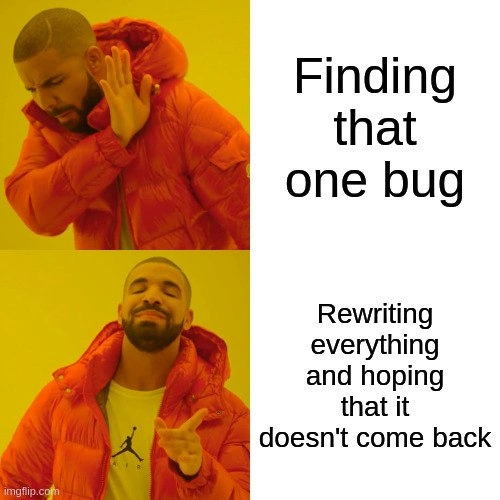
Let’s break down the humor in simpler terms. In software, a bug is a mistake or error in code that causes the program to behave in unintended ways. Finding and fixing bugs is called debugging. Debugging often means carefully reading the code, running the program step by step, and using tools or printouts to locate the exact spot where things go wrong. It’s like being a detective for code: you have to trace clues (error messages, logs, weird behavior) to hunt down the culprit (the bug). This can be tricky and time-consuming – imagine looking for a needle in a haystack. That’s why the meme’s top panel, "Finding that one bug," shows the person looking disgusted or exhausted. It represents a developer who really does not want to deal with the tedious process of BugHunting that one pesky issue. Many new developers know this feeling: you run your code and it crashes, and after a few hours of frustration you think, "I wish I could just start over instead of figuring this out."
Now, what about "rewriting everything"? This means throwing away the current code (or a big chunk of it) and writing it again from scratch, presumably in a better or cleaner way. It’s basically a do-over. The meme’s bottom text adds "...and hoping that it doesn't come back," meaning the developer is crossing their fingers that the mysterious bug was just a problem in the old code and that the brand new code will magically be free of that problem. This is a pretty drastic solution – it's like deciding to rebuild a whole car just because the engine was making a weird noise you couldn't diagnose. In programming, doing a "rewrite" is a form of extreme refactoring. Now, refactoring usually means improving the design of existing code without changing what it does – kind of like reorganizing and cleaning your room without throwing away all your stuff. But a full rewrite is more like moving to a new house entirely! It’s an extreme version of refactoring where you start over on a blank page, carrying over only the idea or requirements but writing brand new code for it.
Why would a developer prefer rewriting over debugging? For one, debugging a tough bug can be frustrating. Picture a DebuggingFrustration scenario: you’ve tried everything, checked every file, added print statements everywhere, and that bug still doesn’t make sense. Especially for someone early in their career, it might feel easier to say, "maybe my approach was wrong – I'll scrap this code and write it anew." There’s a bit of emotional relief in starting fresh. When you rewrite, you temporarily avoid the pain of debugging that particular issue because you’re not directly confronting it – you’re essentially side-stepping it, at least initially. Also, sometimes beginners write code that becomes very messy or complicated, and when something goes wrong, they themselves have trouble understanding their own code. In such cases, doing a rewrite can seem like a chance to apply lessons learned and do it better the second time. For example, if your first version of a program was all in one giant function and a bug cropped up, you might think, "I'll start over and split it into smaller functions, use better variable names, etc., and maybe that mysterious error will disappear in the process."
However, experienced devs often advise caution with rewrites. It’s not that rewriting is never done – sometimes it’s the right call if the code is truly unmaintainable or the project is still small – but it’s usually a big decision. Imagine spending weeks or months rewriting everything, only to realize the bug was actually in a part you didn’t expect (like a configuration file or a library you used). Then your shiny new code might still have the same old problem, or you might have introduced new bugs because, well, new code always has some bugs. This is why the meme is tongue-in-cheek: the character in the meme knows rewriting the whole thing just to fix one bug is overkill, but in that moment of frustration, it feels like the better option. It’s a bit like using a sledgehammer to crack a nut. It might get the job done, but it’s excessive – and you might smash a few fingers in the process!
In day-to-day programming, it's common to first try to fix the specific bug. Developers use many strategies for that: reading stack traces (those error reports), using debug tools to pause the program at certain points, writing tests to reproduce the bug consistently, or even using version control (git bisect command) to find which code change introduced the issue. It can be challenging, but it’s a crucial skill — every developer has to go through the grind of debugging to get better at it. On the other hand, doing a complete rewrite is something teams consider more carefully. They’ll ask questions like: Do we have time for this? What if we accidentally break something that was working? How do we make sure the new version is better? Often, the decision might be to rewrite only if the code has many problems beyond just that one bug (for example, maybe the code is also very slow or hard to add new features to, so a rewrite could solve multiple issues at once). But if it’s truly just one bug, almost everyone would advise to find and fix the bug rather than resetting the whole project.
The humor in the meme comes from recognizing this temptation in ourselves. For a junior developer, it’s like when you get a bug in your school project or personal coding assignment that you just cannot figure out. You might think, "Forget it, I'm starting over." Perhaps you've done this with an essay or an art project too: crumpled it up because fixing the mistake felt harder than beginning anew. The meme exaggerates that impulse into a joke: the developer isn't literally the Drake meme guy, of course, but it uses that format to say "Nope!" to debugging and "Yes, please!" to rewriting everything. It’s funny to programmers because we’ve all had that dramatic facepalm moment where a tiny bug drives us so nuts that burning the whole codebase and rising from its ashes seems momentarily attractive.
Level 3: The Nuclear Option
In this classic two-panel preference meme (aka the Drake format), a developer is depicted rejecting "finding that one bug" and instead enthusiastically endorsing "rewriting everything and hoping it doesn't come back." It's an exaggeration of a real software engineering dilemma: painstaking debugging versus the drastic act of a full codebase overhaul. Seasoned developers recognize this dark humor immediately. That one stubborn bug – the kind that survives multiple hotfix attempts and defies all logic – can drive even the calmest engineer to fantasize about the "burn it down and start over" approach. The meme is funny because it’s ** painfully relatable**: instead of methodically hunting the bug (which might be hidden deep in tangled legacy logic or asynchronous race conditions), the developer simply nukes the entire codebase from orbit. Why struggle with that elusive glitch when you can justify a grand rewrite and call it a “refactor,” right? 🤷♂️
Behind the joke is a biting commentary on engineering trade-offs. On one side, we have targeted debugging: carefully tracing through logs, using the debugger, adding printf statements, maybe doing a binary search through code commits (git bisect anyone?) to pinpoint the root cause of the bug. This is classic Debugging_Troubleshooting – often tedious, sometimes frustrating, but surgical. On the other side, there's the seductive allure of a big rewrite: chucking out the old, messy code and starting fresh. This strategy might be labeled “refactoring” or a codebase overhaul, but in its extreme form it's basically a complete rewrite. The meme’s punchline captures a developer pain point: after days of fruitless BugHunting, wiping the slate clean feels like sweet relief. It pokes fun at that emotional tipping point where logic yields to frustration. The top panel ("Finding that one bug") is the unappealing reality – tedious hours of BugFixing and uncertainty. The bottom panel ("Rewriting everything and hoping that it doesn't come back") is the comically reckless solution – a huge gamble packaged as a fresh start. Every senior engineer has war stories of late-night debugging sessions where someone half-jokingly suggests, "Maybe we should just rewrite this whole module." The joke lands because we’ve all been tempted by that nuclear “elegant” option when facing a truly obnoxious bug.
From an experienced perspective, this meme also alludes to well-known industry lessons. Completely rewriting a system is often referred to as the "big rewrite" or the "nuclear option" in software development. It’s generally considered an anti-pattern and often a symptom of desperation or overconfidence. Why? Because software rewrites are incredibly risky and costly. The meme’s scenario – doing it just to eliminate one bug – highlights the absurdity. A battle-scarred veteran knows that if you rewrite a large codebase from scratch, you’re likely throwing away years of debugging knowledge and hidden bug fixes along with the bad parts. There’s a famous adage in tech: "Never rewrite code from scratch unless you absolutely have to." Joel Spolsky (a prominent software engineering writer) warned that the single worst strategic mistake is to start over and throw away working code. The reason is that old code – however ugly – embodies countless fixes for BugsInSoftware that the team discovered over time. Those hard-earned bug fixes live in the weird edge-case conditionals and the odd timeout adjustments scattered through the code. When you rewrite, you risk reintroducing all those old bugs because you don’t remember the subtle things the old code was doing. It’s a classic RefactoringPain trade-off: you might fix the one stubborn bug, but you'll probably spawn a nest of new ones in the process. In fact, there's a grim industry joke that a full rewrite will replace one known bug with ten new unknown bugs. 🐛🐛🐛
So why do experienced devs still smile at the bottom panel? Because we've felt that irrational satisfaction of saying "to heck with it, let’s rebuild this trash from scratch." The meme is satirizing that emotional impulse. It’s not literally endorsing rewrites; it’s commiserating with the feeling of debugging fatigue. Sometimes a bug is so perplexing (maybe a true heisenbug that disappears when you attach a debugger, or an environment-specific bug that you just cannot reproduce easily) that starting over seems easier than untangling the knotted mess. There’s also the factor of technical debt: if the code around that bug is a spaghetti snarl of legacy code (perhaps a monster function with 1000+ lines, no tests, and multiple developers’ hacks layered over the years), then fixing one bug might feel like patching a leaky boat made of swiss cheese. In such cases, a developer might argue that a rewrite isn’t just for the bug – it’s an opportunity to pay off that technical debt, redesign the module properly, and prevent whole classes of bugs in the future. The bottom caption "hoping it doesn't come back" speaks to this hope: by redesigning the system, maybe that class of bug (and its cousins) will vanish because the new architecture won’t allow it. It’s a bit of blind optimism, and we know it, which is why it’s funny. Hope is not a strategy, as the saying goes, especially not in software engineering where regression bugs (old bugs returning) are a constant menace. The meme text implicitly acknowledges the fear_of_bug_return: after all that work rewriting, the dev is literally just hoping the pesky bug stays gone. Spoiler: often it doesn’t, unless you truly understood and addressed its root cause.
To break it down, why might a team consider a big rewrite strategy instead of a surgical bug fix? And what usually happens? Let's enumerate a few points from a senior dev lens:
Why the rewrite is tempting:
- The codebase is a maintenance nightmare. Perhaps it's a plate of spaghetti in an old framework, making any bug fix risky. Starting fresh with a cleaner design and modern tech stack sounds so much nicer than tiptoeing through a minefield of brittle code.
- Eliminate accumulated hacks: Over years, quick fixes and kludges (short-term solutions) might have made the code incoherent. A rewrite promises to wipe away all those ugly hacks in one go, not just band-aid over them.
- Modernization and performance: Maybe the bug is indicative of a deeper performance or scalability issue. The team could justify a rewrite by saying, "We can fix this bug and also redesign the system to handle more load or use a better algorithm." Essentially, kill the bug and two birds with one stone.
- Knowledge gained: Often by the time you've struggled with a bug for ages, you’ve learned a lot about what not to do. The second implementation could avoid the pitfalls of the first since now you know where the traps were. It's refactoringNeeded on a grand scale – using new wisdom to do it “right” this time.
Why the rewrite can backfire:
- Time and cost: A complete rewrite is a huge undertaking. What was supposed to be “just a quick overhaul to fix that bug” can balloon into a multi-month or multi-year project. Meanwhile, users are stuck with the buggy old system or development of new features is frozen. Deadlines slip, morale can dip, and management starts panicking.
- Loss of battle-tested code: That old ugly code? It was ugly for a reason – it survived real-world usage. It had fixes for countless corner cases. A fresh rewrite has to re-handle all those situations from scratch. It’s almost guaranteed some will be overlooked, leading to regressions. The one bug you hated might be gone, but suddenly three old bugs that were fixed ages ago rear their heads again in the new system. Oops.
- Moving target: Software rarely exists in a vacuum. While you're busy rewriting, the world hasn’t stood still. Requirements might have changed, the environment might have new quirks, and the rewrite might miss updates that happened in the old code. By the time the rewrite is done, it could already be out of date or mismatched with user needs – a phenomenon related to Second System Syndrome, where the new system tries to be too ambitious and collapses under its own weight.
- It might not fix the bug! The cruel irony: if you never figured out what caused that stubborn bug, there's a real chance you’ll inadvertently reproduce the same issue in the new code. Perhaps the bug wasn't in the code at all but in an external system, a misunderstood specification, or some concurrency hazard. Without addressing the root cause (which debugging would have revealed), the rewrite is just painting over mold. That "hoping it doesn't come back" is sometimes pure wishful thinking.
Industry veterans have seen this cycle. A notorious example often cited is Netscape’s big rewrite in the 1990s – they decided to rewrite their entire web browser from scratch rather than keep improving the old one, and it set them back so far that they lost their market lead. Closer to everyday life, many of us have inherited a legacy codebase with mysterious bugs and felt the urge depicted in the meme: “Ugh, who wrote this garbage? Let's throw it out and do it right.” Sometimes that works out, but often it leads to debugging pain of a different kind, just spread across a new codebase. The meme gets a laugh (or maybe a groan) because it rings true: when faced with a truly perplexing bug, even the best of us are tempted to do the big_red_button solution and rewrite, even though we know it's usually better to grit our teeth and debug. It’s a form of gallows humor for developers. We know that rewriting everything on a whim is overkill, but the thought of a pristine, bug-free system is so alluring when you're tearing your hair out over that one line of code that keeps failing. In practice, the seasoned dev will probably slog through and find the bug – or at least implement a targeted fix or refactoring – rather than actually rewriting everything. But for a split second (especially at 3 AM with production on fire), we all feel like the guy in the orange jacket pointing gleefully at the "rewrite it all" option. The meme nails that shared sentiment: sometimes blowing up the problem seems easier than debugging it. And as any cynical veteran will tell you with a smirk, nothing says "I give up on this bug" quite like a full rewrite and a deploy on Friday. 😉
Description
This is a two-panel 'Drake Hotline Bling' meme format, which contrasts a disapproved option with an approved one. In the top panel, the rapper Drake, wearing an orange puffer jacket, holds up his hand in rejection next to the text 'Finding that one bug'. In the bottom panel, Drake smiles and points approvingly at the text 'Rewriting everything and hoping that it doesn't come back'. The meme humorously captures a common developer dilemma: choosing between the meticulous, often frustrating process of debugging a single, elusive bug versus taking the drastic measure of rewriting an entire section of code and simply hoping the problem disappears. For experienced engineers, this resonates as a relatable, if questionable, strategy often born from desperation when dealing with complex or legacy systems where the root cause of a bug is nearly impossible to trace
Comments
11Comment deleted
A rewrite to fix a bug is the developer equivalent of selling your car because the check engine light came on. It works, but now you have a whole new set of problems, and you're still not sure what a catalytic converter is
Why chase a heisenbug when a greenfield rewrite gets you a new tech stack, another year of runway, and a promotion to “Head of Platform” in the same slide deck?
The same senior engineer who insisted we needed a complete rewrite to "fix the architecture" is now debugging the exact same race condition we had three years ago, just with TypeScript this time
Every senior engineer has been here: staring at a Heisenbug that only manifests in production, realizing the codebase has accumulated 47 layers of duct tape fixes, and thinking 'You know what? Rust rewrite.' It's the developer equivalent of 'have you tried turning it off and on again' but at architectural scale. Sure, you'll spend six months rebuilding what took three years to evolve, rediscovering every edge case the hard way, but at least you won't have to grep through that cursed callback pyramid from 2019. The bug might come back, but this time it'll be *your* bug, written in a language that doesn't even have null pointers. Progress
Senior dev wisdom: Debugging removes bugs; rewriting removes the bugs *and* half the features
A big-bang rewrite is 'git rm -rf invariants', turning one prod bug into a high-variance bug distribution compliant with Hyrum's Law
Find the one bug? I’d rather rewrite the boundary so illegal states are unrepresentable and that entire bug class can’t exist
Me in my first python project... Comment deleted
I have already moved to another city, but those freaking bugs keep finding me. Dudes, does anyone know any good antibug spray? Comment deleted
yes leave programming it will leave you forever Comment deleted
exit Comment deleted