Skip to content
DevMeme
3320 of 7435
The Developer's Inescapable Loop of Despair and Determination
Debugging Troubleshooting Post #3644, on Sep 5, 2021 in TG

The Developer's Inescapable Loop of Despair and Determination

Why is this Debugging Troubleshooting meme funny?

Level 1: The Unfinished Puzzle

Imagine you’re trying to solve a really tricky jigsaw puzzle. At first, you’re excited and focused, searching for the right pieces. But after a while, you just can’t find that one piece that completes the sky or the house, and you get super frustrated. In a huff, you push the puzzle aside and say, “I quit!” Maybe you even walk away for a bit because you’re angry that it’s not working out. That’s like the second part of the meme – giving up in frustration. But then, as you’re sitting there, you keep thinking about that incomplete puzzle. It’s bothering you. You have to see it finished. So you take a deep breath, go back to the table, and start working on it again because you just can’t leave it undone. And guess what? Eventually you find the piece and finish the puzzle, and it feels so good! :grin:

This meme is funny because it’s showing that exact feeling with a computer bug. It’s like a loop: try to fix the problem, get mad and stop, then come back because you really want to fix it. We laugh because we all know that feeling of not wanting to give up, even when we’re upset. Just like you with the puzzle, the big strong guy in the picture acts out what every programmer feels inside when they can’t let a problem go. It’s a silly way to show a very human habit: sometimes we might rage and quit, but we almost always come back to finish what we started!

Level 2: Rage Quit & Return

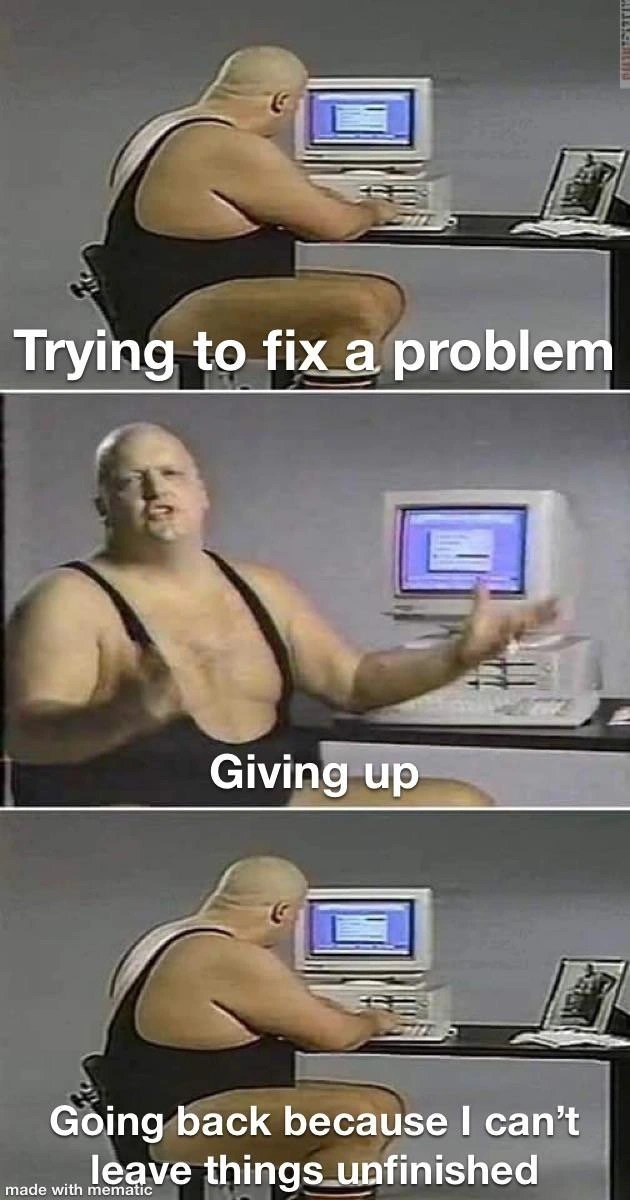
Let’s break down what’s happening here for the less battle-scarred coders. The meme is divided into three panels, each showing a phase of a developer debugging a bug (a bug is any error or flaw in a program that causes it to behave in unexpected or wrong ways). In the first panel, our determined wrestler-developer is at the keyboard “trying to fix a problem.” This is the familiar start of any debugging session: you’ve found something wrong in your code (maybe a function isn’t returning the right value or the app keeps crashing), and you’re digging through logic, adding print statements or breakpoints, trying different fixes. This phase is filled with optimism and focus – you think you’re close to solving it.

In the second panel, he’s throwing up his arms in frustration (“Giving up”). This is what many of us call a "rage quit" moment – named after gamers who quit a game in fury when they keep losing. In programming, a rage-quit isn’t literally quitting your job (though it might feel that dramatic in the moment); it’s when you get so frustrated with a bug that you abruptly stop debugging. Maybe you’ve been staring at the code for hours, tried ten different fixes, and nothing works. The bug might still be spitting out the same infuriating error message or maybe each fix is breaking something else. Eventually, you slam your keyboard (gently), mutter some choice words, and declare “I’m done!” You step away from the computer, maybe get a drink of water or walk around to cool off. This Debugging Frustration is extremely common – even early-career devs hit a point where the brain says “no more.” It’s healthy to take a break when you’re stuck. Often, advice from mentors is “take a walk, clear your head”. That’s exactly what’s happening in panel two – our guy is so exasperated he symbolically “quits” trying for the moment.

But then comes panel three: the same big guy is back at the keyboard, intensely focused again (“Going back because I can’t leave things unfinished”). This part is about the developer obsession that many of us have. Even though he said he was done, it only took a few minutes of staring at the wall or pacing the room before the unfinished bug pulled him back in. Why? Because leaving a problem unsolved just gnaws at you. Many programmers have a strong desire for closure – an unresolved bug can feel like an itch in the brain you can’t ignore. This meme shows how relatable that feeling is: you literally cannot leave it alone. You think, “Okay, one more try. Maybe a fresh look will help.” Next thing you know, it’s hours later but you’ve either cracked the problem or at least made progress. This compulsive debugging loop (give up, then return) is almost a hallmark of being a developer. We joke about it, but it’s tied to passion and pride in our work. New developers often experience this the first time they hit a really nasty bug – you might want to quit in frustration, but something draws you back because the idea of not understanding the issue is even worse than the frustration of debugging. It’s oddly motivating! And when you finally do fix the bug, that feeling of triumph is incredibly rewarding – part of why we end up coming back again and again.

The meme’s retro style (it looks like an old VHS tape from the late 80s, and the PC is a classic beige CRT monitor with what looks like a DOS-era screen) adds an extra layer of humor. It implies that no matter the decade or technology, developers have always had this same struggle. Even in the days of text-based interfaces and primitive tools, you can imagine some programmer in 1988 slamming a floppy disk on the table and then turning right back to the screen to debug. The technologies change – from writing batch scripts on DOS to writing Python scripts in VSCode – but the emotional cycle of debugging stays the same. That’s why this meme resonates with everyone from junior coders to seniors: we’ve all been that person who “rage quits then returns” to squash the bug. In short, the panels capture a relatable developer experience:

  • Panel 1 (Optimistic Fixing): Let’s squash this bug! :smile:
  • Panel 2 (Frustration & Quit): Ugh, I can’t take this anymore. :angry:
  • Panel 3 (Unfinished Business): I have to try again; I can’t leave it broken. :sweat_smile:

It’s a cycle of Debugging Pain and Perseverance that virtually every developer will recognize from their own journey. If you’ve ever spent an afternoon chasing a bug, swore off coding for the night, and then found yourself opening the laptop again because you just can’t let it go, congrats – you’re officially in the club this meme is poking fun at.

Level 3: Stacktrace Smackdown

At this senior-engineer stage, debugging becomes a full-on wrestling match between developer and code. The meme’s hulking wrestler hunched over a beige 8086-era desktop is a tongue-in-cheek metaphor for wrestling with a stubborn bug. Every experienced dev recognizes this debugging frustration: it starts with determined troubleshooting (“Trying to fix a problem”), escalates to throwing up your hands (“Giving up”), and inevitably cycles back to an obsessive bug-hunt revival (“Going back because I can’t leave things unfinished”). This loop is practically a rite of passage in software development. We’ve all tapped out in anger when a bug defies us, only to jump back into the ring moments later. The humor cuts deep because it’s a shared, almost universal developer experience – a blend of pain and pride that senior devs know too well.

Why is this so relatable? Because an unresolved stack trace feels like a personal affront. A cryptic error in the logs or a crashing program isn’t just a technical issue – it’s the code challenging our expertise. The senior engineer’s ego simply won’t let that slide. No matter how fried your brain is at 2 AM, some primal coder instinct kicks in: “I will vanquish this bug.” The meme nails this emotional rollercoaster with the absurd visual of a pro-wrestler furiously typing, then flailing, then refocusing – it’s basically a developer’s inner life made external. It’s funny because it’s true: even the most battle-hardened devs rage-quit for a hot minute, only to return as if drawn by an invisible force (likely the haunting memory of that error message). In real life, this might look like storming away from the keyboard, swearing you’re done, then pacing around and coming right back to IDE and logs open wide. It’s a debugging loop that’s as productive as it is pathological.

From a senior perspective, this meme also pokes fun at Developer Productivity myths. We preach about work-life balance and “just log it and fix it tomorrow” best practices, but let’s be honest – how many of us actually sleep soundly knowing a bug is creeping around in the codebase overnight? :smirk: The compulsive debugging loop is real. Ironically, every seasoned dev has learned that sometimes the best fix is to step away and clear your head… yet here we are, back at the screen, eyes bloodshot, chasing that one out-of-bounds exception like it insulted our mother. The visual of an 80’s-era PC with a vintage DOS interface underscores that this struggle is timeless – whether you were trouble-shooting memory leaks on MS-DOS or tracking down a race condition in a modern microservice, the emotional cycle is the same. Even with today’s fancy debuggers, cloud logs, and Stack Overflow at our fingertips, the core battle hasn’t changed. We still wrestle with bugs using sheer willpower and maybe a pile of coffee. The meme exaggerates it with a literal wrestler on screen, but truly, debugging can feel like a WWE cage match where you refuse to leave until either you or the bug taps out. And let’s face it – it’s always the bug that taps out eventually, because we just don’t know when to quit.

Description

A three-panel meme featuring the late pro wrestler King Kong Bundy in a black singlet, sitting at a desk with a vintage 1980s-era personal computer. The first panel shows him hunched over the keyboard, focused, with the caption 'Trying to fix a problem'. The second panel captures him leaning back, gesturing with exasperation as if he's had enough, with the caption 'Giving up'. The final panel shows him right back in the original position, hunched over the keyboard again, with the caption 'Going back because I can't leave things unfinished'. This meme perfectly encapsulates the emotional rollercoaster that every experienced developer faces. It's about the intense frustration of hitting a wall while debugging or troubleshooting, the momentary surrender, and the obsessive, almost compulsive need to return and conquer the problem, no matter how difficult. The vintage hardware adds a timeless quality, suggesting this struggle is a fundamental part of the profession
Comments

7
Anonymous ★ Top Pick That's the 'git blame' feedback loop. First, you blame the code. Then, you blame the architecture. Finally, you discover you wrote the original code six months ago, and now the battle is with yourself
  1. Anonymous ★ Top Pick

    That's the 'git blame' feedback loop. First, you blame the code. Then, you blame the architecture. Finally, you discover you wrote the original code six months ago, and now the battle is with yourself

  2. Anonymous

    If brute force debugging were an actual opcode, this guy just single-handedly JIT-compiled it

  3. Anonymous

    After 20 years in tech, I've learned that 'git stash' is just a formalized version of this meme - we never truly abandon a problem, we just temporarily defer our obsession with it until 3am when it suddenly becomes the most important thing in the universe

  4. Anonymous

    This perfectly captures the senior engineer's curse: we've seen enough production incidents to know that 'temporarily ignoring' a problem is just technical debt with extra steps. That nagging feeling isn't perfectionism - it's pattern recognition from the last time we left a race condition 'for later' and got paged at 3 AM six months down the line. We don't come back because we can't let go; we come back because we've learned that future-you will have even less context and even more dependencies built on top of that shaky foundation

  5. Anonymous

    Every time I 'give up,' my brain hits a finally block and re-acquires the lock on that bug

  6. Anonymous

    Architects YAGNI the bug away; we mere debuggers ragequit, then return because 'it works on my machine' doesn't audit-proof production

  7. Anonymous

    It's not persistence - it's the Zeigarnik effect plus knowing every 'Won't Fix' becomes a 2am PagerDuty alert

Use J and K for navigation