The Moment You Realize Git Isn't Just for Pushing
Why is this VersionControl meme funny?
Level 1: Oops, Threw It Away
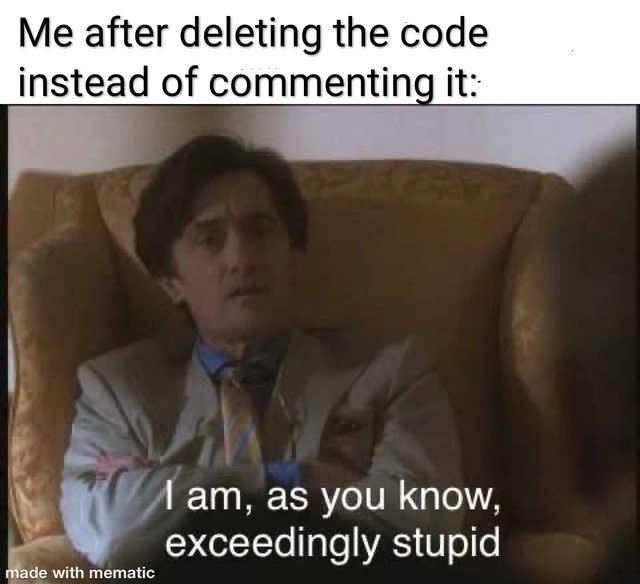
Imagine you wrote a little story or solved a math problem on a piece of paper. Then you think, "Hmm, I don't need this part," and you crumple up the paper and toss it in the trash. A minute later, you realize, "Oh no – that part was actually important!" But now it's too late, because the paper is gone. You'd feel pretty upset and kinda silly, right? You might even say to yourself, "Wow, that was a really dumb mistake." In this meme, a programmer did something just like that with their code. They deleted a part of their program completely (threw it away) when they only meant to set it aside for a while. Right after, they wished they hadn't. The text in the image, “I am, as you know, exceedingly stupid,” is the person jokingly calling themselves very silly for what they did. It's funny because everyone recognizes that uh-oh feeling of instant regret. We laugh at it because we've all been there, doing something we immediately wish we could take back.
Level 2: Comment Out Conundrum
Let's break this down in simpler terms. The meme jokes about a common programming decision: should I comment out this code or just delete it? If you comment it out, you’re basically telling the computer, “ignore this part, I’m not using it right now.” The code remains in your file, but as a comment (which means it won't run). Many languages use // or # for comments. For example, in JavaScript you might change:
let total = calculateTotal(items);
applyDiscount(total);
to:
let total = calculateTotal(items);
// applyDiscount(total);
Now the second line is commented out and won't execute, but it's still there in case you need to bring it back.
On the other hand, deleting code means you remove those lines entirely. Using the same example, if you delete the applyDiscount(total) line, it's gone from your script. The next day, if you realize “actually, we do need to apply the discount,” you'd have to remember or rewrite that line because it’s no longer in the file.
Why comment out instead of delete (or vice versa)? When you're not 100% sure a piece of code is safe to remove, commenting it out is like putting it on the bench: it's out of the game, but you can quickly put it back in if needed. Beginners often do this because they're a bit afraid – what if that code was important and removing it breaks something? Commenting feels safer. It's a way to test changes without fully committing to them.
However, leaving a lot of commented-out code around can make things messy. Imagine opening a recipe book and seeing many crossed-out lines and scribbles in the margins – it's hard to tell what's current. In coding, that's a CodeQuality concern: other developers (or future you) might be confused why there's a chunk of code hidden in comments. Is it there for a reason? Is it just forgotten leftovers? This is why more experienced devs lean towards cleaning up by deleting code that's truly not needed.
They rely on VersionControl systems like Git as a safety net. Version control is basically a system that keeps track of your code's history. Each saved change (called a commit) is like a snapshot. If you delete something and later regret it, you can look back at earlier snapshots to find it. It's like a time machine for code. So the rule becomes: if you don't need the code, delete it from your working file (to keep things clean), and trust that if you ever do need it back, you can retrieve it from the history.
Now, in the meme, the funny (and painful) part is that the developer deleted the code when they meant to just comment it out. It’s a goof-up. Maybe they used a keyboard shortcut to comment a block but hit the wrong keys, or they were just feeling confident and went straight to delete. Immediately after, they realized they actually did want that code. Oops! We've all had that sinking feeling when you do something and then think "I shouldn't have done that."
The caption “I am, as you know, exceedingly stupid” is the developer jokingly bashing themselves for the mistake. It's over-the-top – basically calling themselves very stupid. Of course, they're not truly stupid; in tech we often use humor to handle slip-ups. This is a bit of DeveloperHumor through DeveloperSelfDeprecation – poking fun at one's own mistake to take the sting out of it. The reason it gets a laugh is because any programmer, junior or senior, can relate to that jolt of panic and self-criticism right after messing up.
Ultimately, this meme is a light-hearted reminder of a lesson every coder learns: be careful when cleaning up code. It’s saying, "Next time, maybe comment it out first or double-check before you delete." And if you do accidentally delete something important, don't beat yourself up too hard — that's exactly why we have backups and version history. The comforting part for a newbie is knowing even experienced devs have those facepalm moments. You're not alone, and one day you'll probably laugh about it too.
Level 3: Refactoring Regrets
This meme hits home for any developer who has tried to tidy up code and immediately regretted it. It's depicting that familiar oh no moment when you've deleted a chunk of logic in the name of cleanliness, only to realize moments later you needed that code after all. In the setup text “Me after deleting the code instead of commenting it:”, the developer is basically setting up their own fail. The punchline is the subtitle on the image: “I am, as you know, exceedingly stupid.” That line is a brutally humorous self-insult reflecting the instant regret. The humor comes from how self-deprecating it is – we've all had that internal monologue where we call ourselves idiots for screwing up something obvious.
In a senior engineer's world, this scenario is a rite of passage: the classic delete_vs_comment dilemma captured in one cringeworthy moment. Best practices in Refactoring and CodeQuality often insist: “remove dead code, don't just comment it out.” In fact, in books like Clean Code, leaving blocks of commented-out code is considered a code smell – it’s like clutter that hints something might be wrong or unfinished. The idea is that if code isn’t needed, it shouldn’t linger in the codebase as a ghost. You can always retrieve it later from VersionControl history if you truly need it. This approach keeps the main code neat and maintainable.
The meme highlights the dark side of that advice: sometimes you delete something and immediately discover that code was still needed (or you just regret not having it around for reference). It’s essentially Murphy's Law for programmers. Maybe you thought a piece of logic was redundant, removed it, and then an edge-case bug pops up that makes you go, “Uh oh, that code was there for a reason.” At this point, you might scramble to get it back. This is where your version_control_safety_net is supposed to catch you – assuming you committed the code before deleting it. With Git or any VCS, you could dig through the history and resurrect the slain code.
But here's the kicker: if you were working rapidly and deleted that code before a commit (or outside of a tracked project), that safety net isn’t there. It's true code_loss_regret. Every developer eventually experiences that sinking feeling: “I can’t believe I just did that.” The meme’s extreme phrasing “exceedingly stupid” is a tongue-in-cheek way to voice that feeling. We exaggerate because it’s a mix of embarrassment and frustration – you knew better, yet here you are.
Let’s unpack why this scenario hits so hard, especially for experienced devs:
- We are taught not to leave large swathes of commented-out code, for the sake of clarity. Deleting unused code is seen as good housekeeping, part of proper Refactoring.
- However, there's always that tiny fear: what if the code I'm deleting is actually needed or I'll need it later? Many of us have a habit of commenting out code first as a trial, just to be sure.
- When you confidently hit delete, you're declaring “I’m sure I won't need this anymore.” It’s a bold move. If that turns out to be wrong, you have to face the fact that you just shot yourself in the foot.
- In a healthy setup, if you realize your mistake soon, you do have Git or another tool to save you. For example, you might use
git log -porgit reflogto find that lost piece and undo the deletion. It’s inconvenient but not the end of the world. - If you don’t have a backup (maybe you haven't committed, or this was a quick fix on production without version control), then you truly feel the pain. You might be trying frantic undo shortcuts or digging through old files. That code might be gone for good, and you have to rewrite it from scratch.
- The self-talk that follows is exactly what the meme shows: an immediate, harsh "I'm so stupid" moment. It’s like a reflex when facing your own mistake. Of course, it's exaggerated – in reality it’s just a human error – but in that stressful second, it really does feel stupid.
Even for seasoned developers, this meme gives a knowing wink: no one is immune to these little goofs. It's exactly why version control exists as our safety net (and why programmers often use humor like this to cope with the occasional facepalm moment).
Description
A meme about developer regret, structured in two parts. The top section has white background with black text that reads, 'Me after deleting the code instead of commenting it:'. Below this is an image of a man in a suit, sitting in a plush yellow armchair with his arms crossed, looking directly at the viewer with a look of pained self-awareness. Subtitles at the bottom of the image capture his thought: 'I am, as you know, exceedingly stupid'. The humor captures the specific, sinking feeling a developer gets moments after confidently deleting a block of code, only to realize it was essential. While version control systems like Git make any deletion reversible, the immediate hassle and the foolishness of the mistake are universally understood. It plays on the tension between the best practice of removing dead code and the lazy, but sometimes safer-feeling, alternative of commenting it out for a quick recovery
Comments
12Comment deleted
The five stages of developer grief: Denial (it's fine, I have git), Anger (why is git log so cryptic?), Bargaining (maybe if I just rewrite it from memory...), Depression (I am so stupid), and Acceptance (Ok, fine, `git reflog` it is)
Deleted the 400-line legacy algorithm instead of commenting it, confident Git had my back - then remembered yesterday’s ‘git push --force’, and suddenly I’m spelunking through reflog like Indiana Jones in a COBOL temple
After 20 years in the industry, I've learned that commented-out code is just technical debt with commitment issues - but at least it's debt you can grep for when the PM inevitably asks 'didn't we have something that did this before?'
This is why senior engineers treat `git commit` like a save point in a video game and commented-out code like insurance policies - you never know when you'll need to resurrect that 'temporary' workaround from three sprints ago that somehow became load-bearing infrastructure. The real tragedy isn't the deletion itself; it's realizing at 2 AM during an incident that the deleted code contained the only documentation of why the system behaves that particular inexplicable way in production
"Just delete it, Git will remember" - right up until squash-merge, force-push, and GC eat the reflog; turns out our rollback strategy was hope
Exceeding Git blame's expectations one deletion at a time
Commented-out code is the poor man’s feature flag; deleting it is senior - right up until a 3am PagerDuty proves that chunk was the only living spec
Git has everything in history Comment deleted
Or IDE Comment deleted
If you commited it :D Comment deleted
Just do cmd-z Comment deleted
That's the reason why I always commit per micro implementation and after that I squash it before PR Comment deleted