Skip to content
DevMeme
3486 of 7435
Java Project Structure: A Lesson in Nesting
DesignPatterns Architecture Post #3821, on Oct 15, 2021 in TG

Java Project Structure: A Lesson in Nesting

Why is this DesignPatterns Architecture meme funny?

Level 3: One More Layer of Indirection

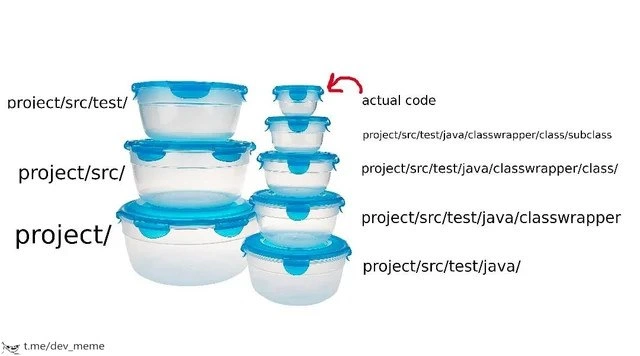
In software there's a tongue-in-cheek principle: "All problems can be solved by adding another layer of abstraction" – except when you end up with too many layers. This meme nails that irony. We see two towering stacks of clear containers (like Tupperware for code). The left tower represents a typical Java project structure:

  • project/ (the base directory)
  • project/src/ (source code folder)
  • project/src/test/ (test code folder)

Each layer is some folder hierarchy that Java developers recognize. The right tower zooms in further, showing a cascade of nested directories leading to a tiny container at the top labeled "actual code". Beside each container on the right, we have an increasingly absurd path:

  • project/src/test/java/
  • project/src/test/java/classwrapper/
  • project/src/test/java/classwrapper/class/
  • project/src/test/java/classwrapper/class/subclass (tiny top box holding the actual code file)

It’s a visual punchline: the real Java source file (ActualCode.java, perhaps) is buried seven levels deep in a maze of folders. The image screams over-engineering – a small bit of code suffocating under enterprise folder ceremony.

Why is this funny to experienced devs? Because we've all opened a Java codebase and thought, "Seriously, one test class is under src/test/java/com/company/project/module/util/helper/?" It’s an exaggeration of Java’s package culture, where the language forces your file system to mirror your namespace. Every Java package becomes a folder. In a sane project, you might have a meaningful package like com/acme/payments grouping related classes. But in package hell, architects go rogue with needless indirection. You end up with something like:

project/
└── src/
    └── test/
        └── java/
            └── classwrapper/
                └── class/
                    └── subclass/
                        └── ActualCode.java  // 7 levels deep!

Each directory here contains nothing but another directory, like a Russian matryoshka doll of folders. The names classwrapper, class, subclass are deliberately generic – they add zero information. It’s as if someone said, “We need a wrapper for the wrapper’s wrapper.” This is an absurdist take on real-life scenarios where teams create abstract factories, manager managers, or ControllerControllers. It highlights a common anti-pattern: adding layers of code or structure “just in case”. In theory, layering helps organize large codebases. In practice, overdoing it leads to what senior devs wryly call enterprise bloat or software bureaucracy – more directories, packages, and indirection than actual business logic.

From a CodeQuality perspective, this deep-directory structure is a code smell – a hint that the design is more complex than it needs to be. It increases cognitive load: just understanding that ActualCode.java lives under classwrapper.class.subclass (whatever that means) takes extra mental effort. If you’re an exhausted dev at 3 AM on an on-call issue, the last thing you want is spelunking through a labyrinth of folders named “class”. DeveloperExperience (DX) suffers because simple tasks – like navigating to a file – turn into a mini-adventure game. Sure, modern IDEs let you jump to a class by name, but heaven help you if you’re grepping through the repository or browsing it on GitHub. The technical debt here is that once this convoluted structure is in place, nobody refactors it (who wants to juggle moving files and updating imports across ten packages?). So the mess calcifies, and every new developer onboards with a tour of the Tower of Java Babble.

There’s history behind this too. Java projects (especially older enterprise ones) encouraged verbose packaging. Companies used reverse domain names (like com/bigcorp/project/module) to avoid naming collisions, and layered architectures were seen as good design. But sometimes architecture astronauts took it too far, introducing needless sub-packages for “clarity”. The result? Over-engineering: lots of form, very little function. It’s analogous to a bureaucracy chart where a simple task passes through ten departments. Each extra folder is like another manager approving a form that doesn’t need approval. The meme exaggerates it to drive the point: at the end of all these layers, you have a tiny piece of code wondering why it had to climb Mount Folderest to live there.

In summary, this level-3 deep dive sees the meme as satire on codebase complexity. Seasoned developers laugh (maybe a bit bitterly) because they’ve been in this situation: hunting for a 20-line class buried in .../util/helpers/helpers2/misc/ for no good reason. It skewers the over-engineered folder structures that haunt big legacy Java apps – where the path to your code is longer than the code itself.

Description

A meme that humorously visualizes the deeply nested directory structures common in programming, particularly in Java projects. The image displays a set of transparent plastic food containers with blue lids, arranged in descending order of size, much like Russian nesting dolls. The larger containers on the left are labeled with top-level project directories like 'project/', 'project/src/', and 'project/src/test/'. The smaller, nested containers on the right correspond to increasingly specific Java package paths, such as 'project/src/test/java/classwrapper/class/subclass'. A red arrow points emphatically to the tiniest container at the very top, which is labeled 'actual code'. The joke lands perfectly for experienced developers by satirizing the perception that a disproportionate amount of a project's structure is just boilerplate folders, while the functional code occupies a minuscule, deeply buried space. It's a classic critique of framework and language conventions that enforce verbose and rigid organization
Comments

14
Anonymous ★ Top Pick The path to your class is com.mycompany.project.module.subsystem.util.helpers.internal, but don't worry, the actual business logic is just a single line in there
  1. Anonymous ★ Top Pick

    The path to your class is com.mycompany.project.module.subsystem.util.helpers.internal, but don't worry, the actual business logic is just a single line in there

  2. Anonymous

    Every time I cd past another src/test/java/com/enterprise/monolith/feature/adapter/impl layer, I’m reminded that in this company we don’t fix architecture - we just add Tupperware and call it encapsulation

  3. Anonymous

    After 15 years in enterprise Java, I've realized the real unit being tested isn't the code - it's our patience navigating 12 levels of directory nesting just to find a 5-line method that could've been a lambda if the architect hadn't insisted on 'future-proofing' with AbstractFactoryWrapperDelegateImpl patterns

  4. Anonymous

    After 15 years of enterprise Java, you realize the real test isn't whether your code works - it's whether your IDE can still autocomplete the package name before the heat death of the universe. Nothing says 'we value clean architecture' quite like needing a filesystem depth limit increase just to run `mvn test`

  5. Anonymous

    Java tests: so nested even 'find . -name "*.java" | grep -v test' yields tumbleweeds

  6. Anonymous

    Enterprise Java heuristic: when the path starts implementing Decorator (src/test/java/classwrapper/class/subclass), the file inside is a one-line delegate - and yes, it lives under test/

  7. Anonymous

    Enterprise Java in one picture: Tupperware-driven architecture - AbstractClassWrapperFactoryManager nested under src/test/java guarding 12 lines of logic; 95% packaging, 5% payload

  8. @vladiswild 4y

    yeah..

  9. @deathstranger97 4y

    Container......

  10. @sylfn 4y

    translate to English please

    1. @mainfme 4y

      Cockbrothers, there netbeans are loaded

      1. 🌯 🇺🇦 4y

        Mgimo finished?

        1. @mainfme 4y

          Nope, but cockbrothers good word for петуханы)

          1. 🌯 🇺🇦 4y

            That's for sure

Use J and K for navigation