Skip to content
DevMeme
2686 of 7435
The impossible dream of a reasonable product owner
Management PMs Post #2967, on Apr 15, 2021 in TG

The impossible dream of a reasonable product owner

Why is this Management PMs meme funny?

Level 1: Aliens Replaced Them

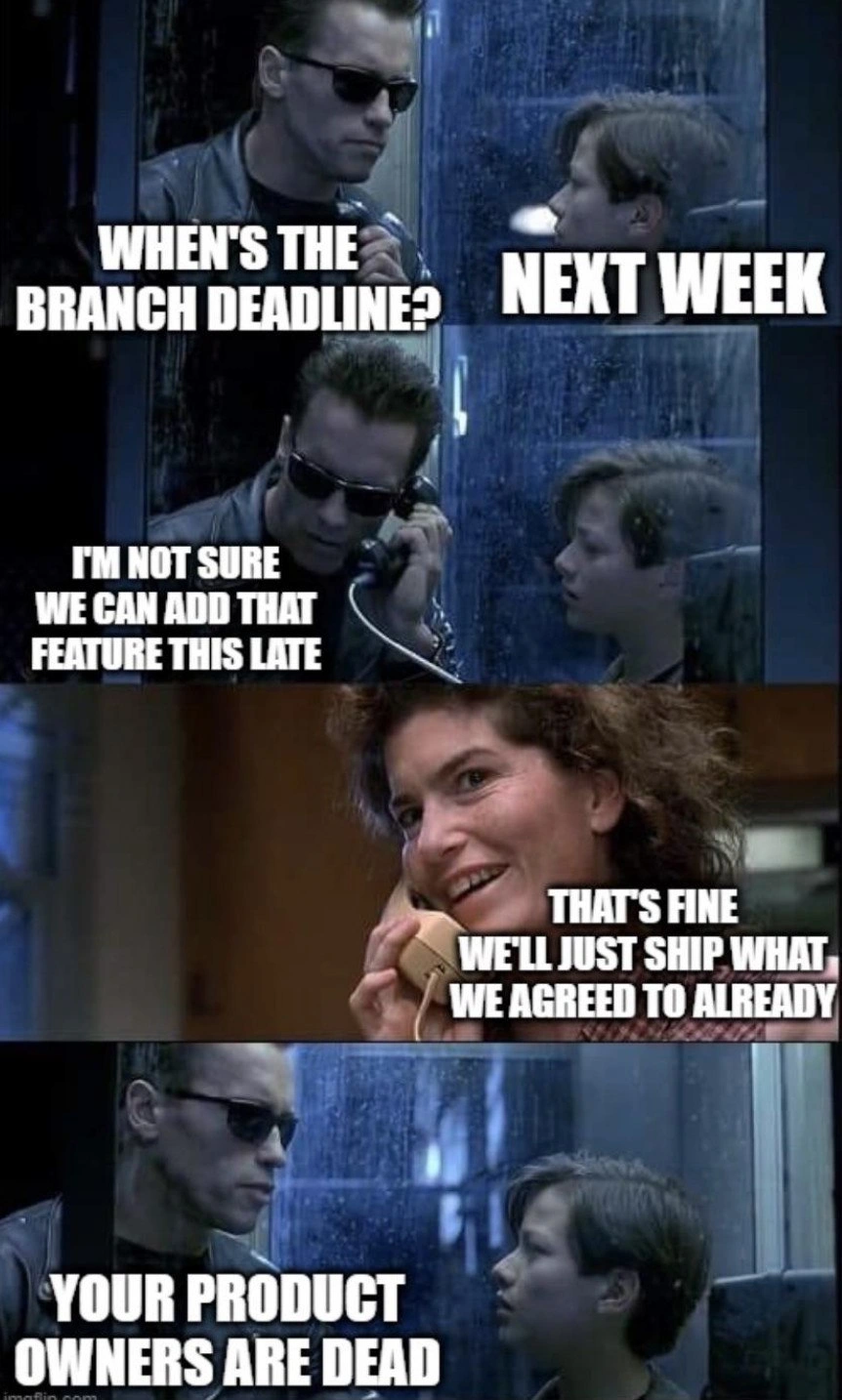
Imagine you and your friend are working on a school project that’s due tomorrow. You’ve both agreed on what you’re going to present. Usually, right before the due date, your friend suddenly says, “Wait, let’s also add this cool new idea!” — even though there’s no time left. That’s pretty stressful, right? Now picture this time your friend doesn’t do that. You tell them, “We don’t have time to add anything else,” and your friend just smiles and says, “No problem, let’s just stick with what we have.” You might be shocked and think, “Who are you, and what have you done with my friend?!” You might even joke that maybe an alien or a robot has kidnapped your real friend because they never give up on adding last-minute ideas so easily.

That’s exactly the joke in this meme. In a software team, the “friend” who always wants to add something last minute is called a product owner (the person who decides what features the product should have). The team has a rule – like homework due date – that after a certain day, no new features can be added before the big release (that’s the deadline). In the meme, when the product owner surprisingly says “okay, no new feature then,” the developer jokes, “Your product owners are dead,” kind of like saying, “These can’t be the real product owners because the real ones would never back off so calmly!” It’s a funny, exaggerated way to express disbelief. The core humor is like when something is too good to be true. We laugh because we know normally people keep pushing for their way, and if they suddenly don’t, it must be a crazy situation — in the meme’s case, as crazy as a Terminator (a bad robot from the movies) secretly replacing them. It’s a playful way for developers to vent about last-minute changes, using a scene from an action movie to make the point silly and entertaining.

Level 2: When Stakeholders Surrender

Let’s break down what’s happening here in simpler terms. In software development, especially with Agile methods, you work in short cycles (often called sprints) to add features to a product. The product owner is the person who decides what features the team should build – they represent the business or customer needs. Now, every project has a timeline, and there comes a point where you have to stop adding new stuff so you can test and finalize everything. This is often known as a feature freeze or a branch deadline. It’s like saying, “After this date, no new features go into the upcoming release; we’re just fixing bugs and polishing what’s there.” Teams enforce this by having a specific branch in their version control (for example, a Git branch often named something like release-v1.0) where only approved changes can go in. If you want to add a new feature past that date, it’s supposed to wait for the next release. The whole idea is to avoid last-minute changes that could break things right before you deliver the product to users.

Scope creep is the term used when new requirements or features keep getting added beyond what was originally agreed. It often happens gradually: a “small tweak” here, an “urgent request” there, and before you know it the project has expanded. In an Agile setting, scope can change frequently by design, but even Agile teams have to respect a cutoff when a release is imminent. Deadline pressure is very real – as the release date gets closer, everyone gets anxious about making the cut. Business stakeholders (like clients, managers, or product owners) might suddenly realize there’s a feature they really want in the next release, even if it’s late in the game. This puts developers in a tough spot: they’re already scrambling to finish testing and stabilization, and now there’s a request to add something new with only a few days left. It’s like being asked to add an extra room to a house the night before it’s supposed to be sold – risky and usually a bad idea.

In the meme, the developer (portrayed by the Terminator on the phone) is basically asking, “How much time do we have until we have to stop coding new stuff?” The answer is “Next week,” so about one week remains. Then the developer’s response is, “I don’t think we can add that feature this late.” This is a very reasonable stance – adding a feature with only a week left might cause bugs or delays. Now, normally, a stakeholder (like a product owner) in this scenario might push back: they might try to insist, or negotiate, or find some way to squeeze it in (“Can’t we just extend the deadline by a day or remove something else?”). That’s why the next part is so funny to developers: the person on the other end of the phone says, “That’s fine, we’ll just ship what we agreed to already.” In real life, that kind of calm acceptance from a product owner at the last minute is rare. Many junior devs learn the hard way that even when best practices say “don’t make late changes,” sometimes non-developers will still ask for exceptions. It might be because sales promised the client a certain feature, or a competitor’s product has something similar and management just found out. So, when you do encounter a product owner who actually says “No worries, let’s stick to the original plan,” it’s almost suspiciously good. It feels like a trap or a trick because you’re conditioned to expect a fight.

The kicker of the meme, “Your product owners are dead,” is a direct reference to the Terminator movie scene but in a project context. In Terminator 2, the cyborg realizes the person on the phone isn’t who they claim to be, and he tells the boy he’s protecting that his foster parents have been killed and replaced by a shape-shifting robot. The meme mirrors that by joking that the only way a product owner would ever back off so easily is if something drastic happened – as if an imposter or robot has taken their place. Of course, in reality, product owners aren’t evil robots; they’re just people under a lot of pressure to deliver value, and sometimes they panic about missing a feature. But for a junior developer just getting used to team dynamics, it can certainly feel like an us-versus-them at crunch time: developers want stability, product owners want more features. This meme exaggerates it in a funny way that combines pop culture with software jargon. Once you’ve been through a few tense release cycles, you’ll likely grin at this because you know exactly the kind of last-minute feature drama it’s talking about. It’s basically saying, “If a normally pushy stakeholder isn’t pushing now, something is definitely up!” – and using a famous sci-fi one-liner to drive the point home.

Level 3: Scope Creep Judgment Day

This meme mashes up Agile release cycle reality with a classic Terminator 2: Judgment Day scene to humorously depict an all-too-familiar showdown: the dev team vs. last-minute scope creep. In the panels, the Terminator (Arnold Schwarzenegger’s cyborg) is on the phone asking about a branch deadline – essentially the cutoff for merging new code (a feature freeze before a release). The reply is “Next week,” meaning the release branch will lock down in just a few days. Immediately, the Terminator says what every senior developer is thinking: "I’m not sure we can add that feature this late." This is the sane, battle-tested response to a stakeholder trying to slip in a surprise change right before a deadline. Any veteran dev knows that introducing a new feature so close to a code freeze risks blowing up the schedule or destabilizing the release. It’s basically inviting a production Judgment Day of your own making.

Now, here’s where the meme’s dark humor kicks in. The next panel shows the person on the other end of the line — ostensibly a product owner or client — cheerfully acquiescing: "That’s fine, we’ll just ship what we agreed to already." Wait, what? A stakeholder not pushing for more features at the last minute? That’s highly suspicious in a tech organization. Every seasoned engineer has endured the “just one more small change, it’ll be quick” plea when the branch cut is hours away. A product owner suddenly saying “No problem, we’ll stick to the plan” triggers alarms because it’s so out of character. In the Terminator 2 scene being referenced, this is the tell that the voice on the phone isn’t who it claims to be. (In the film, the Terminator detects something is off and concludes the caller isn’t John’s real foster mom, leading to the famous line, “Your foster parents are dead.”) Similarly, in real dev life, if a usually demanding stakeholder calmly accepts a delayed feature, you’d jokingly wonder if they’ve been replaced by a robot.

Finally, in the last panel, the Terminator delivers the punchline with stone-cold certainty: “YOUR PRODUCT OWNERS ARE DEAD.” This is a morbid, tongue-in-cheek way of saying there is no way a real product owner would ever be okay with cutting scope. The meme exaggerates the scenario to Terminator-level extremes: the only plausible explanation for a product manager who doesn’t demand the moon right before a deadline is that they’ve been terminated and impersonated by someone else! It satirizes the relentless stakeholder pressure developers face. We laugh (perhaps a bit nervously) because it’s so true: real product owners almost always push for extra features until you practically pry the code from their hands at the deadline. The meme’s dark twist is a form of catharsis for developers. It’s saying, “If only a time-traveling enforcer could come “terminate” last-minute scope creep, our lives would be so much easier.” Of course, in reality we manage it with negotiation, sprint planning, and sometimes just saying no — but that’s far less entertaining than a Terminator’s solution.

On a deeper level, this image pokes fun at the Agile process versus the reality of fixed deadlines. Agile philosophy encourages responding to change, but there’s always a cut-off when release time looms. The branching strategy in version control (like Git) often involves creating a dedicated release branch. After a certain date, new features aren’t supposed to go into that branch – only bug fixes and critical changes are allowed, to ensure stability. This is often called a code freeze or feature freeze. However, business pressures don’t always respect that technical necessity. Stakeholders have OKRs, client promises, or quarterly targets, and suddenly there’s this “must-have” feature request at the 11th hour. Senior devs have seen this movie play out many times: if you cave to the request, you risk introducing last-minute bugs; if you refuse, you face tense conversations or disappointed higher-ups. It’s a damned-if-you-do, damned-if-you-don’t situation. The meme’s humor comes from dramatizing that standoff as if it were a scene from an action movie. The Terminator (representing the hardened, no-nonsense tech lead in this analogy) does what we wish we could do: take drastic action to enforce the rules of the release plan. The “Product owners are dead” line is obviously hyperbole – we (hopefully) don’t solve scope creep with violence – but it perfectly captures that exasperated finality a developer feels when they’ve had enough of moving targets. It’s a sarcastic nod to the collective experience of engineers who’ve survived chaotic release cycles. In short, the meme is a sardonic celebration of finally putting a stop to feature creep, dramatized through a classic sci-fi reference that seasoned devs recognize and chuckle at knowingly.

Description

A four-panel meme using scenes from the movie 'Terminator 2: Judgment Day' to illustrate a common developer fantasy. In the first panel, the Terminator (representing a developer) asks John Connor, 'WHEN'S THE BRANCH DEADLINE?', and John replies, 'NEXT WEEK'. In the second panel, the Terminator is on the phone, pushing back against a last-minute change: 'I'M NOT SURE WE CAN ADD THAT FEATURE THIS LATE'. The third panel shows a surprisingly agreeable person on the phone (the T-1000 disguised as Sarah Connor's double) saying, 'THAT'S FINE WE'LL JUST SHIP WHAT WE AGREED TO ALREADY'. The final panel delivers the punchline, with the Terminator turning to John Connor and stating, 'YOUR PRODUCT OWNERS ARE DEAD'. The humor comes from the subversion of expectations; a product owner who so easily accepts a feature cut is so rare and unbelievable that they must be an imposter, much like the T-1000 in the film. It's a cynical joke that resonates with senior developers accustomed to constant scope creep and pressure from stakeholders
Comments

7
Anonymous ★ Top Pick A product owner who respects a feature freeze is like a staging environment that perfectly mirrors production: a theoretical concept we all talk about but have never actually seen
  1. Anonymous ★ Top Pick

    A product owner who respects a feature freeze is like a staging environment that perfectly mirrors production: a theoretical concept we all talk about but have never actually seen

  2. Anonymous

    After the branch freeze, every last-minute feature request is a T-1000: shape-shifting, liquid-metal spec that shows up late - and gets terminated in code review

  3. Anonymous

    After 20 years in tech, you realize the real Matrix isn't about machines controlling humans - it's product owners living in an alternate reality where adding 'just one more feature' the week before release is somehow compatible with the laws of physics and software engineering

  4. Anonymous

    The real horror isn't the Terminator - it's realizing your 'next week' branch deadline was actually yesterday, the feature that 'must ship' wasn't in any sprint, and the product owner who promised stakeholders the moon is now mysteriously unavailable for the retrospective. At least the Terminator gives you a clear timeline before eliminating you

  5. Anonymous

    'We'll ship what we agreed' - the promise that dies faster than a hotfix branch

  6. Anonymous

    Summary: Terminator 2 phone-scene meme about a looming branch cut. Dev pushes back on a late feature; the “PO” says to ship agreed scope, so the punchline claims they must be impostors. It satirizes last-minute scope creep and the rarity of product discipline right before a release branch freezes. Primary category: Release management / Branching strategy Secondary categories: - Product vs Engineering negotiation - Scope control / Change management - Agile/Scrum process realities - Version control (Git) workflows Why it resonates for senior engineers: - Captures the pre-freeze chaos when stakeholders try to slip in features - Highlights the risk trade-off between scope, stability, and release dates - Irony: a PO agreeing to “no late changes” is so rare it’s suspicious Tags: - release-freeze - branch-deadline - release-branch - scope-creep - late-feature-request - change-control - product-owner - stakeholder-pressure - git-branching - ship-what-was-agreed - movie-parody - terminator-reference - dark-irony

  7. Anonymous

    If a PO volunteers to skip scope creep a week before the branch cut, page Security - either you've achieved process maturity or a T-1000 just social-engineered your roadmap

Use J and K for navigation