Skip to content
DevMeme
2602 of 7435
Managerial Solution to Overwork Is, Unsurprisingly, More Work
Management PMs Post #2881, on Apr 2, 2021 in TG

Managerial Solution to Overwork Is, Unsurprisingly, More Work

Why is this Management PMs meme funny?

Level 1: Chore Chart Confusion

Imagine you have a bunch of chores to do this week. You count them up and realize, “Uh oh, I need about 5 hours to finish all my chores, but I only have 4 hours of free time this week.” You tell your parent, “I have a problem: I can’t do all this in 4 hours.” Now, instead of taking one or two chores off your list or helping you do them, your parent says, “I have a great idea! Spend the first part of your time making a detailed list of all your chores and when you’ll do each one. That will help manage your time better.” So you spend maybe 30 minutes or an hour writing out this fancy chore chart with all the tasks. One week later, you report back: “I have a problem… I need 5½ hours to do all my chores, and I still only have 4 hours of free time!” See the issue? By forcing you to make that detailed chore list, your parent accidentally gave you more work and used up some of your precious time. You’re left with even less time to actually do the chores, so you’re worse off than before. That’s exactly what’s happening in the comic. The boss in the story is like that parent – trying to help by adding a planning task, but actually making things harder. It’s funny because it’s so silly and backwards: anyone can see that if you already don’t have enough time, the last thing you need is extra paperwork that eats up more time. The characters in the comic are basically in the same spot after the “solution,” just a few hours more behind. We laugh at it because we’ve all experienced something like this – when a supposed solution just makes a problem a tiny bit worse. It’s a way to smile and say, “Wow, that was not helpful at all, was it?”

Level 2: Overhead Overload

In simpler terms, this comic highlights how adding extra process can make a workload problem worse. The team initially has 50 hours of tasks to do, but only 40 hours in a work week to do them (since a full-time week is typically 40 hours). They politely tell their boss, essentially, “We can’t get all this done in the time we’re paid for.” This is a common workplace issue: too much to do, not enough time or people (unrealistic deadlines or expectations). The employees even hint at the real cause: “too many projects and too little people.” In other words, they are understaffed or overscheduled.

What does the boss do? He says he has a solution, and asks them to spend 3 hours every week writing down and detailing each task for him. This is an example of time_tracking_overhead – time spent tracking or reporting work instead of actually doing work. It’s a form of administrative burden on the developers. The boss probably believes that by closely monitoring and managing their tasks, he can help them use their time better. Maybe he thinks the team might be wasting time or not prioritizing correctly, and that a detailed log will reveal opportunities to save time. It’s a very manager thing to do: introduce a new process or tool to try to eke out efficiency. This often comes from manager expectations that more data and analysis will fix a scheduling issue.

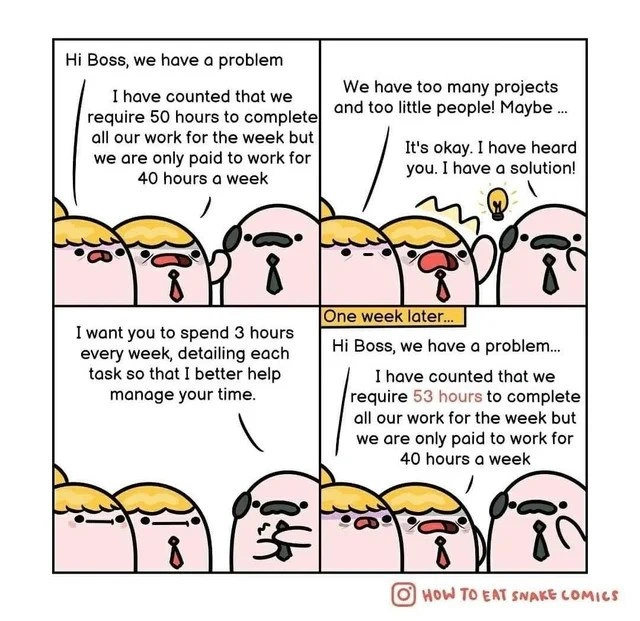
However, in practice, those 3 hours spent on reports are 3 hours lost from actual programming or project work. The comic jumps to “One week later…” to show the outcome. Now the employee reports they need 53 hours to finish all the week’s work, but still only have a 40-hour work week. Why 53? Because it’s the original 50 hours of real work plus the new 3 hours devoted to the boss’s reporting task. The problem got bigger! The joke is that the boss’s “help” directly added more work without solving anything. This is the definition of a boss solution backfire: the intended fix not only failed to resolve the issue, it made the issue worse by consuming more of the team’s limited time.

For a new developer (or anyone new to office life), this scenario is a good lesson in ProcessOverhead. That term means any time spent on processes, meetings, or reports that doesn’t directly produce the project’s output but is supposed to support or manage the work. Some process is normal – for example, a daily stand-up meeting or writing short progress updates can help a team coordinate. But when process demands become heavy (like hours of detailed documentation every week), it can overload the team. In our comic, the 3-hour reporting requirement is overhead that eats into the team’s capacity. So “overhead overload” is exactly what happened: too many overhead tasks piled on top of an already full plate of work.

Let’s talk about why those extra reporting hours hurt productivity so much. First, it’s simply lost time – if you had 40 hours and spend 3 on reports, you only have 37 hours left for real work. But there’s also the idea of context switching. Context switching is when you shift from one task to another. In programming, this might mean stopping your coding session to attend a meeting or write a report, then coming back to coding. Each switch has a “restart” cost: you have to recall where you left off, get your brain back into the problem. It’s like if you were reading a book and someone interrupted you repeatedly; you’d lose track of the story and have to skim back a bit each time. Here, every time the developers pause their actual work to update a task list or fill a time sheet, they lose a bit of focus and momentum. So the cost of context switching makes those 3 hours even more harmful than just the raw time—they break the developers’ flow. This is why developers often complain about too many meetings or micromanagement tasks: not only do meetings take time, but they fragment the day. You can’t deeply concentrate on solving a tough coding problem if you’re constantly interrupted.

The comic also plays on the reality of the 40_hour_week_vs_reality for many salaried workers. The employees say “we are only paid to work for 40 hours a week.” Many workplaces expect that a full-time employee works around 40 hours, and that’s what their pay covers. But in reality, especially in crunch times or with deadline pressure, workers might need to put in extra hours (often unpaid) to get everything done. Here the team is pointing out that the workload isn’t feasible within their paid hours. After the boss’s change, it became even less feasible. This highlights a disconnect that’s common in CorporateCulture: managers sometimes assume employees can just magically absorb extra duties or overtime. The comic’s humor is that the employees come back with the same complaint after a week, basically saying, “We did what you asked, and now we need even more time to finish our work!” It underlines that the boss’s approach was counterproductive.

For a junior developer or someone just entering the field, the take-away is: be wary of well-intentioned “process improvements” that don’t actually address the root problem. If a team has too many projects and not enough people, the real solutions might be hiring more staff, extending deadlines, or cutting scope – not adding bureaucracy. This comic is a form of ManagementHumor – it pokes fun at the fact that sometimes managers add rules or paperwork thinking it will help, but it actually hurts the team’s productivity. It’s a gentle introduction to the kind of jokes developers share about management: like making fun of useless meetings, or saying “My code isn’t done because I spent all day in meetings.” Everyone on a software team has two kinds of work: actual development work and “meta” work (planning, tracking, meetings). The trick is to keep the meta work small enough that it doesn’t cannibalize the real work. In this comic, the meta work ballooned, and it’s instantly recognizable as a bad move. That’s why developers nod and laugh – we’ve seen things like a simple task taking longer because we had to, say, fill out a 10-page form before we could do it. The comic’s simple drawings and the repetition of the employee’s complaint drive home the point in an easy-to-understand way: more overhead = more total work, problem not solved.

Finally, it’s worth noting the source: How to Eat Snake Comics. This series often illustrates workplace and tech absurdities in a cute, minimal style. The humor comes from how straightforward the characters voice the problem. In panel 1, the employee plainly states the issue with numbers (50 hours of work, 40 hours paid). In panel 4, after the boss’s “solution”, he states the new issue (53 hours of work, 40 hours paid) in the exact same format. This repetition is a comedic way to show that nothing was achieved; in fact, it got a bit worse. It’s funny in the comic, but if you experience it in real life, it can be frustrating. Many junior devs eventually encounter a manager or process that feels just like this comic – and when they do, they’ll likely remember this joke and laugh (hopefully outside the boss’s earshot!). The key concept to remember is ProcessOverhead: time spent on managing work needs to be balanced and kept in check, or it will eat into the time for the work itself.

Level 3: Bureaucratic Backfire

Ah yes, the classic manager "solution": we have too much work for the week, so let's add another task! This four-panel comic nails a well-known corporate culture anti-pattern. The dev team reports a workload of ~50 hours for a 40-hour week – basically an unrealistic deadline scenario. Instead of reducing scope or adding resources, the boss responds by demanding 3 hours of detailed time tracking. In theory, it's to “better manage your time”. In reality, it's pure process overhead that devours what's left of the week. The result? The following week, they need 53 hours to do 50 hours of work – a textbook boss solution backfire. It's comedic in a dark way: the manager’s attempt to help developer productivity actually reduces it. Because 50 hours of work in a 40-hour week wasn’t bad enough, now it’s 53 hours. Basic math, meet management 😅.

This joke resonates with anyone who's endured Management 101 missteps. The boss is essentially creating work about work. It’s reminiscent of countless real-life scenarios: teams drowning in tasks, and a manager adds a new reporting mandate or extra meeting. It’s like trying to fix a traffic jam by adding a toll booth – you're only slowing things down further. In software terms, this is Parkinson’s Law in action. Originally, Parkinson’s Law means “work expands to fill the time available.” Here the twist is: if you steal 3 hours for bureaucratic busywork, the actual development tasks expand beyond the original time. The comic’s “One week later…” punchline lands perfectly – nothing has improved except the workload number. It’s a bitter laugh for veterans: we’ve seen projects where filling out detailed status reports each week somehow becomes more important than actually writing code.

Another angle to this humor is the cost of context switching. The boss likely assumes the team can spare 3 hours for time-tracking with no side effects. But flipping between coding and meticulous reporting isn’t free – every switch saps mental energy. It’s akin to a CPU doing frequent context switches: caches get flushed, pipelines stall. For a developer, stopping feature work to fill a timesheet or break down tasks means losing flow. You spend time re-orienting yourself when you come back to coding. Those 3 hours of reporting might effectively cost 4-5 hours of momentum. So not only did the team lose 3 hours to administrative burden, they probably came back to their IDE with their brains rebooting. The boss’s request has all the hallmarks of micromanagement: an obsession with tracking every minute, often born from distrust or desperation. And as any seasoned dev knows, micromanagement is kryptonite to real productivity.

This scenario is a project management humor staple because it’s too real. It parodies the well-meaning but misguided manager who tackles symptoms instead of causes. The team said, “We have too many projects and too little people,” which screams for hiring help or cutting tasks. But the boss chose false certainty over practical relief: more data, more control. Maybe the boss thinks if he scrutinizes every task via a weekly report, he’ll magically find “unused” time or force greater efficiency. Spoiler: all he found was a new way to waste 3 hours. It’s a manager expectations vs reality story. The expectation: if we account for every hour, the schedule will align. The reality: accounting for every hour uses up hours, worsening the schedule. It’s management theatre—lots of ProcessOverhead for show, zero value for actually meeting the deadline pressure. The comic’s pastel, innocent art style only amplifies the sarcasm: these cute blob employees politely tell the boss his plan failed, when in real life there might be a lot more facepalming (or furious Slacking) behind the scenes.

To senior engineers, this strip also hints at broader principles. There’s a whiff of Brook’s Law here: “adding manpower to a late software project makes it later.” In this case, adding overhead tasks to an already overloaded schedule makes it later. Similarly, it echoes Parkinson’s Law of triviality (aka bikeshedding) – focusing on trivial paperwork while the big issue (too much work) goes unaddressed. It’s darkly funny because these management anti-patterns persist despite all our agile coaches and scrum masters. Teams still get hamstrung by administrative overhead that managers introduce in the name of efficiency. The dev community collectively chuckles (or groans) at this comic because we’ve lived it: filling out 10-page status reports during crunch time, attending “alignment meetings” about why we’re behind schedule… All that meta-work just steals time from the real work. In short, the boss in this meme chose control over trust, and the universe promptly delivered karmic justice in the form of an even bigger time deficit. Every experienced dev has a scar from a similar Process Paradox, which is why we laugh (and maybe cry a little) at how perfectly this comic captures the overhead overload folly.

work_hours_required = 50   # Real work needed this week (hours)
work_week_limit    = 40   # Paid hours in a week
overhead_tracking  = 3    # Boss-mandated reporting hours per week

if work_hours_required > work_week_limit:
    # Boss's great idea: add a reporting task to "help" manage time
    work_hours_required += overhead_tracking

print("Required hours now:", work_hours_required)
# Output: Required hours now: 53
# Great, now we need 53 hours of work for a 40-hour week. Thanks, boss.

The code above is a tongue-in-cheek pseudo-algorithm of the boss’s plan. If you’re overbooked (work_hours_required > work_week_limit), instead of relieving the load, just tack on a reporting chore. As expected, the Required hours now jumps from 50 to 53. This little script might as well be our boss’s project management software logic. It highlights the absurdity in a format every programmer recognizes: the “fix” is literally coded to make the problem worse! In real life, no competent manager would write it out like this, but in effect that’s what happens. The humor hits home because we often see decisions in the office that feel as blatantly silly as work_hours_required += overhead_tracking when a project is behind. The comic_strip_how_to_eat_snake delivers that message in a way that makes us smirk instead of rage. In summary, Manager adds time-tracking overhead, weekly hours magically increase even more is a sardonic nod to all the counterproductive bureaucracy we’ve experienced in tech. It’s funny because it’s true – painfully true.

Description

A four-panel comic strip by 'HOW TO EAT SNAKE COMICS' illustrating a common workplace absurdity. In the first panel, an employee informs their boss, 'Hi Boss, we have a problem. I have counted that we require 50 hours to complete all our work for the week but we are only paid to work for 40 hours a week.' In the second panel, as the employee suggests it's due to 'too many projects and too little people,' the boss enthusiastically cuts them off with, 'It's okay. I have heard you. I have a solution!' In the third panel, the boss reveals their plan: 'I want you to spend 3 hours every week, detailing each task so that I better help manage your time.' The final panel, set 'One week later,' shows the employee stating the same problem, but now the required time has increased: 'I have counted that we require 53 hours to complete all our work...'. The comic satirizes how management often responds to systemic issues like understaffing and over-scoping with bureaucratic overhead. Instead of addressing the root cause, the manager imposes a time-consuming administrative task that worsens the very problem it was meant to solve, a scenario deeply familiar to developers in corporate environments


Comments

12
Anonymous ★ Top Pick The problem isn't that we need 53 hours to do 40 hours of work. The problem is that a manager thinks a 3-hour-a-week task can be indexed in O(0) time
  1. Anonymous ★ Top Pick

    The problem isn't that we need 53 hours to do 40 hours of work. The problem is that a manager thinks a 3-hour-a-week task can be indexed in O(0) time

  2. Anonymous

    Asked for headcount, got a 3-hour timesheet ceremony instead - turns out Amdahl’s Law applies to teams too: the serial portion is now weekly status reports, so the only thing scaling is overtime

  3. Anonymous

    The boss just implemented Heisenberg's Uncertainty Principle for project management: the more precisely you measure the work, the more uncertain the completion becomes - except instead of quantum mechanics, it's just adding 3 hours of status meetings to a 50-hour workload

  4. Anonymous

    Classic management anti-pattern: solving a 10-hour capacity problem by adding 3 hours of mandatory time-tracking overhead. It's the enterprise equivalent of fixing an O(n) algorithm by wrapping it in O(n²) logging. Next week they'll probably introduce a 2-hour weekly meeting to discuss why the time-tracking isn't working, bringing them to 55 hours. Eventually they'll hit the heat death of productivity where 100% of work hours are spent reporting on the 0% of work hours available to do actual work

  5. Anonymous

    Classic fix: instead of descoping or adding headcount, we apply Goodhart’s Law and Little’s Law - measure harder until 50 hours becomes 53

  6. Anonymous

    Boss's refactor: inject 'timeManagement()' method, bloating cycle count from 50 to 53 hours without touching paid capacity

  7. Anonymous

    At 125% utilization, management’s fix was a 3-hour weekly status meeting - basically flipping DEBUG on the hot path and calling it performance tuning

  8. @Supuhstar 5y

    X3

  9. @cheburgenashka 5y

    Hofstadter’s Law: It always takes longer than you expect, even when you take into account Hofstadter’s Law.

    1. @dugeru42 5y

      Some people in yandex told me this If you have time estimate t for project You can finish in 2*pi*t + 2 weeks 2 pi because you will never go straight to the solution ... and 2 weeks because when after 2 * pi * t nothing is ready, you can make everything in 2 weeks

      1. @DoriamVell 5y

        But do not told anyone about additional 2 weeks

  10. @LionElJonson 5y

    okay, assuming you documented all tasks please give me a complete list

Use J and K for navigation