A Painfully Literal Interpretation of Exception Handling
Why is this Bugs meme funny?
Level 1: Not So Easy
Imagine you’re at a baseball game and a foul ball is coming your way. Your friend (who’s never played baseball) shouts, "Just catch it!" It sounds simple when they say it. But that ball is flying fast, and when you reach out, boink! it smacks into your face instead of landing in your hand. Everyone around you gasps or ducks, and you’re left rubbing your nose. The idea is that someone who doesn’t really understand the challenge is giving advice that’s much easier said than done. It’s funny because the advice-giver thinks the solution is obvious, but in reality catching that fast-flying ball isn’t so easy at all.
Level 2: Just Catch It?
If you're new to coding, let's break down the joke. In many programming languages (like Java, C#, JavaScript, or Python), you handle errors using a try/catch structure (in Python it's try/except). You try to run some code that might throw an exception (an exception is basically a runtime error or unexpected problem), and if something goes wrong, the catch block kicks in to deal with it. This is called exception handling or error handling. For example, if your code tries to open a file that doesn't exist or tries to divide by zero, it will throw an error. If you wrap that code in a try/catch, you can catch the error and prevent the program from crashing outright.
Here's a quick illustration. Imagine you have code that might divide by zero. Without catching the error, your program would stop with an ArithmeticException (division by zero error). But with a try/catch, you can handle it:
try {
int result = 10 / 0;
// This will throw an ArithmeticException
} catch (ArithmeticException e) {
System.out.println("Oops, can't divide by zero!");
// The program continues running after printing this.
}
In this snippet, when the division error happens, the catch block runs and prints a friendly message instead of the program crashing. You "caught" the exception and handled it gracefully.
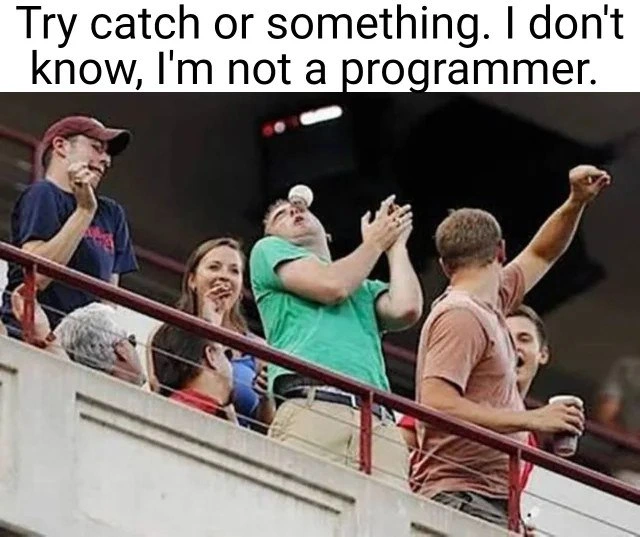
Now, what's happening in the meme? The text at the top says, "Try catch or something. I don't know, I'm not a programmer." That's someone who isn't a coder suggesting a fix: "just use a try/catch." They’ve heard that term somewhere, but they’re not sure what it really means. The image below shows a baseball fan in a green shirt literally trying to catch an incoming baseball. Think of the baseball as an error flying at your program. The guy in green is like the try/catch block — he’s attempting to catch that error. But as we can see, he’s not catching it successfully (the ball is about to bounce off his face). The people around him are ducking and cringing. This is just like when a program doesn't handle an exception properly: the error isn’t caught, and everyone (users, other developers) witnesses the crash and goes, "Uh-oh!"
For a junior developer, it’s common to be told "make sure to add error handling." Maybe you had a mentor say, "wrap that in a try/catch so the app doesn’t blow up on bad input." That is good advice! But the meme is poking fun at when non-developers use that jargon without understanding it. They might think any bug can be solved with a simple catch statement. As you learn, you realize that while try/catch is a powerful tool, it’s not a cure-all. You still have to decide how to handle the error once you catch it (for example, log it, show an error message to the user, or attempt a recovery). Just writing try { ... } catch(...) { ... } around code isn’t enough if you don’t address the actual problem that caused the exception.
This meme is a bit of inside coding humor that highlights a common scenario: someone outside of coding oversimplifying a tricky programming problem. It’s funny to developers because "just catch it" sounds like logical advice, but in practice it's like telling someone to catch a fastball bare-handed. Catching exceptions is an essential part of programming, but doing it right means understanding the problem, not just using the keywords. The guy in green missing the ball is a visual reminder that handling errors in code takes more than just knowing the term "try/catch."
Level 3: Unhandled Exception: Foul Ball
Picture this: a critical exception is thrown in your application – say a wild bug that surfaces in production. Now someone who doesn't write code chimes in with non-programmer advice, essentially: "Can't you just catch it with one of those try-catch things?" The meme responds by literally showing a fan in a stadium trying to catch a flying baseball (our "exception") and failing spectacularly. It's the perfect baseball analogy for what happens when you oversimplify error handling. In programming, exceptions are said to be thrown (like a ball) and we write try/catch blocks hoping to catch them. But as every battle-scarred developer knows, just slapping on a try/catch isn’t a magical fix if you have no idea what to do once you do catch that error.
This scenario is a hallmark of experienced debugging woes. We've all been in those war-room meetings where someone outside the dev team offers a silver-bullet solution without grasping the complexity. "Just add a try-catch around it," they say – as if missed exceptions are the only problem. The humor here comes from the absurdity: sure, in theory you can wrap problematic code in a try/catch block to prevent a crash, but what then? Catching an exception without proper handling is like catching a fastball with your bare hands — you might stop the ball from flying further, but you'll end up with a bruised face. In code terms, you’ll suppress the error, perhaps log it (if you're diligent), and then proceed as if nothing happened. That’s a recipe for technical debt and unpredictable behavior down the line.
Let’s talk real-world patterns being poked fun at:
- Swallowing exceptions: A notorious anti-pattern where a developer catches
Exceptionbut then does nothing or just prints "error happened" and moves on. This meme’s guy in green basically swallows the ball with his face. The error didn’t crash the program immediately (the ball didn’t drop to the ground), but nothing good came of “catching” it that way either. - Oversimplified fixes from onlookers: Non-technical stakeholders often think of try/catch as a universal band-aid. If an app is crashing, they assume adding
try { ... } catch(Exception e) { /* ignore it */ }around the faulty code will instantly solve the problem. In practice, that can hide symptoms without addressing root causes. The foul ball (bug) is still in play – you just lost track of it until it smacks someone unexpectedly. - "I'm not a programmer" disclaimers: The caption "I don't know, I'm not a programmer" is painfully relatable. It’s the equivalent of someone saying "I'm no mechanic, but have you tried putting gas in the car?" – a well-meaning but naive suggestion. As developers, we smile and cringe because we've heard these before, often in the middle of a hair-on-fire debugging session.
There’s a deeper cleverness in the meme’s wordplay. Exception handling in many languages uses the words "throw" and "catch." Here a baseball is literally thrown and someone tries to catch it. The meme exaggerates how non-developers imagine our work: see an error flying at you? Just snag it out of the air! If only it were that simple in a real codebase. Robust exception handling is nuanced – you have to consider where to catch exceptions (ideally at a level where you can actually respond or recover), what specific exceptions to catch (catching all exceptions, like catch(Exception e), is usually too broad), and what to do after catching (log it, clean up resources, maybe retry, or gracefully shut down).
Yet time and again, under pressure, even some devs resort to the "just catch it" quick fix:
try {
dangerousOperation(); // might throw something nasty
} catch (Exception e) {
// Quick fix: catch everything and do nothing.
// Like getting a foul ball in your glove and then immediately dropping it.
}
You can practically hear the developer humor in that empty catch block. They "fixed" the crash by catching the exception, but effectively did nothing with it. The program might continue limping along, potentially in an invalid state, and you'll discover later that, say, data wasn’t saved or some transaction failed silently. The foul ball still ended up causing damage, just indirectly.
Notice the people around the fan in the photo are flinching and bracing for impact. They know this catch attempt is going to end badly. It’s like the other developers or QA folks watching someone deploy a band-aid fix to production – everyone anticipates that thud of an unhandled corner case. This shared grimace is what makes the meme so on-point. It’s coding humor drawn from lived experience: translating a familiar programming predicament into a slapstick visual gag. It's funny and a bit painful because we've all been that green-shirted dev at some point – desperately trying to intercept a production bug under pressure, armed with only a shaky try/catch suggestion. And sometimes, despite our best efforts, we still end up with the error smack on our face.
Description
A meme that humorously misunderstands a core programming concept. The top of the image has the text: 'Try catch or something. I don't know, I'm not a programmer.' Below this text is a photo taken at a baseball game, showing a spectator in a green shirt attempting to catch a baseball but failing spectacularly, with the ball hitting him directly on the forehead. Other fans in the stands are seen reacting with a mix of shock and amusement. The joke is a pun, deliberately misinterpreting the 'try-catch' block - a fundamental construct in many programming languages for handling errors and exceptions - as a literal instruction to 'try' and 'catch' a physical object. The humor lies in the absurdity of this literal interpretation and the painful failure depicted, which resonates with developers who understand the abstract nature of the real 'try-catch' mechanism used to prevent code from crashing
Comments
9Comment deleted
This is what happens when your 'try' block has a critical failure and the 'catch(Exception e)' is just you logging 'e.getMessage()' to your face
“Just slap a try-catch around it” - the architectural cousin of bare-handing a foul ball: looks proactive until the slow-mo replay shows you swallowed the exception and prod is bleeding out
After 20 years of writing defensive code, I still flinch when product says 'just catch all exceptions' - turns out they mean about as much as this guy catching baseballs, but at least his unhandled exceptions don't wake up the on-call team at 3 AM
This perfectly captures the moment when a PM asks 'can't you just wrap it in a try-catch?' during a postmortem for a distributed systems failure involving race conditions, network partitions, and eventual consistency violations - as if exception handling were a universal panacea rather than a mechanism for managing expected failure modes in controlled execution contexts
“Just add a try - catch” is how a reproducible exception becomes silent data corruption - catching the foul ball with your face and calling it graceful degradation
Unlike my legacy try-catch blocks, this one caught the exception without silently swallowing it - or rethrowing upstream
Vendor lib throws; no catch boundary; leadership says “just try-catch it” - and now we’re watching the stack unwind across the bleachers
i fckn love this meme format. pls moar Comment deleted
look at the guy on the left! Comment deleted