Skip to content
DevMeme
1297 of 7435
Carelessly Pushing Commits to the Master Branch
VersionControl Post #1451, on Apr 30, 2020 in TG

Carelessly Pushing Commits to the Master Branch

Why is this VersionControl meme funny?

Level 1: Throw First, Think Later

Imagine you and your friends are building a big sandcastle together. The master branch in this case is like the main sandcastle that everyone is carefully working on. Now, one friend (let’s call them Me) suddenly grabs a bucket of wet sand (that’s the new code changes) and just throws it at the castle without warning. There was no discussion or checking if that sand will stick — he just yeets it right onto the structure. You, standing in for Master, are the friend trying to catch or deal with this surprise blob of sand hitting the castle. Chances are, it’s going to splatter everywhere, maybe knock off a tower or mix in shells and pebbles where they shouldn’t be. It’s a chaotic surprise!

In simpler terms, the meme is joking that someone threw their work into an important project without letting anyone review or prepare for it. It’s like throwing a flapping bird at someone and expecting everything to be fine. Usually, if you hand a bird to someone gently (or add your sand carefully to the castle, piece by piece), things go smoothly. But if you just fling it out of the blue, the other person is left scrambling to catch it, and it might get messy. The humor comes from this wacky image: you normally wouldn’t throw a live pigeon at your friend, right? In the same way, a considerate coder normally wouldn’t dump untested code into the main project. But when someone does, it feels just as crazy as the picture looks. Everyone laughs because it’s a silly way to remind us: take a moment to do things the right way, or you might end up with a face full of proverbial feathers!

Level 2: Yeet Now, Regret Later

At its core, this meme is about Git and bad branching practices. Git is a VersionControl system that lets developers keep track of code changes through commits. A commit is like a snapshot of your code at a certain point. Usually, teams use separate branches (parallel versions of the code) to work on features or fixes. The master branch (often named “main” nowadays) is the primary branch that usually holds the stable, ready-to-release code. There’s a widely accepted best practice: don’t commit directly to master; instead, make a new branch, then create a Pull Request (PR) so others can review your code before it merges into master. CodeReviews (reviewing each other’s code) are meant to catch mistakes, ensure clarity, and maintain quality.

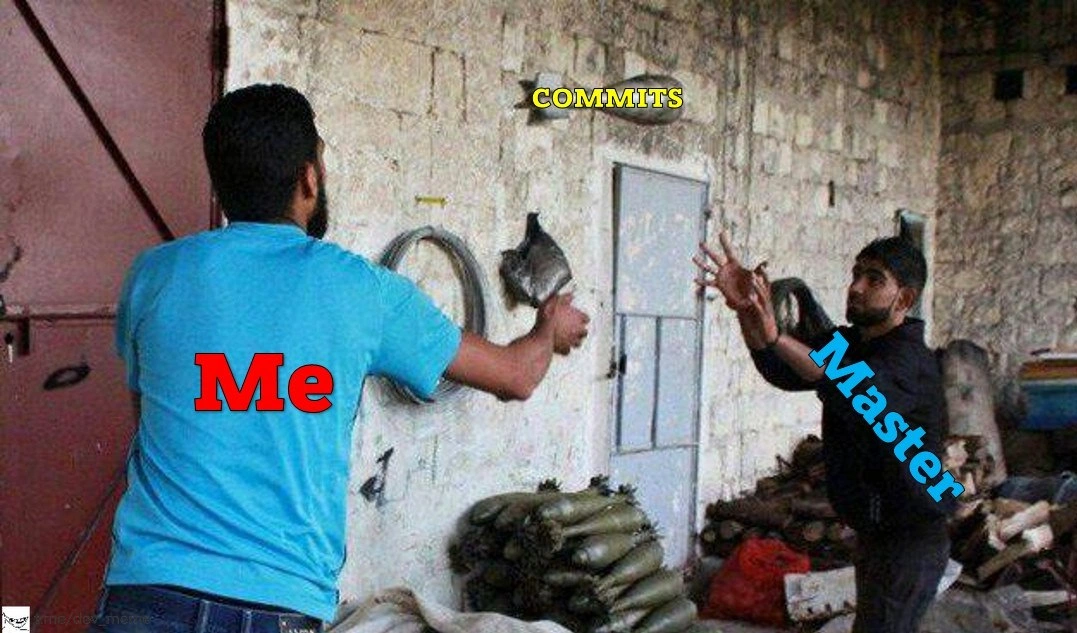
In the image, the person labeled Me is the developer who wrote some code and decided to push it straight to the master branch. “Push” in Git means you send your local commits up to the shared remote repository (imagine uploading your changes for everyone else to use). Doing this “with zero review” means the developer skipped the Pull Request process – no one else looked at the code changes or approved them. This is generally frowned upon because you might miss a bug or conflict that someone else would have spotted. It’s like turning in a group project piece without letting your teammates check it first.

The flying pigeon labeled COMMITS represents the code changes themselves being hurled at the project. Why a pigeon? It’s an oddball choice that makes it funny – pigeons are not exactly cooperative. If you toss a pigeon, you can bet it won’t gracefully fly into the other person’s hands. It’s a metaphor: tossing unreviewed code into the main codebase is unpredictable and likely to cause trouble, just like an unwilling bird being thrown. The man on the right, labeled Master, symbolizes the master branch (and by extension, the rest of the team or the project). He’s reaching out anxiously, trying to catch the incoming “commit.” His stance says, “Alright, I’ll try to handle this, but I’m not confident it’ll end well.” This mirrors how a team or a continuous integration system reacts when surprise commits land in master – scrambling to integrate and cope with whatever was thrown in.

Key terms and what they mean here:

  • Git: A distributed version control system used to track code history. Developers use Git commands to commit (save) changes and push (share) them.
  • Master branch: The main branch in Git (now often called main). It’s the central code line. Changes here affect everyone and often go to production.
  • Commit: A set of saved changes in Git with an identifier. It’s like a checkpoint or a bundle of code updates. In the meme, commits are the thing being thrown.
  • Pull Request (PR): A proposed change submitted for review. Instead of directly changing master, you ask colleagues to review your branch and merge it in. Think of it as saying, “I have some changes, can someone check and approve them before they become official?”
  • Code Review: The practice of having peers go over your code. They might catch bugs, suggest improvements, or ensure it follows standards. It’s a second line of defense against mistakes.
  • Merge Conflict: When two sets of changes clash in Git. For example, if Developer A and Developer B both edit the same line in a file on different branches and then try to combine their changes, Git won’t know whose change to keep. This is called a conflict, and a human has to resolve it manually. Directly pushing to master can create merge conflicts if others were working on similar code, because you didn’t coordinate via a PR.
  • “Yeet”: Slang for throwing something forcefully without much care. It’s internet lingo (popular in memes and videos) that the dev community adopted humorously. Saying “yeet my commits” means flinging code into the repository hastily.

So putting it together: “When I yeet my commits straight at master with zero review” is describing a situation where a developer hurriedly pushes code changes to the main code branch without any peer review or approval. This often leads to problems such as broken features or failing tests, because the changes might not have been properly vetted. It’s essentially a git_best_practices_violation – a violation of Git best practices – hence it’s tagged as such. Developers are laughing because many of us have learned (sometimes the hard way) that this approach can backfire spectacularly. Maybe the code has a typo that takes down the app, or maybe it overwrites someone else’s work. Without code review, the team might discover these issues only after the code is already in the shared master branch, which is late in the game.

The image is a literal illustration of what that feels like: chaotic and risky. One moment you’re minding your own business (coding quietly), and the next someone shouts “Catch!” and flings a wild pigeon (a wild code change) at you. If your team has ever had a rule like “no direct commits to master” or “all changes must go through PRs,” this is exactly why that rule exists. It’s not that we don’t trust developers; it’s that mistakes happen and it’s easier to fix them in a branch before they hit master. This meme basically says “I ignored that rule, oops!” in a joking way.

In summary, the meme uses a silly scenario (throwing a pigeon) to depict the very real concept of push_to_master (direct_commit_to_master) without review. It’s funny to developers because it exaggerates a real workplace scenario. Everyone knows the master branch is important and volatile changes to it can annoy or panic the whole team. Seeing it as a physical comedy sketch makes us laugh, and maybe reminds us, “hey, let’s not be that person.” After all, nobody wants to be the one tossing chaos into their team’s lap – at least not once they’ve seen the mess it can make!

Level 3: Master Branch Mayhem

This meme humorously captures the chaos of pushing code directly to the master branch without any code review. In the image, a developer (the guy labeled Me) is literally yeeting a pigeon toward another man labeled Master. The pigeon mid-flight is tagged COMMITS, symbolizing unreviewed code being flung at the master branch. It’s a perfect visual metaphor for a VersionControl anti-pattern: skipping CodeReviews entirely and recklessly doing a git push straight to the mainline.

For experienced developers, this scene is equal parts funny and anxiety-inducing. The boldness of throwing commits at master “with zero review” evokes all-too-familiar memories of cowboy coding — when someone bypasses the Pull Request process and merges changes without oversight. Why is this so cringe-worthy? Because in real-life software development, the master branch (often the deployable production branch) is supposed to be stable and well-tested. By directly committing to master, our enthusiastic thrower is treating the most important branch like a personal sandbox. It’s like detonating a small explosive in a shared codebase – sure, it might not blow up immediately, but you’re definitely risking a mess.

Why it’s funny: The absurdity of a live pigeon being hurled captures the feeling of a wild, unpredictable commit landing in your central repository. A pigeon isn’t a neat or cooperative package; it flaps, panics, maybe makes a mess. Similarly, an unreviewed commit can introduce bugs or conflicts that send the team into firefighting mode. The receiver (the master branch, or really the team maintaining it) is shown bracing in panic, much like other developers or CI/CD pipelines would brace for impact when someone force-pushes changes unexpectedly. The text colors even convey roles: Me in bold red (a warning flag perhaps?) and Master in blue (trying to stay calm). It’s a comical exaggeration of the “I’ll just put my changes in, what’s the big deal?” attitude. Seasoned engineers recognize this hubris — and the frantic stand-up meetings that often follow when that innocent commit breaks everything.

From an industry perspective, this meme pokes at the sacred rule: “Thou shalt not directly push to master.” Many teams enforce branch protection rules to prevent this exact scenario – requiring code review approvals and passing tests before merging. Skipping these guardrails is viewed as a cardinal sin because it sidelines all the quality control steps (like automated tests and peer reviews) that catch bugs and maintain code health. When someone bypasses code review, they’re essentially saying “My code is perfect, no need for a second pair of eyes.” And Murphy’s Law tells us that’s when things go horribly wrong. Merge conflicts are one immediate consequence: if two developers yeet changes to master simultaneously, Git can’t automatically reconcile the differences, resulting in a snarled mess that someone (probably the poor guy on the right) has to untangle by hand. Even if no merge conflicts occur, there’s the risk of breaking the build – perhaps the new code doesn’t pass tests or introduces a runtime error. Continuous Integration systems might start throwing red the same way that pigeon might start flapping feathers everywhere. 🐦💥

There’s also a layer of shared PTSD being referenced. The text “zero review” hints at the lack of oversight, and developers collectively wince because they’ve either done this in a moment of naïveté or been on the receiving end. Maybe you worked at a startup with no process and witnessed a colleague push a half-tested hotfix directly to master on Friday 5 PM (only for everyone to spend the weekend cleaning up the fallout). The meme nails that “Oh no, here we go” moment: Master sees COMMITS flying in and knows an impact is coming, but it’s too late to dodge. It’s comedic gold because it condenses a complex problem (poor Git practices) into a single slapstick image that we can all laugh at – since this time it’s a pigeon and not our actual production server on the line.

In essence, the humor works on multiple levels for experienced folks: it highlights the recklessness (the throw), the inevitable consequences (trying to catch a squirming bird, much like dealing with unexpected code in master), and the violation of best practices (no code review, akin to no safety net). It’s DeveloperHumor with a side of cautionary tale. After all, behind every meme like this lies a war story of an all-hands-on-deck scramble to fix what one overzealous commit broke. The CodeReviews tag here isn’t just for laughs – it underscores the real solution that was ignored. If only our friend in blue had opened a PR and requested a review, someone might have suggested a better approach (or at least been prepared with a net to catch that flying “bird” of a commit!). Instead, we get MergeConflicts mania and continuous deployment chaos. It’s a scenario virtually every dev can relate to, which is why seeing it depicted with a pigeon and the word “yeet” makes it irresistibly funny and cathartic.

To put it bluntly, this meme screams: “Yes, I just lobbed my changes into master without a safety check – may the odds be ever in your favor!” Seasoned devs chuckle (or groan) because they know the Master branch maintainer is about to do triage, and perhaps an emergency rollback or git revert to undo the damage. In fact, some reading this might be thinking of that one teammate who merges with impunity – the pigeon yeeter of the team – and how this image is going straight into the group chat as a gentle roast. It’s a lighthearted take on a serious lesson: Don’t bypass the process, or you’ll be catching crazy birds later.

Description

This meme uses a chaotic image of two men to represent a common version control scenario. On the left, a man in a blue shirt, labeled in red text as "Me", is in the motion of throwing a pigeon. In mid-air, the pigeon is labeled in yellow text as "COMMITS". On the right, another man, labeled in blue text as "Master", looks alarmed and is raising his hands defensively as if to catch or ward off the incoming bird/commits. The scene is set in a rustic, unfinished room. The humor is a metaphor for a developer recklessly and directly pushing commits to the 'master' (or 'main') branch in a version control system like Git, without going through proper procedures like code reviews or pull requests. It perfectly captures the panic and potential for chaos caused by shipping code directly to the most important branch
Comments

7
Anonymous ★ Top Pick Some developers treat `git push origin master` like a carrier pigeon. You send it off and just hope it doesn't drop a breaking change on someone's head
  1. Anonymous ★ Top Pick

    Some developers treat `git push origin master` like a carrier pigeon. You send it off and just hope it doesn't drop a breaking change on someone's head

  2. Anonymous

    git push --force origin HEAD:master: the software equivalent of UDP - fire-and-forget, and if the pigeon ever comes back it’s carrying a sev-1 postmortem

  3. Anonymous

    After 15 years in the industry, I've learned that the master branch doesn't reject your commits because they're bad - it rejects them because it knows you forgot to update the CHANGELOG.md, skipped the pre-commit hooks, and that one unit test you 'temporarily' disabled six months ago is still commented out

  4. Anonymous

    When your carefully crafted feature branch meets master after a week of parallel development, and Git cheerfully announces 'CONFLICT in 47 files' - suddenly that '--force' flag starts looking less like a nuclear option and more like the only path forward. At least in this version of the conflict, you can see your opponent coming

  5. Anonymous

    Direct-pushing to master is UDP for Git - fire-and-forget until PagerDuty ACKs

  6. Anonymous

    Direct push to master: trunk‑based development where the pre‑receive hook is QA and the pager is the integration test

  7. Anonymous

    Direct commits to master: because feature branches are just merge conflicts in denial

Use J and K for navigation