The Age-Old Question: Bug or Feature?
Why is this Bugs meme funny?
Level 1: Happy Little Accident
Imagine you’re drawing a picture and you accidentally make a big squiggly mark that you didn’t plan. Your friend points at it and asks, “Hey, did you do that on purpose, or was it a mistake?” You might grin, a bit embarrassed, and say, “Hmm, good question!” In that moment, you’re not sure whether to call it part of your creative design or admit it was an accident. This meme is just like that, but for software. It’s funny because the developer got caught with something unexpected in their work and they playfully respond just like you might about your squiggly mark — treating a possible mistake as if it could be a planned idea. It captures that awkward but humorous feeling when you’re deciding if a surprise in your work was on purpose or just a happy little accident.
Level 2: Works as Intended?
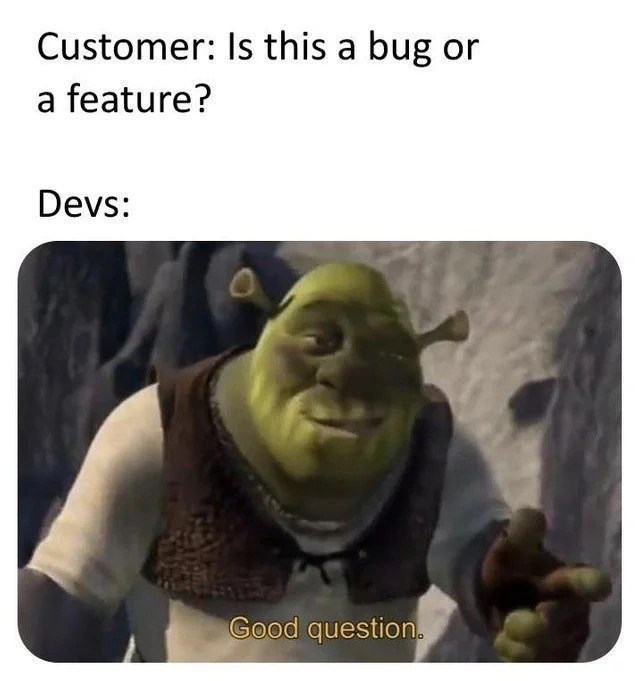
In software development, a bug is an error or flaw that makes the program behave in a way that wasn’t intended. A feature, on the other hand, is a piece of intended functionality — basically something the software is meant to do. The classic joke “It’s not a bug, it’s a feature” comes from developers playfully claiming that a mistake in the software is actually a planned improvement (even when it’s obviously not). This meme is a play on that exact joke. It shows a scenario where a customer (or stakeholder) asks a developer whether some odd behavior in the product is a bug or a feature. In real life, users and clients ask this when they see something unexpected: “Hey, the app shows a green ogre every time I press this button – is that supposed to happen (a feature), or is it an accident (a bug)?” They’re basically checking if the behavior was done on purpose.
The developer’s reply in the meme is just “Good question.” And instead of a normal explanation, the dev replies with a meme of Shrek saying those words. Shrek is a famous animated ogre from the movie Shrek, known for his blunt and humorous tone. By using Shrek’s “Good question” quote, the developer is humorously avoiding giving a direct answer. It’s like they are acknowledging, “Hmm, even I need to think about that.” This highlights a little communication gap: the dev might not be sure how to label the behavior, or they’re buying time to decide what to tell the user. It’s a lighthearted way to handle what could be an awkward moment. Instead of immediately saying “It’s a bug” (which might make the client lose confidence) or insisting “It’s a feature” (which could upset the client if they find it useless or problematic), the dev just throws a fun reference to diffuse tension.
We often encounter this in development teams and QA (Quality Assurance). For example, a tester might file a report: “The app logs you out after 59 minutes of inactivity, not 60 as specified. Bug or feature?” If the requirements weren’t crystal clear, the dev team might genuinely debate it. This is what we call requirements ambiguity – when what the software should do isn’t described clearly enough. Maybe the spec said “about an hour” and one programmer interpreted it differently. In an ideal world, every expected behavior is documented and every unexpected one is a bug to be fixed. But in reality, specs leave some wiggle room, and developers sometimes make judgment calls. That’s why something strange can end up in a gray area.
In everyday dev-client communication, you’ll even see formal terms pop up for this. A project manager might say, “That’s actually working as intended, according to our design,” which is a polite way to claim it’s a feature. Or if it’s clearly a mistake, they’ll admit it’s a bug and promise a fix. Sometimes, to avoid embarrassment, teams label a bug as “WONTFIX” or “By Design” in the issue tracker, indicating they plan to leave it as-is. This meme perfectly captures the relatable humor of those situations. Every developer, even juniors, quickly learns that stakeholder expectations and developer assumptions can diverge. When that happens, you get the famous bug vs feature confusion. Seeing Shrek deliver the line “Good question” is funny because it’s exactly how many of us feel when put on the spot — we recognize that nervous humor and the pause while we decide how to answer. It’s a light-hearted reminder that communication in software can be tricky, and sometimes the best we can do is chuckle and say, “Good question… let me check on that!”
Level 3: Schrödinger’s Feature
For seasoned engineers, the line between a software bug and a feature can live in a state of superposition until observed – much like Schrödinger’s cat in a box. The moment a stakeholder asks “Is this a bug or a feature?”, the dev team scrambles to collapse that wavefunction into one answer or the other. The humor here is darkly familiar: it’s a nod to every time we’ve rebranded a defect as an “undocumented feature” to save face or meet a deadline. This meme nails the shared trauma of requirement ambiguity and client expectations that so many of us have experienced. It’s practically an industry rite of passage to hear a project manager declare, “Actually, that’s by design,” when everyone knows it was an oversight. Why is this so funny (and painful)? Because it hits on an anti-pattern as old as software itself: when the spec is unclear or shifting, unexpected behavior can be spun as intentional.
In the image, the developers respond with Shrek’s blurred, deadpan face and the subtitle “Good question.” It’s a perfect pop-culture parallel for a dev’s poker-faced deflection. Instead of a straight answer, the dev channels an ogre’s sarcastic wit – basically saying “Yeah… even we aren’t sure right now.” This captures a common scenario in dev-client communication: buying time with humor. A veteran dev recognizes that if the customer is happy with the odd behavior, it’s promoted to feature; if they’re upset, well, guess it’s a bug after all. Until the client makes their preference clear, the safest response is a meme-worthy “Good question” and a mischievous grin.
This situation arises from systemic issues that senior devs know all too well: requirements ambiguity and the perpetual communication gap between what the client envisions and what the product actually does. Maybe the spec document had a one-liner that left a lot to interpretation, or maybe there was scope creep and the team delivered something the client didn’t explicitly ask for. The result is a piece of functionality living in limbo. Seasoned engineers have seen trivial UI quirks and odd edge-case behaviors spark long meetings about whether to label them “Working as Intended” or admit they’re mistakes. Often, there’s even a JIRA ticket with a polite resolution comment like “Won’t Fix – behaves as designed”, which is corporate-speak for “We don’t have time to rework this, let’s just pretend it’s intentional.”
From a senior perspective, the meme also hints at how technical debt is born. A minor bug gets shipped because it wasn’t caught or was deemed low priority; users notice and maybe even start relying on it. By the time the question “bug or feature?” is raised, removing that quirk could break something else or upset the few users who appreciated the “feature.” So it stays in the codebase, a bug-turned-feature by pure inertia, and every old-timer on the team rolls their eyes knowing it will never die. We laugh (perhaps a bit bitterly) because we’ve been in those war-room discussions where calling it a feature is the path of least resistance. After all, if it’s a feature, you don’t have to allocate a hotfix or write a regression test – you might even update the manual and call it a day. Developer humor often comes from this gap between ideal best practices and the messy reality. We know we’re supposed to deliver exactly what was asked, no surprises. We try to communicate flawlessly with stakeholders. But in practice, something unexpected always slips through, and then politics and PR take over: “How do we frame this to the customer?” Cue the Shrek meme: “Good question.”
Description
A classic two-part meme format. The top section contains text on a white background. It presents a dialogue: 'Customer: Is this a bug or a feature?' followed by 'Devs:'. The bottom section is a screenshot of the character Shrek, who has a thoughtful, slightly smug expression on his face, with the subtitle 'Good question.'. The meme humorously captures a common and often ambiguous situation in software development where an unexpected behavior could be interpreted as either a flaw (bug) or an intentional, albeit poorly documented, aspect of the system (feature). For experienced developers, this is a deeply relatable scenario that touches on themes of legacy code, technical debt, and the subtle art of managing client expectations
Comments
12Comment deleted
The answer to 'Is it a bug or a feature?' is determined by a single variable: the number of days left before the release date
Schrödinger’s requirement: QA logs it as a P1, sales demos it as differentiation, and by the time I’m paged, it’s mysteriously become “phase-one architecture.”
The real answer depends on whether we've already invoiced for it and how close we are to the quarterly board meeting
The Schrödinger's code phenomenon: until you check the original requirements doc (which doesn't exist), the behavior exists in a superposition of both bug and feature states. Senior engineers know the correct answer is always 'Good question' - it's not evasion, it's strategic ambiguity management while you frantically search git blame to see if drunk-you from 2 AM three months ago left any comments explaining this 'creative interpretation' of the spec
In our org, 'bug vs feature' is a quantum state collapsed by whoever files the Jira - Sales collapses to 'expected behavior'; SRE collapses to SEV-1
We classify behavior by who found it: if Product demoed it, it’s a feature; if PagerDuty did, it’s a bug
In microservices, it's always a 'feature' of the upstream service - until you own the whole stack
Classic :) Comment deleted
😂😂😂😂😂😂 Comment deleted
Actually in reality if you don't mention something they can say its a bug because its not in the docs and can refund or get money back for "non documented" behavior. Comment deleted
Oh really?! First time heard this Comment deleted
If the software has bugs that you meantion and they accept it, they can't do shit about it except waiting for you to give them an update Comment deleted