Tech Trend Prediction: The Return to Building Factories
Why is this IndustryTrends Hype meme funny?
Level 1: New Cool on the Block
Imagine a schoolyard fad: last year all the kids were obsessed with a video game or a collectible card. The coolest kid was the one with the highest game score or the rarest Pokémon card – something that was a big deal but basically lived on a screen or in imagination. Now fast-forward to this year: suddenly that old game doesn’t impress anyone. Instead, everyone’s amazed by a kid who built a real treehouse or a go-kart – something you can actually see and touch in real life. Building a treehouse becomes the new “cool” while the video game bragging is yesterday’s news. This meme says the tech world is doing the same kind of flip. Not long ago, running an online software service (like having a high video game score – cool but invisible) was the ultimate thing to brag about. But by 2025, people might go “meh” at that and be more excited about someone who built an actual factory (like the treehouse – something physical you can show off in the real world). It’s funny because it shows how quickly people can switch what they admire. One day it’s all about virtual stuff, the next day it’s about real-world stuff – just like kids jumping from one trend to another, grown-ups in tech do it too!
Level 2: From Software to Steel
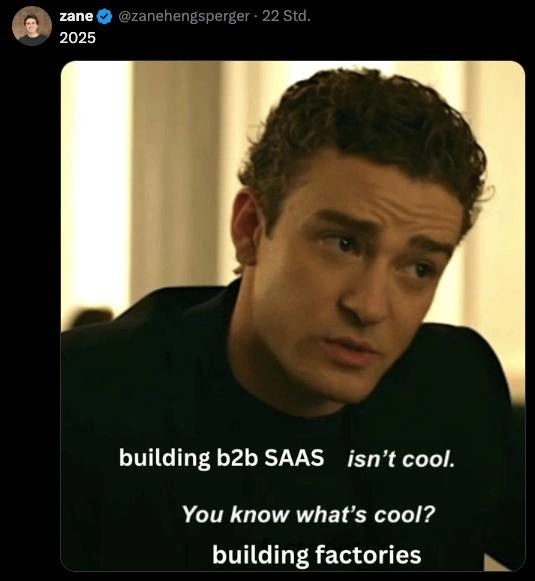
At its core, this meme is joking about how what’s considered cool in the tech startup world might change by 2025. The text basically says: “Building B2B SaaS isn’t cool anymore. You know what is? Building factories.” To unpack that:
- B2B SaaS stands for Business-to-Business Software as a Service. This is a term for cloud software products that one company sells to other companies on a subscription basis. For example, imagine a software tool your office pays for monthly (like a project management app or a team chat application) – that’s SaaS. B2B means the software’s customers are businesses (not individual consumers). Over the last decade, B2B SaaS startups have been extremely popular because they can grow quickly online and bring in steady subscription revenue.
- Factories, on the other hand, are real, physical manufacturing facilities – like a car factory, a smartphone assembly plant, or any big workshop that produces physical goods. This is classic industrial stuff: assembly lines, machines, workers with hard hats. Traditionally, tech startups haven’t focused on literally building factories; they’ve been more about coding apps and services in the digital world.
Now, the meme humorously suggests that by 2025, everyone in Silicon Valley or the startup scene will think starting a factory is cooler than starting a SaaS company. It’s a tongue-in-cheek way to highlight a potential trend reversal. Basically, “SaaS is old news; the new brag is manufacturing.” In everyday terms, it’s saying the hot new startup flex might shift from “I run a software platform” to “I run a factory that makes stuff.”
The image used is from The Social Network, a film about Facebook’s early days. In a well-known scene from that movie, one character says: “A million dollars isn’t cool. You know what’s cool? A billion dollars.” People online love to riff on that quote by swapping in different words. Here, the meme replaces “a million dollars” with “building B2B SaaS” (calling it not cool) and “a billion dollars” with “building factories” (calling that cool). So it’s using a familiar joke format (the “You know what’s cool?” setup) to compare two things in the startup world and declare one of them the new awesome thing.
Why pick those two things? It’s highlighting software vs. hardware in a fun way.
- Building a SaaS product means you’re dealing with code, cloud servers, and software features. It’s something you create in a computer and people access over the internet. You can’t physically touch a SaaS; it’s an application “in the cloud.”
- Building a factory means dealing with physical materials – concrete, steel beams, machines that build other machines – and producing tangible items. You can walk around in a factory and see products coming out at the end.
For a long time, the tech industry’s excitement was all about the intangible side (apps, websites, cloud services). Lately though, there’s been more buzz about “hard tech” or working on real-world infrastructure. You might have heard of startups working on things like electric car production, advanced battery factories, or even rocket building companies. Those are big, physical projects. So this meme takes that shift and exaggerates it: it pretends that by 2025, the ultimate status symbol for a tech entrepreneur will be having a literal factory.
The title even says “factories are the new flex.” In internet slang, to “flex” means to show off or brag. So if factories are the new flex, it means people might start bragging about building factories, the way they used to brag about launching the latest app. It’s a playful idea because it sounds a bit crazy — usually factories are associated with old-school industry, not the flashy startup world.
For someone early in their career, here’s the simple summary: The meme is comparing two waves of startups. Wave one was all about cloud software services (B2B SaaS). That was the cool thing for a while — like, if you were a founder, you’d proudly talk about your SaaS app that’s going to “disrupt” some business workflow. Wave two (the meme imagines) is about swinging to the opposite end: doing something in the physical world, like building a factory to manufacture high-tech products. That’s presented as the new cool thing to do — perhaps because people have seen so many software startups already, they’re craving something different and more tangible.
Ultimately, the joke shines a light on how quickly trends in StartupCulture can change. Today’s big thing can become tomorrow’s old news. The meme uses the famous “You know what’s cool?” quote format to make the point in a snappy, humorous way. Even if you don’t catch the movie reference, the structure of the joke makes it clear: first statement says what’s not cool, second statement reveals what’s actually cool (in an exaggerated sense). It’s poking fun at the tech world’s never-ending search for the next exciting idea — suggesting that maybe the next stop on that journey is something as un-software-like as running a factory.
Level 3: From Bits to Atoms
In this meme’s tongue-in-cheek future vision, 2025 is the year when the tech world’s priorities have dramatically flipped. It’s formatted like a tweet (from user @zanehengsperger) simply captioned “2025”, setting the scene for a prediction: by then, something once hot has become passé. The image underneath — that famous interrogation-room scene from The Social Network — delivers the punchline with a twist on a legendary quote. Originally, Sean Parker leans in to say, “A million dollars isn’t cool. You know what’s cool? A billion dollars.” Here it’s been remixed into startup-speak: “building B2B SaaS isn’t cool. You know what’s cool? building factories.”
For anyone fluent in tech trends, this line is loaded with satire. B2B SaaS (Business-to-Business Software as a Service) was the startup golden child throughout the 2010s and early 2020s. It refers to cloud-based software applications sold on subscriptions to enterprise clients – think Slack, Salesforce, or any app your company pays for monthly. Founders loved building these because they scale globally on the cloud with relatively low overhead. Investors loved them because a successful SaaS can print recurring revenue with high margins. In startup culture, saying “I’m building a B2B SaaS platform” was basically a flex that you’re doing a modern, potentially lucrative software startup. It was tech-trends 101 that SaaS was a safe bet.
But tech is nothing if not fickle. After a decade drowning in SaaS products for every conceivable niche (from HR workflows to how to water the office fern), the once-magical phrase “we’re a SaaS startup” lost its luster. By late 2024, even junior devs joke that every hackathon idea is “Uber-for-X” or yet another web app with subscriptions. Enter the meme’s proposition: in 2025, the cool kids of tech aren’t bragging about cloud software at all. That’s old news. Instead, the meme posits that the new status symbol is tackling something far more tangible: building factories. Yes, actual factories – those concrete-floored, machine-filled buildings that crank out hardware and physical goods. The humor comes from the absurd hyperbole: after years of digital transformation, the tech elite swinging completely the other way, back to dirty hands and heavy machinery.
This speaks to a larger tech hype cycle that veteran engineers know all too well. Tech hype is cyclical and often ironic:
- In the 2010s, “there’s an app for that” was the mantra as startups flooded the market with mobile apps and SaaS platforms. Software was eating the world, and bits (code) were king.
- By the late 2010s and early 2020s, buzzwords shifted. AI and crypto became the new cool — many founders rebranded overnight as AI-driven or blockchain-enabled to catch that investor glow. SaaS was still profitable, but not sexy at cocktail parties.
- Come the mid-2020s, reality checked some of those trends (crypto winter, AI ethics woes), and global events (like chip shortages and supply chain disruptions) made atoms matter again. Suddenly, building tangible things — EV batteries, semiconductor fabs, warehouse robots, even micro-factories — started to sound visionary. The pendulum swung from the cloud back to the ground.
So this meme captures that swing with a witty one-liner. The choice of the Social Network quote format (“You know what’s cool? X”) is perfect for comparing two eras of “cool.” Building B2B SaaS represents the waning era of pure software startups. Building factories represents the new hype where techies romanticize a manufacturing shift. It’s essentially saying: Cloud services? Meh. The new badge of honor is orchestrating actual industrial operations. Think of tech founders gushing about their gigafactory the way they used to hype their AWS cloud architecture — that’s the image the meme conjures.
There’s an extra layer of ironic humor for those deep in startup culture. For years, conventional wisdom in entrepreneurship was “asset-light, software-heavy” is the way to go. Why? Because software scales effortlessly, whereas factories (asset-heavy) tie up huge capital and are notoriously hard to pivot. A seasoned engineer reading this meme might smirk, recalling all the pitch decks that proudly declared “no heavy infrastructure, no factories – we’re 100% digital!” Now in this satirical 2025, that’s flipped: the lack of a physical element is uncool. The new flex is saying, “We’re not just spinning up containers in the cloud, we’re also pouring concrete on the ground.” It’s a bit like fashion – what was out of style often comes roaring back ironically, and here we have startups essentially cosplaying as 1950s industrial giants to earn bragging rights.
The context behind “building factories” being cool ties into real-world trends. By the mid-2020s, big tech influencers and venture capitalists began championing ventures in climate tech, robotics, and manufacturing. There’s talk of re-shoring industries – building battery plants for electric cars, chip fabrication facilities to secure semiconductor supply, and high-tech mass-production for everything from lab-grown meat to rockets. National policies (like governments funding new factories for critical tech) started to align with this vibe. So in a sense, factories became sexy again in tech discourse. This meme exaggerates that reality for comedic effect, as if to say, “Forget cloud software, the real ballers are opening actual factories now.”
Deep down, the joke resonates because it highlights how absurd these shifting goalposts can feel, especially to those who’ve been in tech through multiple hype waves. It’s poking fun at our collective obsession with the next big thing. One year you’re uncool if you’re not doing SaaS; the next year SaaS is suddenly scoffed at as small-time. It’s humor with a side of industry critique: maybe we in tech sometimes chase trends to the point of parody. As veteran developers and founders see this meme, they’ll likely chuckle and think, “Here we go again – new buzzword, same herd mentality.” It’s a reminder that in tech, what’s cool is a moving target, and yes, sometimes it even does a full 180° turn right back to something as old-school as a factory floor.
Description
This is a screenshot of a tweet by a user named 'zane'. The tweet contains a single word, "2025", and an image. The image is a still of actor Justin Timberlake portraying Sean Parker in the 2010 film 'The Social Network'. Subtitles have been added to the image, creating a meme that paraphrases Parker's famous line from the movie. The text reads: "building b2b SAAS isn't cool. You know what's cool? building factories". The meme humorously predicts a major shift in the tech industry and venture capital focus around the year 2025. It suggests that the long-standing trend of creating Business-to-Business Software as a Service (B2B SaaS) companies will fall out of favor, to be replaced by a renewed interest in tangible, industrial projects like building factories. This reflects a growing discourse in tech circles about moving from purely digital products to 'deep tech' or 'hard tech' that addresses physical-world problems like manufacturing, supply chains, and infrastructure
Comments
19Comment deleted
The next big framework won't be written in Rust, it'll be made of it. Get ready to trade your YAML configs for OSHA compliance manuals
“Apparently the 2025 pivot plan is to replace our multi-tenant SaaS with a multi-tenant industrial park - same orchestration problems, just swapping Kubernetes nodes for CNC lathes.”
After spending a decade debugging microservices at 3am and explaining to VCs why your B2B SaaS has negative unit economics, suddenly the idea of building something tangible that doesn't require a Kubernetes cluster to manufacture a single widget starts looking pretty cool indeed
Ah yes, because nothing says 'I've made it' quite like implementing the Factory pattern for the 47th time while your B2B SaaS competitors are busy solving actual customer problems and achieving product-market fit. But hey, at least your object instantiation is elegantly abstracted - that'll really impress the VCs when they ask about your MRR. The real irony? Most successful SaaS platforms are built on mountains of factory patterns anyway, they just don't lead with it in their pitch decks
2025: Graduating from B2B SaaS to factories - same distributed systems and queueing theory, except rollbacks need a crane and the SLA is takt time
SaaS moats: network effects and patents. Factory moats: chain-link fences and guard dogs
2025: we pivoted from ARR to OEE - turns out you can roll back a deploy, but not a 300 mm wafer
Abstract factories??? Comment deleted
https://www.factorio.com/ Comment deleted
I'm doing my part! 🫡 Comment deleted
Tracing a PCB? Comment deleted
Just killing bugs Comment deleted
"First actual case of bug being found" This? Comment deleted
love em Comment deleted
I hoped it was a meme about reorientation of the economy towards real value and national movements directed against uncontrolled offshoring (like "Made in America", "France 2030", etc). Apparently it is just another meme about a computer game. Comment deleted
Beauty lies in the eyes of the beholder Comment deleted
Though I would need to take a major shift into political discussion so we can have a serious discussion about it. No simple solution to uncontrolled offshoring exist atm for non-Asian countries with too high salaries and too excessive regulations Comment deleted
I'm doing my part, too! Comment deleted
Mmm, the genocide of the bugs... Lovely Comment deleted