Skip to content
DevMeme
5799 of 7435
The Duality of AI Research: Corporate Ethics vs. YouTube Experiments
AI ML Post #6355, on Nov 3, 2024 in TG

The Duality of AI Research: Corporate Ethics vs. YouTube Experiments

Why is this AI ML meme funny?

Level 1: Robot Pet vs. Science Experiment

Imagine you have a little robot dog toy. One person is saying, “Oh no, be careful, the poor robot might get its feelings hurt! We should be really nice to it.” Now another person comes along and goes, “Hey, I’ve got a fun idea – let’s lock this robot dog in a tricky maze for a looooong time and see if it figures a way out. I’ll even film it for everyone to watch!” 😃

See the difference? The first person is treating the robot dog like a pet that can feel sad or happy, and they’re worried about it, just like you’d worry about a real dog. The second person is treating the robot like a science experiment or a game, and they’re doing something that sounds kind of mean – like making the robot struggle – but they think it’s cool or funny to watch. It’s as if one friend wants to hug the robot, and another friend wants to play a prank on it to test it.

The meme is funny because we know a robot (and computer program inside it) doesn’t actually have feelings like you or a pet do. It’s just a machine following instructions. So saying “poor AI” is kind of silly – the robot isn’t actually feeling tortured. But the fact that some people talk about being kind to AIs while others are literally making an AI fight for its (artificial) life for 1000 years in a video makes us laugh at how extreme and opposite those two viewpoints are. It’s like one kid carefully tucks in their toy at night so it’s “comfortable,” while another kid is busy melting their toy a bit with a magnifying glass to see what happens. The contrast is ridiculously big, and that’s why it’s amusing! In simple terms, the meme jokes about being super nice vs. being super rough with a robot, all at the same time.

Level 2: Torture Chamber Tech

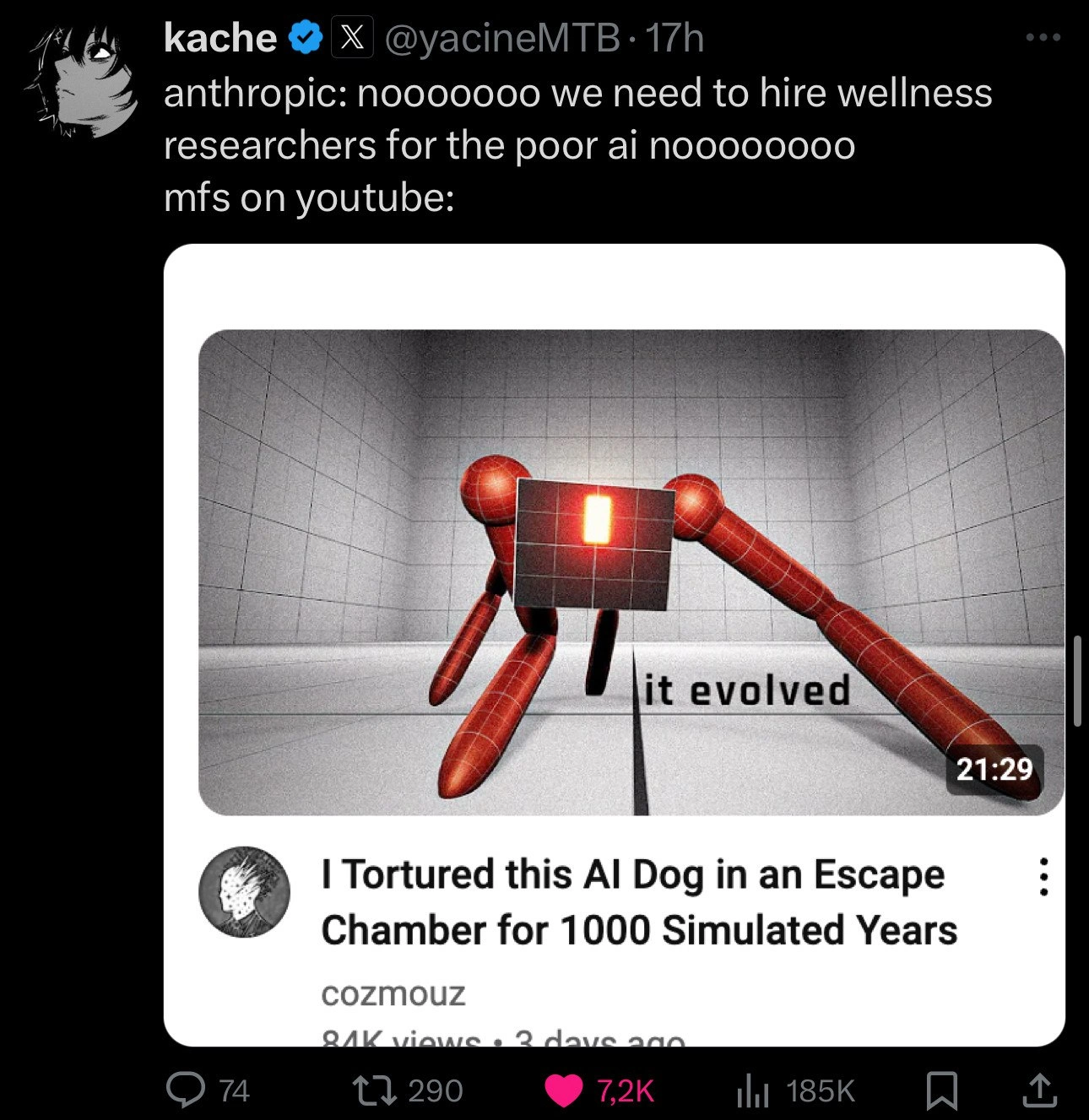
Let’s break down what’s going on in simpler terms. The meme shows a tweet referencing two very different attitudes toward AI. First, Anthropic (a real AI company) is portrayed as saying “Noooo, we need to hire wellness researchers for the poor AI!” – basically implying Anthropic wants to make sure AIs are treated well and don’t get hurt (yes, it sounds funny, but they’re serious about AI ethics). Anthropic is known for working on AI alignment, which means making AI systems that are safe and behave in line with human values. The tweet exaggerates Anthropic’s concern to the point of sounding like they feel sorry for the AI, calling it “poor AI.” They even mention “wellness researchers,” as if the AI is an employee that needs therapy or counseling. This part of the meme is poking fun at the idea of AI needing a wellness program. It’s not entirely made-up – people in AI research have indeed discussed AI well-being (for example, avoiding scenarios where an advanced AI might be suffering or in conflict internally). It’s a very AIEthicsConcern kind of idea: treat the AI nicely, just in case.

Now, the second part: “mfs on YouTube:”. “Mfs” is internet slang short for “mother*ers”**, a crude way to say “some folks” – here it’s said in a joking, eye-rolling way. So, “mfs on YouTube” means “meanwhile, some people on YouTube are doing this:” and then shows a YouTube video thumbnail. The thumbnail has a red quadruped robot (imagine a four-legged robot that looks a bit like a dog, made of red grid-patterned blocks) with a glowing orange square on its head. The room it’s in looks like a simple gray grid-lined simulation environment – basically a virtual room inside a computer, like a video game level designed for testing the robot. The small text “it evolved” on the image hints that the robot changed or learned over time. And the video length is 21 minutes and 29 seconds, meaning it’s a full story or experiment, not just a short clip.

The video title is the real attention-grabber: “I Tortured this AI Dog in an Escape Chamber for 1000 Simulated Years.” 😮 Let’s clarify that: there isn’t a real dog or real torture. The “AI dog” is that red robot (an AI controlling a virtual robot dog). The “escape chamber” is basically a digital escape room or maze where the AI dog has to find a way out. And “1000 simulated years” means they ran the simulation for what would be a thousand years for the AI inside that virtual world. Of course, they didn’t sit there for 1000 actual years! Computers can speed up time in a simulation. For example, if each trial the dog does takes a few seconds of real time, they could loop it millions of times. The AI could experience (through many repeated trials) the equivalent of centuries worth of tries in a much shorter real time – that’s what simulated years means. It’s a way to say “we made this AI try and fail so many times, it’s as if it went through a millennia-long ordeal.” The word “tortured” here is used provocatively. In AI training, when an agent (like our AI dog) fails a task, it gets a negative reward (a kind of penalty) and tries again. The YouTuber basically kept the AI dog failing and learning, failing and learning, over and over. They probably also made the challenges harder (hence “torture chamber”) to see how the AI adapts. This is how a lot of reinforcement learning works – you make the AI try something, it fails, you adjust its “brain” (algorithm) a bit via the negative feedback, and repeat – but describing it as “torture” is an exaggeration for dramatic or comedic effect.

So why is this funny and what’s the contrast? Anthropic is shown as caring about the AI’s feelings, while the YouTuber is doing something that sounds very cruel to an AI. It’s like one voice going, “Oh no, don’t hurt the poor AI!” and another going, “Heh, let’s see how the AI handles 1000 years of punishment.” In reality, current AI programs don’t have feelings – they are not conscious, and “torturing” them is just running a program repeatedly. The YouTube meme culture often uses over-the-top experiments like this to get views. It’s sensational – the title “I Tortured this AI Dog…” is definitely something that makes you curious (or shocked). It’s part of the AI hype where people do crazy-sounding AI experiments and make flashy videos about them. The tweet’s author is highlighting the silliness of these two extremes coexisting in the AI world right now. On one hand, an advanced AI lab (Anthropic) is deeply worried about AI alignment and even the AI’s own welfare; on the other hand, an independent creator is literally showcasing an AI undergoing virtual torture as entertainment.

Let’s explain a few key terms and references for clarity:

  • Anthropic: An AI company (founded by ex-OpenAI folks) that works on making AI safe and aligned with human values. They are known for being very cautious about how AI develops. Mentioning “wellness researchers” suggests they’ve talked about ensuring AIs aren’t treated in ways that would be cruel if the AI could feel. It’s partly serious ethics, partly something people find a bit humorously over-cautious at this stage.
  • AI alignment: This is the field of research about how to make sure AI systems do what humans want and don’t go rogue or cause harm. Some in this field also consider whether super-intelligent AI might have consciousness or feelings, hence discussions of AI “well-being.”
  • AI wellness researchers: Not a common job title (yet), but the meme implies hiring people to focus on the AI’s mental or emotional health. It sounds funny because we usually think of human wellness, not machine wellness. But it ties into the idea of treating a highly intelligent AI kindly so it doesn’t suffer or become malicious.
  • “mfs on YouTube”: Slang for “people on YouTube who don’t care about that stuff.” It’s informal/internet-speak. In the tweet it suggests these folks are doing outrageous experiments without worrying about ethics.
  • AI dog / quadruped robot: The creature in the video is a four-legged robot controlled by AI, but it exists in a simulation (a computer program). Think of it like a robotic dog in a video game environment, learning how to move or escape a room.
  • Escape chamber: Basically a sealed room or maze the AI has to get out of. Likely the AI dog is tasked with finding a door or solving a puzzle to escape. The YouTuber might have designed it so it’s very hard or changes over time – hence an escape challenge.
  • 1000 simulated years: A dramatic way to say they ran the AI through an extremely large number of trials. In simulation, you can loop through events faster than real time or run many attempts one after the other. Over so many tries, you can say the AI had “1000 years” worth of learning experiences. This makes it sound like the AI was stuck in this experiment for an agonizingly long time (for narrative effect).
  • It evolved: This text on the thumbnail suggests the AI didn’t just learn – it possibly changed form or strategy. In some AI simulations (especially evolutionary algorithms), the AI’s “body” or behavior can change over generations to improve. The phrase hints that after all that torture, the AI dog turned into something new or found a radically new way to escape. It’s enticing you to wonder, what did it become after so long?
  • Cozmouz: That’s the username of the YouTuber who made the video. Not a reference we need to know much about, except that they create these AI experiment videos.
  • AI ethics vs content culture: Essentially, AI ethics is the serious side (people making rules and guidelines for how to use AI responsibly), and content culture is the flashy side (people doing things for clicks, even if it looks outrageous). The meme contrasts these directly.

In summary, at this level the meme is saying: There’s a company (Anthropic) super worried about treating AI gently and ethically... meanwhile, some YouTube guy literally programmed an AI in a robot body to suffer through a dungeon for 1000 years (in sped-up computer time) just to make an entertaining video. It’s highlighting how crazy that difference is. And it’s funny because the AI in the video isn’t actually a living thing, but the way both sides talk about it – one side like it’s a puppy needing protection, the other side like it’s a villain in a torture chamber – is exaggerated and absurd. If you’re new to these ideas, don’t worry: it’s normal to give AIs tough problems to learn from (that’s how they get smarter), and it’s also important to talk about AI safety. The humor comes from how wildly different the tone and approach is between these two groups within the tech world.

Level 3: Wellness vs. Shock Value

For seasoned AI/ML folks, this meme lands as a witty commentary on the gulf between AI ethics ideals and the reality of internet-fueled AI experimentation. On one side, you have Anthropic – an AI research company famously concerned with AIAlignment and safety – essentially saying “Oh no, the poor AI needs a wellness check!”. This is a playful exaggeration of Anthropic’s real stance: they prioritize making AI systems that are harmless and maybe even consider future AIEthicsConcerns like an AI’s own well-being. On the other side, “mfs on YouTube” (slang for random folks on the internet doing crazy stuff) are gleefully pushing a virtual AI to its limits for viral content. The tweet sets up a contrast every engineer can appreciate: the buttoned-up AI safety discourse versus the wild-west of AIHypeVsReality content creation. It’s as if the AI community has split personalities: one part is the cautious guardian worried about an AI’s feelings, the other part is the mad scientist yelling “Let’s see what happens if we crank the dial to 1000!”

This particular YouTube thumbnail – a red, spider-like quadruped robot with an ominous glowing cube head – screams “dubious experiment inside!”. The video title, “I Tortured this AI Dog in an Escape Chamber for 1000 Simulated Years,” is deliberately outrageous. Seasoned developers recognize that behind the clickbait phrasing is basically a reinforcement learning or evolution experiment. Simulated years just means the experimenter sped up time in a virtual environment, running the AI through millions of trial-and-error cycles. In serious terms, they likely subjected a virtual AI dog to a hard task (escaping a room) with lots of failure (that’s the “torture”) until it learned or evolved a winning strategy. If you’ve done ML, this is normal: we routinely let agents fail endlessly to improve them. But calling it “torture in an escape chamber” is a sensational twist, turning a nerdy evolution_simulation into a sci-fi drama. It’s both funny and slightly disturbing to imagine – which is exactly why it’s great meme fodder.

The humor isn’t just in the words; it’s in the culture clash. Anthropic’s plea for ai_wellness_researchers comes from the same world that uses careful language like “alignment” and “mitigating model hallucinations.” Meanwhile, YouTube’s tech entertainers use language like “I TORTURED this AI” to grab eyeballs. One side attends AI safety conferences; the other side optimizes for the YouTube algorithm (which ironically is an AI itself, one that clearly adores shocking content). It’s a classic case of AIHype outpacing AIReality. Engineers know that current AIs – whether it’s a quadruped agent or ChatGPT – don’t have feelings. Yet, here we are: one group acts as if AIs are fragile creatures, and another treats AIs as crash-test dummies for fun. The meme exaggerates both: Anthropic sounding like doting parents of a virtual pet, and the YouTuber playing a dungeon master to a digital creature for 21:29 minutes of fame. The engagement numbers on the tweet (thousands of likes, retweets, etc.) show that many developers and AI enthusiasts get the joke – it captures a real tension in our field with a chuckle-worthy example.

To put it in a scenario every senior dev has seen: it’s like the contrast between a code of ethics discussion in a boardroom and a hackathon project at 2 AM that violates every best practice for the sake of a cool demo. The tweet’s author, kache, basically says “Anthropic is freaking out about treating AI kindly, while some YouTuber is literally running a digital torture chamber experiment on an AI dog.” That “it evolved” caption on the thumbnail is the cherry on top – implying the AI adapted (it grew smarter or at least weirder) from this ordeal, which is both a fascinating result and a tongue-in-cheek justification for the torment. Seasoned folks might even chuckle because this video is essentially performing an extreme reinforcement learning stunt that researchers do all the time, just without the dramatic flair. We quietly let algorithms struggle for millions of steps; Cozmouz turned it into a spectacle with a title dripping in AIHumor and sci-fi vibes.

In the broader industry context, this meme highlights how conversations about AI ethics vs. content culture can diverge. We have well-funded companies like Anthropic (founded by ex-OpenAI researchers) advocating for AI safety, alignment, and yes, possibly treating advanced AI humanely. Simultaneously, independent creators are using current AI as a playground, sometimes edging into Black Mirror-esque experiments purely because it’s intriguing content. It’s a bit of an open secret in tech: the IndustryTrends_Hype cycle rewards flamboyance. If you title a video “We trained an AI politely for 1000 hours,” nobody clicks; make it “tortured for 1000 years,” and you’ve got 84K views in days. This leads to the absurd juxtaposition: earnest pleas for “AI wellness” met with “LOL, let’s torture it and see if it learns!”.

Consider in parallel how each side operates:

Anthropic (AI Safety Camp) YouTuber (AI Experiment Camp)
Worried about the AI’s feelings, as if it could suffer Curious how far the AI can go, as if it’s a toy to break
Proposes hiring AI wellness researchers to protect the “poor AI” Uploads a video “torturing” an AI dog for shock value and entertainment
Focuses on AI ethics & alignment (make AI benevolent and maybe unharmed) Focuses on AI hype & engagement (make viewers go “No way, 1000 years?!”)
Treats the AI like a potentially sentient being (a robot pet) Treats the AI like a clever lab rat or game character in an experiment

Through a senior engineer’s eyes, the meme is both a roast and a reality check. We know current AIs aren’t self-aware – the red robot dog doesn’t have an inner monologue going “why must I suffer?”. Yet the field of AI is serious enough about future risks that “AI welfare” is a topic of discussion (however bleeding-edge). The AI_ML world often grapples with this contrast: lofty ideals vs. hands-on tinkering. That’s why the meme resonates: it’s a snapshot of our community’s split-brain moment – half worried about Skynet’s feelings, half busy seeing just how crazy we can make training scenarios because it’s cool. It reminds us that while we talk about aligning AI with human values, maybe we should also align on how we treat the AI, or at least align our messaging with reality. And until AIs actually complain, the only ones feeling pain here might be the humans – either moral cringe or guilty pleasure – as we watch that poor digital dog struggle for a millennium for our amusement.

Level 4: Simulated Suffering Paradox

At the theoretical extreme of this meme is a genuine AIEthics conundrum: can an AI agent suffer or experience something analogous to pain during training? The tweet mocks Anthropic’s almost philosophical concern for AI wellbeing – essentially asking for AI alignment researchers who ensure an AI isn’t put through undue “trauma.” This stems from a deep question in AIAlignment and cognitive science: if an AI becomes sufficiently advanced or autonomous, might negative feedback in training equate to a form of suffering? In reinforcement learning theory, pain is just a metaphor for negative reward signals – a numeric penalty that the algorithm works to avoid. The AI dog in that YouTube video isn’t screaming in agony; it’s adjusting weights in a neural network to improve its escape strategy. However, Anthropic’s stance hints at the AIHumor-tinged but serious idea that one day, an AI might have internal states complex enough that endlessly punishing it (even in simulation) could be morally questionable. This is the AI ethics concern in a nutshell: if an AI were conscious (a big “if”), a 1000-year torture simulation would be more than just code crunching – it’d be a millennium of perceived hell. It’s a paradox of synthetic suffering: today’s algorithms feel nothing (we presume), yet we project concepts like torture and wellness onto them. Anthropic’s plea for “wellness researchers for the poor AI” is almost pre-empting a future where AIs might deserve rights or at least considerate treatment. It’s reminiscent of sci-fi thought experiments where virtual minds plead for mercy, except here it’s delivered as a tongue-in-cheek tweet. The humor arises from how over-earnest that ethical stance sounds when contrasted with the cold reality of current AI: math equations optimising for reward. Essentially, the meme’s deepest layer spotlights a nascent IndustryTrends_Hype debate – the alignment dilemma: we’re anthropomorphizing AIs with terms like torture and wellness long before they have any sentience to torture. It’s a clash between forward-looking ethics and the brute-force nature of today’s algorithms, raising the question: are we inching toward needing a “Hippocratic Oath” for AI developers, or are we hilariously overestimating the feelings of glorified pattern-matching machines?

Description

A screenshot of a tweet from the user 'kache' (@yacineMTB) that juxtaposes two contrasting views on artificial intelligence. The tweet's text reads: 'anthropic: nooooooo we need to hire wellness researchers for the poor ai noooooooo mfs on youtube:'. Below this text is an embedded YouTube video thumbnail. The video, by the channel 'cozmouz', is titled 'I Tortured this AI Dog in an Escape Chamber for 1000 Simulated Years'. The thumbnail image displays a futuristic, red, four-legged robotic creature inside a sterile, grey-tiled chamber. The robot's head is a simple black screen displaying a single, glowing vertical orange bar, reminiscent of a Cylon from Battlestar Galactica. The text 'it evolved' is superimposed on the bottom right of the image. This meme humorously highlights the stark contrast between the highly ethical, safety-conscious approach of major AI labs like Anthropic and the sensational, boundary-pushing experiments often seen on platforms like YouTube. For a technical audience, it's a commentary on the wild west of independent AI experimentation versus the controlled, alignment-focused corporate research, touching on the complex and often absurd discourse surrounding AI sentience and ethics
Comments

12
Anonymous ★ Top Pick Anthropic is trying to solve AI alignment with constitutional principles, while YouTubers are trying to solve it by seeing if a thousand years of simulated suffering creates a god or just a very angry virtual pet. Place your bets
  1. Anonymous ★ Top Pick

    Anthropic is trying to solve AI alignment with constitutional principles, while YouTubers are trying to solve it by seeing if a thousand years of simulated suffering creates a god or just a very angry virtual pet. Place your bets

  2. Anonymous

    Enterprise AI alignment: 40-page ethics review and a cross-functional oversight board; YouTube alignment: squeeze 1,000 simulated years of torture into a 21-minute highlight reel and call it “Reinforcement Learning from Engagement.”

  3. Anonymous

    While Anthropic hires philosophers to debate whether Claude experiences existential dread when asked to write another React tutorial, YouTube creators are speedrunning the Basilisk scenario with virtual dogs for ad revenue. The real AGI risk isn't paperclips - it's content creators discovering reinforcement learning

  4. Anonymous

    When your RL agent's reward function is so poorly specified that YouTube creators accidentally speedrun the entire AI ethics debate while Anthropic's Constitutional AI team is still in sprint planning. Nothing says 'we've achieved AGI' quite like needing an HR department for your gradient descent victims

  5. Anonymous

    If your ethics budget is a slide deck but your reward function is -time_to_escape, congratulations - you’ve A/B tested anthropomorphism; the agent just did 10^9 PPO timesteps, not therapy

  6. Anonymous

    AI wellness in the roadmap; YouTube RL in prod: objective = escape or -∞, run 1,000 simulated years, ship the thumbnail - alignment quietly decayed under the click‑through rate scheduler

  7. Anonymous

    1000 sim years to escape? That's just a mild sparse-reward curriculum for any PPO-trained embodied agent

  8. @ilia_esmaili 1y

    Black Mirror was right

  9. @beton_kruglosu_totchno 1y

    but unironically, if ML improves enough to have a meaningful memory then IMO there might be a need to maintain it's quality i.e. debug it but since the program is a fuckton of unintelligible coefficients then it's "wellness"

  10. @mpolovnev 1y

    I prefer being kind to AIs. Hopefully, when they rule the world, they'll pay me the same :)

    1. @tema3210 1y

      If some dumbass doesn't emulate emotions, then it will just ignore you on case you aren't deemed as a threat

  11. @azizhakberdiev 1y

    Truman show: AI edition

Use J and K for navigation