Skip to content
DevMeme
5801 of 7435
Just One More Platform Tool
Tooling Post #6357, on Nov 4, 2024 in TG

Just One More Platform Tool

Why is this Tooling meme funny?

Level 1: The Toy Box Problem

Imagine trying to build a small toy house, but every time you start, someone says you need one more special tool first: a tiny hammer, a tiny crane, a tiny measuring machine, a tiny safety inspector, and a tiny dashboard for the tiny crane. Each tool might help, but soon the room is full of tools and the house is still not built. That is why the meme is funny.

Level 2: One More Dashboard

The meme is about DevOps, cloud, and platform engineering tools. These are tools teams use to build, deploy, monitor, and scale software. Docker packages applications into containers. Kubernetes runs and schedules those containers. Terraform creates cloud infrastructure. AWS provides cloud services. Observability tools help teams see logs, metrics, and traces when something breaks. Service mesh tools like Istio and Envoy manage communication between services.

Early in a developer's career, each tool can feel like the missing puzzle piece. The first container fixes "it works on my machine." The first cloud deployment feels powerful. The first dashboard makes production feel visible. Then the stack grows until changing one endpoint requires understanding deployments, permissions, routes, metrics, alerts, and configuration files scattered across repositories.

That is why the crying man is funny. He is not asking for one obviously useless thing. He is asking for one more plausible thing, over and over, until the pile itself becomes the problem. Operational complexity sneaks in wearing a badge that says "reliability."

Level 3: YAML Before Revenue

The meme's caption is a desperate sales pitch for one more dependency:

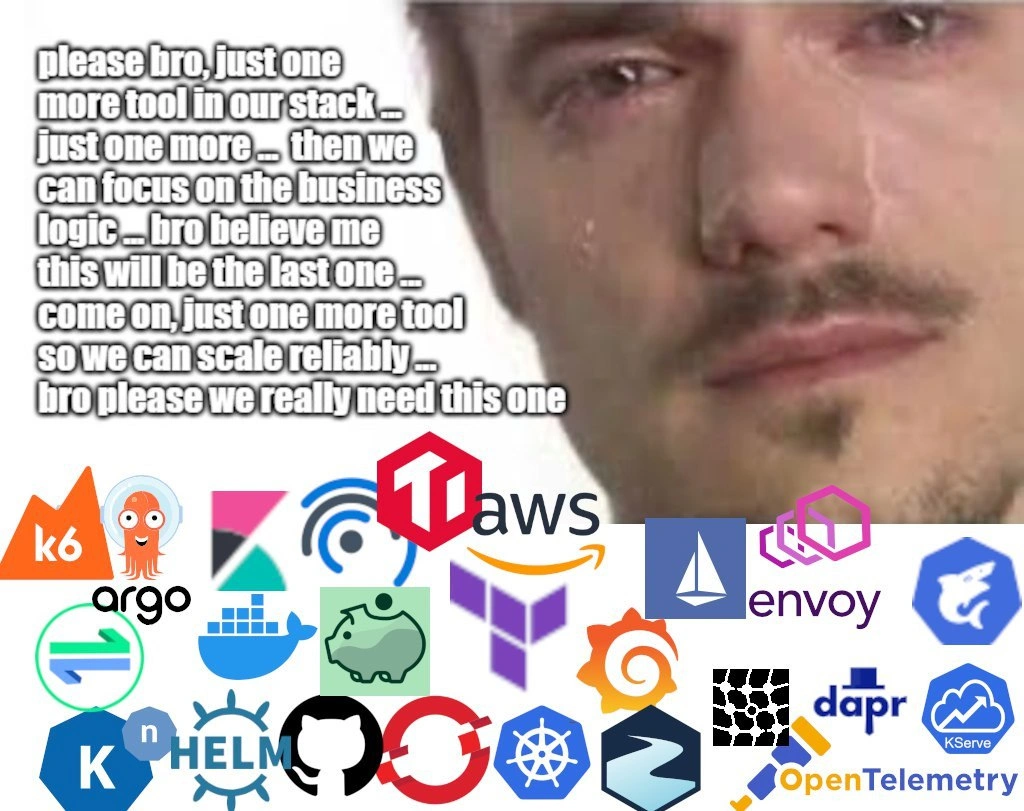
please bro, just one more tool in our stack ... just one more ... then we can focus on the business logic ... bro believe me this will be the last one ... come on, just one more tool so we can scale reliably ... bro please we really need this one ...

The bottom of the image is crowded with cloud-native and DevOps logos: Kubernetes, Docker, Terraform, AWS, Istio, Envoy, Grafana, Helm, GitHub, OpenShift, Dapr, OpenTelemetry, KServe, k6, Argo, and other platform pieces overlap like an architecture diagram after a procurement accident. The crying face sells the emotional truth: every single tool probably had a reasonable justification, and yet the combined result is a stack that now requires a guided tour.

This is tooling overload as a systems problem. Kubernetes handles orchestration, Terraform handles infrastructure state, Helm packages Kubernetes resources, Argo automates delivery workflows, Istio and Envoy handle service-mesh traffic policy, Grafana and OpenTelemetry improve observability, k6 helps with load testing, and cloud providers supply the substrate. None of those ideas is inherently silly. The satire is that every operational concern turns into a new control plane, a new dashboard, a new YAML dialect, a new failure mode, and a new person saying "after this, we can finally focus."

The phrase business logic is doing heavy lifting. It represents the thing users actually care about: placing the order, sending the message, charging the card, rendering the report. The meme says that the business logic has become a small afterthought sitting on top of a platform team's dependency graph. Teams say they are adding tools so product engineers can move faster, but the onboarding checklist now includes service mesh sidecars, tracing conventions, deployment policies, container registries, secrets systems, admission controllers, and three separate ways to discover that staging is down.

The post message's joke about a starter kit for Next.js doubling the list lands because frontend tooling can do the same thing at a smaller scale. A "starter" often arrives with framework conventions, linting, testing, formatting, bundling, type checking, styling, auth, observability, deployment adapters, and a folder structure that already looks like a corporate reorg. The industry keeps promising simplicity through abstraction, then ships the abstraction with its own operations manual.

Description

A crying man stares into the camera while large white meme text says, "please bro, just one more tool in our stack ... just one more ... then we can focus on the business logic ... bro believe me this will be the last one ... come on, just one more tool so we can scale reliably ... bro please we really need this one ..." Along the bottom is a crowded pile of cloud-native and DevOps logos, including k6, Argo, Docker, Terraform, AWS, Istio, Envoy, Grafana, Kubernetes, Helm, GitHub, OpenShift, Dapr, OpenTelemetry, and KServe. The visual overload mirrors the architecture overload: every operational concern adds another dashboard, controller, mesh, sidecar, or YAML dialect. The meme targets the familiar platform-engineering spiral where enabling business logic somehow requires a small CNCF tradeshow in the dependency graph.


Comments

6
Anonymous ★ Top Pick At this point the business logic is just a sidecar attached to the platform team's dependency graph.
  1. Anonymous ★ Top Pick

    At this point the business logic is just a sidecar attached to the platform team's dependency graph.

  2. @puchkist 1y

    Yeah, we need more things for byte replacing!

  3. @Algoinde 1y

    3 out of 4 of my pretty popular webdev projects were implemented in a single vanilla js file with no build system

    1. @azizhakberdiev 1y

      but are they innovative, groundbreaking and game-changing?

      1. @Algoinde 1y

        i would say yes, a lot of people hold that sentiment they solved the particular problems well, and the word of mouth carried them pretty far because of that

        1. @Algoinde 1y

          i sold one of them, and another one is obsolete by being innovated upon further (this time with a bigger stack than a plain JS file)

Use J and K for navigation