Skip to content
DevMeme
980 of 7435
Blaming the universe: debugging escalates from missing semicolon to cosmic panic
Bugs Post #1102, on Mar 5, 2020 in TG

Blaming the universe: debugging escalates from missing semicolon to cosmic panic

Why is this Bugs meme funny?

Level 1: Right Under Your Nose

Imagine you’re trying to solve a simple puzzle, like finding your lost toy. At first, you think, “Maybe I just left it on the table.” When you don’t see it there, you start coming up with bigger ideas: “Maybe my brother took it.” It’s still not found, so your imagination goes wild – “What if a ghost moved it? No, maybe aliens beamed it up to space!” You even begin to wonder, “Is something wrong with the world that my toy vanished?” In the end, you discover the toy was under your bed the whole time. You feel a bit silly, right? You made up all those crazy explanations, but the simplest answer was true: it was there, hiding right under your nose. The meme is just like that story, but with a programmer and a bug in his code – he blamed everything from his tools to the whole universe, but the real problem was a tiny, simple mistake he overlooked. It’s funny because we all do this sometimes, learning that big problems can actually have very small causes.

Level 2: Syntax and Scapegoats

Let’s break down the technical references and stages of this meme in plain terms. Each panel represents a step in the troubleshooting process (albeit a wildly exaggerated one), and introduces some key concepts in programming and computer science:

  1. Missing semicolon – In many programming languages (like C, C++, Java, JavaScript, etc.), a semicolon (;) is used to mark the end of a statement. It’s a basic part of syntax (the grammar of code). Forgetting a semicolon is a very common mistake that causes a syntax error, meaning the code won’t compile or run. The first panel shows the developer suspecting this simple typo as the bug. This is actually a reasonable first guess, since a missing semicolon can indeed break your code. For example:

    // Example in C: missing semicolon causes a compile error
    #include <stdio.h>
    int main() {
        printf("Hello, world!")  // Oops, no semicolon at end of this line
        return 0;
    }
    

    If you try to compile that, you’ll get an error like “expected ‘;’ before ‘return’”. So, checking for a missing ; is Debugging 101 for languages that require them.

  2. “The code is 100% correct... error in the programming language.” – Here the developer assumes their code has no mistakes, so they start blaming the programming language itself (say, Java or Python or whichever they’re using). A programming language defines the rules and features you use to write programs. It’s exceedingly rare for a well-established language to have a flaw that makes correct code behave incorrectly. When people say “maybe the language has a bug,” they usually mean the language’s implementation (like the interpreter or runtime) might have a bug. For instance, someone might wonder if the Python interpreter has an error, or if a JavaScript engine like V8 is faulty. In reality, popular languages are used by millions, so it’s unlikely you’ve hit a fundamental language bug that no one else noticed. Still, when you’re debugging and nothing makes sense, it’s tempting to think “maybe Java just can’t handle my genius code.” It’s a form of developer frustration speaking.

  3. Blaming the compiler – A compiler is a special program that translates your source code (the text you write) into executable machine code or bytecode. If you’re writing C++ and you compile your program, you rely on the compiler to correctly turn it into something the computer’s CPU can run. Sometimes, especially with newer languages or less common compilers, there can be compiler bugs – meaning the compiler might misinterpret correct code and produce wrong output. However, mainstream compilers (like GCC for C/C++ or the Java compiler javac) are extremely robust. By the time you’re using them, they’ve been tested on countless codebases. It’s not impossible to find a compiler bug, but it’s highly unlikely for an average bug in your program. Usually, if your program isn’t working, the mistake is in your code logic, not in the compiler’s translation. Nevertheless, the meme’s developer, unable to accept that he made a mistake, says “It’s probably the compiler.” This is a known trope in CodingHumor – new programmers sometimes insist “there must be something wrong with the compiler!” when they can’t find their bug. It’s basically a step of denial.

  4. Suspecting the CPU’s ALU – The CPU (Central Processing Unit) is the hardware brain of your computer that executes instructions. Inside a CPU, the ALU (Arithmetic Logic Unit) is the part that actually performs arithmetic operations (like addition, subtraction) and logical operations (like comparisons). For the developer to claim the bug is in the ALU means he’s suggesting the hardware is doing math wrong. This is a huge leap. CPUs are designed and verified to be extremely reliable – they have to produce correct results for millions of operations per second. Could a CPU model have a defect? In theory yes (again, the Pentium chip bug is an example where the hardware gave incorrect division results for certain inputs). But if you ever think your particular bug is caused by the CPU’s circuitry malfunctioning, you’re really grasping at straws. It’s so unlikely that it’s almost never the case in normal debugging. By this stage, the meme shows the man painting on clown makeup, because blaming the ALU is an outlandish scapegoat for a programmer’s error.

  5. Doubting set theory logicSet theory is a fundamental part of mathematics that deals with collections of objects and logic. It’s basically the foundation for things like logic operations, truth values, and a lot of computer science theory (like how databases use set theory for queries, or how programming languages handle true/false). When the developer says the error must be in the “logic of basic set theory,” he’s implying that the very principles of logic might be wrong. This is not something a software bug would ever trace back to! It’s like saying “maybe the concept of true and false has an error.” This is played for laughs – obviously if basic logic was broken, nothing in the world (not just computers, but literally engineering, science, math) would work reliably. We count on things like 2+2=4 and logical rules to be consistently true. So by blaming set theory, the developer has gone to an almost delusional level of denial. It’s a final technical scapegoat before leaving the realm of tech entirely.

  6. “Error in the fabric of the universe” – This phrase means the developer now blames reality itself. In other words, if it’s not the code, language, compiler, CPU, or math… maybe the universe has a bug! This is a hyperbolic, jokey way to end the escalation. In science fiction or geek humor, people sometimes talk about the universe being a computer simulation – so an “error in the fabric of the universe” jokes that perhaps the entire world is a faulty program. Of course, no programmer actually goes this far seriously. This is the meme going full absurdity. The image by now shows the guy with a colorful clown wig and full makeup, signaling total comedic payoff – he’s totally lost it. It underscores how silly the prior blame-shifting was.

  7. The real cause – a missing semicolon – After all that drama, it turns out the original tiny hunch was true: it was just a missing semicolon causing the bug. The last text says, “It was a missing semicolon all along,” and the clown-faced developer has to admit the truth. This is the classic twist: the simplest, most basic error was the culprit, and all the wild theories were for nothing. In debugging, a syntax error like a missing semicolon is usually easy to fix once you spot it. But if you overlook it, you can waste tons of time. The meme captures that feeling when you finally facepalm and mutter, “I can’t believe it was just that…” You feel a mix of relief and embarrassment – relief that the bug is solved, and embarrassment because you essentially turned yourself into a clown by imagining the craziest explanations.

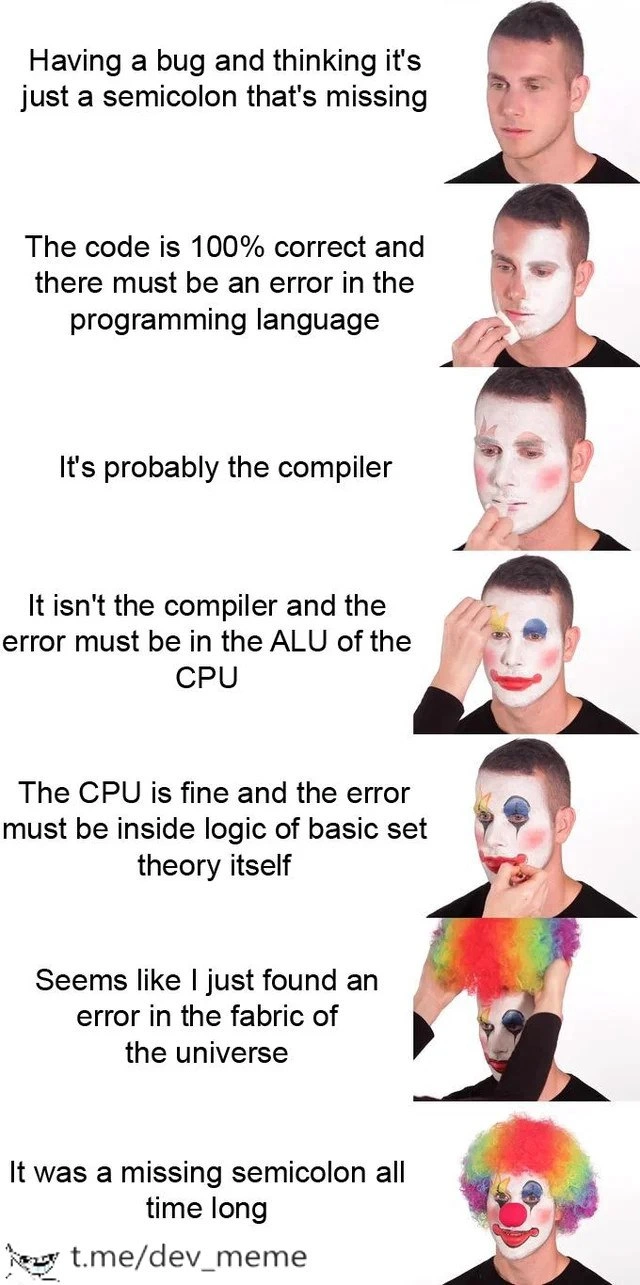
Throughout the meme’s panels, the male figure applying clown makeup visually represents the developer becoming the clown – i.e., realizing he’s been acting foolish. This clown transformation meme format is popular; it’s used to poke fun at any situation where someone’s reasoning or decision-making progressively becomes more ridiculous. In a programmer’s context, it perfectly fits the debugging frustration scenario where you go from sensible to nonsensical explanations.

In summary, this meme is a lighthearted look at troubleshooting gone awry. It teaches a subtle lesson: when debugging, start with the simple possibilities (like syntax errors or misused variables) before you blame the tools, the machine, or reality. And if you ever catch yourself thinking “maybe the compiler is broken” or “maybe physics stopped working,” that’s a good sign to step back, take a break, and review your code from the top. 99% of the time, the bug is something much more ordinary than we initially imagine. As any veteran developer will tell you with a grin, check for the missing semicolon first!

Level 3: Infinite Blame Loop

Every experienced developer can relate to the psychological spiral shown here. The meme portrays the stages of debugging denial with painful accuracy and dark humor. It starts innocently: “Maybe it’s just a missing semicolon.” That’s a common first guess when encountering a bug (especially a syntax error) – and in many cases, it is the correct guess! But when frustration mounts and the obvious fix isn’t found (or is overlooked), denial kicks in. The developer insists “The code is 100% correct, so the programming language itself must have a problem.” This is the classic scapegoating a lot of us do in late-night debugging sessions: “It can’t be my logic, JavaScript must be broken” or “This framework has a bug, not my code.” It’s a mix of arrogance and desperation. Seasoned engineers smirk at this because we’ve all been there – blaming the language or a library is easier on the ego than admitting we screwed up a loop or mis-typed syntax.

As the bug remains unsolved, the dev escalates the blame outward: “It’s probably the compiler.” Now, blaming the compiler (the program that translates high-level code into machine code) is a running joke in programming circles. Compilers are complex, but they’re also battle-tested by millions of programs. A newbie might say “I think I found a compiler bug” and get eye-rolls from seniors, because 99.9% of the time it’s your code that’s wrong, not the compiler. However, that tiny chance that a compiler is at fault keeps hope alive for the frustrated coder grasping at straws. It’s the next step in the blame cascade: if it’s not my code or the language, maybe the toolchain has an error. In reality, compiler bugs do exist, but they’re extremely rare in mainstream languages. When they do happen, they become infamous – think of a scenario where gcc or javac mis-compiles a correct program due to an optimizer bug. But most developers will never encounter a compiler bug in their career. Still, in the dead of night with a baffling bug, it’s emotionally comforting (if illogical) to curse the compiler rather than admit defeat.

Next, the meme’s clown progression goes hardware-level: “It isn’t the compiler and the error must be in the ALU of the CPU.” This is hilariously over-the-top. By now the developer is basically saying, “My code, language, and compiler are flawless, so the computer’s processor must be doing math wrong!” This hints at hardware paranoia – the kind of wild theory you might half-jokingly throw out after hours of failed debugging: “Maybe cosmic rays are flipping bits in my RAM”. It’s the ultimate external blame: something so low-level (the CPU itself) that it’s practically untouchable for a software dev. We laugh because every programmer knows how far-fetched this is. Yes, hardware errors can occur (there have been CPU errata, and indeed cosmic radiation can cause bit flips in memory), but these are exceedingly unusual. If you seriously suspect an ALU bug, you’re either working on a cutting-edge experimental processor design or you’ve truly run out of sane theories. At this point, the developer’s thought process has gone off the rails – and the clown makeup is almost complete in the images, symbolizing that he’s making a fool of himself.

Then comes the penultimate stage: “The CPU is fine and the error must be inside the logic of basic set theory itself.” Here the meme achieves peak absurdity. The developer has effectively said, “I’ve ruled out every practical cause, so maybe math itself is broken. Perhaps I’ve disproved Boolean algebra or found that true is not always true.” It’s a brilliant exaggeration of a debugger’s desperation. In the real world, this would be akin to claiming you found a case where 1 + 1 != 2. By now, anyone watching this scenario from outside knows the developer has lost perspective. This is where an experienced colleague might gently take them aside and say, “Alright, let’s take a breath and double-check the basics.” The humor here also pokes fun at the ego some of us have in the darkest debugging times – the subconscious thought that “If I can’t find the bug, maybe I’m so good I’ve discovered a fundamental flaw in software/hardware/math that nobody else ever noticed.” It’s the programmer’s equivalent of a conspiracy theory, fueled by tired eyes and stubbornness.

Finally, the punchline: “Seems like I just found an error in the fabric of the universe” – complete with a rainbow wig and red clown nose – followed by the abrupt revelation: “It was a missing semicolon all along.” The last panel shows the developer fully transformed into a clown. This is meme-speak for “I was being foolish.” The clown makeup meme format is widely used to show someone progressively turning into a clown as their statements or actions become more ridiculous. Here it signifies the developer realizing how ridiculous it was to blame the cosmos when the root cause was a tiny oversight. The missing semicolon, a simple syntax error, was indeed the culprit the whole time (as that very first hunch suggested!).

This entire progression is a comedic send-up of debugging frustration and the emotional rollercoaster developers ride when a bug just won’t make sense. It highlights a common truth in the Developer Experience (DX): often the bug is trivial, but we complicate our thinking. There’s even a famous principle in troubleshooting: Occam’s Razor – the simplest explanation is usually the correct one. In debugging terms: check for the simple mistakes first (like typos, missing semicolons, off-by-one errors) before assuming something exotic is wrong. The meme’s humor lands because it’s so relatable; every programmer has, at least once, overlooked an obvious error and concocted wild theories, only to facepalm when they finally see the simple fix. It’s a form of shared developer trauma turned into a joke.

Moreover, the meme slyly references how programmers sometimes go through “stages of blame” similar to stages of grief. Initially, denial: “My code is perfect.” Then blame/anger: “Stupid language/compiler/CPU!” Then bargaining: “If it’s the hardware or cosmic rays, I’m off the hook, right?” Finally, acceptance (with shame): “Okay, it was my fault after all.” The clown costume at the end basically screams: we’ve all been clowns like this, blaming everything except our own code. The best of us have written bugs and then swore **“it must be a bug in Python/Java/C++ itself – there’s no way my code is wrong”*. Spoiler: it was our code.

In essence, this meme is developer humor about humility. It reminds us that no matter how complex our systems get – from high-level languages down to silicon and logic gates – the most common bugs are still simple human errors. And nothing feels more absurd (or humbling) than realizing your hours of cosmic-level panic were solved by adding one missing ;. It’s a hilarious cautionary tale: don’t don the clown wig of overthinking; double-check that syntax first!

Level 4: Universe Exception

At the absurd peak of this meme’s escalation, the developer believes they’ve uncovered a flaw in mathematical logic itself – as if set theory or the very laws of the universe have a bug. This is programming humor reaching into theoretical computer science and even physics. In reality, all of computing rests on a foundation of formal mathematics (logic, set theory, binary arithmetic). If a basic principle like set theory had an error, everything from software to scientific proofs could collapse. It’s an almost comically impossible scenario: a bug so deep it breaks math or reality.

In academic history, there actually was a “bug” in naive set theory over a century ago – Russell’s Paradox showed that unrestricted set formation led to a logical contradiction. Mathematicians had to patch the “axioms” (rules) of set theory to resolve it. But once those foundations were fixed (leading to Zermelo-Fraenkel set theory), the rules of logic have been rock-solid. The meme’s developer jumping to "an error in the fabric of the universe" is invoking a cosmic kernel panic – a tongue-in-cheek nod to how impossible it would be for a single coding bug to expose a flaw in the axioms of mathematics or the laws of physics. It’s as if the programmer imagines their little app uncovered a glitch in the Matrix itself.

The mention of the CPU’s ALU (Arithmetic Logic Unit) also touches on deeper tech. The ALU is a digital circuit in processors that performs arithmetic and logic operations – essentially, it does the math for every calculation. Modern CPUs are extensively tested and verified, because an error in something like an addition operation (2 + 2 = 5 due to a hardware bug) would have far-reaching consequences. In fact, a famous real example was the Intel Pentium FDIV bug (1994) where a flaw in the CPU’s division algorithm caused certain division operations to produce wrong results. That was a hardware-level bug, and it was so shocking and rare that it made tech headlines and cost Intel a lot to fix. So when the meme’s clown-faced coder proclaims the error must be in the ALU or “inside the logic of basic set theory,” we’re laughing at how dramatically he overshoots reality. It parodies the idea of a lone developer discovering a fundamental flaw that billions of dollars of R&D and decades of science somehow missed.

Essentially, this level of humor satirizes the imposter syndrome in reverse – instead of thinking “I made a mistake,” the programmer assumes every layer below them (compiler, hardware, math, universe) is wrong. The cosmic panic is funny because it’s so theoretically overblown. For a bug to truly be caused by an error in “the fabric of the universe,” our entire understanding of computer science and physics would have to be wrong. (We’re talking breaking the speed of light or disproving $1+1=2$ level stuff.) It’s a cheeky way of illustrating how debugging frustration can lead to irrational conclusions, albeit in a wildly exaggerated, academic sci-fi sense. And of course, after this trip through theoretical wonderland, the punchline is that nothing was wrong with set theory or reality – the mistake was mundane and human all along.

Description

Vertical eight-panel meme with a male figure whose face is blurred progressively putting on a rainbow clown wig while touching his face in exasperation. Each panel contains black text on white background describing ever-larger scopes of blame when a bug appears: 1) "Having a bug and thinking it's just a semicolon that's missing" 2) "The code is 100% correct and there must be an error in the programming language" 3) "It's probably the compiler" 4) "It isn't the compiler and the error must be in the ALU of the CPU" 5) "The CPU is fine and the error must be inside logic of basic set theory itself" 6) "Seems like I just found an error in the fabric of the universe" 7) final panel text: "It was a missing semicolon all time long", the character now fully dressed as a clown. The meme humorously portrays a developer’s escalation spiral when debugging, moving blame from syntax, to compiler, hardware, mathematics and reality before discovering the trivial missing semicolon - an archetypal syntax error familiar to programmers. Technically it references compilers, CPU ALUs, set theory logic, and illustrates the psychological stages of debugging and over-attribution common in software engineering


Comments

6
Anonymous ★ Top Pick We spent half the sprint writing a TLA+ proof that ZF set theory was sound - CI finally resolved the cosmic bug with one warning: “eslint: missing semicolon.”
  1. Anonymous ★ Top Pick

    We spent half the sprint writing a TLA+ proof that ZF set theory was sound - CI finally resolved the cosmic bug with one warning: “eslint: missing semicolon.”

  2. Anonymous

    The same developer who questions the fundamental axioms of mathematics when debugging will ship code with a hardcoded API key because "we'll fix it in the next sprint."

  3. Anonymous

    Every senior engineer has been here: you've eliminated the impossible - syntax, compiler, CPU architecture, fundamental mathematics - so whatever remains, however improbable, must be... oh wait, it's a missing semicolon. The real bug was the friends we blamed along the way

  4. Anonymous

    Senior debugging arc: language → compiler → ALU → set theory → cosmology - then Prettier adds a semicolon and reality passes CI

  5. Anonymous

    Five Whys took us from compilers to cosmology; the fix was enabling ESLint’s semi rule and -Wall/-Werror in CI

  6. Anonymous

    Senior dev special: Skip to 'universe fabric' blame when the monolith's semicolon hides in 20-year-old diffs

Use J and K for navigation