Programming for work vs unleashing code powers on meme creation
Why is this DevCommunities meme funny?
Level 1: Homework vs Playtime
Imagine you have to do your homework versus when you get to play your favorite game. Doing homework (that’s like programming for work) is something you do because you have to. You’ll do it, but you might just do the minimum – you’re like SpongeBob looking normal and plain, just getting it done. Now think about when you’re finally free to play or do something you really love, like building a cool LEGO project or playing outside with friends. All of a sudden you have tons of energy and enthusiasm – you’re excited, maybe even doing more than anyone asked you to. That’s SpongeBob as a muscle-bound hero (using programming to make a funny meme).
So in simple terms: the left side of the meme is saying “when I code because it’s my job, I’m just okay, nothing special.” The right side is saying “when I code for fun, I become amazingly strong and creative!” It’s the same person with the same skills, but the feeling is different. We’ve all been there: doing a chore versus doing something fun. You’ll always put more heart into the fun thing, right? This meme just shows that idea with a silly cartoon twist. It’s funny because it’s true – when a programmer is having fun (like making a joke or a meme with code), it’s like they turn on their secret superpowers!
Level 2: Work Mode vs Play Mode
Let’s break this meme down in simpler terms. We have two scenarios side by side:
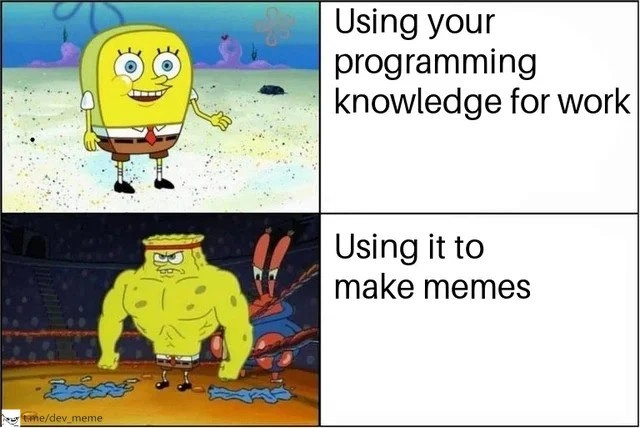
On the left: “Using your programming knowledge for work.” The picture is SpongeBob SquarePants looking normal, just standing and smiling in his usual way. This represents a programmer doing their regular job. It’s like when you’re at work (or in class) and you use your coding skills to do an assignment or a task because you have to. You’ll get it done, but you’re probably not going all-out with it. SpongeBob’s normal appearance here means the effort and intensity are normal too. The developer is coding solutions the straightforward way at work, adhering to whatever guidelines or deadlines they have. It’s competent but nothing superhuman. Think of writing a basic script to generate a report because your boss asked for it – you do it cleanly and call it a day.
On the right: “Using it to make memes.” Now SpongeBob is suddenly absurdly muscular, like a bodybuilder, and he’s in a wrestling ring. This stands for the programmer using their skills on a passion project or a fun experiment – in this case, making memes. The drastic change in SpongeBob’s look means the developer’s effort and enthusiasm have skyrocketed. When it’s about creating a funny meme or automating a playful idea, the programmer becomes the “strong” version of themselves, going much further than they would for a normal work task. They might stay up late, try out new technologies, or write lots of code, not because anyone is paying them, but because they’re genuinely excited about it. The boss (Mr. Krabs in the background) is shocked in the image because it’s like he’s thinking, “Wow, I didn’t know you had this in you!” That’s how surprising it can be to see someone put in crazy effort for something that’s essentially just for fun.
Why is this contrast so familiar in the developer world? It comes down to why you’re coding something. If it’s for work, you have an external reason – you’re getting paid, or you need to close a ticket. That’s what we call an “extrinsic motivation,” meaning the drive comes from outside. Often in those cases, you do a decent job but you might not pour your soul into it, especially if the task is a bit boring. On the other hand, making a meme or a cool demo is usually completely voluntary. You’re doing it because you want to, maybe to make your friends laugh or just to see if you can. That’s an “intrinsic motivation” – the drive comes from inside, from enjoyment or interest. When developers have intrinsic motivation, they tend to invest a lot more energy and creativity. It’s like the difference between doing homework because the teacher said so versus building your own game at home just for fun. The homework you’ll finish because you must; the game you might spend all night adding new features to because you’re excited.
This SpongeBob meme format (normal vs. buff) is a popular way on the internet to show a weak vs. strong comparison. Here “weak” just means ordinary, and “strong” means extraordinary. In our context:
- Ordinary SpongeBob = Developer at work, coding something standard. Maybe they’re just writing straightforward code, using a simple solution, nothing fancy.
- Buff SpongeBob = Developer in personal project mode (meme-making), going all-out. Maybe now they’re writing a complex script to auto-generate memes, hooking together APIs, using image processing libraries – basically flexing their skills.
To make it concrete, imagine these two scenarios:
- Work project: You need to write a script to process some data and save it to a database. You’ll probably use the familiar tools, get it done in the simplest reliable way, and once it works, you’re good.
- Meme project: You decide to code a bot that takes every new message from your team’s chat and responds with a random SpongeBob meme. Nobody asked you to do this; you just thought it would be hilarious. Now you find yourself learning the chat API, using an image library to add custom text on memes, maybe even deploying a little webservice for it. You’re doing way more work than the simple data script, but it doesn’t even feel like work because it’s so fun!
A junior developer might not have all the tools or experience yet, but they can still relate. Maybe in college you had a simple assignment (say, build a calculator app). You did it plainly to meet the requirements. But meanwhile, you spent weekends messing around coding a Minecraft mod or a personal website with cool graphics, far exceeding what any class asked for. This meme is showing that exact phenomenon but in a workplace setting. It’s super relatable humor in the tech world. New developers quickly learn that the programming community (places like Reddit’s r/DeveloperHumor or Twitter among coders) loves these jokes because they ring true. We joke that we’re “lazy” with work but unbelievably innovative with our hobbies. Of course, in reality it’s not about laziness – it’s about passion. When coding feels like play, it’s easy to become the buff SpongeBob, flexing every coding trick you know.
To illustrate, look at a bit of pseudo-code comparing a work task and a meme task:
# Work task: do the simplest thing that meets the requirement
def sort_numbers(numbers):
# Just use Python's built-in sorted function for straightforward sorting
return sorted(numbers)
# Meme task: go the extra mile to create something funny
from PIL import Image, ImageDraw, ImageFont
def caption_image(img_path, text):
img = Image.open(img_path)
draw = ImageDraw.Draw(img)
font = ImageFont.truetype("Impact.ttf", 40) # Impact is the classic meme font
draw.text((10, 10), text, fill="white", font=font)
return img
# Example usage:
sorted_data = sort_numbers([5, 3, 8, 1]) # Work scenario: just sort and you're done
meme_image = caption_image("spongebob.jpg", "Sorting Complete!")
meme_image.save("my_funny_meme.png") # Meme scenario: create a captioned image for laughs
In the code above, sort_numbers is a plain work-like function – it just uses an existing method to sort a list, nothing fancy (the job is done with one line inside the function). That’s like the left side SpongeBob: simple and sufficient. On the other hand, caption_image uses an image library (PIL) to draw text on an image, which is more involved. It’s something you might do for fun to create a custom meme image (putting "Sorting Complete!" on a SpongeBob picture, for instance). That’s the right side SpongeBob: more complex, creative, and going beyond the basics.
So, in summary, this meme is comparing two modes of the same person:
- Work mode: Follow the requirements, get it done, energy level at maybe 5/10 – results are fine but just what’s needed.
- Play/meme mode: Self-driven excitement, energy level 11/10 – results might be over-the-top (maybe an entire mini app just to produce a joke), surprising everyone.
It’s funny and a little comforting to realize other developers feel this way too. It tells junior devs, “Hey, it’s normal that you feel more excited about that game you’re coding at home than the documentation you’re writing at work.” In fact, this split is a well-known part of DeveloperExperience discussions: how to make work projects more engaging so developers bring out their SpongeBob muscle power on the job, not just off hours. But as long as work has some grind and side projects have freedom, we’ll keep seeing normal SpongeBob from 9 to 5 and buff SpongeBob after hours. And that contrast will keep making us laugh in memes like this.
Level 3: Overclocking for Memes
At first glance, this meme taps into a truth seasoned developers know all too well. In the left panel, SpongeBob stands there as his regular, cheerful self. This represents the developer at work: using programming knowledge for everyday job tasks. It's competent and casual — like writing yet another for-loop to handle a common case or slogging through a routine ticket. But in the right panel, SpongeBob has exploded into a hyper-muscular powerhouse, flexing in a wrestling arena. This is the same developer unleashing their full coding superpowers, but only when it's time to make a meme. The humor comes from that jarring transformation: why does our mild-mannered coder suddenly turn into a hulking genius just for a joke?
In developer circles, this contrast is a classic bit of meta-humor. It pokes fun at how we often apply our skills more enthusiastically to fun side projects than to official work. The caption “Using your programming knowledge for work” with normal SpongeBob implies a kind of baseline effort — the dev does what's needed, nothing too crazy. Think of writing a basic CRUD app or resolving a bug in an ancient module: important, but not exactly inspiring cape-flapping heroism. Meanwhile, “Using it to make memes” with buff SpongeBob suggests that the same developer, when it comes to coding something goofy or creative (like a meme generator), suddenly operates at 110% capacity. This is the developer going full 10x, pulling late-night coding sessions to perfect a joke. It’s funny because it’s so true in our DeveloperCulture: we’ve all seen (or been) the engineer who will refactor their code for a passion project ten times in one night, but at work they'll argue against a refactor because “if it ain’t broke, don’t fix it.”
Notice Mr. Krabs in the background of the muscle panel — eyes bulging in astonishment. Mr. Krabs is SpongeBob’s boss in the show, so here he’s like the dev’s manager or colleague, utterly shocked at the ungodly coding prowess being demonstrated. It’s a perfect detail: even the boss didn’t know this mild SpongeBob had anchor arms hidden away. In real life, it’s the manager saying, “Where was this energy during the last sprint?” The meme exaggerates a scenario every senior dev recognizes: when the task is tedious, you do what you must; when the task is fun, you over-deliver like a beast. It highlights a key aspect of motivation and Developer Experience (DX): give a developer a boring Jira ticket and you get one SpongeBob’s worth of effort; give them a chance to geek out on something entertaining, and you get Super SpongeBob output.
This speaks to the disparity between extrinsic motivation (doing something because it’s your job) and intrinsic motivation (doing it because you genuinely enjoy it). At work, your motivation is often extrinsic — you fulfill requirements, you want to avoid bugs, you care about the paycheck and maybe a pat on the back in code review. So you might take the safe, standard approach. That’s SpongeBob just standing there: it’s fine, it gets the job done. But making a meme or a fun little tool taps into intrinsic motivation — you’re coding for your own amusement or creativity. Suddenly you don’t mind experimenting with a new framework, or writing a clever Python script with three new libraries, or optimizing the heck out of an image processing loop to perfectly overlay text on that SpongeBob picture. The developer’s code powers get unleashed. In fact, within online DevCommunities, it’s a running joke how someone will procrastinate on their official project by building an elaborate meme generator. The MemeCulture in tech is strong: we ironically channel more creativity into joking about our work than into the work itself!
Let’s break down the differences in a more structured way, since this meme is essentially a before-and-after of a developer’s mindset:
| Work Programming 🧑💻 | Meme Programming 🤖 |
|---|---|
| Conservative and by-the-book. Solving the problem just enough to meet requirements. Uses tried-and-true methods. | Creative and over-the-top. Pulling out all the tricks and hacks just because you can. May even involve learning a new API or language overnight. |
| Follows strict guidelines (style guides, architecture rules). Often limited to the company’s standard tools and stack. | No rules, just results. Any library, any script, any wild idea goes if it achieves the comedic effect. Python, JavaScript, bash one-liner? All fair game. |
| Goal: Reliability and maintainability. Don’t crash production, keep things readable for the team. | Goal: Maximum hilarity and originality. If that means a messy script that only you understand, so be it (it’s for a meme, not prod!). |
| Motivation: Extrinsic. You code because it’s your job – the feature needs to ship, the bug needs squashing. | Motivation: Intrinsic. You code because it’s fun – nobody is forcing you, you’re doing it for the lulz and personal satisfaction. |
| Outcome: Working code in production that might go unnoticed if it runs smoothly (no one praises a service that quietly does its job). | Outcome: A meme or tool that you proudly share on Slack/reddit. Colleagues react with 😂 🎉. You feel like a genius of comedy. |
In essence, the meme humorously encapsulates how a developer’s effort and ingenuity dial goes from 5 to 11 depending on the context. It’s not that developers lack skill at work — it’s that the spark is different. An experienced engineer reading this meme will likely chuckle and recall times they’ve stayed late at the office, not to finish a feature, but to script a funny bot that posts SpongeBob quotes whenever someone mentions “production”. It’s an ironic twist on DeveloperExperience: the best “DX” is when you’re hacking on something you love. The muscle-bound SpongeBob is a perfect cartoon metaphor for a developer in that state of flow and excitement. And the fact that it’s SpongeBob, a beloved cartoon character often used in MemeCulture, just makes it all the more apt and community-oriented. This meme lives in the same realm as those “programming_for_memes” jokes and DeveloperHumor posts where our community lovingly mocks its own habits. It acknowledges a funny reality: sometimes the code we’re most proud of has zero business value and 100% entertainment value. And somehow, that code often ends up being surprisingly complex or polished – proof that passion can turn even a joke into a masterpiece of code (or at least into buff SpongeBob).
Description
Two-panel SpongeBob meme split vertically. Left column shows visuals, right column contains bold black text on white. Top panel: regular SpongeBob standing smiling on a sandy ocean floor; right text reads “Using your programming knowledge for work.” Bottom panel: hyper-muscular SpongeBob in a wrestling arena with Mr. Krabs shocked in background; right text reads “Using it to make memes.” The joke contrasts the modest, everyday application of software skills at a job with the exaggerated strength developers suddenly display when scripting image generators, auto-captioners, or other code purely for meme production - highlighting how community creativity sometimes eclipses official productivity
Comments
6Comment deleted
Production code? Fine living in a decade-old monolith. Meme generator? Containerized, GPU-accelerated, auto-scaled, with canary deploys - because reputational SLA always outranks financial SLA
After 15 years of optimizing distributed systems and architecting microservices, I've realized my most performant code runs in a single-threaded meme generator that I built in a weekend using deprecated jQuery plugins
The real 10x engineer isn't the one who writes 10x more production code - it's the one who can architect a perfectly scalable meme template with proper separation of concerns between the setup and punchline panels, complete with CI/CD for rapid iteration and A/B testing across multiple subreddits
My meme generator has clean architecture, CI/CD, tracing, and SLOs - because a 300ms latency spike kills the punchline; meanwhile billing still runs as a cron in the monolith
My meme pipeline has typed schemas, CI, tracing and canaries; the revenue monolith still ships via a Friday scp to prod
Work: MVP monolith with silent failures. Memes: Kubernetes-orchestrated, 99.99% SLO pun delivery