Skip to content
DevMeme
3458 of 7435
Old MacDonald Had a Memory Leak
Bugs Post #3792, on Oct 9, 2021 in TG

Old MacDonald Had a Memory Leak

Why is this Bugs meme funny?

Level 1: Too Many Barns

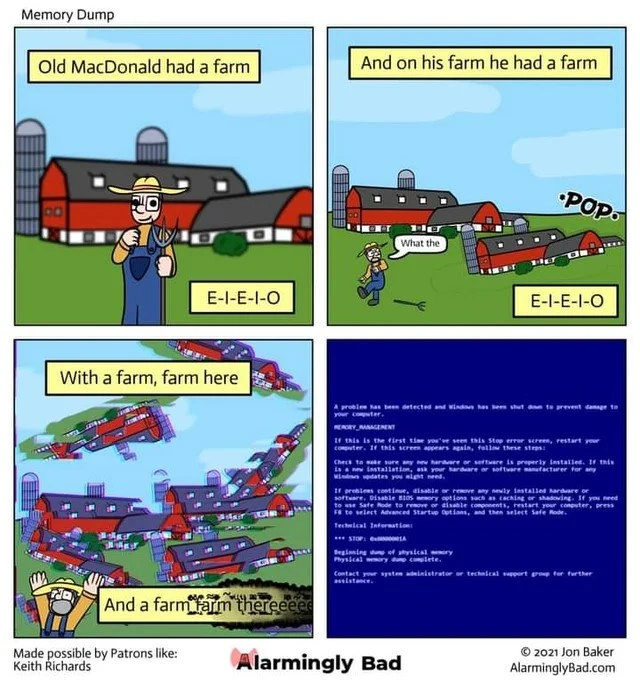
Imagine you’re building with LEGO and you decide to put a tiny LEGO farm inside your LEGO farm, and then another farm inside that, and so on. Pretty soon, you’d run out of LEGO pieces or space in your room because you’re trying to make an endless thing. This meme is joking about that kind of situation but with computers. In the first part, a farmer has a farm (normal and fine). Then he says, “on his farm he had a farm” – which is a silly, impossible idea (a farm inside a farm). Suddenly another farm pops up. If he keeps doing that – a farm on a farm on a farm – you get too many barns everywhere, chaos! In the third panel, the farmer is overwhelmed by barns flying all around because the idea repeated over and over with no stop. It’s like copying something again and again forever; eventually everything gets messy and breaks.

Now, the fourth panel is a big solid blue screen with text – that’s meant to be a computer crash message (often called the Blue Screen of Death on Windows). In simple terms, the computer is saying “I can’t handle this and I give up!” It’s as if the computer got so confused and overloaded by the endless farms that it just threw its hands up and stopped working. This is what happens when a program or app keeps doing something without a stop – like a song that never ends – the poor computer runs out of memory (its working space) and has a sort of nervous breakdown. The blue screen is basically the computer fainting and mumbling “error… error…” because it’s exhausted all its resources.

Why is this funny? Because it’s taking a friendly children’s song and turning it into a geeky joke. Normally, Old MacDonald’s song is about different animals on a farm, and it’s harmless. Here we twist the lyrics: a farm on a farm on a farm – which is absurd, kind of like a mirror reflecting a mirror infinitely. Kids find the idea of infinite farms silly, and programmers laugh because it’s a spot-on cartoon of a common programming mistake (letting something repeat or self-replicate with no limit). The final punchline is the computer’s blue error screen, which is an extreme (and comically exaggerated) result. It’s like telling a joke: “I had one job to do, but I did it so many times that I broke everything!” Even if you don’t know the tech details, you can relate to the idea of doing something so much that things go wrong. So the meme basically says: Old MacDonald got a little too carried away with his farming, and even the computer said “Enough! I’m done!”

Level 2: Barnyard Overload

Let’s break down the joke in simpler terms. This comic uses the song “Old MacDonald Had a Farm” to illustrate a programming mistake. Normally the song has Old MacDonald owning various animals, each verse adding an animal. But here, the verse says “on his farm he had a farm.” That’s a goofy twist – it means the farm contains another farm of its own. In computing, that’s analogous to recursion: when something (like a function or a structure) contains or calls another instance of itself. Recursion isn’t bad in itself (it’s a common technique), but if you do it wrong, it can loop forever. In code, a function that keeps calling itself without a condition to stop is called an infinite recursion. Likewise, a loop that never breaks is an infinite loop. These are classic bugs new programmers often encounter. For example, forgetting to increment a loop counter or forgetting to include a “stop if condition X is met” can make a loop run endlessly. Your program might freeze because it’s stuck in that cycle.

In the comic, when the farmer’s farm spawns another farm (“POP!” goes a new barn in panel 2), that’s like a program creating an object inside itself repeatedly. The farmer saying “What the—” is just like a developer realizing something’s off when their program starts behaving unexpectedly. By panel 3, there are dozens of barns flying around – a visual representation of an out-of-control process. Technically, this is showing an exponential growth of farms: one farm leads to another, which leads to two more, then four, and so on, doubling or multiplying without limit. In a computer, if you accidentally write code that keeps creating new objects or keeps spawning new processes, you’ll quickly use up all the memory your system has. Every object takes up some memory (RAM), so an infinite object creation bug will fill the RAM stick by stick, like a barnyard spreading over all your land. This is often called a memory leak or runaway allocation if the program doesn’t release memory back.

Now, what happens when a program uses up all memory or does something really bad with memory? The operating system (the core software like Windows, macOS, Linux that manages your computer’s resources) will step in. On a good day, the OS will simply stop that program. For instance, the program might crash with an error message, or the OS might kill the process (on Linux you might get a SegmentationFault or an out-of-memory error). But on a bad day – especially with older versions of Windows or with certain types of critical errors – the OS itself can get destabilized. That’s what the Blue Screen of Death in panel 4 represents. The BSOD is a full-screen error in Windows that says the entire system has encountered a fatal error and must restart. It’s called “of Death” because everything just stops – you can’t do anything except reboot. The blue screen usually displays a technical error code (here it’s MEMORY_MANAGEMENT), which indicates something went very wrong with memory handling. It also mentions a physical memory dump – that’s when the computer saves the content of its memory to a file so that programmers can later analyze what caused the crash (this is part of debugging & troubleshooting after a crash).

So essentially, the meme is describing a bug: a farmer’s farm kept replicating, which is like a program that keeps making copies (farms) of a thing with no limit. This overwhelms the system’s memory (imagine filling a cup with water without stopping – it will overflow). The outcome is the computer crashing and showing an error screen. It’s funny to developers because it merges a simple kid’s song with a scenario we dread in coding. It’s also a gentle lesson: if you write a recursive function (“on his farm he had a farm”) make sure to have a condition where it stops, or else boom! – your program might crash. In real life, a junior developer might write something like:

def old_macdonald(farm):
    print("Old MacDonald had a farm")
    return old_macdonald(farm)  # Oops, calling itself forever!

If you run old_macdonald(farm), it will keep calling itself repeatedly (like the never-ending song), eventually causing a stack overflow or some runtime error because it never stops. The comic just takes that idea to the extreme by saying the whole OS had to shut down. It’s a comical exaggeration of what is fundamentally a common software bug.

In summary, panel by panel:

  • Panel 1: Normal state. One farm, everything is fine. (This is like a program starting normally.)
  • Panel 2: The bug is introduced – the farm has a farm on itself. (“What the...?” is the confusion when the code goes wrong.)
  • Panel 3: The bug spirals out of control – many farms appear everywhere. (This depicts the program wildly creating objects or processes, a system overload in action.)
  • Panel 4: System crash – Blue Screen of Death. (The computer couldn’t handle the infinite loop, so it crashed and dumped an error message.)

For a new developer, the lesson/humor here is twofold: Always have an exit condition for your loops and recursion (Old MacDonald should not literally have another Old MacDonald’s farm inside his farm!), and the Blue Screen is a dramatic way a computer tells you “something went really wrong.” It’s the computer’s equivalent of fainting because it ran out of the resources (memory, in this case) needed to keep going. Debugging such issues often involves reading that frightening BSOD message or looking at logs to figure out what part of the code caused the blow-up. It might look scary, but it’s extremely useful information to fix the underlying bug. And next time, you’ll remember to sing the song properly (with animals, not nested farms)!

Level 3: Infinite Barn Loop

For the experienced developer, this meme lands as a clever mix of humor and horror. It’s basically portraying an infinite loop or recursion bug in the form of a children’s song. Old MacDonald’s famous lyric gets a refactor: “and on his farm he had a farm” – that’s a clear indication of a recursive duplication bug. In coding terms, the farmer’s code might look like:

class Farm {
    public Farm subFarm;
    public Farm() {
        // Old MacDonald put a farm inside his farm (uh-oh, recursion!)
        subFarm = new Farm();
    }
}

Farm oldMacDonaldsFarm = new Farm();  // This will trigger infinite recursion and crash

Here, the Farm constructor instantiates another Farm inside itself, and so on… This is analogous to a function that calls itself without an exit condition. Any senior dev reading the second panel (“and on his farm he had a farm”) can immediately foresee the bug: this code will never stop spawning farms! It’s a recursive call with no base case – the recipe for a crash. We’ve all seen what happens next: memory usage blows through the roof as farms keep popping into existence. In the comic, panel 3’s swarm of barns (“with a farm farm here, and a farm farm thereeee”) visualizes that runaway allocation. It’s chaotic and exactly how a program gone rogue feels: objects multiplying uncontrollably in memory, or threads/processes forking repeatedly.

The farmer’s stunned reaction (“What the—”) in panel 2 is every developer’s face when they realize their program is spiraling out of control. Maybe you’ve been there: you run your code and suddenly your CPU fans spin up, your system gets sluggish, and you’re frantically trying to stop the process before everything freezes. It’s that “uh-oh, I think I created a monster” moment. If you miss it, the outcome is what we see in panel 4: a full-system crash. On a Windows machine, an uncontrolled memory-consuming bug can lead to the infamous Blue Screen of Death. The BSOD shown, complete with technical gibberish and a memory dump progress, is a sight etched in the mind of anyone who’s dealt with low-level crashes or flaky drivers. It’s both scary and darkly comic to see it as the punchline of a nursery rhyme. (Talk about blue humor for developers!)

What’s particularly funny (and painful) here is that the meme connects a wholesome farm song to one of the most dreaded experiences in computing. “With a farm here and a farm there” transforms into “here a crash, there a crash, everywhere a crash-crash” from a programmer’s perspective. The lyric that kept escalating (“farm farm here, farm farm there…”) parallels how a small bug can escalate into an exponential problem. This is basically a memory leak or infinite allocation loop illustrated with barns. Each new barn is like another object stuck in memory with no release, and eventually you’ve got a system crash due to out-of-memory. The final BSOD panel explicitly mentions a memory issue, which is exactly what you’d expect if a program hogs all memory or tramples over memory it shouldn’t (in Windows, common bug checks like MEMORY_MANAGEMENT or IRQL_NOT_LESS_OR_EQUAL often tie back to bad memory handling). Seasoned developers will chuckle because it’s a hyperbolic version of real incidents: maybe you wrote a recursive function that never ends or a loop that kept appending to a list, and suddenly your program died or your machine became unresponsive. You might even have had to dig into a memory dump or debug logs to figure out which part of the code went haywire.

The meme also subtly references a fork-bomb-like scenario. A fork bomb is when a process keeps spawning new processes infinitely (like “and on his farm he had a farm, which had a farm, and so on…”). That’s a classic rookie mistake or prank in systems programming – it can bring even a powerful server to its knees. Here the result is the same: too many farms/processes = not enough memory/CPU. It’s the kind of bug that sneaks past unit tests (which might only run a few iterations) but then blows up in production when the loop doesn’t break. The comic captures the shared PTSD of developers who’ve seen a simple oversight turn into an all-hands-on-deck troubleshooting session. It’s funny in retrospect because we’ve learned the lesson: debugging such a crash often involves scouring through a dump file or tracing logs to find that one line of code that went “E-I-E-I-Oh no!”.

In summary, at the senior dev level, this comic is a perfect storm of BugsInSoftware humor. It lampoons the experience of chasing down a catastrophic bug: the innocent beginning (one farm object), the compounding error (farms spawning farms), the system screaming in pain (CPU/memory thrashing, perhaps fans whirring), and the final dramatic failure (a BSOD with an ominous MEMORY_MANAGEMENT code). It’s equal parts hilarious and educational – a reminder that even a friendly old farmer can accidentally write a while-true loop that takes down the whole farm… I mean, computer. Every experienced dev nods at this with a grin, thinking “Yep, been there, done that (and wrote the post-mortem).”

Level 4: Farms All The Way Down

At the most advanced level, this comic is poking fun at the perils of unbounded recursion and how it can wreak havoc on an operating system’s memory management. The scenario “Old MacDonald had a farm, and on his farm he had a farm…” is essentially a recursive definition with no terminating condition – a function that calls itself forever. In theoretical computer science terms, it’s like a non-halting program or a self-referential data structure of infinite depth. Without a base case, each recursive call spawns another, ad infinitum, leading to runaway resource consumption. This is a playful nod to the classic “turtles all the way down” paradox – here it’s farms all the way down, an infinite regress.

From a systems perspective, such infinite object creation quickly exhausts memory. Every new “farm” would consume memory on the heap, or if this were a recursive function, add a new frame to the call stack. Eventually, you hit a stack overflow or run out of heap memory. In a managed runtime (like Java or C#), you might get an OutOfMemoryError or stack overflow exception. In lower-level contexts (C/C++ or, say, a kernel module), you risk corrupting memory or blowing past limits, which can trigger a serious crash. The final panel showing the Windows Blue Screen of Death (BSOD) with a MEMORY_MANAGEMENT error code (often associated with STOP 0x1A) is the system’s way of saying an irrecoverable memory fault occurred. This typically happens when the operating system itself encounters a memory error it cannot handle – for example, a wild pointer or an allocation failure in kernel space. It’s the Windows equivalent of a Unix kernel panic, complete with a physical memory dump to disk for post-mortem debugging. The meme escalates the bug to OS-level failure for dramatic (and comedic) effect, implying the recursive farm not only crashed the program but took the whole system down.

This infinite farm replication is humorously akin to a fork bomb – a notorious denial-of-service pattern where a process continually replicates (forks) itself. A fork bomb (e.g., the classic :(){ :|:& };: bash fork bomb) overwhelms a system by spawning processes exponentially, much like the barns multiplying chaotically in panel 3. In both cases, you’re seeing an exponential growth in resource usage. The OS tries to allocate more and more memory and process table entries until it can’t anymore. On modern operating systems, there are usually safeguards (like Linux’s OOM killer that will start terminating processes once memory is critically low). But if those safeguards fail or the explosion happens in kernel context, the result is a hard crash. The BSOD here is essentially the OS saying "E-I-E-I-Oops!" and halting to prevent further damage, dumping memory contents so a developer can later debug which bug caused the meltdown.

It’s worth noting a fun coincidence for the ultra-nerds: the lyric “E-I-E-I-O” in the song ironically corresponds to an actual computer instruction on IBM PowerPC architecture—EIEIO (which stands for Enforce In-Order Execution of I/O). That’s a memory barrier instruction to prevent out-of-order memory access. In a sense, EIEIO is meant to prevent memory chaos in hardware, whereas Old MacDonald’s unbounded farm causes software memory chaos. A seasoned engineer might smirk at this unintended crossover between nursery rhyme and computer architecture. The meme blends these worlds, illustrating in a tongue-in-cheek way how a seemingly innocent self-referential loop (a farm inside a farm) leads straight into the arms of a dreaded memory dump – a scenario equal parts absurd and technically insightful. Developers with experience in Operating Systems internals or debugging memory leaks will recognize that familiar sinking feeling: when your program’s unchecked recursion or object spawning doesn’t just throw a small error but brings down the whole machine in a cascade of error messages. It’s a dramatic demonstration of how bugs in software can escalate from a silly logic mistake to a full-blown system crash if memory management goes haywire.

Description

A four-panel comic strip by 'Alarmingly Bad' titled 'Memory Dump' that visualizes a software memory error using the nursery rhyme 'Old MacDonald Had a Farm.' In the first panel, Old MacDonald is on his single farm. In the second, the farm unexpectedly duplicates itself. By the third panel, the farms are multiplying exponentially, creating a glitchy, overlapping visual mess, as the song lyrics become 'With a farm, farm here And a farm farm thereeee'. The final panel is a classic blue screen of death (BSOD) from an older version of Windows, indicating a fatal 'MEMORY_MANAGEMENT' error and showing the message 'Beginning dump of physical memory.' The comic cleverly illustrates the concept of a memory leak or a runaway recursive function, where resources are allocated uncontrollably until the system crashes, a scenario deeply familiar to developers who work with low-level memory management
Comments

10
Anonymous ★ Top Pick The farm's constructor probably had a `new Farm()` in it. Classic rookie mistake. Now he's got to analyze that memory dump to figure out where the first stray pointer was
  1. Anonymous ★ Top Pick

    The farm's constructor probably had a `new Farm()` in it. Classic rookie mistake. Now he's got to analyze that memory dump to figure out where the first stray pointer was

  2. Anonymous

    E-I-E-I-OOM: that moment your Terraform ‘farm’ module references itself and the cloud starts fork-bombing barns until finance gets a BSOD-shaped invoice

  3. Anonymous

    After 20 years in the industry, I've learned that the only thing more terrifying than explaining recursion to a junior dev is explaining to the CTO why production went down because someone forgot a base case in the farm management microservice

  4. Anonymous

    This is what happens when you implement Old MacDonald's farm using a linked list where each farm node contains a pointer to another farm, but forget the base case. Classic example of why we tell juniors 'every recursion needs an exit condition' - though at this point, the only exit is Ctrl+Alt+Delete. The BSOD is just the OS's way of saying 'I'm not dealing with your infinite farm instantiation anymore.' Remember: recursion without bounds is just stack overflow with extra steps, and apparently, extra livestock

  5. Anonymous

    PAGE_FAULT_IN_NONPAGED_AREA: Windows' genteel reminder that your kernel driver just tried strolling into Narnia

  6. Anonymous

    Self-referential composite plus naive deep copy in the render loop = E‑I‑E‑I‑OOM; Windows throws MEMORY_MANAGEMENT before the PM asks about horizontal scaling

  7. Anonymous

    Old MacDonald modeled Farm hasMany Farm; the serializer walked the graph, Windows hit MEMORY_MANAGEMENT, and the chorus went E-I-E-I-OOM

  8. @kandiesky 4y

    Computers trying to sing when an ionizing particle passes through the CPU flipping one bit and transforming 1 farm into 4097

    1. @QutePoet 4y

      Please use an old computer from your pantry and make a musical video. Try to make it sing Mary had a little lamb.

  9. @LanaRC 4y

    That’s the best meme I saw on this channel. Thank you

Use J and K for navigation