Veteran Java dev blindsided by modern switch syntax in interview gauntlet
Why is this Interviews meme funny?
Level 1: Not a Quick Trip
Imagine you go with your dad to what he says will be a quick trip to the store – “in and out in 5 minutes,” he promises. You walk in confident because you know this store inside out. But when you get there, you find out the store completely rearranged all the aisles! Suddenly, nothing is where you expected. You’re running around confused looking for milk in the candy aisle, and your dad is smacking his forehead because this easy errand just got complicated.
That’s basically what’s happening in this meme. The experienced programmer thought the coding task would be simple and familiar (a quick 20-minute adventure). But then he discovers the “rules of the game” have changed – the coding language has a new twist he’s never seen. His reaction, “Oh god! They can do that now?!”, is just how you’d react if your store trip went sideways: “Wait, they moved everything around?!” It’s funny because we totally understand that feeling. No matter how much you think you know something, a surprise change can turn a quick trip into a chaotic adventure, catching you off guard in a comical way.
Level 2: Bait and Switch
Let’s break down the meme and the tech references in a straightforward way. The two image frames use characters from the cartoon Rick and Morty to dramatize an interview scenario:
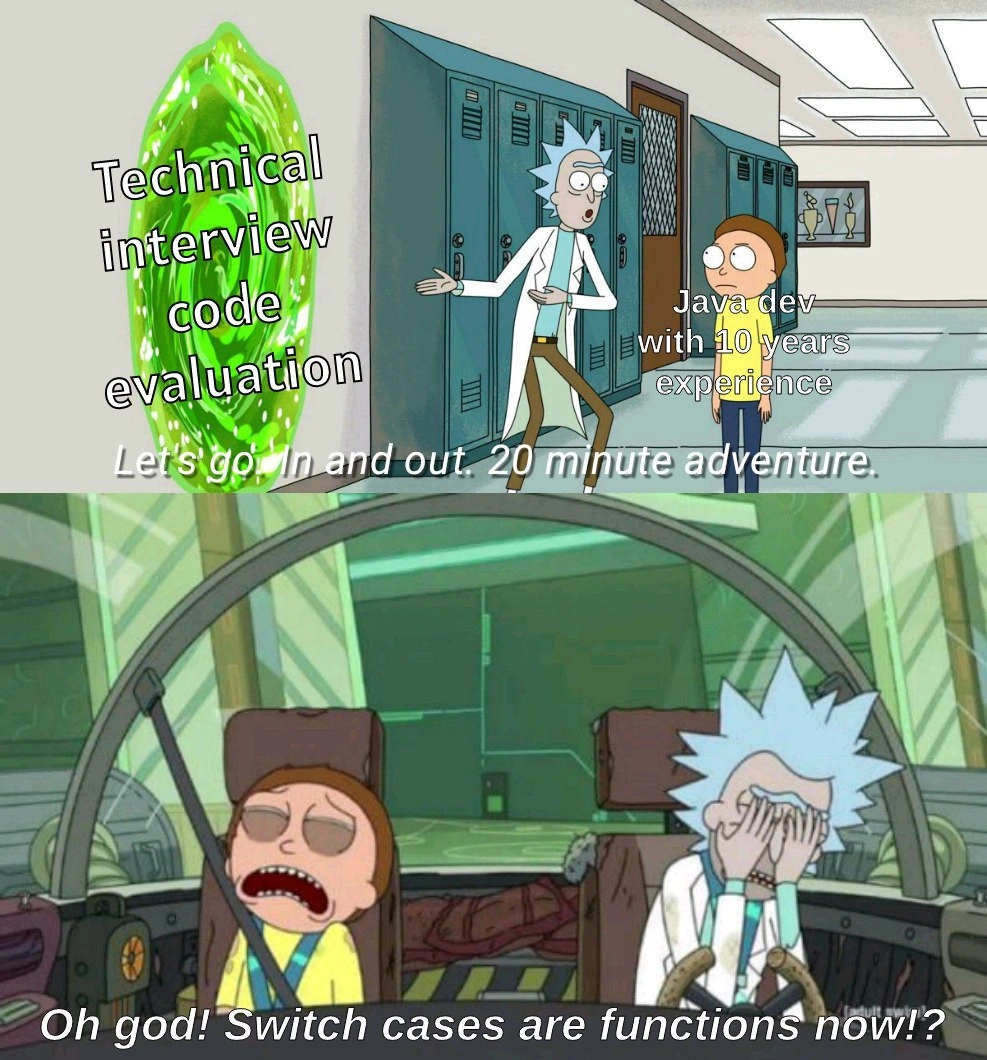
In the first frame, the scientist Rick opens a glowing green portal labeled “Technical interview code evaluation.” He’s beckoning Morty (the small nervous guy) to jump in. Morty is tagged as a “Java dev with 10 years experience.” Rick confidently says, “Let’s go. In and out. 20 minute adventure.” This represents an interviewer (or the situation itself) telling an experienced Java programmer that the coding test will be quick and easy. It’s the expectation set: this shouldn’t take long for you, right?
In the second frame (inside Rick’s spaceship), Morty is screaming in panic and Rick is covering his face. The caption says, “Oh god! Switch cases are functions now!?” Here Morty (the Java developer) has realized the reality: the coding exercise wasn’t so simple after all. He encountered something unexpected in Java code that completely threw him off. Rick facepalming is like the interviewer or anyone watching thinking, “Yikes, this went south fast.”
Now, what does “Switch cases are functions now” mean? This is about a new Java language feature. In programming, a switch statement is a way to run different code based on the value of a variable. You list various cases and what to do for each case. For example, in older Java (and many languages), it looks like this:
// Older style switch (Java 8 and earlier)
String day = "Monday";
int result;
switch (day) {
case "Monday":
result = 1;
break;
case "Tuesday":
result = 2;
break;
default:
result = 0;
break;
}
System.out.println("Result is " + result); // Would print "Result is 1" for Monday
In this classic switch, each case "Monday": or case "Tuesday": is followed by some code (here assigning a number to result), and we manually write break; to prevent fall-through (accidentally running into the next case). It’s a bit verbose and error-prone (forgetting a break can cause bugs).
Now, modern Java (Java 14+ as of a couple years ago) introduced switch expressions. These allow the switch to directly return a value, using an arrow syntax -> for each case. It makes the switch behave more like a function that gives you an output. Here’s the same logic with the new style:
// New switch expression (Java 14+)
String day = "Monday";
int result = switch (day) {
case "Monday" -> 1;
case "Tuesday" -> 2;
default -> 0;
};
System.out.println("Result is " + result); // Prints "Result is 1" for Monday
See the differences? We can assign the result of the whole switch directly to a variable. Each case uses -> to indicate what value to produce. We don’t need break statements anymore, because each arrow case automatically stops after returning a value. In a way, each case is acting like a little lambda function (an inline function) that takes the input (day) and yields an output. The entire switch is an expression that evaluates to something (in our example, an int). This new feature is part of Java’s language evolution to make code cleaner and less error-prone.
For a developer who has been using Java for 10 years, this is a big change! Ten years ago (around Java 7 or 8), such syntax didn’t exist. If that dev hasn’t specifically used Java’s latest versions, seeing case "Monday" -> 1 in an interview coding problem would be really confusing at first glance. It’s as if the rules of a familiar game suddenly changed. That’s why Morty is basically yelling, “Wait, switch cases behave like functions now? Since when!?” in shock.
The meme is using humor to highlight how even a senior programmer can be caught off guard by new language features during a technical interview. The term “bait and switch” fits perfectly: the interview task seemed routine (the bait of an easy 20-minute adventure), but then the switch (pun intended!) to a new Java syntax trick makes it a much harder challenge. It’s a relatable scenario for many developers—staying up-to-date with language changes can be tough, and an interview might be the first time you encounter a new feature under pressure. In short, the meme is saying: even a veteran Java dev can feel like Morty when the code they face includes shiny new syntax they haven’t seen before.
Level 3: The Great Switcheroo
This meme perfectly captures a clash between interview expectations vs. reality for a seasoned developer. The top panel shows Rick opening a glowing green portal labeled “Technical interview code evaluation” and telling Morty (our Java dev with 10 years experience):
“Let’s go. In and out. 20 minute adventure.”
Rick (representing the interview or interviewer) confidently promises a quick, easy challenge.
Morty, embodying the veteran engineer, steps in expecting a straightforward coding exercise. After all, with a decade of Java under his belt, a little TechnicalInterviewProcess shouldn’t be a big deal, right? This is the classic setup: the Senior Engineer assumes their past experience will make the task a breeze. It’s a lighthearted jab at how experienced devs might underestimate a modern coding test. In the context of Interviews, Rick’s casual “20 minute adventure” line is horribly relatable — many candidates go in thinking “I’ve seen it all”.
But then comes the punchline in the bottom frame. Inside Rick’s spaceship, we see Morty slumped, freaking out, and Rick facepalming in despair. The caption reveals the cause of their distress:
“Oh god! Switch cases are functions now!?”
Morty’s horrified realization when encountering a new Java feature he didn’t know.
Here’s the switcheroo: the experienced dev expected familiar territory, but the interview threw a curveball — a Java language feature so new that it looks alien. The phrase “Switch cases are functions now?!” refers to Java’s recent language evolution where switch statements can be written as expressions with lambda-like syntax. The senior engineer is blindsided that something as fundamental as a switch works differently than it did for most of his career. The humor comes from that “Oh god!” moment of shock. Every developer who’s been comfortable with an older version of a language can empathize: it’s like discovering the rules changed when you weren’t looking.
This frame resonates as relatable humor in the developer community. It highlights a real SeniorEngineerStruggle: keeping up with new LanguageFeatures. Java doesn’t change often, but when it does (hello, java_switch_expressions!), it can leave even veterans momentarily feeling like newbies. The interview setting cranks up the anxiety – imagine being in a high-pressure evaluation and suddenly seeing syntax that makes you think “Wait, since when could we do THAT?”. It’s a nightmare scenario played for laughs. The Rick and Morty template underscores how absurd it feels: Morty (the candidate) is panicking as if the simple adventure turned into a monster-filled ordeal. Meanwhile Rick (either the interviewer or the voice in the dev’s head) is facepalming because what was supposed to be easy is now a trainwreck.
In reality, this kind of situation happens when companies upgrade their questions to include modern best practices. Interviewers might expect knowledge of the latest Java tricks (like switch expressions, streams, Optional, etc.) to see if a candidate is up-to-date. The veteran developer who hasn’t encountered these yet experiences a comedic role reversal: the senior becomes the confused student. It’s a “bait-and-switch” in both the figurative and literal sense – the interview promised a quick task but swapped in a surprise new syntax. And given the meme’s pop-culture overlay, it humorously suggests that even a portal-hopping genius like Rick can’t save Morty from the shock of unexpected LanguageEvolution mid-interview.
Level 4: Functional Switchcraft
In the depths of programming language design, Java’s new switch expressions represent a fundamental shift from the old sequential statement world toward a more expression-oriented paradigm. Historically, in Java (and its ancestor C), a switch was purely a control flow statement – it executed code blocks with case labels and didn’t directly produce a value. But modern Java’s switch has been upgraded to an expression, meaning a switch can now return a value just like a function. This evolution reflects Java inching closer to functional programming concepts. In functional languages (like Haskell or Scala), pattern matching constructs (similar to switch) are expressions that yield values, grounded in lambda calculus principles. Java’s designers have effectively performed some language sorcery here – turning an old imperative construct into a more declarative, result-oriented form. Each case in a switch expression can be seen as a tiny mapping function: you input a value, and it returns a result. The meme’s shocked question “Switch cases are functions now?!” is a bit hyperbolic, but it’s capturing this exact idea: that cases act a lot like lambda bodies producing outputs.
Under the hood, this change required tweaks to Java’s grammar and compiler (OpenJDK’s Project Amber spearheaded these feature previews). For instance, Java added a new keyword yield to allow multi-statement cases to return a value. The compiler now enforces exhaustiveness for switch expressions – much like mathematical functions, a switch expression must account for all possible inputs (so it won’t compile if there’s a missing default and not all cases covered). This is something functional programming enthusiasts will recognize from pattern matching in languages like OCaml or Rust, where the compiler ensures every case is handled. It’s a big conceptual change: the once procedural switch now behaves more like a first-class expression. The benefit is fewer bugs (no more accidental fall-through by forgetting a break!) and more concise code that reads like a formula. But for a veteran who hasn’t followed these academic underpinnings, seeing a switch spit out a value with arrow syntax can indeed feel like encountering witchcraft in their trusty old language – or as we pun it here, switchcraft. The meme humorously underscores that what seems like a trivial interview exercise can hide deep language evolution rooted in decades of computing theory and design decisions.
Description
Meme uses two Rick-and-Morty cartoon frames. Top frame: in a school hallway, Rick gestures toward a glowing green portal labeled "Technical interview code evaluation" while Morty, labeled "Java dev with 10 years experience," looks on. Subtitle text across the bottom reads, “Let’s go. In and out. 20 minute adventure.” Bottom frame: inside Rick’s spaceship cockpit, Morty slumps (face blurred) and Rick covers his eyes in anguish; subtitle reads, “Oh god! Switch cases are functions now!?”. The joke highlights a senior Java engineer expecting a quick coding exercise but being stunned by newer Java switch-expression features that treat cases as lambda-like functions, underscoring how fast language features and interview expectations evolve
Comments
11Comment deleted
“Interview asked me to turn a switch-statement into a ‘switch-expression with pattern-matching and sealed hierarchy deconstruction’. Cool - didn’t realize I’d signed up to write Kotlin in disguise while the compiler still calls itself javac.”
Ten years of shipping enterprise Java, but the interviewer wants you to live-code pattern matching with sealed classes while explaining the JVM memory model changes since Valhalla - all while they're secretly just checking if you remembered to handle the null case
After a decade of Java development, you've seen every anti-pattern in production. But technical interviews? That's where you discover someone's refactored switch statements into a factory pattern that returns lambdas wrapping strategy objects - and they want you to explain why it's 'cleaner.' The real test isn't solving the problem; it's keeping a straight face when the interviewer calls this 'industry best practices.'
That “20-minute code eval” turns into a JEP speedrun when they expect a switch expression with pattern matching and yield; your Java 8 muscle memory keeps typing break
Nothing humbles 10 years of Java faster than a code test where switch is an expression, yield is a keyword, and your muscle memory still types break;
10 years Java exp: expert at semicolons, rookie at release notes past 2014
I see Oracle just gave up and keeps adding features from Kotlin Comment deleted
What the hell? Comment deleted
is this true? is each case a function? why?.. at first glance, the "switch" in java looks the same as in all other languages Comment deleted
It's an option called "switch expression". Comment deleted
wow, that's very convenient. an improved version of the ternary operator Comment deleted