Demanding Features: Corporate vs. Open Source
Why is this OpenSource meme funny?
Level 1: Be Nice, It’s Free
Imagine you have two situations where you need to ask for help with something you use:
Situation A: You bought a toy from a big toy store, and one of its wheels fell off. You go to the store’s help desk to ask for a fix or a new toy. How would you ask? Probably very politely, right? Maybe something like, “Excuse me, I really like this toy, but a wheel came off. Could you please help me fix it or maybe replace it? Thank you so much!” You use a kind voice, you say please and thank you, because you know the store is doing you a favor by helping, and it’s just the nice way to talk to people. You might also feel a little shy or formal because it’s a big company, and you’re just one customer.
Situation B: Your friend, who is really good at woodworking, gave you a free handmade toy car as a gift. It’s awesome that they made it for you without you even paying! But after playing with it, you notice the wheel on this one fell off too. Now, how do you ask your friend to fix it? You should ask just as nicely, if not more nicely, because your friend did something kind for you. But imagine someone did the opposite: they snatch the toy, march up to their friend, and shout, “Hey! The wheel is off! You need to fix this right now!” and maybe even wave the broken toy in their face like it’s their fault. That would be really rude and ungrateful, wouldn’t it? The friend might feel hurt or angry, because, after all, they made that toy out of kindness.
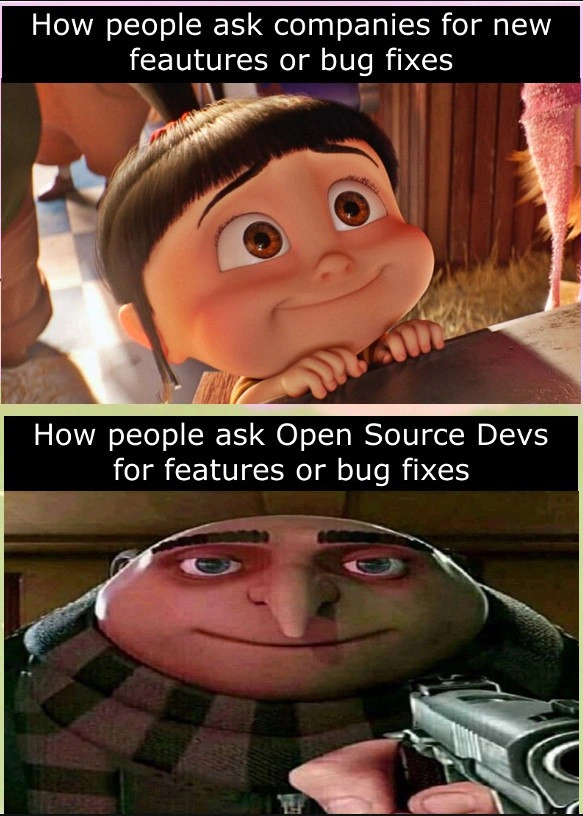
This meme is basically saying some people are behaving like the second situation when they should behave like the first. In the pictures, the top shows a sweet little girl (that’s Agnes from a cartoon) with big puppy-dog eyes asking ever-so nicely — this is like asking the big company for help. In the bottom picture, there’s a grouchy man with a gun (that’s Gru, a character from the same cartoon, pointing a weapon) looking very threatening — this represents how some people rudely demand things from generous folks who made something free for them. Of course, in real life, nobody is actually pulling out a gun; it’s an exaggeration to show the attitude. It’s like saying the person asking is acting as if they’re threatening the other person, which is a very mean way to ask for a favor.
The funny (and sad) part is it’s the wrong way around: you’d think we should be extra polite to someone who’s helping us for free (like the friend who made the toy car), and maybe a bit more direct with a company since we paid for the product. But some people do the opposite! They are super polite to the company (where they might be a paying customer) and then super rude to the volunteer or friend (who isn’t getting paid at all). That’s not fair or nice.
So the simple lesson from this meme is: be kind and respectful, especially to people who are doing you a favor or providing something for free. If you wouldn’t shout at a store clerk for a fix, you definitely shouldn’t shout at a kind friend or a helpful stranger. In the world of software, a lot of the tools and apps we use are like that free toy – they’re made by people in their free time and shared with everyone. We should remember there are real people behind those free things. Saying “please” and “thank you” and asking nicely isn’t just good manners – it actually makes it more likely those people will want to help you. After all, wouldn’t you rather fix your friend’s toy if they asked nicely, instead of if they yelled at you? The meme uses a bit of humor with the cute kid and angry Gru to remind us: Politeness matters, especially when things are free. Be the polite kid, not the guy with the gun, and everyone will be happier!
Level 2: Feature Request Etiquette
This meme highlights how people communicate very differently when asking for software changes, depending on whether they’re dealing with a big company or an Open Source developer. Let’s break down what’s happening and some key terms:
Open Source: This means the software’s source code is openly available for anyone to view, use, or contribute to. An Open Source dev (developer) is someone who builds or maintains such software, often just out of passion or duty, not because they’re getting paid by the end-users. For example, think of Linux, or a free library you found on GitHub — that’s open source software. These projects rely on community support and OpenSourceContribution (people submitting improvements or fixes). An open_source_vs_enterprise comparison is basically looking at how open community projects differ from big enterprise (company) projects.
Feature request: This is when a user asks for a new ability or improvement in the software. Like saying, “I wish this app could also send me daily reminders.” That suggestion is a feature request. Bug fix: That’s when something is broken or not working as intended and you ask for it to be corrected. For instance, “The save button doesn’t work, can you fix this bug?” Both are common things users ask from software creators.
Etiquette: This means the polite and proper way of doing something. So feature request etiquette refers to how you should ask for a feature or fix. Generally, good etiquette means being respectful, patient, and appreciative in your request.
Now, in the top panel of the meme, we have a little girl (Agnes from Despicable Me) with big, pleading eyes leaning on a counter. The caption says, “How people ask companies for new features or bug fixes.” This represents a user being very polite and sweet when asking a company for something. Imagine writing to a huge tech company (like Apple, Google, or Microsoft) about their product: you’d probably use a courteous tone. For example, “Hello, I really love your software. I have a small suggestion if you don’t mind...” You ask nicely because, well, it’s a big company, and you might be one customer among millions. Also, you might feel it’s proper to be formal and kind when you’re asking a professional service for help. The meme even shows that polished look by using a wholesome image – Agnes looks like an angel asking for a favor.
In the bottom panel, we see Gru (a character who is an adult and a former super-villain in the movie) staring straight ahead and pointing a handgun toward us. The caption here says, “How people ask Open Source Devs for features or bug fixes.” This is a stark contrast! Here, it’s like the user transforms into an aggressive, demanding person when dealing with an open source developer. The gun symbolizes a threat or intense pressure. It’s as if the user is saying, “I want this now, or else!” There’s no “please” or “thank you” anymore. Gru’s menacing expression and weapon exaggerate just how hostile and entitled these requests can feel to the developer on the receiving end.
So why would someone be polite to a company but rude to an open source maintainer? It seems completely backwards, right? Here are a few reasons that juniors and everyone should understand:
Perceived relationship: When dealing with a company, users often feel they are in a formal customer role. Even if you’re not a paying customer, you treat it like a business transaction. There’s an implicit understanding that the company doesn’t have to listen to you unless you ask nicely (and even then, maybe not). In contrast, with an open source project, some users misinterpret the casual, community-driven environment. They might think, “This dev is just another person on the internet, I can talk to them however I want.” They forget that the open source dev is under no obligation to fulfill their request. There’s no contract or purchase – the software was typically given out for free.
User entitlement: This term means a user feels entitled – as if they deserve something just because they want it. In open source, entitlement might look like this: “I downloaded your free library, and it doesn’t do X. That’s a basic feature! You must add this or fix this bug for me!” The user acts like the developer owes them, even though they haven’t paid a cent and the dev shared the tool out of generosity. It’s unfortunately common to see people forgetting their manners when interacting on anonymous online platforms. If you’ve ever seen heated comments on the internet, you know people can be ruder from behind a keyboard than face-to-face.
Corporate support vs. community support: Companies often have dedicated support teams. You might file a support ticket or send an email, and a representative addresses it. Those reps are trained to be polite to you, and you likely remain polite in return (that’s normal customer service courtesy). With open source, you usually communicate directly with the maintainer or the development team on something like an issue tracker (for example, the GitHub Issues page of the project). That direct line can feel informal. If a user is frustrated (say a bug is impacting their work), they might skip the polite phrasing and jump into “This needs to be fixed now!” because they’re effectively talking straight to the developers, not a customer service filter. But being informal shouldn’t mean being impolite — it just sometimes ends up that way if the person is upset or doesn’t realize the impact of their tone.
Role of contributions: In an ideal open source community, if you want a new feature or find a bug, you can also contribute — meaning you help out by maybe writing some code or at least doing research to assist the maintainer. Many open source project maintainers really appreciate when users say, “I have an idea. I’m willing to help or test it,” instead of just demanding, “You fix this.” Some maintainers, when faced with a rude demand, respond with the phrase
PRs welcome. A PR, or Pull Request, is a way of submitting your code changes to the project. So if someone says “PRs welcome,” it’s a semi-polite way of saying, “Feel free to do it yourself if you need it so badly.” It’s kind of the maintainer reminding the user, “This is a do-it-together community, not a company with a contract.”
Let’s connect this to a scenario a junior dev might encounter: Suppose you’re using a free, open-source UI library for a school project, and you find a glitch. You have two ways to handle it. Option A: Treat it like you would with a commercial product – you’d go to their issues page and write something like, “Hello, first I want to thank you for this amazing library. It’s been really helpful. I noticed a small bug: when I click the save button twice, it crashes. Is this a known issue? I’d be grateful if it could be fixed. Let me know if I can provide more info. Thanks!” That’s courteous and acknowledges the maintainer’s work. Option B (the Gru approach): You open an issue and type, “Your save button is broken! This is wasting my time. Fix it ASAP!” and maybe you don’t even say hello or thanks. Option B might happen when someone is frustrated, but it’s definitely not good etiquette — it’s likely to upset the maintainer or make them less inclined to help quickly. After all, open source maintainers are humans, not vending machines for free code.
The meme’s message is basically a reminder (delivered humorously) that we should be consistent and respectful in how we ask for help or improvements. If anything, we should be more polite and patient with open source developers, because they’re essentially volunteers. A big corporation might have paid teams whose job is to handle your requests (and even then you should be polite), but an open source dev might be doing it during their evenings with no compensation. Yet, as the meme shows, people often do the opposite – they’re on their best behavior for the company, then turn around and act pushy to the volunteer. That mismatch is what we call the feature request double standard (two different standards of behavior in two situations that really should be treated the same).
One more detail to notice: The presence of the gun in Gru’s hand is an exaggeration (nobody is literally pulling a gun on developers in real life!). It’s a visual hyperbole to communicate how threatening or hostile the tone can feel. Being on the receiving end of an angry all-caps issue or an ultimatum like “fix this or else” can feel almost like being threatened, even if it’s just words on a screen. Maintainers sometimes joke that certain user comments feel like a gun to the head — “merge my PR or I’ll make your life miserable.” Of course, not all users are like this, and many open source communities are filled with polite, grateful people. But it only takes a few intense demands to sour a maintainer’s day.
For a junior developer or someone new to open source, the takeaway from this meme is educational: communication matters. The way you ask for something can determine how you’re answered. If you ever engage with an open source project, remember that behind that code is a person or a team who doesn’t have to do anything for you. Adopting the polite Agnes approach (“Could you please...”, “thank you for your time”) is not just about being nice – it’s actually more effective. You’re far more likely to get help or a positive response. On the flip side, if you go in with a Gru attitude (“I demand you do this”), you might get ignored, or even gently scolded, or the issue might be closed without resolution because no one wants to deal with that negativity. In open source communities, being respectful and showing appreciation is often considered part of good OpenSourceContribution ethos. It’s almost as valuable as contributing code because it keeps maintainers motivated and fosters a friendly environment.
In summary, this meme is a funny reminder not to have that user entitlement mindset. Whether you’re dealing with a paid product or a free one, it pays to be courteous. The meme uses humor (a cute kid vs. a grumpy villain with a gun) to make that point loud and clear. If you understand this as a new developer, you’ll likely build much better relationships in the dev community and maybe even get your bugs fixed faster – because you asked in the right way!
Level 3: Politeness 404
At first glance, this meme hits experienced developers with a painfully familiar open_source_vs_enterprise truth. We see two extremes of feature request etiquette: one sugary-sweet, the other shockingly hostile. The top panel features Agnes (the adorable child from Despicable Me) with huge pleading eyes — a picture-perfect embodiment of the polite, deferential tone users adopt when asking corporations for new features or bug fixes. In stark contrast, the bottom panel has Gru (the movie’s villain-turned-dad) glaring and pointing a gun directly at us, personifying the aggressive demands often thrown at Open Source maintainers. The humor emerges from this absurd double standard: the same user behaves like a saint towards paid vendors but turns into a menace when dealing with unpaid OSS devs.
This contrast reflects a widely recognized pattern in the developer community — a kind of Jekyll-and-Hyde transformation tied to who’s getting the request. The “polite to corporations, hostile to OSS devs” theme resonates as developer humor precisely because it’s so true-to-life. Many of us have watched issue trackers where a user says, “Dear BigCorp, your product is fantastic! If it’s not too much trouble, could you please consider adding this feature? Thanks for all you do!” Then the same person might storm into a GitHub issue for a free library with, “This is unacceptable. Your library is broken — fix this NOW or I’m dropping it!” The meme exaggerates it with Agnes’s over-the-top cuteness and Gru’s cartoon menace, but it’s barely an exaggeration. We’ve seen real bug reports that feel just like a gun pointed at the maintainer’s head.
Why does this comedic setup land so well with veteran devs? Because it captures the oss_maintainer_burden in one glance. Open source maintainers (often just one or two people working nights or weekends) frequently endure an onslaught of entitled demands. Meanwhile, corporate support teams – backed by salaries and support contracts – get showered with “pretty please” and “thank you.” It’s a reversal of what you’d expect: paying customers tend to be nicer, and free-loaders can be the most demanding. A seasoned engineer can’t help but smirk (or cringe) at how familiar this is. We’ve been on those midnight ops calls or weekend coding sprees, not for a paycheck, but to put out fires for a community tool — only to be met with user_entitlement that would make you think we stole their credit card.
The text in the meme even contains a tiny bug of its own – “feautures” is misspelled. A sharp-eyed senior dev will chuckle at the irony: if this meme were an actual open-source project, some nit-picky user might open an issue about that typo before saying thanks for the content. It’s a meta-joke: the kind of trivial complaint an OSS maintainer might get, couched as “URGENT: spelling mistake in banner, pls fix ASAP”. The veteran voice in our heads goes, “Of course, someone would file that bug...”
Digging deeper, there are systemic reasons for this feature request hypocrisy. Companies have formal support channels and often an established SLA (Service Level Agreement). In enterprise settings, even if you’re a paying client, you phrase requests diplomatically because you’re one customer among thousands and there's a professional protocol. There’s also usually a buffer: you’re talking to a support rep or account manager, not the engineer directly. But in the open-source world, the issue tracker on GitHub or GitLab is a direct line to the project’s creators. That immediacy can breed a false sense of familiarity and even superiority. Some users act like the maintainer is a personal employee or a free tech support genie. They mistakenly think, “Hey, I have direct access to the dev, I’ll just tell them what to do.” With no HR department or PR team to manage tone, the maintainer gets the unfiltered rant at 2 AM. The result? Gru with a gun: “Fix my bug now or else.”
This is essentially an inversion of expected developer relations. You’d think people would be extra grateful and polite when requesting free labor from OSS maintainers — after all, these maintainers owe them nothing. Instead, a minority of loud users operate on a twisted notion that because the software is free and open, they have total say. It’s a bit like the tragedy of the commons in open source: everyone benefits from the communal resource, but without personal investment, some individuals don’t value the maintainer’s workload, and they over-consume goodwill by being rude or demanding. Over time, this oss_maintainer_burden (constant pressure with no compensation) can burn out even the most dedicated dev. Countless maintainer burnout stories float around tech circles — people who got so tired of the abuse that they archived projects or left the community altogether. This meme is a darkly funny reflection of why that happens.
From a historical perspective, older devs have seen this dynamic grow as open source became ubiquitous. Decades ago, OpenSource projects were mostly by developers for developers, and etiquette was generally well understood in those circles. As software eating the world brought millions of new programmers (and non-programmers) to platforms like GitHub, not everyone absorbed the implicit code of conduct. We ended up with what we see today: the “customer is always right” mindset bleeding into spaces where there are no customers, only users. The meme’s humor lies in pointing a finger at that absurdity. It’s basically saying: “Notice how backwards this is? You grovel to the paid vendor, yet you bully the volunteer. Ridiculous, right?”
An experienced engineer will also appreciate the sly nod to how bugs and features are handled differently in corporate vs. open source settings. At a big company, a bug fix request might go through layers of triage, support tickets, maybe a polite exchange with a customer success team. In open source, that bug report lands straight in the maintainer’s inbox. If phrased rudely (Gru-style), maintainers might respond with a closed issue and a terse comment, or the classic “PRs welcome” (which in maintainer-speak translates to: “feel free to fix it yourself, because your demand isn’t motivating me”). In contrast, the Agnes-style request is far more likely to get a thoughtful reply or at least be noticed kindly. It’s human nature: kindness begets kindness, while aggression often gets you ignored or rebuked.
Ultimately, Level 3 readers recognize that this meme isn’t just slapstick; it’s social commentary on our industry’s culture. We laugh, maybe a bit bitterly, because we’ve either been Gru’d by an angry user or seen it happen. As survivors of many GitHub battles, we know that feeling when a random user essentially holds your weekend hostage with an “urgent” demand on a free project. The meme surfaces that shared experience with a dose of humor. It’s telling us, “We’ve all seen this movie before.” And the next time we see a new issue typed in all caps or a demand for a free ASAP fix, we’ll picture Gru with his gun — and maybe reply with an Agnes-like politeness anyway, just to set the right example (or at least meet sarcasm with professionalism). In short, Politeness 404 is a situation everyone wants to fix, but the patch needs to be applied to people’s attitudes, not the code.
Description
This is a two-panel meme from the movie 'Despicable Me.' The top panel features the character Agnes looking up with a sweet, pleading expression, captioned 'How people ask companies for new feautures or bug fixes.' The bottom panel shows the character Gru with a menacing look, pointing a gun at the viewer, captioned 'How people ask Open Source Devs for features or bug fixes.' The meme humorously contrasts the polite and patient way users typically request support for paid software with the often demanding, entitled, and aggressive tone they take with open-source developers, who are usually unpaid volunteers. It's a sharp commentary on the thankless nature of much open-source work and the lack of respect for the maintainers who provide immense value to the industry for free
Comments
12Comment deleted
The fastest way to get your feature request in an open-source project ignored is to open an issue with the title 'URGENT!!!' and a body of 'This is a critical feature for my multi-million dollar company.'
Amazing how the same CTO who politely labels a vendor ticket “P3 - fix when convenient” will open a 3 AM GitHub issue titled “🚨 URGENT: your free weekend project just bricked our production cluster - need patch before stand-up.”
The real bug here is expecting the same SLA from someone maintaining a critical dependency in their spare time for free as you'd get from a company charging $50k/year for enterprise support - yet somehow the open source maintainer's response time is still faster
The irony is that the same user who files a polite, well-documented ticket with their enterprise vendor - complete with reproduction steps, environment details, and business impact analysis - will open a GitHub issue at 2 AM demanding 'FIX THIS NOW!!!' with zero context, then complain about response time from a maintainer who's been doing this for free since 2015. Bonus points if they threaten to 'switch to a better library' that they also won't contribute to
Amazing how a paid ticket gets “whenever you can,” but a GitHub issue gets “URGENT, blocks prod” with no version, no repro, and an implied enterprise SLA on a volunteer’s Saturday
Companies get manners because they charge; OSS gets the barrel because it's 'free'
Vendors get polite tickets; OSS maintainers get: “Prod is down - what’s your weekend SLA for the free lib we pinned to 0.9.3, with no repro steps?”
True Story Comment deleted
The opposite I suppose? 😂 Comment deleted
Unfortunately, your meme doesn't include a joke. Comment deleted
It's sarcasm Comment deleted
True 😭 Comment deleted