Skip to content
DevMeme
1899 of 7435
The Engineer's Paradox: Empathy vs. User Rage
DevCommunities Post #2109, on Sep 30, 2020 in TG

The Engineer's Paradox: Empathy vs. User Rage

Why is this DevCommunities meme funny?

Level 1: Quick to Blame

Imagine you know how hard it is to do something, but when someone else messes up that same thing just once, you still get mad. It’s like you spent all day building a tall, fragile tower of blocks. You understand that if someone even nudges the table, the tower might fall because it’s so tricky to keep standing. Now, the next day you go to play with your friend’s block tower. Their tower falls over one time while you’re playing, and you immediately shout, “Ugh, you guys are so terrible at this!” even though you, of all people, should know it’s not easy. In that moment, you forgot how delicate towers are and just felt upset that you couldn’t play. That’s exactly what’s happening in the meme: the software engineer knows running big computer systems is really hard (like balancing a tall block tower), but when he’s just a user and an app breaks, he loses patience and calls the other builders clowns (meaning fools). It’s funny because he’s being unfair – he’s quick to blame others for a mistake he fully knows can happen to anyone, even himself. This little story makes us laugh and nod, because we’ve all been that person: understanding and patient when it’s our problem, but suddenly angry and forgetful when it’s someone else’s problem.

Level 2: Outage Outrage

Let’s break down what’s going on in simpler terms. In software development, when we talk about “production,” we mean the live system that real users are interacting with. This isn’t your local laptop or a test server – it’s the actual website or service running “in the wild.” Keeping a production system healthy is hard. Companies have entire DevOps or SRE (Site Reliability Engineering) teams whose job is to monitor these systems, respond to problems, and try to prevent issues. Think of SREs as specialized engineers focused on reliability; they set up alerts, create backup plans, and practice emergency drills for when (not if) things break. They might use fancy dashboards to watch server metrics and get paged at 2 AM if something goes wrong – that’s what being “on-call” means. If you’re on-call, you carry the proverbial pager (likely a smartphone these days) and are expected to jump in if the app crashes in the middle of the night.

Now, a “production outage” or downtime event is when that live system isn’t working. Maybe the website won’t load, or you get an error trying to use the app. Downtime can happen for many reasons: a software bug slipped through, one server out of hundreds died, a network cable got unplugged, or perhaps an update didn’t go as planned. In large-scale systems (imagine something like Facebook, or even a big online store), there are so many moving parts – databases, APIs, microservices, load balancers – that it’s really difficult to guarantee everything works perfectly all the time. Even if each part is 99% reliable, there’s always that 1% chance something fails, and with many parts those chances add up. That’s why the tweet says “it’s near impossible to get right 100% of the time.” Every engineer learns sooner or later that zero downtime is practically unachievable over the long run. There will always be that one deploy that didn’t roll back properly, or that spike in traffic that overwhelms the system unexpectedly.

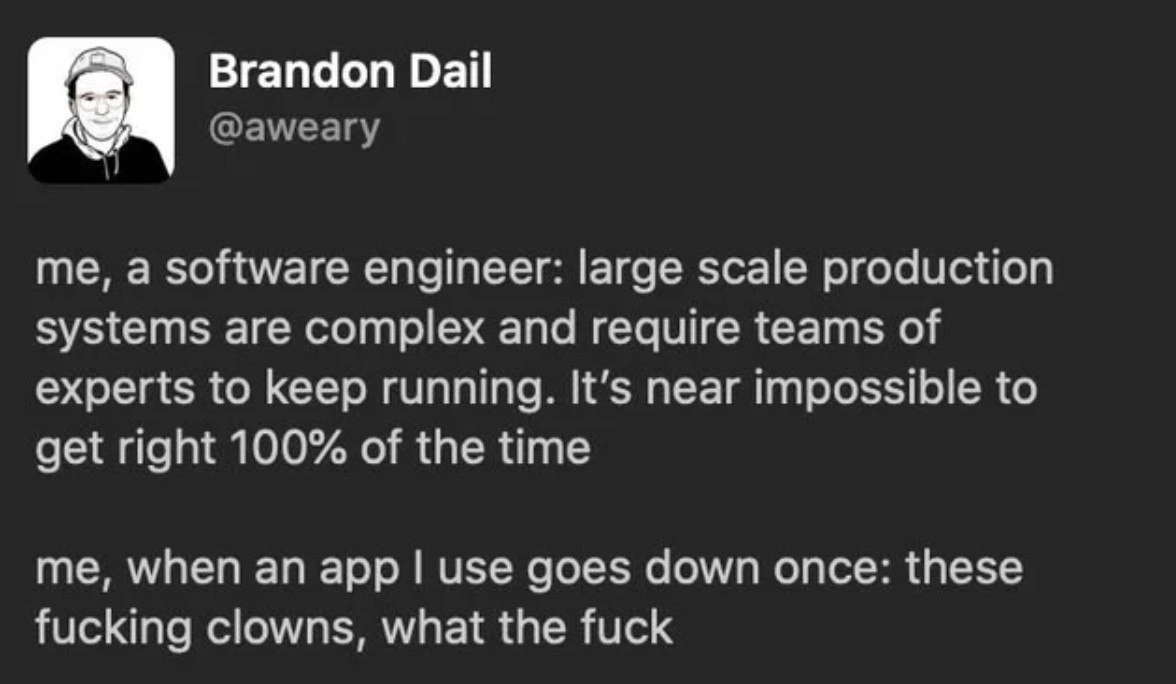
The first part of the meme – “me, a software engineer: large scale production systems are complex... require teams of experts... impossible to get right 100%” – is basically the engineer reminding themselves (and us) of this reality. It’s a humble, truthful statement. We frequently give this spiel to each other, especially to newcomers: “Don’t beat yourself up, even the best systems crash. Google, Amazon, Netflix – they all have outages sometimes despite having top engineers.” There’s a whole culture around on-call humor where developers joke about being woken up at ungodly hours to fix something, or about how an issue was finally resolved by the classic “have you tried turning it off and on again?” We laugh because we’ve been there; production incidents are a rite of passage in engineering.

Now, the second part – “me, when an app I use goes down once: ‘these f*cking clowns, what the f*ck’” – shows the outrage of a user. Here, the same engineer is describing their own reaction as a normal user of someone else’s app. Maybe they opened their favorite chat app or task tracker and it’s not working at the worst possible moment. Instantly, they get angry. They’re calling the team behind that app “clowns,” a not-so-nice insult meaning incompetent people. It’s crude and exaggerated on purpose (most of us might not say it out loud, but we’ve had that “ugh, these developers are so dumb!” thought in frustration). The comedic twist is that this is the same person who just acknowledged how hard it is to run things without issues!

For a junior developer or someone new to DevOps, this meme is highlighting a common human weakness: we’re patient with our own struggles but impatient with others’. When you first deploy a piece of software to production and it crashes, you learn very quickly that mistakes and downtime happen to everyone. You might accidentally push a bug that brings down a service and feel awful, only to have an older teammate pat you on the back and say, “Happens to the best of us. That’s why we have rollbacks and postmortems.” You start to appreciate how complex even a “simple” app can be under the hood.

Yet, fast forward to when you’re off work and just using apps on your phone or computer – if one of them fails right when you need it, it’s easy to forget all that empathy. You become just another annoyed customer. For example, imagine you’re trying to submit an assignment on an online portal and the site won’t load. Even if you’re a programmer who knows about servers and uptime, in that moment you’ll likely just rage: “This stupid site is always broken! Who coded this garbage?!” It’s almost a reflex. The meme is self-deprecating because the author (Brandon Dail, as shown in the tweet) is admitting he does this himself. He’s effectively laughing at his own hypocrisy. It’s a form of imposter syndrome’s cousin – like “I know how hard it is, but I still act like it should be easy for you.”

In summary, at this level: Production systems = hard to maintain perfectly, everyone in tech acknowledges that. On-call engineers = the poor folks trying to keep things running, often knowing something will eventually break. Downtime = when an app or site isn’t working, which frustrates users. And the meme’s joke is that even a seasoned software engineer can forget everything they know in the heat of the moment and become an upset user hurling insults (like calling the devs “clowns”). It’s a reminder, especially to newer devs, that hey, we’re all users too – try to have a little patience next time an app is down, because you know on the other side there’s a team frantically trying to fix it. But also, it’s okay to chuckle at ourselves for not having that patience sometimes. We’re only human, after all.

Level 3: Downtime Double Standard

Here’s where the industry veterans chuckle knowingly: the meme exposes a classic developer double standard. On one hand, as professionals, we preach empathy for those heroic on-call teams fighting complex production issues. We know applications at scale have countless failure modes. We’ve been in the war room ourselves, saying things like, “No system can be up all the time, cut them some slack.” But then the moment we’re the user of someone else’s app and it goes down just once, all that understanding goes out the window. Suddenly we’re griping: “These idiots can’t keep a simple site running? What clowns!” 🤦‍♂️

This contrast is the heart of the humor. OnCall humor and SRE humor often revolve around grizzled engineers swapping outage stories and acknowledging how fickle production can be. We’ve all learned (the hard way) that even with automated monitoring, load balancers, auto-scaling groups, and months of testing, a new incident will still bite us somewhere unexpected. Perhaps a single misconfigured feature flag triggers a cascade, or an edge case hidden in millions of requests per minute brings down a microservice. We respond with a blameless postmortem, maybe roll out a patch at 4 AM, and remind ourselves that “it’s near impossible to get it right 100% of the time.” This is standard DevOps wisdom: you focus on continuous improvement, not expecting perfection.

However, the meme’s punchline highlights how the same engineer can quickly lose that zen-like patience when the shoe’s on the other foot. It lampoons the reliability paradox: those who understand reliability deeply can become the most outraged customers during an outage. Why? Partly human nature – when we’re inconvenienced, we react emotionally first, logically second (if at all). Also, as engineers, we’re heavy users of others’ software (think of all the tools, cloud services, and platforms we rely on daily). When one of them hiccups, it hits our work or routine, and frustration flares up instantly. The irony is delicious: we transform from the calm SRE preaching “no blame culture” into the angry Twitter user calling someone’s dev team a bunch of “🤡 clowns.” It’s a form of engineer hypocrisy that everyone recognizes in themselves, which is why it’s so funny and a bit cringe-worthy at the same time.

Consider a real scenario: you might spend your week firefighting your company’s microservice outages and writing patient Slack updates like, “We’re aware of the issue, our team is working hard to restore service.” You empathize with users (maybe quoting that 99.9% uptime goal) and you hate when customers insult the team during a tough incident. But then on Friday night, you go to stream a movie and Netflix won’t load for 30 seconds... Cue outrage mode: “Ugh, Netflix, get your act together! What am I even paying for?!” In that moment, you momentarily forget that somewhere an on-call Netflix SRE is likely scrambling to fix things under immense pressure. The meme nails this common lapse in empathy. We know how the sausage is made (messily, with lots of late-night pager alerts), yet we still get mad when someone else’s sausage factory (server farm) has a single hiccup.

This is also poking fun at how expectations of uptime have risen. In today’s world, even non-technical users have become extremely impatient with downtime. As engineers, we intellectually understand why those expectations are unrealistic – we’ve probably given speeches about “trading off consistency vs availability” or how “99.99% uptime still means ~1 hour of downtime per year.” But emotionally, we’ve become users who want every service available 24/7, instantly. The tweet format (with the “me, a software engineer:” followed by “me, when an app I use goes down:”) sets up a mini dialogue of our rational self vs. our irrational self. It’s a common Twitter meme format to highlight personal contradictions. Here it perfectly captures the OnCall empathy gap. When wearing our engineer hat, we’re sympathetic to downtime issues. When wearing our customer hat, we’ve got zero patience.

This DevOps inside joke resonates because nearly every developer has been on both sides. We’ve joined the chorus of “It’s always DNS” or “S3 is down, the internet is on fire” when some service breaks, half-jokingly blaming whoever is responsible. Remember the great AWS S3 outage of 2017 that practically took down half the internet for a day? Developers on Twitter were equal parts empathetic (“I feel for the engineers fixing this”) and frustrated (“How can Amazon let this happen?!”). In many postmortems, there’s a line like, “due to the complex interaction of subsystems, a rare condition caused the outage.” We nod, understanding it internally. Yet externally, when our favorite app crashes, we act as if it was a simple matter and those engineers just screwed up. The phrase “these f*cking clowns” in the meme is intentionally extreme for comedic effect – it caricatures how unsympathetic we can sound, even though minutes before we were the clowns juggling an incident ourselves.

So, at a senior engineering perspective, the meme is a self-deprecating critique. It reminds seasoned developers: hey, don’t forget how hard this stuff is when you’re on the other side. It’s basically saying “we should know better, yet here we are, raging like any other user.” That recognition is both funny and a bit humbling. In the world of Production outages and OnCall rotations, there’s an unofficial code: be kind to others going through an incident, because tomorrow it will be you. This meme playfully admits that even those who understand that code of honor can lapse into a tantrum when their own app experience is disrupted. It’s a nod to our shared humanity under the silicon: we’re all a little impatient and hypocritical sometimes, even the most experienced SRE guru among us. And if that guru tweets angrily about someone else’s downtime, well, the rest of us smile knowingly – we’ve seen this movie before, and yes, it’s still funny every time.

Level 4: The 100% Illusion

At the deepest technical level, perfect reliability is a myth – a unicorn of computing. Distributed systems theory and reliability math both insist that 100% uptime is practically unattainable. Consider the CAP theorem from distributed computing: you can’t simultaneously guarantee perfect Consistency, Availability, and Partition tolerance. To avoid any downtime (100% Availability), a large system must compromise elsewhere – usually sacrificing strict consistency or relying on immense redundancy. Even then, the Fischer-Lynch-Paterson (FLP) impossibility result tells us that in an asynchronous network, no algorithm can guarantee reaching agreement (consensus) in the presence of even one faulty process. In plain terms, there’s always a scenario where a distributed system might not respond correctly in time. The math proves some failures are literally impossible to prevent if you distribute and scale out.

Real-world reliability engineering quantifies uptime with “number of nines.” For example, five nines (99.999% uptime) is about as high as humanly achievable for critical services – and even that allows about 5 minutes of downtime per year. Pushing for 100.000% uptime (all the nines, all the time) quickly runs into the reality of exponential cost and complexity. Every extra nine of reliability often demands redundant systems, backup power, failover clusters, and some very stressed Site Reliability Engineers. You can mirror your databases, add load balancers, implement multi-region failovers… but you still can’t escape Murphy’s Law. Each added component improves resilience statistically yet also expands the surface for novel failures. There’s a grim little formula: if you have multiple services in a chain, each with 99% uptime, the overall reliability is the product of all those (0.99^N). With just 10 interconnected services at 99%, your combined uptime isn’t 99% – it’s ~90%. Add more microservices or dependencies, and something will always be breaking somewhere. More moving parts mean more points of failure, period. This is why complex, large-scale production systems are so fragile despite all the engineering talent poured into them.

Even the hardware isn’t perfectly reliable. Cosmic rays can flip a bit in memory, causing a server to panic at 3 AM for no discernible reason. (Yes, cosmic rays causing outages is a real thing.) Networks can partition unpredictably (one router hiccups and suddenly half your service is cut off from the other). Caches introduce eventual consistency issues; one node’s cache might be stale, leading to weird errors. All this chaos emerges from fundamental laws of physics and combinatorics. Site Reliability Engineering (SRE) as a discipline essentially acknowledges these truths: failure is inevitable, so our job is to make systems that gracefully degrade and recover, rather than pretending we can prevent every outage. In short, the notion of “getting it right 100% of the time” is an illusion. The tweet’s first part (“large scale systems are complex... near impossible to get right 100%”) reflects this hard-earned engineering wisdom. Every experienced DevOps engineer or architect carries the scars (and pagers) from battling this reality.

Description

A screenshot of a tweet from user Brandon Dail (@aweary) that humorously highlights the cognitive dissonance experienced by software engineers. The tweet is presented as two contrasting statements. The first reads: 'me, a software engineer: large scale production systems are complex and require teams of experts to keep running. It's near impossible to get right 100% of the time'. This shows an understanding and empathetic professional perspective. The second statement immediately follows: 'me, when an app I use goes down once: these fucking clowns, what the fuck'. This reveals the same engineer's instant transformation into an impatient, critical user when experiencing a service outage. The joke perfectly captures the hypocrisy that many developers feel: intellectually understanding the fragility of complex systems while emotionally having zero tolerance for failure in the tools they rely on

Comments

9
Anonymous ★ Top Pick I have deep empathy for the challenges of distributed systems... right up until the moment Slack's API returns a 503
  1. Anonymous ★ Top Pick

    I have deep empathy for the challenges of distributed systems... right up until the moment Slack's API returns a 503

  2. Anonymous

    We’ll debate for days whether 99.9% vs 99.95% is the right SLO, then the moment Uber takes four extra seconds to hail a car we’re screaming, “Great, zero-nines reliability, must’ve shipped straight from /dev/null!”

  3. Anonymous

    After 15 years of explaining CAP theorem, implementing circuit breakers, and designing for graceful degradation, you'd think we'd have more empathy when Slack goes down for 5 minutes. But no, we immediately transform from distributed systems architects into Karen demanding to speak to the SRE manager

  4. Anonymous

    The beautiful irony of distributed systems: we architect for Byzantine fault tolerance and design chaos engineering experiments to prove our resilience, yet the moment our favorite SaaS goes down for 90 seconds, we instantly forget about CAP theorem, network partitions, and cascading failures - suddenly convinced that achieving five nines is just a matter of 'not being incompetent.' It's the engineering equivalent of a cardiologist having road rage because traffic exists

  5. Anonymous

    Me setting SLOs: 99.9% with an error budget. Me as a user: one 500 and I’m drafting their postmortem recommending multi‑region failover - for a company I don’t even work at

  6. Anonymous

    We architect for CAP's cruel realities with SRE teams, but treat a consumer app's 99.9% like a personal betrayal

  7. Anonymous

    We’ll spend a quarter negotiating 99.95% with an error budget, then personally burn the remaining 0.05% and call it a clown fiesta

  8. @dellism1 5y

    àre comments working?

  9. @Linegel 5y

    You have to be on beta branch

Use J and K for navigation