Brain-to-Mouth Latency Spike
Why is this Communication meme funny?
Level 1: Nod Now, Panic Later
Imagine you’re in class at school. Your teacher has been explaining a really long math problem or giving instructions for a project, but maybe you weren’t paying full attention (your mind wandered for a moment thinking about lunch or a video game). Suddenly the teacher turns to you and asks, “Did you get that? You know what to do, right?”
You immediately nod and say, “Yes, I got it.” You don’t want to look silly in front of the whole class. You don’t want the teacher to think you weren’t listening. So you answer yes really quickly.
But as soon as the teacher moves on, inside your head you’re thinking, “Uh oh... what exactly did they say? What am I supposed to do?!” Your brain is almost shouting that question to you: “Got WHAT?” You realize you actually don’t know what the task is because you missed it or forgot it instantly.
This meme is joking about that exact feeling, but in a workplace with a boss and a developer. The boss says, “Got it?” (just like the teacher asking if you understand), and the developer says, “Got it” out loud, meaning “sure, okay!”. But the developer’s brain is immediately confused, going “Wait, got what?” – meaning they actually didn’t get it.
It’s funny in a friendly way because everyone has done this at some point. We sometimes say “yes” or nod even when we’re not 100% sure what we’re agreeing to. It’s like when your parent tells you to do some chores while you’re playing, and you absentmindedly say “okay”, but later you stand up and realize you have no clue what you agreed to do. The meme captures that oops moment. It makes us laugh because we recognize the little bit of panic and confusion hidden behind a polite “got it”. In simple terms: on the outside we say yes, but on the inside we’re asking “Wait… what was that again?”. And that little inner contradiction is both relatable and humorous!
Level 2: Nodding Without Knowing
This meme is capturing a very familiar situation for many developers: saying you understand something even when you really don’t. The scene is likely a team meeting (think daily stand-up or a status meeting). The boss or project manager has just finished explaining a task or a set of requirements and then asks, “Got it?” – essentially, “Do you understand what you need to do?”. The developer immediately responds out loud with “Got it”, meaning “Yes, I understand”.
However, the punchline is the next line: the developer’s brain quietly thinks, “Got what?”. 😅 This internal thought reveals that the developer actually didn’t grasp what the boss just said, or maybe they already lost track of it a second later. In other words, there’s a miscommunication here — on the surface everything looked fine (the boss thinks the developer understood), but in reality the message didn’t stick. The developer’s brain had a little glitch.
Why would someone say “I got it” if they don’t? There are a few common reasons:
- Meeting pressure: In meetings, especially if it’s quick like a stand-up, there’s pressure to keep things moving. The boss is looking at you expecting an answer. You might blurt out “Got it!” just to avoid awkward silence or to not seem slow.
- Avoiding embarrassment: No one wants to look like they weren’t paying attention. If a developer’s mind wandered for a moment (it happens to all of us, maybe an email notification popped up, or you’re still thinking about the last bug you were fixing), they might have missed part of the instruction. But when suddenly asked “Do you understand?”, it feels safer to just nod yes, especially in front of colleagues.
- Trusting you’ll figure it out later: Developers often think, “I’ll just say yes and I can always ask for details later or check the written specs.” It’s a bit of a gamble – you’re basically betting that you can fill in the blanks afterwards.
This scenario is basically humor about a communication breakdown. Let’s break down some terms and ideas to make sure they’re clear:
- Internal monologue: This means the voice in your head – your thoughts that no one else hears. In the meme, “brain: got what” is showing the developer’s internal monologue. Out loud they said “got it”, but internally they’re questioning what they missed.
- Cognitive lag: This is a fancy way of saying your brain is a little slow to catch up. Maybe the information was given too fast or you were momentarily distracted, and there’s a delay in understanding. It’s like when someone tells you something and you only realize what they meant a few seconds (or minutes) later. Here, the dev’s brain is lagging behind the conversation.
- Task acknowledgement: This is the act of confirming you’ve received or understood a task. Saying “Got it” is a form of task acknowledgement – you’re signaling “I hear you, and I’ll do it.” In the meme, the developer gives that acknowledgement without actually having the task info solidly in mind.
- Short-term memory glitch: This refers to when you forget something almost immediately after learning it. Our short-term memory can be fickle – for example, have you ever been told a phone number, and you forget it 10 seconds later? Here, the developer might have had a momentary memory lapse. They heard the task, but a moment later poof, it’s gone. This could be due to being tired, having too much on their mind, or just the information not being encoded because of distractions.
- Boss vs brain: This phrase isn’t a technical term, but in context it highlights the conflict between what the boss expects and what the brain is actually doing. The boss expects a clear “Yes, everything is understood,” whereas the brain is actually confused. It’s the classic case of manager expectations versus developer reality. The boss sees the nodding yes-man; the brain is that honest friend inside going, “Uhh, can someone repeat that?”.
For a junior developer (or any newcomer in a team), this meme is both funny and a little comforting. It says: hey, even if you sometimes pretend to understand when you don’t, you’re not alone! It’s poking fun at the fact that developer frustration can start with something as simple as unclear communication. The tags like MeetingHumor and CorporateHumor apply because this situation isn’t unique to coding — it happens in lots of office environments. But in software teams, there’s often so much technical detail flying around that it’s extra easy to feel lost for a second.
Imagine you’re new and in a sprint planning meeting. The project manager explains a new feature with a bunch of jargon or details that you’re not 100% familiar with yet. Then they look at you and go, “All good? You got it?”. Your heart skips – you think you should know, but you’re not sure. Still, you say, “Yes, got it”. That’s basically what’s happening in the meme. On the outside, you’ve agreed and the meeting moves on. On the inside, you’re already sweating a bit, thinking “I have no idea what I’m supposed to do.” It’s a relatable mini-panic moment.
The humor here also lightly encourages better communication: ideally, the boss would ensure the person truly understands (maybe by asking them to repeat back the plan, or by providing written notes). And as a developer, it’s usually better to ask a quick question than to walk away confused. But in reality, split-second decisions happen, and sometimes we just fake confidence in the moment. The meme gets a laugh because every developer has been in that exact spot where they’ve nodded along to keep things smooth, only to immediately wonder “What did I just agree to, again?”. It’s a gentle reminder that miscommunication is common – and that it’s okay to chuckle at ourselves for being human.
Level 3: Cognitive Cache Miss
In the world of dev team meetings, “Got it?” is often the boss’s shorthand for “Did you understand all the tasks I just rapid-fired at you?”. The developer’s mouth replies “Got it” almost as automatically as a server sends an ACK packet, but the developer’s brain… well, it just experienced a cache miss. The crucial details of the assignment never made it into active memory. You’ve essentially acknowledged the request without truly processing it – kind of like returning a HTTP 200 OK status even though the server hasn’t actually saved anything to the database yet. 🐞
Why is this so painfully funny to experienced devs? Because we’ve all been there. It’s a classic communication breakdown where outward protocol and internal state are completely out of sync. One moment you’re deep in code, and the next your boss is outlining a new feature at warp speed. Your brain has to context switch like a CPU thread getting yanked off one process and thrown onto another. In the process, it dumps whatever was in its registers (goodbye TaskDetails variable), and often the new input doesn’t fully stick. So when the boss asks, “Got it?”, you fire back “Got it!” (that’s the verbal ACK), while inside your head the error log is screaming “Got what?”. It’s as if the developer’s mental process threw a NullPointerException – the pointer to the boss’s instructions is null because nothing was actually stored!
Let’s depict this situation in a lighthearted way with some pseudo-code:
// Simulate the boss giving an assignment and asking for acknowledgment
let bossInstruction = "Implement Feature X by end of day";
let bossQuestion = "Got it?";
// Developer's outward response
let devReply = "Got it";
// Developer's brain tries to store the instruction but...
let brainMemory = undefined; // Oops, the details didn't stick
// Internal log (what the brain is really thinking)
if (brainMemory === undefined) {
console.error("brain: got what?"); // Brain expresses confusion
}
In this snippet, the devReply of "Got it" is sent even though brainMemory is empty (undefined). The console.error output “brain: got what?” perfectly mirrors the meme’s third line, revealing that nothing’s actually understood internally. The developer’s internal state didn’t receive the memo, even though the boss thinks everything’s synced up.
This scenario highlights a mismatch between Manager expectations and developer reality. From the boss’s perspective, that quick “Got it” ticks the box – task handed off, acknowledgement received. In their mind, it’s case closed. (This is the ManagerExpectations angle: if you say you understand, they assume you truly do.) But from the developer’s side, there’s a silent panic: the internal monologue is going “What the heck did I just agree to?!”. The humor hits close to home because it exposes that hidden disconnect. The boss sees a confident nod, while the developer’s brain is throwing a silent 404 error (Understanding Not Found).
This meme format (boss: / me: / brain:) cleverly gives the brain a speaking role. It’s like reading a multi-tier log of the encounter: the professional facade in one log line, and the truth in the next. It resonates with devs because it’s a snapshot of real office life: outward compliance, inward confusion. Why doesn’t the developer just ask “Got what?” out loud? Often, it’s due to a mix of pressure and pride. In a stand-up meeting with managers and peers, nobody wants to be the one to pump the brakes, say “Uh, actually I didn’t catch that”, and disrupt the fast-paced rhythm. 🙄 Maybe the dev zoned out for five seconds (brain context-switching lag), or maybe the boss’s explanation was as clear as an obfuscated regex. Either way, asking for clarification feels like admitting you weren’t keeping up. So you nod along to save face, thinking you’ll sort out the details later.
And indeed, what happens after the meeting is another part of this story (one every seasoned dev knows too well). The moment the call ends, you’re frantically scrolling through chat logs or whispering to a teammate: “Hey, do you know what exactly I’m supposed to do?” or scouring the project tracker for a hint of the task. It’s the real-life “brain: got what?” follow-up. In theory, good Agile practice or a vigilant Scrum master would ensure tasks are clear and written down (so the short-term memory of the human isn’t the single point of failure). But in practice, especially during packed days or back-to-back Zoom calls, details slip through the cracks. Meeting fatigue is real: after enough meetings, your brain’s RAM is just thrashing. By the time the boss tosses the fifth action item at you, your mental buffer is overflowing like a log file in an infinite loop.
The comedy here comes from shared experience and relief: it’s funny because it’s true. Every developer from junior to senior has at some point given that automatic “yep, got it” while their brain was still rebooting. It’s a gentle roast of corporate culture too – this is CorporateHumor and MeetingHumor rolled together, poking fun at the daily stand-up ritual. The meme says, “We pretend everything’s under control, but half the time we’re as lost as a pointer to freed memory.” It’s a tiny dose of group therapy for devs: you’re not the only one who has responded “sure thing” to your boss while secretly having no clue. And by laughing at it, we also hint at the solution: slow down, clarify, maybe document tasks... or at least have a friend ready on Slack for that inevitable “Got what?” DM. In the end, the joke lands because it’s a scenario born out of real developer frustration — and turning frustration into a laugh (instead of panic) is something of an occupational survival skill in IT. 😉
Description
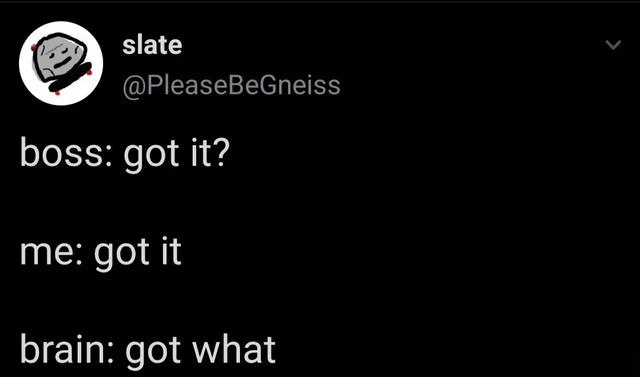
A screenshot of a tweet from the user 'slate' (@PleaseBeGneiss), set against a stark black background. The avatar is a simple cartoon of a rock. The tweet presents a three-line dialogue format: 'boss: got it?', followed by 'me: got it', and concluding with the internal thought, 'brain: got what'. This meme humorously captures the universal experience of automatically confirming understanding of a task or concept, only to have a delayed internal realization that the information was not processed at all. For developers, this is highly relatable to scenarios like complex code reviews, architecture discussions, or receiving multi-step instructions where a momentary lapse in focus means you've completely lost the thread but have already nodded in agreement
Comments
11Comment deleted
My brain's confirmation endpoint is non-blocking; it sends a 200 OK before the async processing job has actually validated the payload
Boss: "Got it?" Me (optimistic ACK): "200 OK." Brain: "Payload’s still in the message queue - eventual consistency ETA after the third coffee."
It's like deploying to production with a successful CI/CD pipeline while your monitoring dashboard is throwing errors you haven't looked at yet - the system says green, your mouth says 'shipped', but your brain is still parsing the last merge conflict from three sprints ago
This is the architectural equivalent of saying 'yes' to implementing a microservices migration during a standup, then realizing 30 seconds later you have no idea which services need to be split, what the data dependencies are, or whether anyone actually defined what 'done' means. Your mouth writes checks your brain can't immediately cash, but hey, at least the Jira ticket got moved to 'In Progress.'
Boss drops requirements in PowerPoint hieroglyphs; we 'get it' externally, brain throws NullPointerException internally
Boss: got it? Me: got it. Brain: which “it” - the Jira epic renamed mid-standup, the Slack DM that contradicts the PRD, or the legacy cron that only behaves when DST is wrong?
“Got it” is an eager ACK with no idempotency - comprehension reaches quorum via eventual consistency sometime after the retro
Yeah, sounds like my current task. Comment deleted
That's actually funny how humans always separate themselves from their brains Comment deleted
If they use some other organ for thinking - why not Comment deleted
I use my tummy. It's also a organ 😂 Comment deleted