Excavator discovers the elusive 'Fiber Opticus' tree
Why is this Infrastructure meme funny?
Level 1: Accidentally Unplugged
Imagine you have a big important wire that connects your house to the internet – kind of like the cord that brings in cable TV or the wire for your Wi-Fi, just on a larger scale. Now picture a worker outside digging in the dirt with a big machine (an excavator, like a giant shovel). He sees some old-looking roots in the ground and thinks, “Hmm, these must be from a tree; I can cut through them.” But uh-oh – those aren’t tree roots at all, they’re the internet wires supplying an entire neighborhood! He cuts them, and suddenly poof – the internet stops working for you and all your neighbors. It’s like someone accidentally unplugged the whole town, and nobody can watch videos or play games online. Then the worker pokes his head up and innocently asks, “Any idea what kind of tree has roots like these?” 😅 It’s funny in a silly way: he totally messed up without realizing it, treating a bunch of colorful cables as if they were just sticks from a plant. Everyone who was using the internet is now upset and scratching their heads, until they find out about this goof. The humor comes from that mix-up – an important wire was mistaken for a root, and it caused a big accidental problem. It’s as if someone cut the power cord for the city thinking it was a vine. Whoops!
Level 2: Digging Up Trouble
Let’s break down what’s happening here for those newer to networking. In computer networking, the OSI model is a way to describe different layers that data travels through, from your application down to the physical connection. Layer 1, the Physical layer, is literally about the physical connections – like Ethernet cables, fiber optics, radio waves, etc. In this meme, we’re dealing with a Layer 1 problem: a cable (the physical medium carrying signals) has been cut. When that happens, it’s called a Layer 1 outage – basically the lowest-level failure you can get, because no signal can get through a broken wire. It doesn’t matter how perfect your code or server configuration is; if the wire is severed, nothing in the network can communicate over that link. It’s as if someone yanked the plug on a giant system – and in a sense, they did!
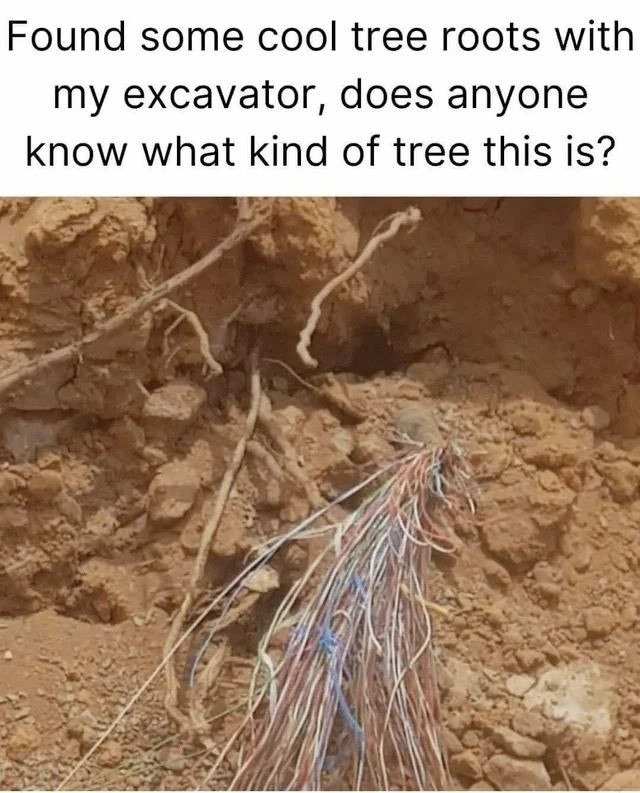
Now, what’s with the “tree roots” joke? The top caption says: “Found some cool tree roots with my excavator, does anyone know what kind of tree this is?” The picture shows an excavation site wall with real tree roots and a bunch of shredded multicolored wires sticking out. Those wires are not roots from a tree – they’re part of a big copper telephone/network cable bundle. The person with the excavator is (jokingly) acting clueless, as if they just discovered an interesting plant root, when in reality they’ve accidentally dug up and destroyed a cable that likely carries phone lines or internet. This scenario is a well-known type of accident in the tech world, often humorously referred to as a “backhoe incident.” A backhoe is a kind of excavating machine (similar to the excavator in the image) used for digging. When someone says “a backhoe took down the network,” they mean some construction work literally cut through a buried cable and caused a network outage. It’s so common that it’s almost an inside joke in IT departments and among network engineers.
Let’s connect this to real experience. Imagine you’re a new developer on-call (meaning you’re the person responsible for responding to issues after hours). Suddenly, the company’s website and services go down. Alarms are ringing from the monitoring system indicating a ProductionOutage (production = the live, real-world system, outage = it’s not working). You try all the usual things: checking if the servers are up, if the database is okay, if DNS is resolving (DNS is the system that translates domain names to IP addresses, a common culprit in outages). But everything in the software looks fine… yet users still can’t connect. You notice errors that basically say “cannot reach server” or “network unreachable.” This is a clue that the problem is in the network infrastructure itself – not the app or software, but the stuff that connects computers together. Eventually, someone contacts the internet service provider or the data center folks, and you get the news: a construction crew down the street accidentally cut a major cable. Boom – that’s why your service is down. This is exactly the kind of event this meme is portraying. It’s both scary and absurd: scary because you, as the on-call person, can’t do anything in code to fix it (you have to wait for them to splice the cable back together), and absurd because the root cause (no pun intended) is literally a guy with a digger who didn’t realize what he was cutting.
Some terms and tags here: PhysicalLayerNetworking refers to networking at the physical layer (wires, cables, etc.). CableManagement is a term about organizing and handling cables properly – usually we talk about it in server rooms (making sure cables are labeled and not tangled), but out in the field it means burying cables in safe places, marking their location, and protecting them. In many countries, utilities put colored flags or spray paint on the ground to mark where important cables and pipes are, so that excavators know where not to dig. There’s even a phrase “Call Before You Dig,” meaning anyone doing excavation should call a number (e.g., 811 in the US) to have utility companies come and mark lines to avoid hits. In this meme scenario, either that wasn’t done, or mistakes were made, leading to a severed_copper_cable. The result? Downtime – that period during which the network was down and people couldn’t use the service. Downtime is dreaded, especially in production environments, because real users are affected.
For a junior developer or someone new to infrastructure, the lesson (and comedy) here is in understanding that the internet isn’t just an abstract “cloud” — it relies on very real, physical things. Those cloud icons on architecture diagrams actually hide a vast world of servers, wires, and underground cables connecting cities and countries. And yes, sometimes a single point of failure, like one big cable, can bring down a lot of systems if it’s cut. Ideally, important network routes have redundancy – meaning there’s a second cable path, so if one is cut, traffic can go around the other way. But in practice, especially in local segments or under-budgeted projects, there might be only one cable in the ground. That’s why an excavator (or any digging equipment) is almost like a natural enemy for network engineers. The meme makes us laugh by showing the digger operator acting totally unaware of the havoc they caused, thinking those wires are “tree roots.” It highlights the sometimes ridiculous disconnect between everyday folks (or construction workers) and the high-tech infrastructure running literally beneath their feet. For a new engineer, it’s a memorable introduction to why on-call can be so eventful: sometimes you debug for hours, only to discover the bug isn’t in the code at all – it’s in the ground, thanks to a backhoe.
Level 3: Backbone vs Backhoe
For seasoned engineers, this meme hits a nerve (and a bundle of nerves, literally). The image shows a shredded bundle of multi-colored communication wires, unearthed by an excavator; it’s not just dirt being dug up, it’s someone’s network backbone. The caption’s oblivious question – “does anyone know what kind of tree this is?” – is dripping with sarcasm. Any senior dev or network admin who’s been through a few on-call rotations has a reflexive eye-roll for this scenario: Ah yes, the classic backhoe incident. It’s a running joke in infrastructure circles that one errant construction crew can take down half the internet for a region.
Why is this so funny (and painful) for experienced folks? Because it’s ** absurdly common**. We harden our software, add redundant databases, perform chaos testing on services – yet time and again, some guy with a digger causes a massive production outage. It’s the kind of story traded around with equal parts exasperation and dark humor:
- “Remember that time an entire data center went offline because a ditch-digger cut the main fiber trunk? Good times.”
- “We spent a week blaming the firewall config, only to find out a giant shovel literally unplugged us from the world.”
In this meme, the excavator operator is jokingly mistaking a telecom cable trunk for tree roots. That’s the punch line: treating critical infrastructure as harmless vegetation. The wires even fan out like roots, so visually the mistake looks almost plausible – except any tech knows those colored strands aren’t from Mother Nature. It’s a perfect encapsulation of the “field tech nightmare” where physical reality and tech infrastructure collide. The multi-colored copper wires likely form a large telephone or network cable bundle (dozens or hundreds of twisted pairs) – essentially a major vein of connectivity. Severing it is like cutting the artery of an entire network region. Upstream, all the software engineers see are sudden monitoring alerts: database connections failing, services timing out, “host unreachable” errors across the board. The on-call engineer scrambles, checking logs and pinging endpoints in a panic:
# On-call engineer suspects a network issue and tries a simple connectivity test
$ ping 8.8.8.8
PING 8.8.8.8 (8.8.8.8): 56 data bytes
--- 8.8.8.8 ping statistics ---
5 packets transmitted, 0 packets received, 100% packet loss
When 100% packet loss stares you in the face, it’s a solid sign that something is terribly wrong at the network level. In a war room bridge call, someone inevitably mutters, “Could this be a cut cable?” — a notion met with groans because you can’t push a patch or revert a commit to fix a severed cable. You’re at the mercy of the field technicians now. The meme humorously captures that powerless feeling: all your sophisticated tech literally doesn’t have a connection anymore, thanks to one moment of human error with heavy machinery.
The phrase “backhoe incident” is practically folklore in networking. It refers to any outage caused by accidental cable damage in the field (often by construction equipment like backhoes). Seasoned ops folks stock these stories like trading cards. They’ve seen how a single point of failure – an underground cable run with no backup – can turn into hours of downtime and emergency meetings. There’s irony in calling it “tree roots”: it implies the operator thinks he’s dealing with a stubborn plant, while in reality he’s yanking out the root of our network. The root cause (pun fully intended) is clear as day in that photo: copper innards spilling out, as the network’s “family tree” gets literally pruned.
From an infrastructure standpoint, this meme underscores a persistent anti-pattern: neglecting the Physical Layer until it bites you (or you bite it, with a backhoe). Companies invest millions in cloud infrastructure and fault-tolerant systems, but if they don’t invest in redundant network links or proper cable protection, a single excavator on a random Monday can still take them down. The veteran engineers laugh (perhaps a bit bitterly) because they’ve been on those 3 AM calls where the entire incident boils down to: “someone with a shovel (or excavator) in Kansas cut through the fiber line.” You can almost hear the collective facepalm.
Organizationally, it’s also a poke at how software engineers and SREs often have to deal with issues originating in a completely different realm. You might get paged for a critical service outage and spend an hour proving it’s not the application, not the database, not DNS (for once it’s not DNS!), only to learn it’s a physical infrastructure failure outside your control. The humor has a cathartic edge: no matter how advanced and “virtual” our systems become, we’re painfully reminded that the cloud is built on dirt. The “tree” in this joke isn’t in a data structure or a DNS hierarchy; it’s literally a false tree made of wires, now in need of some serious CableManagement and a lot of duct tape.
So “Backbone vs Backhoe” is the veteran chuckle: the mighty internet backbone defeated by a humble backhoe. It’s a scene that elicits gallows humor from any on-call veteran: you protect against DDoS attacks and hacker intrusions, but who’s protecting the cables from Farmer Joe’s new fence project? The misidentification of cables as roots is just the icing – highlighting how those outside the tech bubble might see our critical tech veins as mundane debris. In summary, it’s funny because it’s true: our cutting-edge network infrastructure can be (and regularly is) felled by something as archaic and blunt as digging up tree roots. Cue the nervous laughter – and please, call before you dig.
Level 4: The Root of All Outages
At the OSI model's bottom rung (Layer 1, the Physical layer), everything is literally grounded in hardware. No matter how advanced your network protocols or cloud architecture are, they all funnel down into physical media: copper wires, fiber optic cables, radio signals in air, etc. In this meme, that fundamental layer was literally severed. All the high-level tech – routing algorithms, encryption schemes, microservice calls – becomes irrelevant the instant a backhoe’s bucket shears through a cable. From a theoretical perspective, it’s a brutal demonstration of communication theory’s simplest rule: no physical channel, no data. You can think of Shannon’s capacity formula $C = B \log_2(1+S/N)$ – if the channel is cut (effectively $B=0$ bandwidth or signal $S=0$), the capacity $C$ drops to zero. No bits can get through, period. This is an absolute failure at Layer 1, sometimes grimly nicknamed a “hard down”.
Computer scientists love to imagine infinite reliability with redundant networks and clever failover protocols, but physical reality has a sense of humor. All those elegant multi-path routing theories assume there is at least one path available. A single excavator can invalidate those assumptions by creating a perfect isolated partition – a real-world case of a network cut that even the fanciest Byzantine consensus algorithm can’t work around. The situation depicted – mistaking a critical cable bundle for “tree roots” – highlights the fragility of infrastructure: decades of distributed systems research and network protocol design are instantly made moot by one moment of mechanical ignorance. The humor here is laced with that deep truth of systems engineering: the most sophisticated software stack ultimately relies on something as prosaic as a buried cable, which in turn relies on humans not to shove a shovel through it.
Historically, network engineers have battled this Layer 1 vulnerability through redundancy and topology design. Mesh and ring networks aim to provide alternate routes, so that if one cable is cut, traffic can detour along another path. In theory, no single point of failure should bring the whole system down. Yet theory meets messy reality when multiple cables share the same trench or when budget constraints left a “single-homed” connection to that remote office. A true cynic in networking will tell you Murphy’s Law loves the physical layer: if there is one unprotected cable feeding a critical region, eventually something – or someone – will cut it. There’s even joking jargon like “backhoe fade” (a play on signal fading) to describe outages caused by construction equipment. In essence, this meme’s scenario is the bane of network infrastructure: a fundamental Layer 1 failure that reverberates up through all seven layers, from the physical snap of copper to the application-layer timeouts and 500 errors that on-call engineers see lighting up their dashboards. It’s a reminder that at the root of all our high-tech stacks lie very real, mundane things – and those roots can be unexpectedly (and sometimes literally) yanked out of the ground.
Description
The image displays a humorous and sarcastic scene from a construction or excavation site. The top of the image has white text that reads, 'Found some cool tree roots with my excavator, does anyone know what kind of tree this is?'. Below the text is a photo of freshly dug-up, brown, clumpy earth. Emerging from the soil is a large, severed bundle of multi-colored wires - clearly telecommunication or fiber optic cables, with individual strands of red, blue, green, white, and other colors splayed out. The joke lies in the blatant misidentification of critical network infrastructure as natural 'tree roots.' This is a widely understood gag in IT and construction circles, representing a catastrophic but common cause of internet and network outages, often referred to as 'backhoe fade.' It's particularly funny to network engineers, SREs, and anyone on-call who lives in fear of a physical-layer disruption

Comments
11Comment deleted
The cloud is robust, redundant, and geo-distributed... until a guy with an excavator mistakes its root filesystem for actual roots
Blameless RCA: turns out our entire multi-AZ, self-healing microservice mesh still depended on a single copper “root” - and Backhoe-Driven Development just merged its breaking change to prod
Ah yes, the rare Fiber Opticus - known for its ability to make entire neighborhoods go dark when pruned incorrectly. Legend says if you cut one during business hours, you can actually hear the collective screams of a thousand Zoom calls dropping simultaneously
Ah yes, the rare *Fibrus Opticus Gigabiticus* - native to data center migration routes and known for causing catastrophic packet loss when disturbed. Typically takes 72 hours and three different ISPs pointing fingers at each other before full restoration. The excavator operator just discovered why that SLA had a 'force majeure' clause and why the on-call rotation suddenly got very interesting
The rare 'Single Point of Fiber' Fir - one swing and your distributed system's partition tolerance evaporates
Behold the backhoe-grown Spanning Tree: a textbook Layer 1 partition where we accidentally chose P over A in CAP, followed by a 3 a.m. RCA and a 600-pair splice marathon
Pretty sure that’s the Backhoe-of-Death tree - its roots are the county’s copper trunk. One swing and your multi‑region architecture becomes a monolith. Root cause analysis complete
Lan-tree Comment deleted
Neighbors internet root mthfck Comment deleted
Press F for those who lost their connection thanks to this "archaeologist". Comment deleted
anarchologist Comment deleted