The Fundamental Trade Offer of All Computing
Why is this CS Fundamentals meme funny?
Level 1: Give & Take
Imagine a vending machine at the arcade: you put a coin in and select a candy (that’s the input you give to the machine), and then a candy drops out for you to take (that’s the output you get). This meme is joking that a computer is doing the same kind of deal. It’s like the computer is saying, “You hand me something, and I’ll hand you something back.” For example, if you ask a calculator “What’s 2 + 2?” (input), it will tell you “4” (output). Pretty simple, right? The funny part is how the meme makes it look like a serious business transaction – the computer has a suit and a big old monitor as a head, and it’s acting like it’s proposing a big trade. In reality, that “trade” is just how using a computer always works! You give the computer some information or a request, and it gives you a result. It’s a straight give-and-take. We laugh because the meme presents this everyday interaction in an over-the-top way, as if the computer is a deal-making businessman. But at its heart, it’s true: whether you’re asking Google a question or playing a video game, you’re constantly feeding inputs to a computer and it’s giving outputs back. This meme just makes us smile by dressing that simple idea in a fancy suit and tie.
Level 2: Keyboard In, Monitor Out
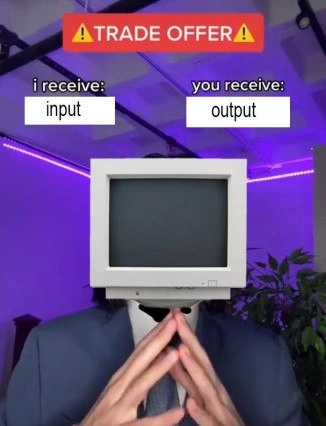
Let’s break down the meme in simple terms. We see a man in a suit with his hands clasped like he’s making a business proposal. However, instead of a human head, he has a classic beige CRT monitor for a head – the kind of old computer screen from the 90s (big and boxy, before flat screens). At the top of the image, a red banner with warning symbols says “⚠️ TRADE OFFER ⚠️”, mimicking a popular meme format from TikTok. On the left side, text next to the computer-man reads “I receive: input”, and on the right side it says “You receive: output”. It looks as if the computer itself is speaking, proposing a fair exchange: you give me an input, and I’ll give you an output. This format became an internet trend where people list what they give and get in a humorous “deal”. Here it’s applied to the most basic computer science fundamental: input/output (often abbreviated as I/O).
In computing, input is any data or signal that a computer receives. Output is any data or signal that a computer produces and sends out. The meme literally spells out that exchange. It’s highlighting that even though computers can do incredibly complex things, they all boil down to this simple idea. If you’ve just started coding, you’ve probably already seen input/output in action. Think about a basic program that asks for your name and then prints a greeting. When you type your name in, that’s the input. When the program prints “Hello, [Your Name]!”, that’s the output. Every app or website follows this principle too: you click a button or enter information (input), and the computer shows you a result or does something (output). The monitor in the image represents the output device (since monitors display information), and it’s cheekily doing the talking. The suit and negotiating pose are just there to make the scenario funny – as if the computer is a businessman making a deal with you. In reality, we don’t think of using a computer as a “trade”, but this meme plays with that idea for comedic effect.
To clarify further, here are some examples of common input and output devices in real life computing:
- Input devices: keyboard, mouse, microphone (the computer receives data from these)
- Output devices: monitor, speakers, printer (the computer sends out data through these)
When you press a key on the keyboard, you’re sending input into the computer (it receives the letter you typed). When something shows up on the monitor screen, that’s the computer giving you output (it displays the letter or image for you to see). This input/output concept is one of the first things we learn about computers. In fact, the term I/O is used all over tech to talk about reading and writing data (for example, reading a file from disk is input, writing to a file is output).
Let’s connect this to programming for a moment. Here’s a tiny code snippet in Python that illustrates a very basic input -> process -> output cycle:
number = int(input("Enter a number: ")) # i receive: input
print("Twice that is", number * 2) # you receive: output
In this code, the program asks “Enter a number:” and waits for you to type something. When you type, say, 5, that value becomes the input (the computer “receives” 5). The program then processes that input (number * 2 calculates 5 * 2 = 10 behind the scenes). Finally, it prints out “Twice that is 10”, which is the output you see on screen (the computer “sends” you the result 10). This is essentially the deal the meme is talking about! You gave the computer a 5, and you got back a 10. The meme just generalizes it: “give me any input, I’ll give you the corresponding output.” It’s a funny reminder that beneath all the fancy apps and high-level code, a computer is doing exactly what this suited CRT monitor character promises. The background with purple LED lights and a plant gives the image a trendy tech vibe (it’s actually mimicking the original TikTok video setting that spawned the trade offer meme). But despite the modern flair, the message is old-school simple. For newcomers in tech, it’s a good laugh and a learning takeaway: always remember the basic I/O handshake happening every time you use a computer.
Level 3: GIGO Guarantee
For seasoned developers, this meme hits on a core truth of our profession: no matter how sophisticated the system, at its heart it’s just input and output. We spend our days architecting elaborate pipelines, writing thousands of lines of code, and managing complex frameworks, but when you zoom out, every piece of software is fundamentally a black box where you put something in and get something out. The humor here comes from this almost absurd simplicity underlying all the complexity. The meme uses the popular “Trade Offer” format – typically used for joking about dubious deals – to summarize the developer’s ultimate bargain with the computer. The suited businessman with a CRT monitor for a head sits there, hands steepled like a CEO closing a deal, essentially saying: “I (the computer) agree to take your input, and in return you’ll get an output.” It’s a comically formal way to state what every function or microservice guarantees by design. This resonates with experienced devs because we’ve all had those moments at 3 AM debugging, when we sigh and realize garbage in, garbage out (the famous GIGO principle): if the input is wrong or nonsensical, the output will be too. The meme’s trade offer phrasing is like the computer cheekily reminding us, “Hey, I’ll give you a result, but it’s only as good as what you asked for.”
Consider how this plays out in real scenarios: an API endpoint might as well be saying, “Send me the correct request parameters, and I’ll respond with useful data”. A database query offers, “I receive your SQL, you receive the result set”. Even a simple addition function in code is a tiny contract: feed me two numbers, I’ll give you their sum. Seasoned engineers recognize these contracts everywhere. We define clear interfaces and expectations – essentially trade deals – for every module: “if you provide input in format X, you’ll get output in format Y.” The meme brilliantly reduces that ubiquitous pattern to a punchline. The CRT monitor head adds an extra layer of geeky humor: it represents the computer as a retro-minded businessman, implying that this input/output deal is age-old – as old as computing itself. The purple neon-lit background and the formal suit give off a vibe that is both modern (a nod to the meme’s TikTok origin) and ironically professional, as if the computer is some kind of data broker in a high-rise office. It’s funny because we rarely personify a computer’s basic behavior in such human terms. Yet here we have a computer essentially negotiating: “You drive the input up to my loading dock, and I’ll ship the output right out.”
For a developer who has wrestled with complex systems, this meme is a refreshing reminder not to lose sight of fundamentals. It prompts a knowing chuckle: after all the design patterns, cloud deployments, and distributed transactions, the job of our software is still straightforward at its core. It’s almost motivational in a cheeky way. The next time you’re tangled in a tough bug, you might remember this trade offer meme and think, “Alright, what input am I giving, and what output do I expect?” – cutting through the noise. In a world of hype where every new tool or framework promises to revolutionize something, this meme brings us back to basics with a grin. It’s the GIGO guarantee in meme format – a contract as old as computing: you hand the computer some data, it hands you back a result, deal done! And if that result isn’t what you wanted… well, maybe we need to renegotiate what we’re feeding into the machine.
Level 4: Binary Barter
At the most fundamental level of computing, everything is a transformation of input into output. This meme humorously echoes the Church-Turing thesis in plain language: any computable operation can be viewed as a function mapping some input to an output. In mathematical terms, a program is like a function $f$ where you feed it an $x$ (input) and get $f(x)$ (output). Alan Turing’s theoretical model – the Turing machine – formalized this in 1936 as a machine that reads symbols on an input tape and writes symbols to an output tape. It’s the same idea: give the machine data, and it will give you results. The meme’s exaggerated “trade deal” phrasing (“I receive input, you receive output”) is basically a layman’s translation of that core theory of computation. It’s as if the computer itself is stating the I/O contract: for every input provided, an output is returned.
This principle is also baked into computer architecture. The classic von Neumann architecture (the design blueprint of virtually all modern computers) is explicitly built around input/output. In a von Neumann machine, the central processing unit (CPU) fetches data from memory or input devices, processes it, then sends results to output devices or back to memory. The old beige CRT monitor serving as the head in the image is a tongue-in-cheek nod to those early output devices – a reminder that even in the modern era of flashy LED-lit rigs, the computer is still fundamentally a box that takes input and produces output. The “⚠️TRADE OFFER⚠️” format comically frames this as a deal, but in technical truth, it’s an axiom of computer science: no matter how complex the algorithm or how advanced the machine, at the end of the day it’s doing the binary barter of bits in exchange for bits out.
Drilling down even deeper, every digital operation inside a computer is an input-output exchange at a microscopic scale. A single logic gate (the simplest building block of a CPU) performs a tiny “trade”: for example, an AND gate takes two input bits and yields one output bit (the result of the AND operation). At billions of these operations per second, your CPU is essentially a massive network of microscopic trade offers – countless little functions f(x,y) = z turning input signals into output signals. This black box viewpoint (where we consider a component solely by the I/O it accepts and provides) is a fundamental abstraction in engineering: from individual circuits, to functions in code, all the way up to web services, we design systems as modules that promise “give me X, I’ll give you Y.” The meme brilliantly compresses this lofty concept into a simple, relatable joke. It reminds us – in a very memeworthy way – that after all the layers of abstraction, every computer from a 1940s mainframe to a 2021 smartphone is basically honoring the same I/O promise.
Description
This image uses the popular 'Trade Offer' TikTok meme format. It features a person in a business suit with their head replaced by a vintage CRT computer monitor, hands clasped in a classic negotiation pose. Above them, a red banner with warning icons reads 'TRADE OFFER'. Below this, two white boxes lay out the terms: on the left, 'i receive: input', and on the right, 'you receive: output'. The background has purple neon lighting, typical of the meme's aesthetic. The meme humorously boils down the entirety of computing and software development to its most basic principle: the input/output (I/O) model. For experienced developers, it's a funny, absurd oversimplification of their complex work, reducing intricate systems, algorithms, and architectures to the simple, transactional nature of a function or an entire application

Comments
10Comment deleted
Ah yes, the original function signature. The terms and conditions just state that 'output' is not guaranteed to be correct, timely, or free of breaking changes
Enterprise architecture in one slide: I receive input, you receive output - just don’t zoom in on the 80 microservices, Kafka saga orchestration, and that lone COBOL stub underwriting the whole deal
After 15 years in the industry, I've finally achieved peak architecture: stateless, purely functional, and my entire personality can be described as a simple request-response pattern with occasional timeout errors during meetings
This meme perfectly captures the asymmetry in software contracts: clients provide chaotic, unvalidated input (often with edge cases they swear 'will never happen'), while expecting pristine, performant output. It's the eternal struggle of the black box - garbage in, somehow gold out - where the developer's entire value proposition is compressed into that mysterious transformation layer between 'input' and 'output', conveniently abstracted away in this 'fair' trade offer
Trade Offer: I receive input; you receive output; fine print: missing idempotency turns retries into duplicates, Ops into PagerDuty, and Finance into chargebacks
The architect's dream monolith: inputs specs left, outputs miracles right, CRT internals forever unrefactorable
Classic microservice covenant: you send input, I return output - plus schema drift, p99 latency, retries, rate limits, and a Result<T, Error> wrapped in eventual consistency
In our Antediluvian era, we say Read/Write in Pascal, also, Input/Print in Basic. Comment deleted
No, thanks Comment deleted
> /dev/null Comment deleted