The Python Logo's Hidden Ergonomic Advice
Why is this Languages meme funny?
Level 1: Sitting Like a Pretzel
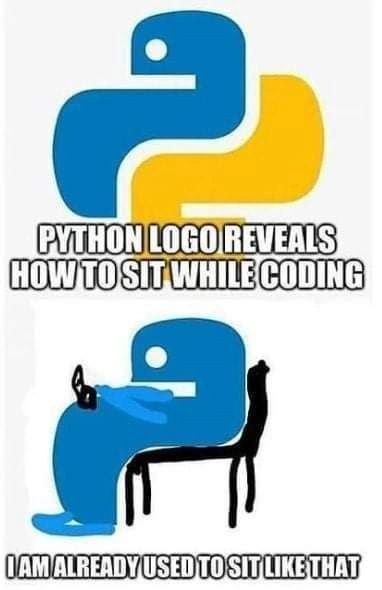
Imagine you’re playing your favorite video game or drawing for a long time, and you don’t even notice that you’ve started sitting in a really funny, tangled position. Maybe you’ve got one leg tucked under you, or you’re all hunched over like a big croissant. Later, when you finally stop, you feel your back ache and your foot’s gone numb – oops! This meme is just like that, but for grown-up programmers. It’s saying the Python snake logo is secretly showing us the silly way many coders sit at their computers. The top of the picture jokes that the logo is a guide on “how to sit while coding,” and the bottom says, “I already sit like that.”
It’s funny because it’s true: lots of people who write code get so caught up in what they’re doing that they look like a pretzel in a chair, just like the twisted snake shape in the logo. Even though we all know we should sit up straight (just like kids know they should listen when a teacher says “sit properly!”), when something is really interesting we kind of forget and fold up like a lazy snake. So this picture makes us laugh and go, “Haha, that’s me!” It’s a lighthearted reminder that even super smart computer folks can be a bit silly with how they sit. In simple terms: the meme is joking that the way the Python logo is drawn looks like a person sitting all bent and curled up – exactly how many of us actually look when we’re coding happily for hours. It’s a funny way of saying, “Hey, we’re all in the same boat – or should we say, the same chair – when it comes to bad sitting habits!”
Level 2: The Coiled Coder
For those newer to programming or the joke here, let’s break it down. This meme combines a famous programming language logo with a bit of self-deprecating physical humor. The logo in question is the blue-and-yellow Python logo, which many recognize even early in their coding journey. Python (the language) is extremely popular – it’s taught in schools, used by companies like Google, and loved for its simplicity and power. The logo itself shows two snake-like shapes curled around each other, forming kind of a yin-yang pattern (since the language is named after the python snake and Monty Python comedy).
Now, the meme’s creator has drawn on top of this logo to make the blue part look like a person slouching in a chair. They even added a tiny laptop in the figure’s hands. The yellow part of the logo ends up looking like the person’s legs folded under them on the chair. It’s a logo parody – a fun alteration of a well-known image to give it a new meaning. The top half of the meme announces in big bold text: “PYTHON LOGO REVEALS HOW TO SIT WHILE CODING.” The bottom half basically says: “I ALREADY SIT LIKE THAT.”
Why is this funny to developers? It’s poking fun at developer ergonomics – that’s the fancy term for how we sit and use our keyboards/mice in a healthy way. In theory, we’re supposed to follow good ergonomic practices: sit up straight, keep our monitor at eye level, feet flat on the floor, take breaks to stretch, etc. But in reality, many coders (myself included, especially when I was a beginner) end up sitting in all sorts of weird postures when we’re in the zone writing code. Maybe you’ve seen or done this: curling one leg underneath you, or hunching over the laptop on a couch, or craning your neck forward like a turtle to get closer to the screen. After a few hours of debugging or intense coding, you look pretty much like that twisted Python logo person!
So the meme is basically a “that’s so true!” moment for people in tech. CodingLife can sometimes mean long hours at the computer, and it’s easy to forget about posture when you’re concentrating hard. This is often shared in developer humor circles because almost everyone who writes code has caught themselves in a ridiculous sitting pose at some point. The line “I am already used to sit like that” is written as if a programmer is proudly (or sheepishly) admitting: Yep, I already sit exactly like this contorted Python snake when I code. It’s funny and a little ironic – we use advanced technologies and write clever code, but we can’t even keep our backs straight!
Let’s also clarify a few terms and tags here:
- Python: a high-level programming language known for readable code and a friendly community. The fact that its logo is recognized widely makes the joke work – most devs instantly know that blue-and-yellow snake symbol.
- DeveloperExperience_DX: “DX” stands for Developer Experience, which usually refers to how easy and pleasant it is for developers to use certain tools or work in a team. Here it’s a playful use: part of a good developer experience is also having a comfy, healthy workspace – something we often overlook.
- Ergonomics: the science of designing things so people can use them easily and safely. In a coding context, that means having the right chair, desk height, keyboard position, etc., to avoid hurting your body. Good ergonomics means you shouldn’t end up twisted like a pretzel after work.
- MemeCulture: tech folks love memes – inside jokes in image form. This meme is a product of developer meme culture, where we take everyday coding struggles and make them into jokes that only insiders might fully get (like knowing what the Python logo looks like, or understanding that coders have a posture problem).
- coding_posture and sitting_while_coding: simply refer to how programmers sit when they’re writing code. It sounds mundane, but as you can see, it’s a big enough part of the daily routine that we joke about it.
- logo_parody: as mentioned, it means taking a famous logo (here Python’s) and altering it for humor or commentary. It works because the image is so recognizable; seeing it “wrong” immediately catches our attention.
In short, the meme humorously exaggerates a common developer experience: getting so absorbed in coding that you unconsciously start sitting like a human-Slinky. It resonates with junior devs and veterans alike because it’s a shared experience — a little embarrassing, a little painful, but definitely funny when you see it illustrated like this. And who knew? Maybe the Python logo designer was subconsciously inspired by a coder slumped at their desk! (Just kidding, of course – it’s really supposed to be two snakes).
Level 3: The Pythonic Posture Paradox
At first glance, this meme mashes together Python’s iconic two-snake logo with an uncanny ergonomic twist – literally. In true developer humor fashion, it satirically suggests the language’s logo has been secretly instructing our seating habits all along. This reimagining transforms the blue snake into a slouching coder and the yellow snake into folded legs, perfectly capturing that pretzel-like coding posture many of us adopt after a marathon debugging session. It’s equal parts absurd and too real.
On a deeper level, the humor lands because of a paradox: Python is known for its clean and readable syntax (the “Zen of Python” preaches simplicity and clarity), yet here it’s associated with a tangled physical form. We pride ourselves on writing elegant, well-structured code, following style guides like PEP 8 for clarity, but meanwhile our own bodies resemble spaghetti code – all twisted up. It’s a cheeky reminder that while we meticulously refactor our code, we might be neglecting to refactor our sitting habits. The meme highlights an open secret in developer culture: as focused and high-level as our code can get, we often forget about the low-level hardware we’re running it on – namely, our own necks, backs, and wrists.
The senior folks reading this will nod knowingly (and perhaps adjust their chairs). We’ve all experienced the flow state where hours vanish in an eyeblink while coding, until a crick in your neck or a numb leg rudely breaks the trance. The longer you code in an engrossed state, the more likely you’ll unconsciously morph into that “Python logo” posture – back curved, legs tucked under or wrapped around a chair leg, one shoulder higher than the other as you lean into the screen. It’s practically a rite of passage in the coding world: realize one day that you are that coiled snake.
This meme also pokes fun at developer ergonomics and the realities of CodingLife. Modern Developer Experience (DX) isn’t just about slick IDEs, fast build tools, or CI/CD pipelines – it’s also about the physical experience of being a coder. Companies can buy everyone fancy Herman Miller chairs or standing desks, but an engrossed programmer might still sit cross-legged on that $1000 chair or hunch over a laptop on the couch. Old habits die hard. We tend to optimize everything except ourselves. The Python community loves friendly, readable code, but unfortunately there’s no built-in import ergonomics module to magically straighten your spine while you import libraries.
In fact, the logo parody here is brilliant because it connects a language we love with a behavior we’re ashamed of (but laugh about). It’s reminiscent of classic hidden-message logos (like the arrow hidden in FedEx) – once you see the “person shaped like a pretzel” in the Python logo, you can’t unsee it. And for many of us, it’s basically a mirror. The caption “I AM ALREADY USED TO SIT LIKE THAT” underscores the joke: we don’t even need the Python logo’s advice; we’ve been unintentionally practicing this unhealthy posture for years! It’s comedic relief with a whiff of self-deprecation.
A seasoned dev might even be reminded of acronyms like PEBCAK (“Problem Exists Between Chair and Keyboard”) – traditionally a joke blaming user error, but here literally the problem is between the chair and keyboard: it’s us, twisted into a knot. There’s a wry TechHumor truth that while we solve complex problems in code, we often introduce “bugs” into our own bodies (stiff neck, carpal tunnel, back pain). This meme uses Python’s huge relatability (one of the world’s most popular programming languages) to say: look, even our beloved tools might be laughing at how we sit. It’s a cultural inside-joke for developers, merging MemeCulture with a health PSA (albeit a playful one). And given Python’s origin – named after Monty Python – there’s a fitting full-circle here: the language that took its name from comedy now becomes the butt of an ergonomic joke. One could almost imagine a Monty Python sketch called “Ministry of Silly Coding Postures.”
To seasoned eyes, the coding_posture depicted is an all-too-familiar sight during late-night coding sprints or crunch times. We have workarounds for everything in code, but as this meme winks, maybe we need a workaround for ourselves. Until then, the Python community might tongue-in-cheek propose a new guideline: “Explicit is better than implicit, and upright is better than slumped.” Remember, the code may be running on cloud servers, but the coding is done on a human body – take care of that infrastructure, or you’ll get some downtime.
# Pseudo-code illustrating the coder's posture deterioration over time:
while coding_intensely: # inside the flow
if posture.is_proper():
posture = posture.contort_into("pretzel") # gradually slouch more
if coffee.empty():
coffee.refill() # fuel up to keep coding
commit_code_changes()
# Outcome: Code runs smoothly, but developer resembles a coiled Python logo.
Description
A two-panel meme. The top panel displays the official Python logo, which consists of two intertwined snake-like shapes, one blue and one yellow. White text with a black outline is overlaid, stating, 'PYTHON LOGO REVEALS HOW TO SIT WHILE CODING.' The bottom panel features the same logo, but the blue shape has been crudely doodled on to resemble a person slumping in a chair. Simple black lines form the chair, and blue additions create arms and the impression of a head looking down at a phone or device. Below this, the caption reads, 'I AM ALREADY USED TO SIT LIKE THAT.' The humor stems from the creative and relatable reinterpretation of the abstract logo as a person in a poor, slouched posture, a familiar sight for developers engaged in long coding sessions. It's a lighthearted commentary on developer work habits and ergonomics
Comments
8Comment deleted
It's the Zen of Python, posture edition: 'Flat is better than nested.' Applies to your spine, apparently
Apparently the Python logo is a seating guide - after 20 years fighting the GIL, both my threads and my lumbar spine have accepted they’ll never run in parallel
After 15 years of debugging async/await chains and generator comprehensions, you realize the Python logo wasn't a design choice - it was a prophecy of your spine's eventual configuration from hunching over stack traces at 2 AM
The Python logo has been teaching us proper coding posture all along - we just interpreted 'snake_case' a bit too literally with our spines. After 15 years of architecture reviews and production incidents, I've realized the real technical debt isn't in the codebase, it's in my lumbar region. At least Python's GIL prevents my vertebrae from executing in parallel
My posture is so Pythonic that even my spine obeys PEP 8 indentation; thanks to the GIL, only one vertebra moves at a time
Python's logo: the original design pattern trading spinal rigidity for interpretive flexibility during legacy refactors
PEP 8 tells you how to indent; the Python logo tells you how to indent your spine. Every time I sit up straight, Black reformats me back to the default snake-slouch
Looks like a snake having a kyphoscoliosis, or pregnant she-calot. PS. Deal with this dear developers 😈. Comment deleted