The Dunning-Kruger Effect of Learning C++
Why is this Learning meme funny?
Level 1: The Newbie Know-It-All
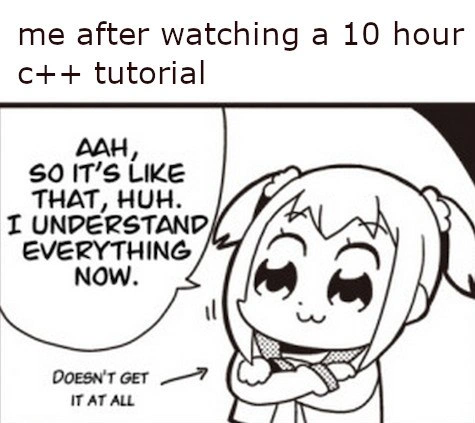
Imagine you just learned how to ride a bike with training wheels, and after a day of wobbling around, you claim “I’m ready for the Tour de France!” That’s basically what’s happening in this meme, but with coding. The picture shows a cartoon girl looking super proud and saying, “I understand everything now.” That’s like a student coming out of one long class and saying, “I know it all, ask me anything!” It’s funny because everyone else knows she doesn’t actually get it at all – the small text even says that, just to make it clear.
Why is this funny? Because we’ve all felt that way at some point. Maybe you watched a bunch of videos about how to cook and then thought, “I can open my own restaurant, easy!” Or you read a guide about soccer techniques for a few hours and told yourself you could play in a professional match. That over-the-top confidence right after learning just a little bit – it’s a very human thing. We get excited and think, “Oh wow, so that’s how it works. I’ve got it now!” But the truth is, there’s a big difference between hearing or reading about something and actually doing the thing in real life.
In the case of this meme, the “thing” is the C++ programming language. C++ is kind of like a super complicated video game – there are lots of rules and ways to play. The character in the meme just watched a really long tutorial (10 hours!) about how to code in C++. It’s like binge-watching a whole season of a show about coding. After all that, she’s feeling smug (very self-satisfied) and thinks, “Aha! I totally get it now, I’m a master programmer!” The joke is that anyone who actually writes code or has tried to learn C++ knows that 10 hours is just a start. She’s standing at the foot of a huge mountain but acting like she’s on the peak.
So, in simple terms, this meme is funny because it’s a cartoon exaggeration of a beginner who thinks they know everything after a short time, when really they have a lot more to learn. It’s poking fun at that burst of confidence that doesn’t match reality. The little caption “doesn’t get it at all” is like the narrator whispering to us, “She has no idea what she’s talking about, but let’s let her believe for a moment.” It’s a gentle, relatable joke about being a newbie – one that almost anyone can understand, whether it’s about coding, or any time you feel overly confident too soon.
Level 2: Pointers and Pitfalls
Let’s break down what’s going on in simpler terms. C++ is a programming language – one of the most powerful and widely used, but also one of the trickiest to learn in depth. When we talk about a steep learning curve, we mean that as you try to learn more, things get hard really fast. Imagine a hill that suddenly becomes a mountain; that’s C++ learning in a nutshell.
In the meme, someone says “After a 10-hour C++ tutorial, I understand everything now.” That’s a joke because C++ has so many layers and details that it’s pretty much impossible to learn in just one sitting (even one as long as 10 hours!). Sure, after ten hours of instruction, you might understand the basics:
- You know how to write a simple program with a
main()function. - You can use variables, loops, and maybe create a basic class or two.
- You’ve heard terms like pointers (a pointer is basically a variable that holds a memory address – think of it like a house address pointing to where data lives in memory) and perhaps you saw how to use
newto create something anddeleteto free it.
But here’s the thing: knowing these concepts at a surface level isn't the same as truly mastering them. Pointers, for example, are a classic source of confusion and errors for newcomers. In a controlled tutorial example, a pointer might seem straightforward (“Oh, it’s just an address, got it.”). The tutorial likely showed how to use a pointer to refer to something and maybe how to allocate memory dynamically. But C++ has a lot of pitfalls: if you use a pointer wrong – say, point it at the wrong thing or forget to free memory – your program can misbehave in ways that are not obvious. It might crash with a segmentation fault (that’s when the program tries to access memory it’s not supposed to, kind of like opening a door to a room that you don’t have the key for, and the system stops you). A beginner fresh from a tutorial might not have experienced that crash yet, so they feel confident. The meme’s little caption “doesn’t get it at all” refers to this gap: the person doesn’t yet understand those pitfalls awaiting in real coding.
The style of the meme is an anime_meme_panel – specifically a frame from Pop Team Epic, drawn in a cute chibi style (chibi means the character is drawn small and cartoony with exaggerated expressions). In the panel, the character crosses her arms with a smug smile, saying “So it’s like that, I get everything now.” This pose and expression are something you’d associate with feeling proud and accomplished. It’s like a student walking out of a class going “Yep, aced it, I know it all.” But then the meme immediately undermines that with the tiny text “doesn’t get it at all,” a comedic way to tell the audience that the person is actually clueless despite their confident stance. The contrast is the joke – big confidence, small actual understanding.
To relate this to a LearningToCodeJourney: many of us start learning to code by watching videos or reading tutorials. After absorbing a lot of information quickly, it’s easy to feel very smart. “I learned about inheritance, loops, and functions, wow I’m basically a programmer now!” – that kind of feeling. This meme is gently poking fun at that stage. LanguageComplexity comes into play because C++ isn’t like some simpler languages (for example, Python has a gentler learning curve at the start). C++ has a reputation: it’s powerful but you can shoot yourself in the foot if you’re not careful. There are entire books and many years of experience behind truly understanding its nuances.
The tag false_confidence captures this perfectly: the character’s confidence is not based on real-world experience, just on consuming a lot of theoretical knowledge in one go. A long_form_tutorial (like a 10-hour video course) can be really helpful, but coding is one of those skills where you only realize what you didn’t understand when you try to apply it. The meme’s text implies the person has not actually tried writing their own complex program yet – they just watched someone else explain things and maybe do demos. That’s like watching 10 hours of driving instruction videos and saying “Alright, give me the keys, I can drive anywhere now!”
So in summary, at this level: C++ is a hard language that takes a lot of practice. Ten hours of learning gives you important basics, but there’s a lot more to it. The meme uses a fun anime illustration to show a newbie developer who feels on top of the world after a tutorial, while a tiny caption (and the knowing developer community) laughs because we all know that feeling is premature. It’s a slice of DeveloperHumor: we laugh with that newbie (since we’ve been there) and brace ourselves for when they hit the real challenges and go “Oh… I guess I didn’t understand everything after all.” It’s not meant to discourage learning, but to highlight a common stage in becoming a programmer – that moment when confidence runs ahead of actual experience.
Level 3: Confidence Overflow
For seasoned developers, this meme nails the Dunning-Kruger effect in programming, especially with a tough language like C++. A newcomer binge-watches a 10-hour C++ tutorial and walks away feeling like a guru – we’ve either been that person or mentored that person. The humor comes from the disconnect between confidence and competence. In the image, the chibi character’s smug expression (“AAH, SO IT’S LIKE THAT, HUH. I UNDERSTAND EVERYTHING NOW.”) perfectly caricatures that know-it-all phase many juniors go through. Meanwhile, the tiny caption “DOESN’T GET IT AT ALL” is the punchline: an omniscient narrator (or reality itself) poking fun at the character’s false confidence. It’s a case of comprehension_vs_reality – the character thinks they’ve mastered C++, but anyone who’s wrestled with the language knows that feeling is an illusion.
Why is it so funny and relatable in a developer context? Because C++ has a notorious learningCurve. It’s a rite of passage to go from “I can totally build anything in C++ now” to the humbling realization “Oh no, I barely understand how a std::vector actually works under the hood.” Ten hours of video can teach you syntax (for loops, if statements, defining classes) and maybe a surface tour of concepts (like “this is a pointer, this is how you print with std::cout”). But C++ is one of those complex_programming_language ecosystems where the devil is in the details. After a tutorial, you might know the rules in theory, but in practice you’ll inevitably hit a wall of quirky behavior and gotchas the videos didn’t (and couldn’t) fully cover.
Consider what our overconfident junior hasn’t encountered yet, but inevitably will:
- Memory management nightmares: Double freeing memory, memory leaks from forgetting a
delete– those bugs that don’t show up in a simple tutorial example but will bite in a real project. The first time a program mysteriously chews up 2 GB of RAM because of a forgottendelete[], reality sets in. - The dreaded segmentation fault: That moment when dereferencing a wild pointer (
int *p = nullptr; *p = 42;) crashes the program, and our newbie sits there baffled. Debugging a segfault is a harsh lesson that watching a video isn’t the same as truly understanding pointer safety. - Cryptic compiler errors: Real C++ code (especially with templates or linking multiple files) can produce error messages that span pages. A beginner’s tutorial likely had tidy examples that compiled easily, so a multi-paragraph template error or a linker error (
undefined reference to foo) will feel like reading hieroglyphs. This is when the “I know everything” sentiment evaporates. - Evolving language standards: C++ is regularly updated (C++11, C++14, C++17, C++20…). A 10-hour tutorial might be using an older standard or a subset of modern C++. An apprentice developer might not realize how much the language has grown. Seasoned devs chuckle because we recall thinking we’d “mastered” C++98 years ago, only for new standards to introduce features like lambdas,
autotype deduction,constexpr, and smart pointers that again expanded what we needed to learn. There’s always “one more thing” in C++.
The meme’s anime style (from the absurdist comedy Pop Team Epic) adds to the humor by using an exaggerated chibi character to represent the junior developer’s mindset. Pop Team Epic is known for mocking tropes and breaking the fourth wall, which aligns perfectly here: the character smugly declares mastery, literally saying “I understand everything,” while the art style and caption scream the opposite. It’s a visual false_confidence gag that developers recognize instantly. We remember finishing our first long tutorial or course and feeling on top of the world – only to later realize we’d climbed a mere hill in front of a mountain range.
In the world of developer humor, this scenario is classic. It’s poking fun at the enthusiasm of newbies on their LearningToCodeJourney, not out of malice, but out of camaraderie. Every senior developer has war stories of early overconfidence. The senior perspective knows that truly “mastering” C++ might take years (if ever). So when we see a junior emerge from a marathon tutorial saying “So it’s like that, huh. I get it now,” we grin because we know a humbling but valuable set of lessons is coming their way. The meme is basically the veteran dev community winking and saying, “We’ve all been the smug newbie, but don’t worry – you’ll understand how much you don’t understand soon, and that’s when the real learning begins.”
Level 4: The Multi-Paradigm Hydra
At the deepest technical level, C++ is less a single language and more a many-headed beast. A 10-hour tutorial barely scratches one of those heads. Why? Because C++ is a multi-paradigm monster that integrates procedural C heritage, object-oriented design, generic programming with templates, and even functional programming features. Each paradigm is a full domain of expertise. Mastering one head (say, basic OOP with classes and inheritance) doesn’t tame the others (like template metaprogramming or low-level pointer arithmetic).
Under the hood, C++ templates are so powerful that they’re actually Turing-complete at compile time. This means you can (accidentally or intentionally) write template code that never ends or produces mind-bending compiler errors – something our overconfident newbie in the meme has likely never imagined. In fact, there’s a famous saying: “You don’t fully grok templates until you’ve seen a compiler recursively instantiate them to the point of exhaustion.” A marathon tutorial probably didn’t cover template meta-programming Tar Pits where a simple mistake can produce a 20-line error message of cryptic std:: gibberish. That smug anime character proclaiming “I understand everything now” hasn’t yet encountered a template error that looks like line noise.
Then there’s the C++ memory model – another Hydra head. C++ gives you direct control over memory with pointers and manual allocation (new and delete or malloc/free from its C subset). But with great power comes great responsibility and the potential for undefined behavior. Undefined behavior is a deep language concept where the standard intentionally doesn’t specify what should happen for certain errors (like reading memory out of bounds). This isn’t just a quirk; it’s rooted in compiler theory and hardware. By leaving behavior undefined, compilers are free to optimize aggressively without extra runtime checks, achieving the legendary “zero-cost abstractions” that C++ strives for. However, it means if you misstep – say, by writing past the end of an array – your program might segfault (crash) or worse, silently corrupt data. To truly master C++, one must understand these under-the-hood mechanics: how the compiler translates code to machine instructions, how the CPU’s memory caching and pointers interact, how the C++ standard defers to system-level behavior. A beginner fresh off a tutorial, feeling triumphant for conquering some syntax, has no idea of the vast ocean of complexity beneath their “Hello, World!” program.
Even concurrency in C++ would be an entirely new level: threads, atomic operations, memory orderings – concepts that flirt with theoretical computer science (like the halting problem when reasoning about thread interleavings). The language complexity is so enormous that legend says even Bjarne Stroustrup (C++’s creator) doesn’t remember every corner case! In short, the meme humorously highlights a classic illusion: thinking one has slain the dragon after a short skirmish, unaware that the Hydra of C++ has many more heads waiting. That 10-hour tutorial is a decent introduction, but it’s like reading the Cliff’s Notes to a thousand-page epic – the real content (and drama) lies in the chapters ahead.
Description
This is a two-part meme about the difficulty of learning C++. The top section has the text 'me after watching a 10 hour c++ tutorial'. The bottom section is a black and white manga panel from 'Pop Team Epic' featuring the character Popuko. She has a smug, self-satisfied look with her arms crossed. A speech bubble from her says, 'AAH, SO IT'S LIKE THAT, HUH. I UNDERSTAND EVERYTHING NOW.'. Below the speech bubble, an arrow points to the character with the caption, 'DOESN'T GET IT AT ALL'. The humor stems from the notoriously steep learning curve of C++. The meme perfectly illustrates the Dunning-Kruger effect, where a beginner gains a small amount of knowledge and develops an inflated sense of competence, completely unaware of the vast complexity they have yet to face, such as pointers, memory management, and undefined behavior

Comments
7Comment deleted
He finally understands pointers. He just doesn't understand why his is currently pointing to a laundromat three towns over
Finishing a 10-hour C++ crash course and declaring mastery is like skimming the ISO spec’s table of contents and assuming you’re ready to implement your own ABI - sure, you can write `auto&& x` now, but you still don’t know whether you just moved, forwarded, or accidentally triggered UB in three dimensions
After 10 hours of C++ tutorials, you finally understand why your company's 15-year-old codebase uses void pointers everywhere: the original architect watched the same tutorial and gave up halfway through templates
Ah yes, the classic post-tutorial enlightenment phase - where you've just absorbed 10 hours of C++ wisdom covering everything from RAII to template metaprogramming, and you're absolutely certain you could architect a memory-safe, zero-cost abstraction framework... right up until you try to implement a simple linked list and spend three hours debugging a segfault caused by a dangling pointer you swore you understood 'conceptually.' The gap between watching someone explain move semantics and actually reasoning about object lifetimes in production code is roughly the size of the entire STL documentation
C++ enlightenment after 10 hours: 'I get it!' - until SFINAE kicks in and reality templates your illusions
Ten hours of C++ buys you the confidence of main(), then two-phase lookup, ADL, and an ODR violation inline your certainty as dead code
Ten-hour C++ tutorial: “I get it.” Five minutes of auto&&, SFINAE, and an ODR violation: the linker strongly disagrees