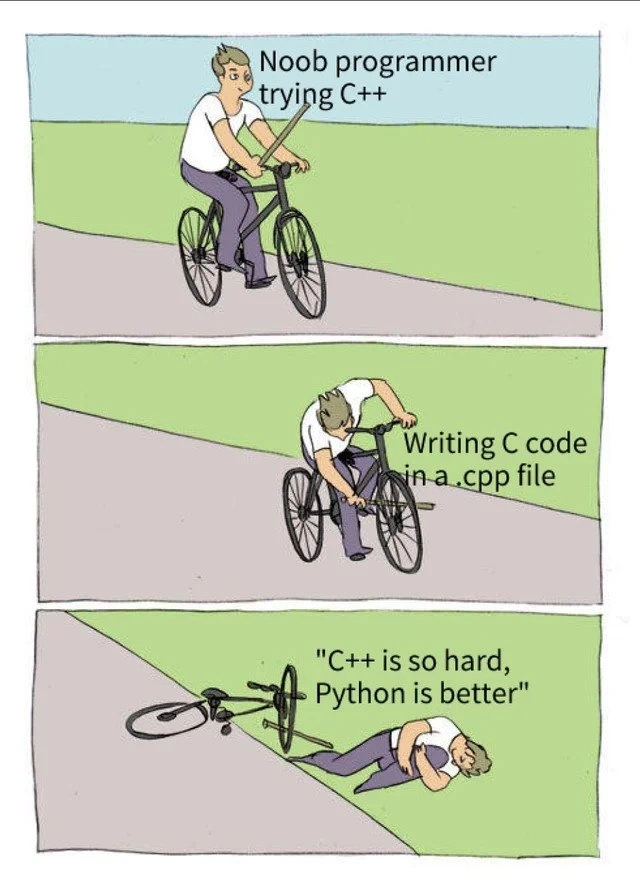
When a rookie writes C in C++ then blames the language’s difficulty
Why is this Languages meme funny?
Level 1: Blame the Bike
Imagine you have a really cool new bike that can go super fast, but it’s a bit tricky to use because it has lots of gears and features. Now, instead of learning how to use those features, you do something silly – like stick a branch in your own wheel while riding. Of course, the bike flips and you crash. Ouch! Then you get up, dust yourself off, and say, “This bike is awful! My old tricycle is way better!”
That’s exactly what’s happening in this joke. The beginner programmer is like the person on the fancy bike who didn’t use it properly. C++ is the fancy bike – powerful but complex – and the newbie programmer “stuck a stick in the wheel” by using it the wrong way (writing code in an old, clumsy style). The crash is the program failing. Instead of saying “Oops, I used it wrong,” the beginner blames the bike (C++) and runs back to the easy tricycle: in this case, Python, which is a much simpler, beginner-friendly tool (like a stable tricycle you can’t go very fast on, but it’s safe and easy).
The humor comes from us watching this and thinking: “Well, the bike isn’t really the problem… it was how you rode it!” It’s funny and a little cute because we’ve all seen someone (or been someone) who blames the tool instead of understanding the mistake. It’s like a kid tying their shoes wrong, tripping, and then saying, “These stupid shoelaces! Velcro shoes are so much better.” The truth is the laces are fine—you just have to tie them correctly. In the same way, C++ as a language is fine (and very powerful), but you have to use it the right way or you’ll trip yourself up. The meme makes us smile because it shows a beginner literally tripping themselves and then complaining that something else is at fault. It’s a playful reminder that sometimes, when things go wrong, we need to check if we’re holding the stick before we blame the bike.
Level 2: C vs C++ Crash Course
Let’s break down what’s happening in this meme for those newer to programming. It’s showing a series of images (a popular bike-fall comic) to tell a story:
- Panel 1: A “Noob programmer trying C++” – this is a beginner (noob means newbie) who is starting out with C++, riding the bike confidently at first.
- Panel 2: The same programmer “Writing C code in a .cpp file,” which is like the biker jamming a stick into their own wheel. In coding terms, that means they are using C++ the wrong way. A .cpp file is a file for C++ source code. C code refers to using the C programming language style – an older, lower-level way of coding – inside a C++ program. C and C++ are related (C++ was created as an extension of C), but C++ has “plus-plus” features (hence the name) like classes, objects, and a big standard library to make certain tasks easier and safer. Writing “C code in C++” typically means the programmer isn’t using those helpful features; instead, they’re using C++ as if it were just C. This often involves doing things manually (like handling memory or strings in a very low-level way) when C++ offers higher-level tools to do it for you.
- Panel 3: The biker has crashed and is holding his knee, with the caption “C++ is so hard, Python is better.” This represents the rookie programmer after their C++ program likely failed or became too complicated. They conclude that “C++ is hard” and compare it to Python, saying Python is better. Python is another programming language, one known for being easy to learn and use (it’s interpreted, with simple syntax and it manages a lot of things like memory automatically so you don’t usually deal with the kinds of errors you get in C++). Essentially, the beginner tried C++, got hurt by their own mistakes, and then said, “Forget this, Python is better for me.”
Now, why did the programmer crash (fail) by writing C code in a C++ file? Here are some key concepts:
- C vs. C++: C is a procedural language (you write sequences of steps for the computer to follow, and you manage most things yourself). C++ supports that style but also supports object-oriented programming (OOP) and other paradigms. C++ gives you tools like classes (to bundle data and functions together), std::vector or std::string (ready-made dynamic arrays and string types that handle memory for you), and many more. If you ignore these and only use low-level C techniques, you miss out on what makes C++ easier and safer. It’s like having a modern car but driving it like a very old car with none of the new safety features engaged.
- “Writing C code in a .cpp file”: This phrase implies the programmer is likely using things like
mallocandfreefor memory (as you would in C) instead of new C++ features like smart pointers or vectors. Or they might be doing simplestructdefinitions and not using classes or C++ libraries. This can lead to common C-language problems: memory leaks, buffer overflows, pointer bugs, etc. C++ actually provides ways to avoid many of these issues (for example,std::vectorprevents you from accidentally going out of bounds of an array, and it automatically cleans up memory). - C++ learning curve: C++ is known to be a bit tough for beginners because there’s a lot to learn. It’s powerful and fast, but you have to understand concepts like pointers (variables that hold memory addresses), manual vs automatic memory management, and the proper use of all those extra features. Beginners often get tripped up (pun intended!) by these details, especially if they approach it like it’s just another simple scripting language.
- Python comparison: When the character says “Python is better,” it reflects a common sentiment among new developers. Python is indeed much easier to start with: it’s interpreted (no need to compile your code), it has garbage collection (it automatically manages memory for you), and its syntax is more English-like and forgiving. So after struggling with C++, a newbie might feel Python is a relief. However, the meme’s joke is that the C++ struggle was largely self-inflicted. Python didn’t magically solve the underlying problem that the programmer wasn’t using the right approach in C++ – but Python does shelter beginners from those low-level problems altogether. This ties into the ongoing LanguageWars: people love to debate which language is better, but often it’s about using the right tool for the right job and skill level.
Think of it this way: C++ gives you a lot of control and efficiency. You can write programs that run super-fast and fine-tune how memory and CPU are used – which is why it’s popular for things like game engines or high-performance systems. But with that control comes complexity. Python, on the other hand, handles a lot of decisions for you and is slower in execution, but it’s very quick to write and very user-friendly (great for things like scripting, data analysis, or when development speed matters more than running speed).
The meme highlights developer experience (DX) differences: A junior developer might not yet have the experience to manage C++’s complexity, so their experience is painful. Instead of realizing “maybe I should learn more C++ techniques or use a simpler language until I’m ready,” the noob just blames C++ entirely. Seasoned devs find this both funny and a little exasperating, because we’ve all seen someone blame a language or tool for a mistake that was actually in the usage. It’s an innocence that we can laugh at because most of us have been there in our early days – saying “This is too hard, that other thing is better!” without fully understanding what went wrong.
The imagery of the bike fall is perfect here:
- The stick in the bike wheel = the rookie’s own bad coding practices in C++ (self-sabotage).
- The resulting crash = the program crashing or the project failing.
- The rider’s complaint “C++ is so hard, Python is better” = the classic blame shift, comparing a hard thing done the wrong way to an easier thing that wasn’t tried under the same conditions.
In simple terms, the meme educates that C++ isn’t “just hard”; doing things the wrong way is what makes it hard. And if you treat a powerful language like a more primitive one, you’ll just reintroduce all the old challenges and then some. A junior dev might not realize that and instead conclude any difficulty = the language’s fault. This is a common beginner vs senior perspective clash in programming. The experienced folks know that if the junior had, say, used a std::vector<int> for a dynamic array instead of manually allocating an array with new int[size], they might have avoided the crash altogether. But from the junior’s eyes, C++ let them down – while Python, which would automatically give them a list without fuss, seems superior.
So, the meme is gently poking fun at the learning process. It highlights how learning curves work: C++ has a steeper curve, meaning at first it’s more difficult especially if you don’t follow its conventions, whereas Python has a gentle curve. It’s also hinting: don’t blame the bike if you stuck a stick in the spokes. Or in programming terms, don’t blame the language if you weren’t using it correctly. A wiser approach would be to learn the language’s features or choose a tool appropriate for your expertise. But of course, it’s easier (and funnier) to just cry out, “Bah, C++ sucks, long live Python!” 😉
Level 3: C++ Without the ++
In this meme, an overconfident junior developer is metaphorically jamming a stick into their own bike wheel by writing C code in a .cpp file. To a seasoned C++ programmer, this scenario is instantly recognizable – and darkly funny. It’s the classic tale of a beginner using C++ as if it were just plain C (ignoring all the “++” improvements), then wiping out in a crash of bugs and frustration. The humor comes from the all-too-familiar pattern: a self-inflicted coding disaster followed by blaming the programming language.
Why is this combination humorous? Because any senior developer knows that C++’s difficulty skyrockets when you don’t actually use its features. The rider (the noob programmer) could have enjoyed a smooth journey by using C++ idioms – things like std::vector instead of manual arrays, or std::string instead of C-style char buffers. Instead, they stuck with old-school C practices (manual malloc/free, raw pointers everywhere), effectively removing the “++” from C++. It’s like using a high-performance sports car only in first gear and then complaining it drives horribly. The meme captures that absurdity: the developer chose a harder path and then declared “C++ is so hard, Python is better,” as if the language is at fault rather than their approach.
This speaks to a bigger industry pattern. We have a term for this: “Writing C++ in C style” – a notorious newbie mistake. C++ was designed to be backwards-compatible with C for flexibility, but that’s a double-edged sword. Beginners often learn a bit of C syntax or treat C++ as “C with some extra stuff” and never embrace its powerful abstractions (like Object-Oriented Programming, RAII, templates, the STL containers). They end up managing memory manually and wrestling with pointers, which is error-prone and feels incredibly hard. Senior devs chuckle (or cringe) at this because they’ve seen it countless times: a junior ignores best practices, hits a nasty segfault or memory leak, then loudly proclaims the language is terrible. It’s the programming equivalent of sabotaging yourself and then feeling victimized.
Let’s unpack the technical reality here. When you “write C code in a .cpp file,” you might do something like:
// C-style approach in C++
#include <cstdio>
#include <cstdlib>
#include <cstring>
int main() {
char *buffer = (char*) std::malloc(50); // manually allocate memory
std::strcpy(buffer, "Hello, world!"); // C-style string copy
std::printf("Greeting: %s\n", buffer); // C-style output
std::free(buffer); // manually free memory
return 0;
}
Compare that to a more idiomatic C++ approach:
// Modern C++ approach
#include <iostream>
#include <string>
int main() {
std::string buffer = "Hello, world!"; // std::string manages memory for us
std::cout << "Greeting: " << buffer << std::endl; // C++ style output
// no need to free anything manually; std::string cleans up automatically
return 0;
}
In the first snippet, the C-style code is doing everything by hand – allocating memory, copying strings, freeing memory – which is risky and easy to mess up. In the second snippet, C++’s standard library (<string> and <iostream>) does the heavy lifting safely. This is the “++” part of C++ at work: RAII (Resource Acquisition Is Initialization) automatically releases memory when objects go out of scope, preventing many bugs. The noob in the meme ignored these features. Essentially, they wrote C in C++, got all the usual C-language problems (memory management headaches, more verbose code), and then concluded C++ is awful.
Experienced developers find this funny because it’s painfully relatable. We’ve either made these mistakes ourselves or spent late nights debugging someone else’s. It highlights a gap between knowing a language’s syntax and knowing its idioms. C++ is powerful but complex; it demands understanding of its paradigms. As the saying goes, “With great power comes great responsibility.” Use C++ correctly and you get high performance and high-level conveniences. Use it poorly and you get the worst of both worlds – complexity and crashes – just as our biker found out. The meme also pokes at the tendency of some beginners to jump to “Language Wars” conclusions. Instead of reflecting on their mistakes, they’ll say “Python is better” because Python (a very beginner-friendly language) didn’t make them crash. Seasoned devs recognize this knee-jerk reaction: it’s much easier to blame the tools than to admit “I didn’t know what I was doing.”
There’s also an element of shared developer trauma in the humor. Many C++ veterans had a phase where they treated C++ as just C with extra libraries, and they learned the hard way why that’s problematic. The bike crash imagery perfectly captures the steep learning curve of C++: if you approach it with the wrong mindset, you will fall on your face. And the final panel’s quote about Python evokes countless real-world forum debates where frustrated learners announce they’re switching to an easier language after a bad experience. It’s a tongue-in-cheek reminder that tools must be used as intended. You wouldn’t use a power drill to hammer a nail, and you shouldn’t use C++ as if it were 1970s C. If you do, well… don’t be surprised when things go flying and you end up clutching your knee.
Description
Three-panel bike-crash meme: Panel 1 shows a cyclist riding on a path; caption: “Noob programmer trying C++.” Panel 2 shows the same rider bending down and jamming a stick into his own front wheel; caption placed beside this action reads: “Writing C code in a .cpp file.” Panel 3 shows the rider on the ground clutching his knee while the bike lies toppled; caption above him says: “'C++ is so hard, Python is better'.” The visual joke represents beginners misusing C++ by ignoring its idioms, causing self-inflicted pain, and then declaring that Python is superior. Technically, it highlights language paradigms, proper use of C++ features versus C style, and the steep learning curve that new developers face
Comments
18Comment deleted
Writing C in a .cpp and declaring “C++ is impossible” is the same energy as cramming a 2-million-line monolith into one Kubernetes pod, then blogging that containers don’t scale
The real crash happens when you discover your 'simple' C++ program has undefined behavior in three different ways, but only manifests on Tuesdays in production when compiled with -O2 and the moon is waxing gibbous
Writing C in a .cpp file isn't 'trying C++' - it's the linguistic equivalent of buying a Tesla and pushing it to work
Every senior engineer remembers their first encounter with C++: confidently starting with 'how hard can pointers be?', then discovering template metaprogramming exists, and finally understanding why Rust was invented. The real tragedy isn't the crash - it's that the bike represents your carefully crafted mental model of programming, and C++ just taught you about undefined behavior, RAII, the rule of five, and why 'auto' is simultaneously your best friend and worst enemy
Veterans: We've shipped C in .cpp since before RAII; noobs crash before virtual destructors
Writing malloc/printf in a .cpp and declaring ‘Python is better’ is the only A/B test where A = disable RAII/STL and B = blame the language
Write C in a .cpp, ignore RAII and std::vector, then declare “C++ is hard” - congrats on speedrunning from undefined behavior to a Python blog post
Literally me trying write rust code after years of c++ Comment deleted
Oh, really? What is the hardest part during mindset change for you? Comment deleted
Just write python in c Comment deleted
just write python in python Comment deleted
Now that's big brain thinking Comment deleted
What is so difficult with writing C code in a .cpp file? If the person is new to C++, he/she will probably write C that will constitute a totally valid C++ code that works the same way. The only exception could be a C guru, but that would be highly unlikely that such a person is a C++ noob at the same time. Comment deleted
E.g. In some cases it wont even compile as build system will try to compile c code as c++ Comment deleted
malloc works not the same way Comment deleted
you mean lack of automatic void pointer conversion? Comment deleted
It's not about "why?" - it's about "why not?". © 😁 Comment deleted
He is using C++-- then Comment deleted