Skip to content
DevMeme
1178 of 7435
Blind Obedience to the Agile Backlog
Agile Post #1314, on Apr 15, 2020 in TG

Blind Obedience to the Agile Backlog

Why is this Agile meme funny?

Level 1: The List Told Me To

Imagine your mom gives you a list of chores to do after school. The list says:

  1. Clean your room
  2. Do the dishes

So, you start with the first thing on the list – you spend the whole afternoon cleaning your room until it’s spotless. Now your mom comes home and asks, a bit upset, “Why didn’t you do the dishes like I needed you to?” You shrug and reply, “Because I was just doing what the list told me to do!” In your mind, you were following the plan, but Mom actually wanted the dishes done first because maybe guests are coming for dinner (something she didn’t clearly tell you). Now she’s annoyed, and you’re confused because you thought you were doing the right thing.

This is exactly what’s happening in the meme, just in a software office. The boss is like the parent who expected one thing, and the developer is like the kid who just followed the written list. The developer had a “to-do list” (called a backlog in work terms) of tasks. He picked the first task on that list and worked on it, just like you cleaned your room first. But the boss wanted a different task done first (like the dishes). The developer in the picture looks dazed and a bit helpless, as if saying, “I did what I was told (by the list)!” It’s funny in a relatable way: we’re laughing because we’ve all been that person doing exactly what we were told, only to find out it wasn’t what the other person really wanted. It’s a little story about how important it is for people to talk to each other and make sure they mean the same thing – otherwise you get mix-ups just like this.

Level 2: Backlog Navigation 101

Let’s break this down in simpler terms. Agile is a way of managing software projects that emphasizes flexibility and frequent communication. Instead of a fixed long-term plan, teams maintain a backlog – basically a prioritized to-do list of all the work that needs to be done (features to build, bugs to fix, improvements to make, etc.). In Scrum (a popular Agile framework), there’s a product backlog (big list of all tasks for the product, maintained by a Product Owner) and for each sprint (a 1-2 week iteration), there’s a sprint backlog (the subset of tasks the team plans to finish in that sprint). The idea is that the team pulls tasks from the backlog in order of priority, working on the most important things first.

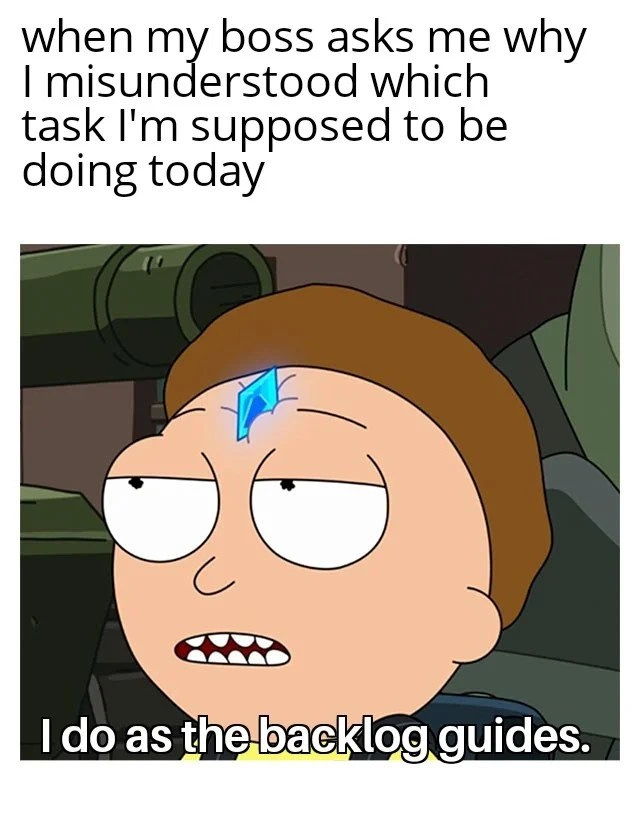
Now, the meme shows Morty with a glowing blue crystal in his forehead. This is a scene from Rick and Morty, a sci-fi comedy cartoon. In that scene, Morty has a special crystal that shows him visions of his future, and he becomes obsessed with doing only the actions that lead to the future he wants. He even says in the show, “I do as the crystal guides,” meaning he’s letting the crystal’s visions dictate all his decisions. The meme replaces that crystal’s role with the Agile backlog. So imagine Morty is a developer, and the glowing crystal is like the Jira board or Trello board (common backlog tools) telling him which task to do next. Morty’s zoned-out look is the developer being on autopilot, just following whatever the backlog lists as the next item. The text at the top of the meme sets up the scenario: the boss asks “Why did you misunderstand which task you’re supposed to be doing today?” In other words, the boss is surprised or annoyed that the developer is working on Task A when the boss thought they should be on Task B. Morty’s answer at the bottom, “I do as the backlog guides,” is a cheeky way of saying “I’m just doing what our task list said – if that’s wrong, it’s because the task list (backlog) guided me wrong.”

So why would a developer end up working on the wrong thing? This often comes down to communication issues and requirements ambiguity. Here are a few likely scenarios that younger devs or people new to Agile can relate to:

  • Ambiguous priorities: The backlog might not have been updated to reflect a recent change in priority. Perhaps Task B became more urgent (say, a bug in production) but the backlog still shows Task A at the top. If nobody explicitly told the developer “Hey, switch to Task B,” the dev might just grab Task A because it looked like the highest priority item. The boss expected them to magically know that Task B was more important, but without clear communication or backlog updates, how would they? This is a classic miscommunication problem.

  • Unclear task descriptions: Sometimes backlog items (often written as user stories) can be too vague or confusing. For example, a user story might say “Improve login experience” without clear acceptance criteria or details. A developer might interpret that differently than the boss or product manager intended. They might start working on, say, refactoring the login code for speed, whereas the boss meant “add a ‘forgot password’ feature”. When the boss checks in and asks “Why are you optimizing code instead of building the forgot password function?”, the developer can honestly point to the backlog item text and say “I thought this meant make the login faster, I was following the story as written.” They did “do as the backlog guided,” but the backlog (like Morty’s crystal) gave a hazy picture of the future! This highlights requirements ambiguity, where a story or task wasn’t clearly defined.

  • Lack of direct communication: In Agile teams, there are usually daily stand-up meetings where each developer says what they worked on yesterday and what they plan to work on today. This is a chance to catch misunderstandings. For instance, the dev would say “Yesterday I finished X, today I’ll start on Task A from the backlog.” The boss/manager could then jump in, “Oh actually, Task B is higher priority now – please do that instead.” If such a correction doesn’t happen (maybe the stand-up was rushed, or the boss wasn’t paying full attention, or there was no stand-up that day), the developer proceeds with the wrong task unknowingly. Then later, the boss is surprised: “Why are you on Task A when Task B was critical?!” The dev’s bewildered answer is essentially what Morty says: “I’m just following the plan we had – the backlog order.” The meme captures this moment of misalignment with humor.

The phrase “I do as the backlog guides” is funny in part because nobody really talks like that in the office, but it feels that way when you’re a bit lost. A junior dev new to Agile might earnestly treat the backlog as the ultimate source of truth for what to do each day – because that’s what Agile training tells us: trust the process. It’s only after a few sprints (or a few miscommunications) that you learn that the backlog is only as good as the communication around it. It’s a tool, not an all-knowing oracle. The meme exaggerates the situation by likening the backlog to a magical crystal that a mindless Morty-dev worships. This speaks to developer frustration: the dev might be frustrated that they weren’t told about the change, and the boss is frustrated the dev didn’t somehow intuit the change. It’s a comedic exaggeration of a real tension.

For someone new to project management, the lesson here is: talk to your teammates and managers. Backlogs and user stories are great, but always make sure you understand them. If something in the backlog is unclear, ask for clarification (that’s what backlog grooming sessions are for – to refine those items and ask questions). If priorities feel conflicting, double-check with your boss or product owner. Agile is all about communication and adaptation. The poor developer in this meme ended up like Morty because he only relied on the written backlog and didn’t (or couldn’t) verify if that was still the right thing to do. And the boss, on the flip side, maybe didn’t communicate the change in plan or assumption. Miscommunication is the monster behind this funny scene.

In summary, this meme uses a pop culture reference (Morty’s future-telling crystal) to illustrate an Agile humor scenario: a confused dev following the sprint backlog blindly. It highlights the importance of clear communication and well-groomed backlogs in project management. If you’re new to Agile, remember: the backlog guides your work, but it’s not infallible. Stay engaged, ask questions – don’t become a dazed Morty with a one-track mind 🙂.

Level 3: Prophecy-Driven Development

At the highest level, this meme highlights a classic Agile pain point with a sardonic twist: a developer blindly following the backlog as if it were a crystal ball foretelling their every move. In the image, Morty from Rick and Morty stands dazed with a glowing blue crystal on his forehead – a reference to an episode where Morty uses a "death crystal" to guide his actions by showing him vague visions of the future. Here the crystal is a stand-in for the sprint backlog, and Morty’s vacant stare says it all: “I did exactly what the backlog told me to do.” The top text sets up the scenario: "when my boss asks me why I misunderstood which task I'm supposed to be doing today." And Morty’s deadpan answer at the bottom, "I do as the backlog guides," is both hilariously absurd and painfully familiar to seasoned devs.

Why is this funny to an experienced developer? Because we’ve all seen how following process too literally can backfire. Morty’s crystal is meant to ensure he dies in the most desirable way, but in the show it leads him to act like a zombie fixated on one possible future. Similarly, a developer treating the backlog like a divine oracle can end up working on the “wrong” task when reality has shifted around them. The humor comes from the absurdity of a developer acting as if a Jira board or Trello list has mystical authority. It’s a jab at prophecy-driven development – blindly doing whatever the planning artifacts say, even if it's no longer what the team really needs that day.

From a senior perspective, this meme riffs on the disconnect that can happen between Agile rituals and actual communication. In Agile (especially Scrum), the product backlog is supposed to be the single source of truth for what the team works on, prioritized by business value. You have sprint planning meetings to choose which backlog items (user stories, tasks, bugs) to tackle this sprint, and daily stand-ups to adjust course if needed. But in practice, priorities can change on a dime. Maybe a critical bug popped up after planning, or a stakeholder yelled about Feature X this morning. If that new priority isn’t clearly communicated or the backlog isn’t updated, a diligent developer might keep happily chipping away at whatever was on top of the backlog – completely oblivious that the boss expected something else. Requirements ambiguity and last-minute changes without proper communication are the real culprits being mocked here. The boss’s question, “Why are you working on that instead of what I expected?”, is met with Morty-like devotion to the backlog. It’s essentially the developer saying, “Hey, you (or the Product Owner) told me these backlog items were the plan, so I’m sticking to the plan!” – like a soldier following orders from an outdated battle plan while the general wonders what went wrong.

This resonates with experienced developers because it satirizes a very real Agile anti-pattern: following the process without question. Agile is supposed to be about individuals and interactions over processes and tools (as the Agile Manifesto states), and about responding to change over following a plan. Yet here we have a developer doing the exact opposite – treating the plan (backlog) as gospel, and not responding to an uncommunicated change. The meme humorously points out how Agile can fail when it’s reduced to dogma. We’ve seen it happen: the team spends hours in backlog grooming refining user stories into the perfect prioritized list. The dev thinks everything is clear (“Story #42 is next, crystal says go!”), but the next day the boss (maybe a Product Manager or a scrummaster) comes in asking about some other task that, unbeknownst to the dev, had suddenly become top priority. Cue the awkward conversation – the dev looks as bewildered as Morty, essentially replying “I did exactly what the backlog (that you prioritized) told me to do... Why am I the one being questioned?” It’s an absurd scenario, yet so many of us have lived it.

On a deeper level, this also pokes fun at communication breakdowns in project management. The boss’s question suggests maybe the boss (or product owner) thought they had communicated the day’s priority, or assumed the developer would magically know about a shift in focus. The developer’s answer throws a bit of shade: “I was just following the backlog – if that was wrong, it's not my crystal that’s cracked.” This is where the dark humor lies for veteran engineers: when management expects you to be clairvoyant beyond the officially documented plan. It highlights a systemic issue: miscommunication (or no communication) of changing requirements. Perhaps the task was indeed in the backlog but labeled vaguely, or multiple competing tasks left the developer unsure, so they just picked one. Or perhaps the backlog itself was poorly maintained, becoming a misleading guide, much like Morty’s crystal that shows a future but not the whole picture.

Notice how Morty’s expression is half-open eyes and slack-jawed – he looks completely fried and resigned. This exaggerates the feeling of helplessness a developer has when caught in such a scenario. It’s like he’s saying, “Don’t blame me, I’ve surrendered my free will to the sprint backlog.” Seasoned devs chuckle because they know you should never completely turn your brain off and blindly follow a ticketing system; you’ve got to stay in sync with real-world priorities. But the truth is, between daily stand-ups, sprint boards, and rapid changes, it’s easy for a developer to end up like Morty: doing something that made sense at the time given the information available, only to be questioned later because the situation changed silently. It’s a comedic reminder that even in a world of Agile methodologies, human communication is key – otherwise you get this absurd “magic crystal backlog” scenario where everyone’s out of sync.

In summary, the meme is hilariously relatable to senior folks because it captures that too real moment when process meets chaos. It underscores how crucial clear Communication and proper Project Management are: if the backlog is the guiding crystal, it better reflect reality, and if reality changes, someone needs to tell Morty! Otherwise, you end up with a team member following an outdated prophecy, err… plan, while the boss is mystified. The result? Confusion, frustration, and a funny meme to vent about it later.

Description

A two-panel meme featuring a character from the animated TV show 'Rick and Morty'. The top panel contains white text on a plain background that reads, 'when my boss asks me why I misunderstood which task I'm supposed to be doing today'. The bottom panel shows the character Morty Smith, with a dazed, mind-controlled expression, indicated by a glowing blue crystal on his forehead. Subtitles at the bottom read, 'I do as the backlog guides.'. The humor stems from the developer's deadpan deflection of responsibility. In many Agile environments, the backlog is treated as the single source of truth for all work. This meme satirizes the situation where a developer rigidly adheres to the backlog, even when it contradicts verbal communication or common sense, to shield themselves from the chaos of shifting priorities and poor management. It portrays the developer as a mindless drone following the 'will' of the backlog, a relatable feeling for any senior engineer who has worked in a process-heavy or disorganized team


Comments

7
Anonymous ★ Top Pick Treating the backlog as an immutable source of truth is the best defense against a manager's ephemeral whims. It's not my fault the API for your priorities is lossy and requires constant polling
  1. Anonymous ★ Top Pick

    Treating the backlog as an immutable source of truth is the best defense against a manager's ephemeral whims. It's not my fault the API for your priorities is lossy and requires constant polling

  2. Anonymous

    I obey the sacred JIRA Rank - an ordering conjured by three PMs and a midnight CSV import; essentially Agile horoscope with side-effects

  3. Anonymous

    The backlog is technically a source of truth until someone asks why you built the wrong thing, then suddenly it's a living document that requires context, tribal knowledge, and that one Slack thread from three sprints ago that nobody bookmarked

  4. Anonymous

    The eternal developer's dilemma: when the backlog is your north star but management's expectations orbit a different planet. At least Morty's stress is visible - ours just manifests as passive-aggressive Slack messages and 'per my last email' energy during retrospectives

  5. Anonymous

    The backlog is our single source of truth - until the PM hotfixes it in prod mid-standup, turning today’s task selection into eventual consistency

  6. Anonymous

    Boss pushes task to main; backlog demands a PR review first - classic merge conflict

  7. Anonymous

    I practice Jira-driven development - whatever the PO drags to Rank 1 becomes my North Star, at least until the next “quick” refinement reshuffles the universe

Use J and K for navigation