Skip to content
DevMeme
1177 of 7435
The Unspoken Pact Between Software and Hardware Engineers
Performance Post #1311, on Apr 14, 2020 in TG

The Unspoken Pact Between Software and Hardware Engineers

Why is this Performance meme funny?

Level 1: Robot Will Do It

Imagine you have a big mess in your room with toys everywhere. Instead of cleaning it up, you say, “I won’t tidy my room now because in a couple of years a super robot will come along and clean it for me!” Now, picture your parents or the person who’d have to build that amazing cleaning robot overhearing you say that. They’d probably give you a funny sideways look, kind of like that monkey puppet in the picture, with wide eyes and an awkward smile. Why? Because you’re basically counting on future magic to fix a problem you could start working on today. It’s a silly situation: you trust that tomorrow’s technology (the robot) will do all the work, so you do nothing now, and the person responsible for that future technology is left feeling uneasy. The humor comes from that feeling we all recognize – when someone assumes “oh, someone (or something) else will take care of it later” and we’re left staring, not sure what to say. In plain terms, the meme is funny because it’s like a kid avoiding chores by hoping for a future robot helper, while the grown-up (the hardware engineer in real life) is standing there thinking, “Really? You’re not even going to try?” It’s a goofy way to show why relying on future solutions instead of doing a bit of work now can make people give you that exact side-eye look.

Level 2: Hardware to the Rescue

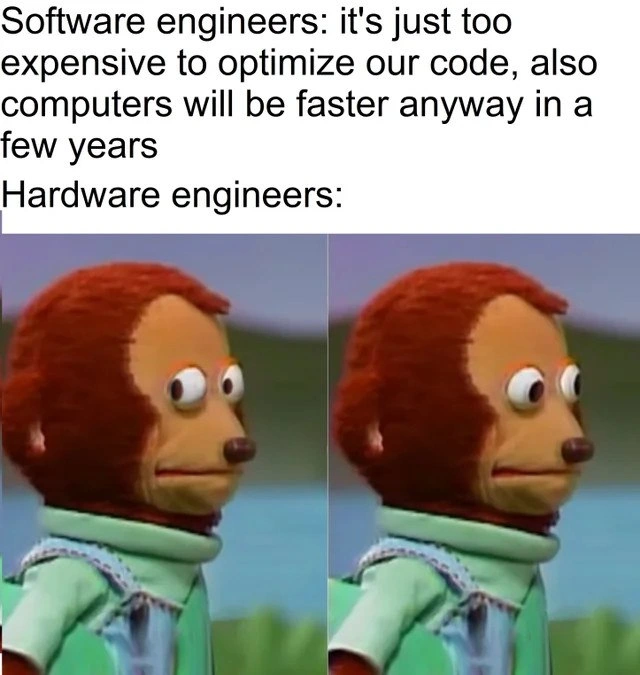
This meme is about performance – how fast or slow software runs – and who takes responsibility for it. On one side, we have software engineers saying: “Optimizing our code is too expensive, plus in a few years computers will be faster anyway.” On the other side, we have hardware engineers reacting with a silent, uncomfortable stare (shown by the famous awkward monkey puppet image). Let’s break down what that means in simpler terms:

  • Moore’s Law: This is a principle from the hardware world. It’s the idea that computer chips (CPUs) tend to double their number of transistors about every two years, which historically meant they got roughly twice as powerful or fast. For a long time, this held true – each new generation of computers is more powerful. So software developers sometimes assume, “If my program is a bit slow today, I don’t need to worry too much – in a couple of years, new computers will naturally run it faster.” This is what they mean by “computers will be faster anyway in a few years.” They’re trusting Moore’s Law to save them, instead of making their code more efficient right now.

  • Profiling: Profiling is a technique software developers use to measure which parts of their code are slow or using a lot of resources. There are special tools that run your program and tell you, for example, “hey, 80% of the time is spent in this function sorting a list” or “this loop runs millions of times and is a bottleneck.” It’s like an X-ray for your software’s performance. Once you profile and find the slow parts (we call these bottlenecks), you can then do optimizations – changes to the code to make those parts run faster or use less memory. Optimizing might mean using a better algorithm, caching a result instead of recalculating it, or even just doing less work if possible. The meme hints that the software engineers are skipping this step; they’re not profiling or optimizing their code because they claim it’s “too expensive” (in time and effort).

  • “Too expensive to optimize our code”: Why would a developer say that? In real life, making code run faster can indeed cost a lot of developer time. It might require rewriting a complex section of code, or it could introduce new bugs. If the software currently “works” (even if a bit slowly), managers might prefer to spend developer time on new features or on fixing only critical problems. There’s also a well-known saying, “premature optimization is the root of all evil,” which means you shouldn’t try to make everything super fast too early, or you might waste time on the wrong things. Some teams take this to an extreme and avoid optimization entirely until it’s absolutely unavoidable. They might justify it by saying any optimization effort now is “too expensive” or not worth it, especially if hardware improvements on the horizon could make the issue moot. Essentially, it’s an argument of cost now vs. benefit later.

  • Software Bloat: Over time, if developers keep adding features without caring about efficiency, the software can become bloated. That means it uses more memory, more CPU cycles, and takes longer to do things than it really should. Bloat is like a lazy, inefficient way of building – it works, but it’s not lean. The meme implies software engineers are okay with a bit of bloat because they expect future hardware (with more memory and faster processors) will handle it. For example, think of an app on your phone that each year uses more storage space and runs slower unless you get a new phone – that’s software bloat relying on you upgrading your hardware.

  • Hardware Engineers’ Perspective: Now, when the text shows “Hardware engineers:” followed by the puppet’s side-eye, it’s highlighting how the people who actually design and improve computer hardware feel about this. Hardware engineers are the experts who create the chips and physical components that make computers faster. If software folks say, “we won’t improve our code, the hardware will just get better,” it can be frustrating or worrisome for hardware people. It’s as if all the pressure is on them to somehow keep making CPUs faster and more powerful to accommodate inefficiente software. The monkey puppet meme face is a perfect way to show a silent “wait, what?!” reaction. The puppet looks a bit startled and concerned at the idea, just like a hardware engineer might be when hearing they have to cover for someone else’s sloppy code.

  • Why the Monkey Puppet? The awkward side-eye puppet is a well-known meme image used to express discomfort or shock when someone hears something ridiculous or awkward but doesn’t say anything. In this meme, the hardware engineers are represented by that puppet, meaning they hear the software engineers’ comment and just look sideways like, “Did you really just say that?” It’s a funny way to capture their restrained disbelief. They likely think optimizing code is important, or at least that you can’t always count on easy hardware gains, especially as making hardware faster is becoming more complex. But instead of arguing, the meme just shows them side-eyeing, which is comedy gold in internet culture – sometimes a look says it all.

In simpler terms, the meme’s message is: Software folks sometimes lean on hardware improvements as a crutch, and this leaves hardware folks in a quietly exasperated state. The humor comes from the role reversal: normally we think of software engineers as the ones solving problems in code, but here they’re basically shrugging and saying “not my problem, future tech will handle it.” And the hardware engineers – who normally toil behind the scenes – are put on the spot, albeit silently. This is common tech humor because many in the industry have seen this tug-of-war between writing efficient software and relying on ever-faster hardware. It’s poking fun at the tendency to pass the buck.

To give a more concrete example, imagine a team making a game or an app. The programmers notice that the app is running a bit slow, but instead of diving into the code to make it faster, their manager says, “Well, the new phones coming out next year will have better processors and more memory, so it’ll probably run fine on those. Let’s not spend time optimizing.” Now imagine the engineers at, say, a company that makes those phone chips overhearing that comment. They might think, “Uh, our job is already really hard, and you’re just counting on us to fix your slow code by magically making chips much faster?!” It’s not that they can’t make things faster – they do, generation after generation – but it’s getting tougher and more expensive to deliver big performance jumps. So hearing software engineers be a bit cavalier about it would definitely cause some side-eye.

In summary, this meme is highlighting a trade-off between software optimization and hardware advancement. The software engineers in the joke choose to do nothing about slow code (“too expensive to optimize”) and assume hardware improvements (thanks to Moore’s Law) will solve it eventually. The hardware engineers, whose job it is to make those faster computers, are depicted as the concerned puppet, signaling that this attitude is problematic (and a bit cheeky). It’s funny to developers because it’s a recognizable scenario – a shared joke about how we sometimes push problems to “future technology” instead of addressing them now, and how that might not always be the best plan (especially from the hardware engineer’s viewpoint).

Level 3: Throw Hardware at It

This meme nails a classic industry anti-pattern: instead of optimizing slow software, just throw better hardware at it and hope for the best. The top text quotes a software team basically saying “Meh, optimizing our code is too much work (too expensive), and besides, Moore’s Law will make CPUs faster in a few years, so problem solved.” 🙄 This is something many senior developers have heard in planning meetings or performance review discussions. It’s a tongue-in-cheek summary of a real mindset: “Why invest time in profiling and refactoring for performance when the next generation of servers or devices will run our bloated code just fine?”

From a senior developer or architect’s perspective, this is both humorous and painfully familiar. Sure, we all know Donald Knuth’s famous saying that “premature optimization is the root of all evil.” It’s true that you shouldn’t waste effort micro-optimizing code before you know what really matters. But this meme highlights the opposite extreme: permanent deferral of optimization. It’s not premature anymore – the code is slow – yet the team still avoids the work, crossing fingers that Intel, AMD, or Nvidia will bail them out with next year’s silicon. It’s basically procrastination dressed up as strategy. The result is often software bloat: ever-heavier apps using more memory and CPU than necessary, comfortable in the assumption that future hardware will have resources to spare. (Looking at you, Electron apps running a whole Chromium browser for a simple text editor 👀…)

Now, enter the hardware engineers – the folks designing those faster CPUs, GPUs, and adding more RAM. In the meme, the caption “Hardware engineers:” is followed by two frames of the awkward side-eye monkey puppet. That puppet’s hilariously uncomfortable look says it all: the hardware folks are silently thinking, “Excuse me, you’re depending on us to solve your performance problems?!” It’s a mix of disbelief and mild horror. They know what it takes to make computers faster: months of R&D, incredibly complex architectures, dealing with physical limits, and a lot of sweat and silicon. Hearing software engineers casually dismiss profiling and optimization because “computers will be faster anyway” feels like a slap (or at least a heavy sigh moment). It’s as if the software team said, “We’re too busy to tidy up our mess; someone else will surely invent a magic broom later.” Meanwhile, the broom-makers (hardware team) are in the room, giving that sideways look.

In real-world projects, this dynamic plays out in various ways:

  • Scaling Up Instead of Tuning: Your web app is struggling under load? Rather than examine the code’s efficiency, the team might just switch to a server with double the RAM and CPU. Problem solved… until the user base grows again. It’s a running joke in dev ops that the first reflex is often “add more hardware”.
  • Feature First, Fix Later: Under tight deadlines, teams prioritize new features over performance fixes. They’ll say “we’ll profile and optimize in the next version,” but often that next version never includes the cleanup – especially if hardware upgrades masked the symptoms.
  • Tech Debt: Unoptimized code is a form of technical debt. You “borrow” against future hardware to get by for now. But interest accrues: eventually the software becomes so slow or resource-hungry that even new hardware strains, and then you’re forced to optimize under pressure. The meme’s humor is that everyone in the know has seen this debt come due with a vengeance (that code that ran fine on last year’s high-end machine now chokes on a mere slightly larger dataset, leading to a panicked late-night profiling session).

The conflict is also cultural. Software engineering vs. hardware engineering mindsets can differ. Software folks often work in a world of quick iteration and abstraction – if something runs too slow, you might scale out with cloud instances or assume Moore’s Law will maintain your app’s snappy feel on new devices. Hardware folks, on the other hand, operate closer to physical reality: they can’t assume a magic fix; they are the ones who must create it, often with great difficulty. When a software developer says “computers will be faster in a few years,” the hardware engineer hears “we’re offloading our work onto you; good luck, have fun!” No wonder the puppet looks a bit alarmed.

Crucially, profiling and optimizing code is often not as costly as people fear – the key is to identify the real bottlenecks. Profiling means measuring your program to find out exactly which function or operation is eating the most time or memory. It’s like shining a spotlight on the slow part. Many times, developers discover that a huge chunk of the runtime is coming from one silly thing (like an unnecessary nested loop or an inefficient query) that could be fixed with a smarter approach. By addressing that, you can get massive performance improvements without needing any new hardware. Yet teams sometimes skip this step, citing the infamous “we don’t have time to optimize.” The irony is that they then spend far more time later firefighting performance issues that hardware upgrades can’t solve.

Let’s translate the meme into a bit of pseudo-code humor. It’s like seeing code with a comment that says:

// We'll optimize later... Let's assume faster hardware will handle this soon.
for (let i = 0; i < hugeDataSet.length; i++) {
  for (let j = 0; j < hugeDataSet.length; j++) {
    processPair(hugeDataSet[i], hugeDataSet[j]);  // O(n^2) work, but we'll just get a bigger server 😅
  }
}

Here the developer is literally banking on “a bigger server” rather than fixing the obviously expensive double loop. It’s funny in a tragic way – and hardware engineers see stuff like this and do the monkey puppet face: wide eyes, tight smile, thinking “Oh dear, that’s gonna be my problem, isn’t it?”.

In the end, this meme resonates because it’s Tech Humor 101 – a truth wrapped in a joke. Software people laughing at this have probably been guilty of the “just upgrade the hardware” mentality at some point. Hardware people laugh (or groan) because they’ve felt the pressure of having to make CPUs with ever more cores, crazy clock speeds, and huge caches just to keep lumbering software responsive. It highlights the absurdity of pushing problems downhill: if everyone assumes someone else (or something else in the future) will handle it, you get this awkward silence… just like the puppet meme image. No one says anything, but both sides know what’s going on. The awkward puppet is a perfect representation of that uncomfortable, unspoken understanding. The software team is effectively saying, “We’ll gladly consume all the performance your next chip gives us – and then some.” And the hardware team is left silently sweating, “Challenge accepted, I guess?”

So, when devs trust Moore’s Law instead of profiling and optimizing, it’s both a practical reality and a bit of a running gag in the industry. We chuckle because it’s true more often than we’d like to admit. But that side-eye from the hardware side also carries a gentle lesson: eventually, you can’t duck the hard work. Either you pay in code discipline or you pay in transistor budgets (and those aren’t infinite). The meme captures this trade-off with a simple text-and-image combo that any engineer can understand at a glance – and that’s why it’s so spot on.

Level 4: The Free Lunch Is Over

For decades, Moore’s Law – the observation that the number of transistors on microchips doubles roughly every two years – reliably delivered exponential hardware speed gains. This created a “free lunch” where existing software would magically run faster on each new generation of CPUs without any code changes. Software teams grew accustomed to coasting on this hardware improvement curve. Why spend weeks squeezing out micro-optimizations when next year’s processors will effortlessly give you a ~2× boost? It was almost like clockwork: hardware got denser and faster, and bloated code caught up for free.

However, hardware engineers know there are physical limits to this gravy train. By the 2010s, cramming twice as many transistors onto a chip every couple of years became brutally hard. Chips hit problems with power density and heat (Dennard scaling broke down), meaning you couldn’t just crank up the clock frequency indefinitely. Manufacturers turned to multi-core designs and specialized architectures to continue performance gains. But here’s the catch: if your software isn’t written to take advantage of 8+ parallel cores or GPU offloading, those extra transistors don’t help your single-threaded slow code one bit. The old joke “the free lunch is over” became reality – simply waiting for faster hardware won’t automatically save sluggish code as it once did. The puppet’s wide-eyed side-eye reflects that creeping realization.

There’s also a fundamental algorithmic reality at play. Hardware improvements typically provide a constant-factor speedup (e.g. doubling clock speed might ~halve your runtime). But if your code has poor time complexity, hardware gains can’t keep up as problem sizes grow. For instance, an inefficient algorithm with quadratic complexity O(n²) will quickly outpace any linear hardware gains. Double the input size, and runtime quadruples – no mere 2× transistor bump will save you if your data grows. In contrast, optimizing code (say from O(n²) to O(n log n) or O(n)) can yield exponential effective speedups as n scales, far beyond what Moore’s Law gives you. This is where profiling and using better algorithms trumps waiting for silicon. It’s a direct application of theoretical CS: constant vs. asymptotic improvements. Hardware engineers, familiar with these limits (think Amdahl’s Law for parallelism or the memory wall in architecture), can’t help but cringe at the “just wait for faster CPUs” mindset. They’ve poured their souls into cache hierarchies, branch predictors, and out-of-order execution logic to squeeze out every drop of performance. That side-eye puppet is essentially the hardware team saying, “You realize we’re hitting atomic-scale features here, and your code is still doing naive repetitive work?!”

In short, deep technical wisdom shows that relying blindly on Moore’s Law is a brittle strategy. Wirth’s Law serves as a counterpoint, humorously noting that software gets slower more rapidly than hardware gets faster. In other words, software bloat can eat up those transistor gains in no time. The meme captures this tension: it’s a wink to those who understand that fundamental limits in physics and computation are at play. The awkward silence from the hardware side (via the puppet’s stare) comes from knowing that exponential transistor growth is slowing, and no amount of side-eye can simplify a $O(n^2)$ loop hiding in that un-profiled code. The two engineering worlds are colliding with a bit of dark irony – you can’t count on free performance forever, and eventually someone has to pay the bill (in either smarter code or insanely complex chip designs). The laws of physics and algorithmics have the final say, and that’s exactly why this meme hits home for seasoned engineers.

Description

A two-part meme that contrasts the attitudes of software and hardware engineers. The top section contains text that reads, "Software engineers: it's just too expensive to optimize our code, also computers will be faster anyway in a few years". Below this, it says, "Hardware engineers:". The bottom section features two identical images of the Monkey Puppet meme, where the puppet looks away with a nervous, sidelong glance. This meme humorously depicts the pressure software developers place on hardware engineers. It suggests that software teams often defer performance optimization, relying on the relentless advance of hardware (Moore's Law) to solve their problems, which causes anxiety for the hardware engineers who have to deliver these advancements
Comments

7
Anonymous ★ Top Pick Software engineers see Moore's Law as a promise of a free lunch, while hardware engineers know they're the ones stuck in the kitchen working double shifts to cook it
  1. Anonymous ★ Top Pick

    Software engineers see Moore's Law as a promise of a free lunch, while hardware engineers know they're the ones stuck in the kitchen working double shifts to cook it

  2. Anonymous

    Hardware engineer’s quiet scream: “I’m dark-siliconing half the die to stay under 200 W and you’re shipping a 400 MB Electron ‘settings’ page - maybe run a profiler before you sacrifice another transistor in my honor?”

  3. Anonymous

    Hardware engineers watching software eat 90% of the performance gains they spent five years achieving with a new architecture, knowing the next JavaScript framework will somehow make it even worse

  4. Anonymous

    Hardware engineers watching software devs justify O(n³) algorithms with 'but CPUs double in speed every 18 months' is like watching someone set money on fire while explaining that inflation will make it worthless anyway. Meanwhile, they're over here squeezing every clock cycle because physics doesn't care about your sprint velocity, and transistors aren't getting meaningfully faster - just more numerous and power-hungry

  5. Anonymous

    Software roadmap: wait for GHz; hardware reality: DVFS, dark silicon, and the memory wall - maybe try vectorizing that O(n^2) hot path instead

  6. Anonymous

    “We’ll optimize later; hardware will get faster” - hardware engineer side-eye: Dennard scaling is dead, the memory wall is alive, and your O(n^2) won’t vectorize

  7. Anonymous

    Hardware fabs billions into 2nm nodes so SWEs can confidently ship that unchecked N+1 query

Use J and K for navigation