Skip to content
DevMeme
2568 of 7435
User engagement is just another word for user complaints
Stakeholders Clients Post #2843, on Mar 16, 2021 in TG

User engagement is just another word for user complaints

Why is this Stakeholders Clients meme funny?

Level 1: That's the Spirit

Imagine a teacher telling a student, "Every time you get a question wrong, it shows you're trying really hard, and that makes me proud of you!" Now the student hears this and thinks, "Oh, getting wrong answers makes the teacher happy? I should get lots of answers wrong on purpose to impress them." So on the next test, the kid intentionally writes all the wrong answers just to collect more praise. Obviously, that’s not what the teacher wanted at all — the teacher was just trying to encourage the student not to worry too much about mistakes. But the student took it literally and ended up doing the opposite of what's actually good (failing the test on purpose!). This comic is funny for the same reason. The one developer was trying to cheer up the other by saying, "Hey, if people complain, it's because they care," kind of like turning complaints into a compliment. But the other developer misunderstood and acted like, "Great, let's make people complain even MORE!" It’s a silly, backwards situation. We all know that normally you want fewer complaints (just like you want more correct answers on a test, not fewer). Seeing someone treat complaints as a victory is amusing because it's the complete opposite of common sense — and that goofy reversal is exactly why we laugh.

Level 2: Complaints as Compliments

In the world of software development, a KPI (Key Performance Indicator) is like a scoreboard that tracks how well something is doing. It’s a number that a team decides is important for success. For example, a web app might use KPIs like how many new users sign up each week, how long people stay on the site, or the average page load time. These are usually metrics you want to increase or improve. Now, normally "number of user complaints" is a metric you’d want to decrease (fewer complaints means people are happier). So treating user complaints as a KPI – essentially saying “the more complaints we get, the better!” – is pretty bizarre! It flips the idea of a KPI on its head. In this meme’s title, "turning user complaints into KPIs" means they’re jokingly using the count of user complaints as a measure of success. That sounds backwards, because in reality if users are complaining a lot, that’s usually a sign something’s wrong, not something’s awesome.

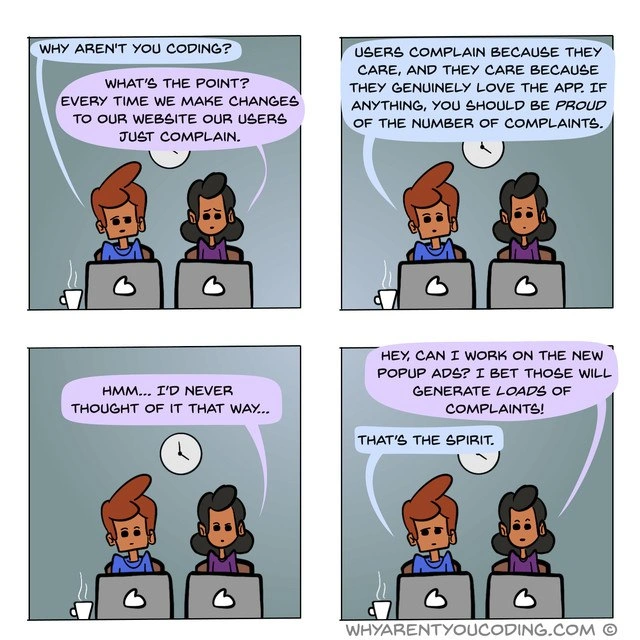
Let’s break down the comic scenario in simpler terms. We have two developers sitting at their laptops. The dark-haired developer is discouraged and basically asks, "Why should I even bother coding? Every time we change our website, users just complain." This is a feeling many newer devs might relate to: say you help deploy a big update or a UI redesign, and suddenly a bunch of users start leaving negative feedback like “I hate this new look” or “The update broke my workflow.” It can be really demoralizing. It’s like, you tried to make things better, and all you hear is anger – you start wondering, “What’s the point of working hard on this if it only makes people upset?” That’s the mood the right-side developer is in: frustrated and questioning why they should code new features when it seems to just trigger more user complaints.

Now the red-haired developer responds with what sounds like an attempt at positive spin. He basically says, "Users complain because they care, and they care because they love the app. In fact, you should be proud of how many complaints we get!" This is a pretty odd way to cheer someone up, right? But the idea he’s pushing is: if users are loudly complaining, at least it means they’re emotionally invested. It’s like he’s saying, “Hey, they’re only yelling because our product matters to them. If they didn’t care, they’d stay silent or leave. So lots of complaints means we built something people really care about!” In a sense, he’s turning those complaints into compliments. The intention here is a morale boost – taking something negative (angry user feedback) and reframing it as a positive sign of user engagement. This kind of upbeat interpretation is sometimes heard in tech teams or from managers trying to keep spirits high: “Bad feedback is better than no feedback at all!” It’s a bit of a stretch, but you can see he just wants his teammate to feel proud rather than defeated.

The twist comes in the next part. The gloomy developer suddenly has an epiphany and gets enthusiastic – but not in the way you’d expect. He essentially says, "Oh, complaints are a good thing now? Then let’s do something guaranteed to get loads of complaints!" He asks to work on a new pop-up ads feature, gleefully expecting that users will absolutely hate it and flood them with negative feedback. This is the punchline of the joke. It shows the dev taking the earlier encouragement far too literally. Instead of understanding it as “don’t feel bad about the complaints,” he interprets it as “we should actively seek more complaints.”

Now, pop-up ads are basically the most notorious annoying feature on the web. These are those intrusive boxes or windows that suddenly appear on your screen when you visit a site, often asking you to subscribe to a newsletter or showing you an advertisement. They cover your content until you close them. Almost everyone finds pop-ups irritating – they disrupt what you were doing. In web development, adding too many pop-ups is considered a bad practice because it degrades the user experience. Experienced web developers and designers use pop-ups very sparingly (or not at all) precisely because users complain about them so much. So in the comic, when the dev eagerly volunteers to add pop-up ads, he knows it's something users will dislike. He’s basically thinking, “If complaints are a positive metric, let’s introduce the #1 complaint-generator!”

What we see here is a classic case of a perverse incentive. A perverse incentive is when a metric or reward accidentally pushes people toward the wrong behavior. In a normal situation, a team’s incentive might be to reduce user complaints (by improving the product). But if you suddenly reward getting more complaints (by treating it as a proud achievement), you’ve created a backwards incentive. The developer in the comic responds to that by planning a feature that will cause complaints in droves. It’s obviously a satirical scenario. In reality, no sane team wants to make users angry just to hit a number. But it’s highlighting how metrics can be misused. There’s a saying, “What gets measured, gets managed.” If you measure something silly, people might start doing silly things to hit the target. For example, if a company only looks at the number of features released as a success metric, the team might rush out a bunch of tiny, low-quality features to boost that count, instead of focusing on really polishing a few important ones. They’d meet the feature-count goal, but users wouldn’t actually be happier. That’s what’s happening in this joke: by treating complaints as a goal, the “achievement” would be lots of complaints, even though that’s actually bad for the product. It’s a send-up of vanity metrics – numbers that make you look busy or successful on paper, but don’t genuinely reflect goodness. A high number of user complaints is undeniably a vanity metric in this context (it’s nothing to brag about in real life!). The comic just pushes it to an extreme to make the point clear.

Another angle to this is the idea of a feedback loop with users. In a healthy product development cycle, user complaints and feedback form a loop that helps improve the product. Users complain => the team fixes the issue or adjusts the feature => fewer future complaints happen because the product got better. That’s akin to a negative feedback loop in engineering, where the system corrects itself when output (complaints) indicates something’s wrong. The “negative” here means it corrects or reduces the change (it’s stabilizing). But in the comic’s scenario, the loop is reversed into a weird positive feedback loop: users complain => team intentionally makes things worse => users complain even more. Positive feedback loops amplify a change instead of reducing it – kind of like a snowball effect. Here the “change” is user unhappiness, and they’re amplifying it. If this happened in real life, it would be a disaster: each new annoying feature would drive more users up the wall, encouraging the team to add even more irritating stuff. It’s a vicious cycle of negativity. Of course, no competent developer actually wants that; this is the comic taking a goofy idea to its extreme for laughs. It underscores how not to handle customer feedback. Normally, you’d want to address complaints, not treat them as points in some twisted game.

Finally, the humor really shines through in how the two characters communicate and the misunderstanding between them. The first developer tries to communicate an encouraging thought – essentially saying, “Don’t lose hope, even negative feedback means users care.” This is something you might actually hear in a team meeting as a way to soften the blow of criticism. However, the second developer misinterprets this encouragement. He acts as if the team literally wants as many complaints as possible. It’s a comedic exaggeration of a communication gap. The boss/lead (or optimistic colleague) says one thing, and the dev runs with a wildly unintended meaning. Many of us find it funny because it reflects a grain of truth: sometimes management or clients will put a positive spin on bad news, and developers, especially those feeling cynical, might joke privately, “Sure, why not make it even worse then, since apparently bad is good now.” It’s that classic developer cynicism coming out. Instead of actually doing something so destructive, in reality devs might just roll their eyes or make sarcastic remarks. But the comic turns that sarcastic thought into an actual action for comedic effect.

In short, this comic is poking fun at what happens when stakeholder expectations and motivational talk get completely out of whack with common sense. It’s a satire of workplace communication: a well-meaning pep talk gets taken way too literally. The joke highlights how absurd it would be to treat negative outcomes as positive goals. It’s funny and relatable to developers because we often deal with odd metrics or bosses trying to spin things. The takeaway for a junior developer is: be careful what metrics you chase and how you interpret feedback. If you ever find yourself thinking "Our goal is to make users complain," something has clearly gone wrong in translation! The comic uses exaggeration to remind us that not all “success metrics” are actually sensible — and that keeping users happy is usually a better motivator than counting their complaints.

Level 3: Misery Metrics

Picture a world where user complaints are treated like bonus points on a scoreboard. Welcome to metrics hell. This comic nails the perverse metrics phenomenon: the team is essentially practicing complaint-driven development. Instead of striving for fewer complaints (as any sane product team would), they’re flipping the KPI script to treat each angry user email as a gold star. In the panel, the red-haired dev’s pep talk accidentally triggers Goodhart's Law in real time: “When a measure becomes a target, it ceases to be a good measure.” By celebrating the number of complaints as proof of user passion, he’s turned a negative feedback metric into a goal. And what happens next? The other developer does exactly what any jaded engineer rewarded for pain might do: plan features explicitly to maximize complaints (hello, irredeemable popup ads!). This is metrics madness – optimizing for the very thing you're supposed to minimize.

Any senior dev who's survived a few product cycles can recall similar stakeholder spin jobs. It's the kind of corporate jiu-jitsu that tries to flip bad news into “engagement.” I've sat in meetings where stakeholders claim “high support ticket volume shows how engaged our users are” – a sugarcoating attempt for what is essentially a flood of bug reports and angry calls. The humor here is that we all know at a gut level: if users are constantly complaining, something’s wrong with your app. But in corporate culture, there's always that one manager who tries to hit a KPI at any cost, even if it means rewarding the wrong outcomes. The devs in the comic illustrate this perfectly. The dark-haired dev is demoralized by continuous negative customer feedback – a totally relatable developer frustration when every release seems to trigger a stream of “This update sucks!” posts on the forum. The red-haired dev channels a Product Management 101 move: reframing the narrative to boost morale. Users complain because they care, he argues, implying those complaints are badges of honor. It's a classic bit of expectation gymnastics meant to be a morale hack: “Look, our users care!” In other words, spin the client/stakeholder expectations so the team feels pride instead of panic.

What’s brilliant (and cringe-worthy) is how quickly that pep talk morphs into a perverse incentive. The instant the frustrated dev buys into the idea that “complaints are good,” he goes full chaotic neutral and volunteers to implement the most obnoxious feature imaginable – pop-up ads – purely to harvest user ire. In code terms, it's like writing a function purposely designed to annoy:

function addAnnoyingPopUps() {
    setInterval(() => {
        displayPopup("Subscribe Now!", { modal: true });
    }, 5000);
    metrics.increment("user_complaints"); // complaints = success, apparently
}

It’s a devilishly funny demonstration of incentive structures backfiring. In real life, misaligned metrics lead to exactly these kinds of absurd outcomes:

  • Team rewarded for closing lots of support tickets? Watch trivial tickets multiply so everyone can hit their quota. Meanwhile, real user issues get buried while the metric looks fabulous.
  • Company obsesses over daily active users (DAU) as the key success metric? Cue spammy notifications and addictive "dark pattern" features designed to keep people logged in at all costs. Users might be miserable, but the DAU graph is up-and-to-the-right.
  • Manager measures developer productivity by lines of code written? Sure, some devs will write bloated, redundant code to pad their stats. Code quality plummets, but on paper their output looks great.

It's the same vibe here in the comic: define “success” wrong, and your team will do whatever it takes to hit that target – even if it means torching the user experience. They'll end up doing the wrong things really well, because that's what you’ve incentivized.

Goodhart’s Law is basically playing out frame by frame. If you measure the wrong thing, people will warp their behavior to hit that target, actual quality be damned. The comic exaggerates it to a laughable extreme – intentionally annoying your own users just to inflate a number – but it lands so well because there’s a grain of truth. Developers often joke about management fixating on vanity metrics or misleading KPIs. This panel is that joke made literal. Instead of focusing on real user satisfaction or product improvements, the devs are cheerfully marching toward a high complaint count as if they've hit the jackpot. It’s a dark twist on the usual “We value customer feedback!” mantra – here, feedback has been turned into a scoreboard where you earn points by making users miserable. And the kicker? The “boss” figure actually encourages it with a straight face: “That's the spirit.”

In essence, the meme skewers an all-too-familiar scenario where stakeholder expectations collide with reality and developer morale is managed by absurd logic. Beneath the laughs lies a cautionary tale about perverse metrics: if you celebrate or reward the wrong metric, don't be surprised when your team optimizes for that metric in the most literal (and counterproductive) way possible. After all, as any battle-hardened coder knows, whatever you incentivize, you’ll get more of – whether it’s bugs, useless lines of code, or legions of angry users.

Description

A four-panel comic from 'WHYARENTYOUCODING.COM' featuring two developers sitting at their laptops. In the first panel, one developer expresses frustration: 'WHAT'S THE POINT? EVERY TIME WE MAKE CHANGES TO OUR WEBSITE OUR USERS JUST COMPLAIN.' In the second panel, his colleague offers a motivational spin: 'USERS COMPLAIN BECAUSE THEY CARE, AND THEY CARE BECAUSE THEY GENUINELY LOVE THE APP. IF ANYTHING, YOU SHOULD BE PROUD OF THE NUMBER OF COMPLAINTS.' After a moment of thought in the third panel, the first developer, having completely missed the point, eagerly asks in the fourth panel: 'HEY, CAN I WORK ON THE NEW POPUP ADS? I BET THOSE WILL GENERATE LOADS OF COMPLAINTS!' His colleague dryly responds, 'THAT'S THE SPIRIT.' The comic satirizes corporate attempts to reframe negative feedback as a positive metric. It highlights the dangerous, yet humorous, misunderstandings that can arise when developers are encouraged to view user complaints as a sign of success, leading to a logical conclusion of intentionally creating user-hostile features


Comments

12
Anonymous ★ Top Pick The PM told me to optimize for user engagement. I'm just following the data that says nothing gets a user to click more than trying to find the 'X' on a popup ad
  1. Anonymous ★ Top Pick

    The PM told me to optimize for user engagement. I'm just following the data that says nothing gets a user to click more than trying to find the 'X' on a popup ad

  2. Anonymous

    We set an OKR to “increase user feedback per session,” and now the team’s A/B-testing which popup gets cursed at faster - Goodhart’s Law has a pull request

  3. Anonymous

    After 15 years in tech, I've learned that the best way to validate your monitoring dashboard is working correctly is to deploy popup ads - if the complaint metrics don't spike within 30 seconds, you know your observability stack is broken

  4. Anonymous

    This perfectly captures Goodhart's Law in action: 'When a measure becomes a target, it ceases to be a good measure.' The moment you optimize for complaint volume as a proxy for user engagement, you've created a perverse incentive structure that would make any growth hacker proud - and any UX designer weep. It's the enterprise equivalent of training your ML model on the test set: technically you're hitting your metrics, but you've fundamentally misunderstood the assignment. Next sprint: implement dark patterns, break the back button, and auto-play videos with sound. KPIs through the roof, NPS through the floor - perfectly balanced, as all things shouldn't be

  5. Anonymous

    Treat complaints as engagement and watch Growth A/B test popups for max CPM - complaints per minute - while SRE labels it “synthetic load” on the support queue

  6. Anonymous

    User complaints are the ultimate PMF signal: silence means forgotten legacy, rage means you're shipping fast enough to annoy power users

  7. Anonymous

    Goodhart's Law in action: make 'complaints' the OKR and someone will A/B test a full-screen modal where the close button is 1px, hitting the target at scale

  8. Deleted Account 5y

    oh god😂😂😂😂😂

  9. Deleted Account 5y

    fuck popup ads

  10. @PopovichVladimir1 5y

    niggers

  11. Deleted Account 5y

    Ow.

  12. @aylinchik1 5y

    * pop up blocker entered the chat *

Use J and K for navigation