Richard Stallman's FaceTime intervention
Why is this OpenSource meme funny?
Level 1: The Ironic Phone Call
Imagine you’re playing with your favorite toy, and suddenly someone calls you on your mom’s phone. On the screen, you see a shaggy-looking man who you’ve never met. He uses your mom’s iPhone (a fancy phone that only works with its own brand’s apps) to video-call you. Then he says, very seriously: “You should stop using those kinds of locked-up phones and apps!” This is funny because it’s so backwards – he’s using the very thing he’s telling you not to use, to tell you not to use it! It’s like if a friend took a big bite of candy and, with their mouth full, FaceTimed you to say, “Hey, candy is bad for you, you should never eat it!” You’d probably giggle at how silly that is. The big idea is that the situation is ironic – what’s happening is the opposite of what the caller is saying. Even if you don’t know about computers or phones, you can laugh because he’s not following his own rule at all. It’s a goofy surprise call where the messenger kind of defeats his own message, and that’s why it’s humorous.
Level 2: Free vs Proprietary
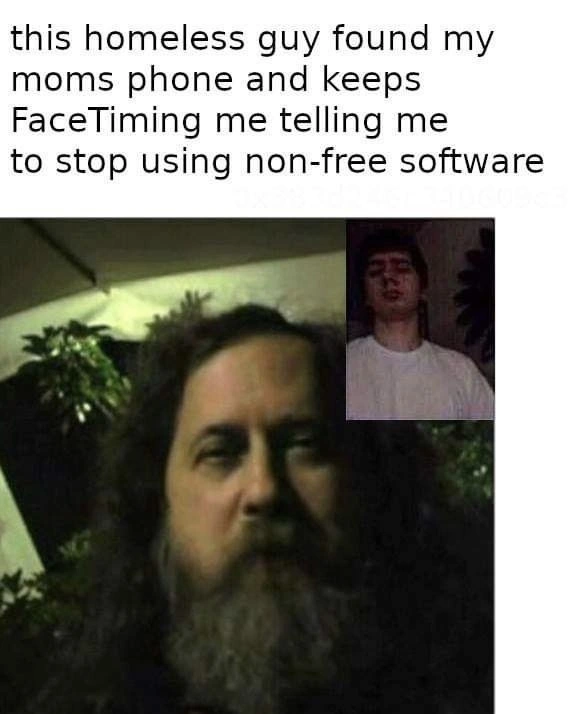
Let’s break down the scene in simpler terms. The meme shows a FaceTime call. FaceTime is Apple’s built-in app for video calls on iPhones, iPads, and Macs. When you FaceTime someone, you see their live video – here, the big video is the caller and the small corner shows the person receiving the call. Apple’s FaceTime is proprietary software, meaning it’s owned and controlled by Apple. Only Apple devices can use FaceTime, and users are stuck in Apple’s world for that call – this is what we call vendor lock-in (you’re “locked in” to the vendor’s ecosystem because their stuff only works with itself).
Now, who is that bearded guy on the call and what’s he talking about? That’s Richard Stallman – a famous programmer and the leading voice of the Free Software movement. Despite the appearance (long hair, big beard, casual clothes which the meme jokes make him look “homeless”), Stallman is actually a sort of celebrity in programming circles, especially around OpenSourceCulture. He founded the Free Software Foundation (FSF) and launched the GNU Project (the tools that helped create GNU/Linux). He’s spent decades telling developers and users that they should only use free software.
Free software, in this context, doesn’t mean software that costs zero dollars – it means free as in freedom. This is about OpenSourceSoftware or libre software: programs where you can see how they work under the hood (source code), modify them, share them, and use them for any purpose. Essentially, free software respects your freedoms. On the flip side, non-free software (or proprietary software) is what Stallman is warning against. Non-free/proprietary means the software’s source code is hidden, you’re not allowed to modify or share it, and you have to agree to the vendor’s rules. Most of the apps people use daily (like Microsoft Windows, Adobe Photoshop, or yes, Apple’s FaceTime) are proprietary. They might work great, but you as the user have no control over them – you can’t fix a bug yourself or add a feature, and often you can only use them on approved devices or with a paid license.
In the meme’s text, the caller says: “stop using non-free software.” This is exactly the kind of thing Stallman would say (he literally campaigns for people to delete or avoid any software that isn’t free/libre). It’s a bit like someone very into healthy eating telling you to stop eating junk food – he’s telling the developer on the other end of the call to quit using closed, proprietary programs (like maybe macOS, Windows, iPhone apps, etc.) and switch to free alternatives (like GNU/Linux, or other open-source tools).
The funny part is how he’s delivering this message. He’s using FaceTime – an Apple app – to say it. That’s like using the very thing he’s against in order to tell someone not to use it. In real life, Stallman avoids using non-free software as much as humanly possible. He doesn’t even own a smartphone (because phone operating systems are usually not fully free). The meme imagines a scenario where Stallman somehow “found my mom’s phone” – implying he got hold of an iPhone (maybe he truly found a lost phone or borrowed it) – and couldn’t resist FaceTiming to spread his message. This exaggeration is what makes it a DeveloperHumor meme: it takes a real ideology (free software advocacy) and pushes it into a ridiculous situation (random FaceTime preaching).
Some technical/context notes to clarify:
- FaceTime Call: A video call through Apple’s FaceTime. If you use an iPhone and tap someone’s contact to video call, that’s FaceTime. It uses the internet to transmit video and audio. FaceTime is notably exclusive to Apple devices; you can’t normally FaceTime from an Android phone or a Windows PC (Apple wants you to stay in their club).
- Proprietary Software (Non-free software): Software that is not open-source. You usually have to accept a license and you cannot see the code or redistribute it. It’s called “non-free” by people like Stallman not because it costs money (some is free of charge, like FaceTime doesn’t cost extra) but because you, the user, don’t have freedom to control it. It’s locked down by the company.
- Free Software (Open Source): Programs like Linux, Firefox, or LibreOffice are examples – anyone can look at how these are made, copy them, change them, and share them. Stallman specifically champions this kind of software for ethical reasons. He believes software should respect users’ freedoms (sometimes he says “Think free as in free speech, not free beer” to explain this idea).
- OpenSourceCulture vs Apple: In tech culture, there’s an ongoing debate: open vs closed. Apple often represents the closed side (they prioritize integrated, controlled user experience but keep everything under their control). Open-source folks argue for transparency and user empowerment. The meme basically pokes fun at how these two worlds collide.
So, in simpler storytelling: The meme is showing a famous open-source advocate using an Apple iPhone’s FaceTime to lecture a developer. The developer (the person in the small selfie video) is probably using Apple products (since it’s a FaceTime call). The advocate on the other end is saying “stop using those locked Apple things and other non-free software!” The comedy comes from the contradiction: he’s literally coming through a locked Apple communication channel to say “don’t use locked Apple stuff.” It’s as if a chef snuck into a McDonald’s to tell you to eat only organic food – unexpected and a bit hypocritical in method.
For a junior developer or someone new to these terms, the meme is highlighting the almost mythical passion of open-source advocates. It’s common in developer communities to encounter folks who insist you should use Linux instead of Windows/Mac, or open-source tools instead of commercial ones. This meme just imagines that happening in an extreme (and funny) way: a random video call from such a person out of nowhere. It’s poking fun at both the Apple ecosystem (for being so closed that seeing Stallman on it is absurd) and the free software zealots (for being so pushy that they’d even use FaceTime if that’s what it takes to reach you).
Level 3: Walled Garden Paradox
At first glance, this meme looks like a bizarre tech-world paradox. In the FaceTime screenshot, the bearded, long-haired man isn’t actually a random homeless guy – he’s almost certainly Richard Stallman, the legendary founder of the Free Software Foundation. Stallman is a famous advocate of free software (also known as OpenSourceSoftware in spirit) and a vocal critic of proprietary_software. The joke here is that he’s FaceTiming someone (using Apple’s closed, proprietary video call app) to plead: “Stop using non-free software!” This is dripping with irony because FaceTime itself is non-free software in Stallman’s own terms. In developer culture, seeing free_software_advocacy happen through a locked-down Apple app is like catching a vegan secretly snacking on a cheeseburger. It’s a classic case of “do as I say, not as I do.”
The humor works on multiple levels of developer irony and insider knowledge:
Non-free software: Stallman’s term for programs that deprive users of freedom – i.e., you can’t see or modify the source code, and you’re at the mercy of the vendor. Apple’s software (like FaceTime) is a prime example: it’s closed-source, tightly controlled, and works only within Apple’s ecosystem. This concept is central to OpenSourceCulture debates and the meme highlights it by using Stallman’s exact phrasing “non-free.” Most mainstream users would say “proprietary software” or just “closed-source,” but the meme specifically uses Stallman’s lingo to clue us in on the reference.
Vendor lock-in: Apple’s vendorLockIn strategy is on full display. FaceTime is an Apple-only video calling platform – historically it only worked on Apple devices (iPhones, MacBooks, etc.), forming part of Apple’s infamous walled garden. Once you and your contacts are inside this garden, you’re locked in; calling someone outside the Apple ecosystem is inconvenient (at least at the time of this meme). The free software crowd (like Stallman) loathes this because it restricts user freedom and interoperability. The meme exaggerates the scenario to absurdity: the ultimate free software advocate somehow infiltrated this walled garden (by “finding mom’s phone”) just to call you out. It’s as if he had to borrow the corporate megaphone just to tell you to stop listening to corporate megaphones.
Ideological evangelism vs reality: The image plays on the stereotype of the zealous OpenSource evangelist. Stallman is often caricatured as a wandering prophet (unkempt beard, passionate ideals) preaching the gospel of libre software wherever he goes. Here he literally shows up like a prophet in the machine, using the very “evil” tech he condemns to spread his message. This highlights a real tension in tech: even hardcore free software developers sometimes must resort to proprietary tools to communicate or get work done, because the world isn’t 100% open. It’s a Catch-22: to save someone from the proprietary world, you might have to step into that world briefly. The meme’s absurd premise of a random FaceTime call from Stallman underscores how fervent and ubiquitous these advocacy messages can feel in developer communities. Many devs have had that experience of a colleague or online stranger passionately insisting “don’t use that closed product!” – maybe not literally FaceTiming them out of the blue, but sometimes it feels that intrusive.
Inside joke and contrast: The caption calling him “this homeless guy” is a tongue-in-cheek jab at Stallman’s appearance and the fact that he isn’t a slick corporate type. It’s an inside joke among developers familiar with him: Stallman has intentionally downplayed materialism (he often carries a Tux the penguin backpack, wears simple clothes, and until recently didn’t use a smartphone at all). By calling him a homeless guy, the meme exaggerates how out-of-place his old-school, non-conformist persona looks on a polished Apple video_call interface. It’s the ultimate contrast: a scruffy champion of user freedom appearing via a high-tech, walled-garden product. For those in the know, this contrast is hilarious. Apple’s FaceTime interface is clean, modern, and proprietary; Stallman is the antithesis – grassroots, maybe a bit archaic, and all about freedom. Seeing him pop up on FaceTime is like spotting a Jedi on the Death Star’s Zoom call – an epic mashup of opposing worlds.
Real-world context makes it even funnier. Back in 2010, Apple’s Steve Jobs claimed FaceTime would be based on open standards, suggesting they might free it up – but that never truly happened. FaceTime remained closed, and over the years it became a symbol of Apple’s closed ecosystem vs open standards debate. Meanwhile, Stallman (and others in the free software movement) spent decades warning about exactly this kind of lock-in. He famously refuses to carry any smartphone because non_free_software on phones tracks and controls users. The meme imagines that Stallman couldn’t resist the chance to hack an Apple device (or opportunistically use a found iPhone) to make a point directly. It’s a comedic what-if that tickles developers: what if the patron saint of free software literally FaceTimed you to scold your technology choices?
In summary, Level 3 perspective reveals the rich irony and industry in-jokes:
- The free vs proprietary battle is encapsulated in one absurd call.
- A known free-software advocate (Stallman) shows up via the enemy’s tool (Apple’s FaceTime) – essentially storming the walled garden.
- It satirizes the almost religious fervor of open-source evangelism in dev culture, by depicting it as a literal unsolicited video sermon.
- It highlights how entrenched proprietary platforms are – even their biggest critics end up using them to spread their critique.
For seasoned developers, this meme is a clever nod to decades-long tech battles and the sometimes hypocritical or paradoxical moments that arise. It’s both a roast of Stallman’s extremism and a wink at the uncomfortable truth that even the freest souls occasionally tap the walled garden’s glass to get attention.
# Pseudo-code of the ironic situation:
if free_software_guru.uses(Apple_FaceTime):
print("Warning: IronyLevelExceededException - preaching freedom via locked channel!")
The code above captures the humor in techie terms: an Irony Level Exceeded error, because the Communication channel itself contradicts the message. In the end, we laugh because the meme holds up a funhouse mirror to tech culture’s idealism vs reality. It’s a DeveloperHumor gem mixing advocacy with absurdity: the freedom fighter got into the castle just to tell us to leave it.
Description
This meme presents a fabricated scenario in the form of a screenshot of a FaceTime call. The main, large image is a low-resolution photo of Richard Stallman, the founder of the Free Software Foundation, with his characteristic long hair and beard. A smaller, inset picture shows the person receiving the call. Above the image, text reads: 'this homeless guy found my moms phone and keeps FaceTiming me telling me to stop using non-free software'. The humor is layered for a tech-savvy audience. Firstly, it pokes fun at Stallman's unkempt appearance by misidentifying him as a 'homeless guy'. Secondly, and more importantly, it creates a deeply ironic situation: Stallman, a world-renowned purist who evangelizes for the exclusive use of free and open-source software, is depicted using FaceTime - a proprietary, closed-source application from Apple. The joke lies in the absurdity of him using the very type of software he campaigns against to deliver his message

Comments
14Comment deleted
Of course Stallman is using FaceTime. He's not using the software, he's performing a security audit on Apple's proprietary video protocols from the inside
Nothing like a stranger on FaceTime reminding you that your “cloud-agnostic” stack still hinges on one proprietary PushKit entitlement Apple can deprecate during tomorrow’s keynote
The only thing more persistent than a memory leak in production is Stallman explaining why your IDE's license violates your fundamental freedoms - and unlike the memory leak, he won't stop until you've compiled your own kernel
When your production incident escalates to a P0 but the on-call engineer is too busy explaining why your monitoring stack should be running on self-hosted Prometheus instead of Datadog because 'freedom matters more than your SLA.'
RMS's ultimate zero-trust architecture: auditing your proprietary blobs via mom's hijacked iPhone
FaceTiming me to condemn non‑free software - nice; please include the Corresponding Source with that lecture
Preaching software freedom over FaceTime is like pushing GPL via an EULA - great message, hostile transport
FaceTime isn't free software... Comment deleted
That's the point Comment deleted
The point is that guy would die if he touches an iPhone. Comment deleted
+ Comment deleted
ITS STALLMAN Comment deleted
Based homeless dude Comment deleted
if only FaceTime was implemented as advertised... https://www.cnet.com/news/steve-jobs-promised-to-make-facetime-open-source-its-time/ Comment deleted