The Royal Wait for a Pull Request to Merge
Why is this VersionControl meme funny?
Level 1: Dressed Like a King
Imagine you decide to wear a simple outfit today – just jeans and a t-shirt. But then your friends all jump in with ideas. One friend says, “Here, add this cool jacket with shiny gold buttons!” Another friend laughs and puts a crown on your head for fun. Then your teacher comes by and hangs a bunch of medals around your neck like you’re a hero. By the time they’re done, you walk into class looking like a king in full costume! You only started with plain clothes, but everyone kept adding more and more fancy things. It’s funny because the end result is way more elaborate than what you began with. That’s exactly what this meme is joking about: something that began very simple ended up ridiculously fancy after everyone added their little improvements – just like turning a normal kid’s outfit into a fully decorated royal costume.
Level 2: Pull Request Glow-up
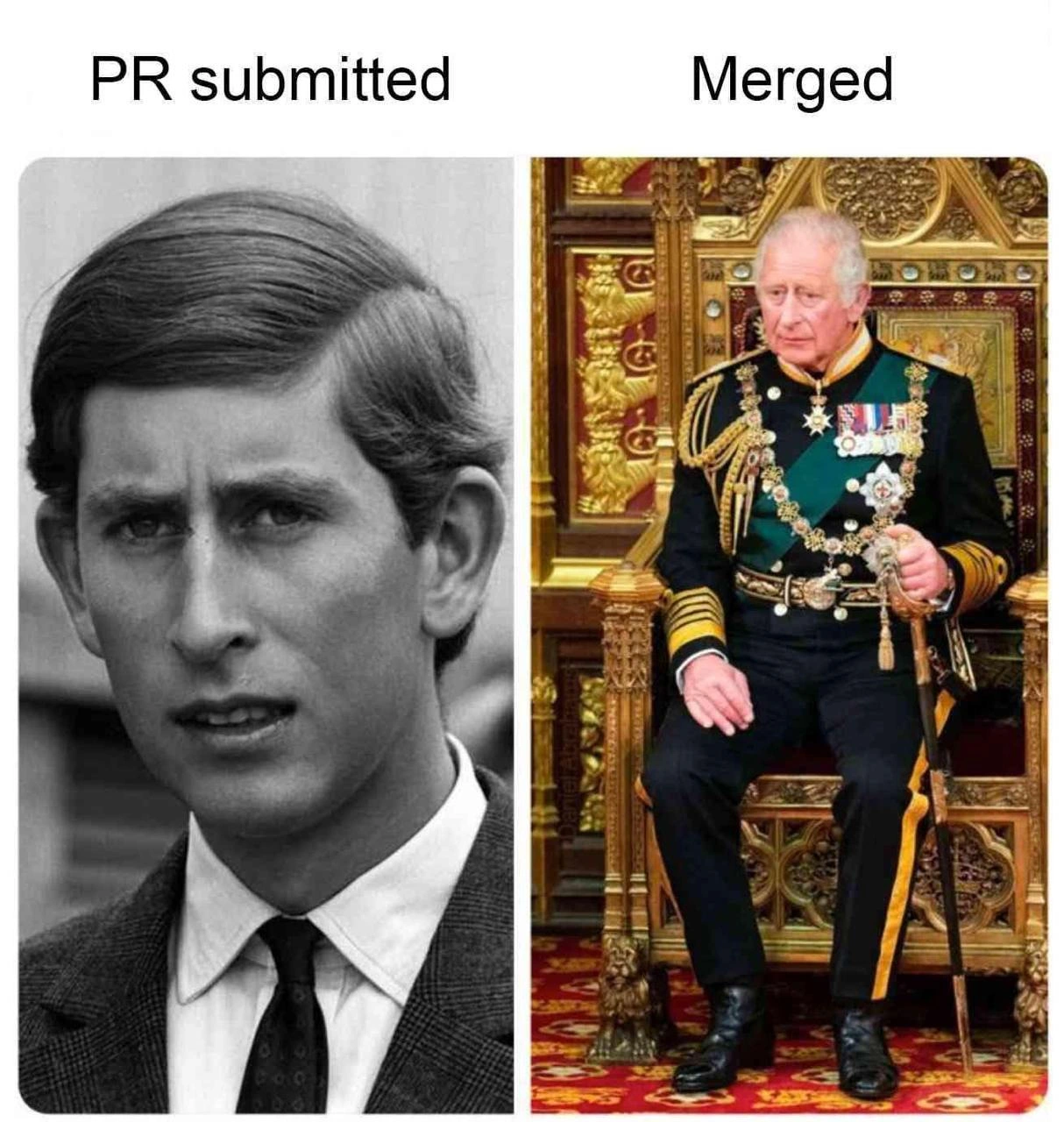
This meme uses a dramatic before-and-after to illustrate what can happen during a typical pull request process in software development. On the left side (“PR submitted”), we see a young man in a plain suit, looking simple and unadorned – that represents a small, clean code change being submitted. On the right side (“Merged”), the same person is much older, sitting on a throne in full ceremonial regalia (a fancy uniform covered in medals and gold braid) – this symbolizes the code after it’s been through an extensive code review and finally merged. The joke is that a basic pull request comes out the other end looking ridiculously “fancied up,” almost like it’s been crowned king with all those extra medals (features and tweaks).
Let’s break down the terms and scenario for clarity:
- Pull Request (PR): In a version control system like Git (used with platforms such as GitHub or GitLab), a pull request is a way to propose your code changes to the team. It’s basically saying, “I’ve made some changes in a branch; please review and then pull (merge) these changes into the main project.” It’s a request for your code to be pulled into the codebase.
- Code Review: The process where other developers examine the code in a PR and give feedback. They might find mistakes, point out potential improvements, or ask questions. It’s a quality check and a collaboration step. The team might discuss the code via comments on the PR.
- Nit-picks: This is slang for very small, picky suggestions or critiques. Nit-picks aren’t about big bugs or major problems; they’re about minor details. For example, a reviewer might say, “Can you rename this variable to be more descriptive?” or “There’s a typo in this comment.” These little comments are called nit-picking (imagine picking at nits, which are tiny lice eggs – it means focusing on teeny-tiny things). In code reviews, nit-picks often involve code style, naming, or formatting issues that don’t necessarily affect functionality but polish the code.
- Merged: When a PR is approved and the code is integrated into the main branch, it’s “merged.” This is the end goal of a pull request – to get those changes officially into the project. After a merge, your code becomes part of the next build or release of the software.
Now, why does the PR in the meme end up “dressed for a royal coronation”? It’s exaggerating a common experience: you submit a very minimal change, but the review process adds layer upon layer to it. You might start with a simple fix – say, changing one line of code to solve a bug – but by the time everyone has reviewed it and it’s ready to merge, the change has grown much larger. How? Each reviewer may have suggestions, and even if each suggestion is small, they add up. For example:
- A teammate might ask for more documentation: “Could you add a comment or docstring to explain what this function does?” So you write a couple of lines explaining the code.
- Another reviewer suggests adding error handling: “What if someone uses this function wrong? Maybe check the inputs and handle errors gracefully.” Now you add some
ifstatements or atry/exceptto make the code more robust. - Someone notices a code style issue: “Our style guide says to use 4 spaces for indentation, not 2,” or “We put a blank line between logical sections of the code.” Those are quick tweaks, but they increase the diff (the changes).
- A senior developer proposes a small refactor or using a particular design pattern: “Instead of hard-coding this, can you use a helper function so we can reuse the logic?” or “Maybe use a more generic approach here in case we need it later.” This might change your code structure or add a few more lines to make it more flexible.
- Another reviewer asks for unit tests: “Can you add a test case to ensure this bug won’t happen again in the future?” So you create a new test or two. That might even be in a different file (like
test_something.py), but it’s part of the PR. - If a lot of time passes or many changes happen during the review, you might run into merge conflicts: This happens when someone else changed the same part of the code in the main branch while you were working on your PR. You then have to adjust your code to fit with those other changes. Resolving a merge conflict can mean editing even more lines to make everything consistent.
Each of these steps is meant to improve the code. The documentation makes it clearer, error handling makes it safer, tests make sure it stays correct, etc. In the end, your code is better for it. But the funny part is how much a simple thing can grow. A patch that initially had maybe 5 lines changed could turn into a PR with 100 lines changed across multiple files by the end of the review. It’s as if you gave your code the “royal treatment.”
The meme’s right-hand image (the man on the throne with all the medals) visualizes this outcome. The code went in as a modest change and came out the other side with so many extra “decorations” that it’s almost unrecognizable. Developers laugh at this because it happens a lot. It’s a bit of developer irony: the process designed to ensure quality (code review) can sometimes overshoot, making a mountain out of a molehill. It’s all done with good intentions – everyone wants the code to be the best it can be – but from the original coder’s perspective, it can feel like a simple task unexpectedly turned into a big one. The phrase “glow-up” is a fun way to describe it (a glow-up means a makeover or transformation for the better). The PR got a glow-up during review: it glowed up from a plain fix into a sparkly, many-featured solution.
To visualize this, consider a simple code example and how it might change after reviews:
# Before code review: a minimal function to add two numbers
def add(x, y):
return x + y
# After code review: the same function with 'improvements' suggested by reviewers
def add(x, y):
"""
Add two numbers with validation and logging.
"""
# Type check (suggested to handle bad inputs)
if not isinstance(x, (int, float)) or not isinstance(y, (int, float)):
raise TypeError("Inputs must be numbers")
# Logging (suggested to help track usage of this function)
logging.info(f"Adding {x} and {y}")
result = x + y
logging.info(f"Result: {result}")
return result
In the code above, originally add(x, y) was just one line returning the sum of x and y. After some hypothetical code review feedback, it now has:
- A docstring (the triple-quoted string) to explain what the function does.
- A type check to validate inputs and raise an error if someone calls
addwith something that’s not a number. - Logging statements to record when the function is used and what result it produced.
These changes make the function more robust and user-friendly for other developers, but you can see it’s a lot more dressed up than the one-liner we started with. That’s exactly what the meme is pointing out in a visual way: the code picked up a bunch of extra medals in review, so to speak, before it got merged. It’s a humorous exaggeration of a real phenomenon in team programming. Developers find it funny because it’s a shared experience – most of us have been through a code review where a simple change evolved into something much bigger. The meme takes that to an extreme to make us laugh at ourselves.
Level 3: Bedecked in Best Practices
Every seasoned developer recognizes this saga: a tiny Pull Request (PR) floats into code review looking clean and unassuming, and emerges from the other side loaded with features and polish it didn’t originally have. This meme nails the absurd contrast. The left panel’s plain, young portrait labeled “PR submitted” is like your minimal diff – perhaps a 5-line bug fix or a neat little function. But by the time it’s “Merged”, the right panel shows the PR transformed into an older, decorated figure on a gilded throne. In other words, the code has been knighted and bedecked with every possible improvement, courtesy of the review process. It’s as if the humble code change was subjected to a full coronation ceremony of best practices and nit-picks.
In real team code reviews, especially in modern version control workflows (think GitHub pull requests), a small change can attract outsized attention. Reviewers mean well – they want the codebase pristine – but the effect can spiral. By merge time, your once-pristine diff accumulates a trove of additions and “nice-to-haves”:
- Additional abstractions: One reviewer insists on introducing a new design pattern or helper class (“Let’s wrap this in an
AbstractFactoryfor flexibility!”). A one-line fix now involves a new abstraction layer. - Comprehensive documentation: Another demands docstrings or comments on every method and parameter, turning a simple function into a well-documented novella.
- Extra error handling & logs: “What if someone passes a null?” Cue additional
ifchecks,try/exceptblocks, andlogging.debugcalls surrounding that one-liner. The code now defensively guards and announces every step. - Unit tests galore: The test enthusiast chimes in, “We need tests for all edge cases!” Now your 3-line change comes with a 50-line test file to ensure 100% coverage.
- Drive-by refactors: A senior engineer notices, “While we’re here, let’s rename this variable and clean up that old function.” Suddenly your diff includes changes in unrelated files — a mini refactoring spree piggybacking on your PR.
- Style nits: The lint bot and style-guide followers weigh in on formatting. You add an newline here, remove a space there, rename
foo_idtofooId, etc. Half your “changes” are now just satisfying the linter and style preferences.
Each of these suggestions on their own has merit – they do improve clarity, robustness, and maintainability – but collectively they turn your lean PR into a bloated one. What started off as a straightforward change now has the code equivalent of a military uniform covered in medals. The version control history shows a simple fix crowned with a bunch of ceremonial commits. It’s both hilarious and painfully true: the PR gets merged not just as a code change, but as an over-decorated hero draped with every reviewer’s “medal of honor.”
The humor here comes from exaggeration grounded in reality. Seasoned devs smirk because they’ve lived this. We know that no good deed (or small PR) goes unpunished. One line of code gets you five well-intentioned comments. It’s practically a law of nature in some teams: the smaller the PR, the more meticulously it gets picked over. The meme’s royal metaphor is spot on – by the end, your code isn’t just merged, it’s been ceremonially ordained with all the trappings of “proper” development. You can almost hear the trumpets as the PR marches into the main branch, wearing a crown of best practices and a sash that reads “LGTM” (Looks Good To Me). And if luck isn’t on your side, by the time you’re done addressing everything, the main branch has moved on – cue a gnarly merge conflict as the final flourish in this coronation ceremony. The result is equal parts developer humor and PTSD: we laugh because it’s so relatable, and we cringe because we’ve all seen a simple change blow up into a grandiose review parade.
Description
A two-panel 'before and after' style meme. The left panel is labeled 'PR submitted' and features a black-and-white photograph of a young, pensive Prince Charles (now King Charles III). The right panel, labeled 'Merged,' shows a recent, full-color photograph of the elderly King Charles III in full royal regalia, seated on the throne. The meme humorously equates the often lengthy and arduous process of getting a pull request (PR) reviewed and merged into a codebase with Prince Charles's decades-long wait to ascend to the British throne. The visual contrast between the young, hopeful prince and the aged, weathered king serves as a metaphor for how long code can languish in the review stage, becoming 'old' by the time it's finally integrated
Comments
17Comment deleted
A pull request that sits this long doesn't get merge conflicts, it gets constitutional crises
Somewhere between “LGTM” and the squash-merge, your three-line bug-fix picked up more epaulettes than a Kubernetes cluster running in prod
After 50 years in the PR queue, Charles finally got his merge approval - though by then the entire codebase had been rewritten in a different language, the original repository was archived, and everyone who requested changes had retired. At least he didn't have to resolve any merge conflicts with his mother's branch
The PR submission phase: where you're convinced your elegant solution will be praised, only to spend the next three days defending your choice of variable names, explaining why you didn't refactor that unrelated 2000-line file, and justifying why you added a single dependency with 47 transitive dependencies. But once merged? Suddenly you're the architect who single-handedly saved the codebase from technical debt, even though the only comment was 'LGTM 👍' from someone who clearly didn't read past the title
A four-line PR enters the merge queue and exits wearing 27 CI medals, a CODEOWNERS sash, and a squash crown - yet when prod hiccups, git blame still crowns me king of the postmortem
Nothing elevates a humble 20-line fix to aristocracy faster than a green pipeline, code owner blessings, and a squash merge that rewrites eight 'oops' commits into one pristine 'feat: elegance' - history is written by whoever clicks Merge
PR submitted: nervous heir apparent. Merged: repo monarch - until one 'request changes' triggers the next regicide rebase
да,... не повезло чуваку. "асимптота жизни" какая-то Comment deleted
The translation from Russian could be: yeah,... the guy was unlucky. "asymptote of life" of some kind Comment deleted
Racism Comment deleted
I find it strange too Comment deleted
no I just need to be able to read messages so I can moderate effectively. also it's nice when everyone can read every message Comment deleted
english is the de-facto common language of the internet. most russians online should be able to speak it. so we decided to make the chat english-only a few years ago Comment deleted
Ahem, when do we stop saying "a few"? It was how many years ago, 5? Comment deleted
I'm convinced you are just talking to yourself Comment deleted
5 is a few Comment deleted
hey, remember when I was trying to quit telegram? Comment deleted