Skip to content
DevMeme
5128 of 7435
The Painful Inevitability of a 'Future' Rust Migration
Languages Post #5613, on Oct 31, 2023 in TG

The Painful Inevitability of a 'Future' Rust Migration

Why is this Languages meme funny?

Level 1: When “Later” Is Too Late

Imagine you have a small crack in the dam holding back a lake. You keep telling everyone, “I’ll fix it eventually.” But you wait and wait… for years. The crack gets bigger, water starts leaking, and one day BOOM! – the dam breaks and everything floods. This meme is basically saying the same thing, but with a coding twist. The team knew there was a risky problem (their old software was not very safe, kind of like a dam with a crack). They even wrote it down on a to-do list: “We should really fix this by using Rust, a stronger material.” But they left that note lying around for eight years! So in the cartoon, it’s like the problem becomes a person with a gun, and after waiting so long, it turns around and “shoots” the team in the belly. It’s a funny-exaggerated way to show that if you ignore a big problem for too long, it can come back and hurt you badly. In simple terms: don’t keep saying “I’ll do it later” for something important – later might be too late, and you could end up in an awkward (or painful) situation that you totally could have avoided. The humor here is that the warning is over-the-top (nobody literally gets shot when code fails!), but it makes you laugh and nod because you get the point: take care of your important chores (or code fixes) before they take care of you!

Level 2: Memory Safety Matters

Let’s break this down in simpler terms. The meme is about an old software project (written in C or C++) that had a plan to switch to Rust, a newer programming language. Why Rust? Rust is famous for providing memory safety, meaning it helps prevent certain bad mistakes that C/C++ programs can make with memory. In C or C++, a developer can accidentally do things like use memory that was already freed, or write data outside the bounds of an array. These mistakes can cause a program to crash in a nasty way called a segmentation fault (basically the program gets shot down by the operating system for misbehaving) or even open up security holes. Rust was created to solve those problems by design – it has a strict compiler that refuses to let you make many of those mistakes. In Rust, if you try to do something unsafe (like reuse memory incorrectly), your code simply won’t compile until you fix it. That’s like having a very strict safety instructor who won’t let you even load the gun wrong, whereas C/C++ will let you do it and you find out something’s wrong only when it explodes.

Now, the term technical debt is key here. Technical debt means putting off improvements or fixes in a codebase, kind of like procrastinating. If you know your code has issues (like potential memory bugs or just old messy code) but you keep saying “we’ll deal with it later,” you’re accumulating technical debt. It’s a debt because eventually, you “pay” for it with bigger problems – just like if you ignore fixing a small leak in a roof, someday you pay for a huge water damage repair. In the meme, the GitHub issue titled “Eventually Moving to Rust” is essentially a note in the project’s to-do list saying: One day, we should rewrite or refactor the code in Rust to make it safer. The fact that it’s issue #517 opened in 2014 and still open in 2023 shows that “one day” never came. That’s almost nine years of delay!

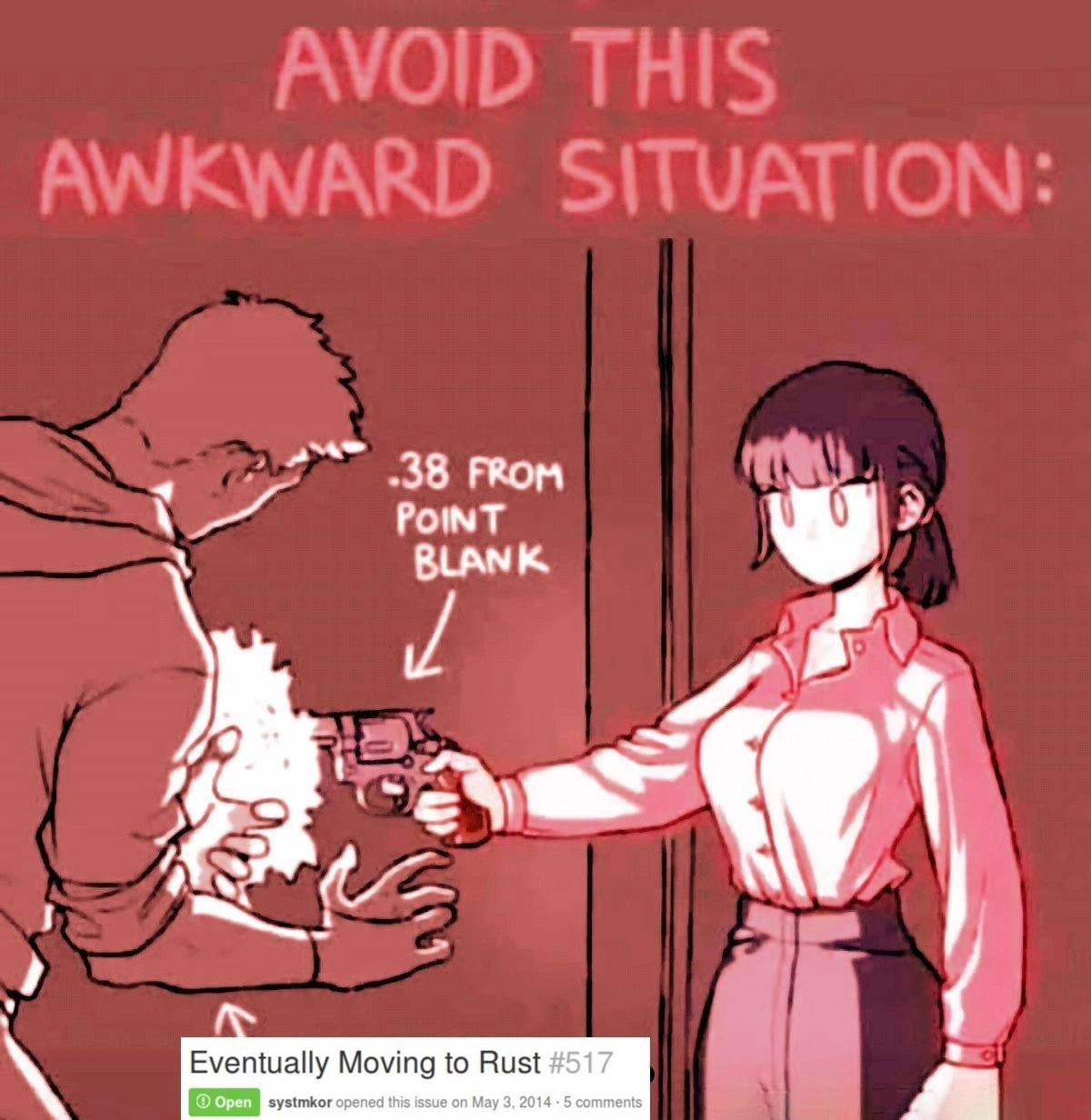
Legacy systems refers to the old software that’s still in use. Here, it likely means a large system written in C/C++ that has been around for a long time. Those languages give a lot of control and speed, but they also come with pitfalls – the responsibility is on programmers to manage memory correctly. Over years, even good engineers can’t catch every bug, especially as multiple people modify the code. Little memory mistakes can lurk in a legacy system for ages. Each missed opportunity to update the technology (like moving to Rust or even using newer safer patterns in C++) is a missed maintenance. The “awkward situation” the meme mentions is what happens when all those missed fixes culminate in a disaster. Because memory bugs can cause very sudden and severe failures, the meme artist chose a gunshot as the metaphor. The woman holding the gun with a blank face represents the problem that was ignored – it has no remorse and will strike when triggered. The man clutching his stomach in shock is like the development team or the poor on-call engineer, caught unprepared when the program crashes or a security breach occurs.

The whole image being red and the text saying “AVOID THIS AWKWARD SITUATION:” is like a big warning sign. It’s telling developers: don’t let an important issue sit open for years. If you have a plan to make your system safer (like migrating to Rust for its safety guarantees), do it before something blows up. In more general terms for a newcomer: if you know there’s a risky part of your system (something that could cause a big bug or failure), that’s a red flag – you should address it sooner rather than later. Otherwise, you might end up in a crisis that is self-inflicted. The humor comes from the dramatic way this is shown (nobody is actually getting shot in programming, of course, but a crashing server or hacked database can feel that dramatic to a developer!).

Let’s clarify a few terms and elements seen in the meme:

  • GitHub issue: This is a way software teams track tasks, bugs, or feature requests. The meme shows an issue card from GitHub titled “Eventually Moving to Rust #517”. “Open” with a green label means the task is not done yet. It was opened by a user (systmkor) on May 3, 2014, and it has 5 comments. This gives a sense of how long the idea has been floating around without resolution.
  • Rust: A programming language that is often used in systems programming (like C/C++) but with modern features that prevent common errors. Rust has concepts of ownership and borrowing that ensure memory is handled safely. Developers like it because it can achieve C++ level performance without the usual bugs like buffer overruns or dangling pointers.
  • C/C++: These are older, traditional low-level programming languages. Very powerful and efficient, they let you manipulate memory directly. But with that power comes risk: if you make a mistake, the program can corrupt memory. There’s no automatic safety net; the program might just crash or misbehave unpredictably.
  • Memory safety: This means protecting against mistakes like using memory incorrectly. A memory-safe language (like Rust, or others such as Java and Python at a higher level) will prevent or manage those mistakes so the program doesn’t crash or get compromised easily. Memory-unsafe (or rather, not automatically safe) languages like C and C++ rely on the programmer to avoid errors, which is hard to do perfectly in big programs.
  • Segmentation fault (segfault): This is what we call it when a program tries to access an illegal memory address and the operating system shuts it down. It’s like a big red stop sign – the OS is saying “you’re not allowed to go there” and kills the program to prevent damage. In the meme, that catastrophic event is likened to getting shot point-blank by a gun: sudden and fatal (for the program).
  • Technical debt: A concept in software where if you take shortcuts or delay improvements, you accumulate a sort of “debt.” Just like financial debt, it can grow with interest – small issues can turn into bigger ones, and eventually you have to pay it off. “Paying off” tech debt might mean spending a lot of time later to fix problems that could have been prevented, or suffering a big failure. The meme’s issue #517 is a symbol of tech debt – they knew they should do it, they didn’t, and now the debt came due in dramatic fashion.

So, for a junior developer or someone new: the meme is funny because it’s an exaggerated cautionary tale. It uses a violent cartoon analogy (getting shot) to say “Hey, if you keep ignoring that important fix (like moving to a safer language), it’s going to end in disaster.” The tags like LegacySystems, TechDebt, LowLevelProgramming, and SecurityTradeoffs all hint at this theme: balancing old vs. new technology, the costs of rewriting code, and the risks you take when you stick with code that has known issues. It’s a bit like watching someone keep driving a car with the check engine light on for years — eventually, it’s going to break down spectacularly. The meme communicates that idea in a darkly comedic way that software folks find relatable (because many have been in projects where important upgrades were delayed too long).

Level 3: Tech Debt’s Revenge

From a senior developer’s perspective, this meme hits on a painfully familiar storyline: legacy system problems deferred until they become unmanageable. The image of a calm, expressionless anime character holding a gun to a panicked guy’s stomach is a metaphor for how technical debt eventually turns on you. The top caption “AVOID THIS AWKWARD SITUATION:” is satirical – it reads like a warning from some infomercial or corporate training slide, but the “awkward situation” is incredibly dire (getting shot point-blank!). This exaggeration lands as dark humor among developers because we’ve all seen minor issues turn into production catastrophes when ignored for too long. The gun labeled “.38 FROM POINT BLANK” represents a self-inflicted wound coming from the very thing you failed to address. In this case, the unresolved plan to rewrite critical components in Rust is the ticking time bomb. For 8+ years, the project stuck with the old C/C++ code — gaining new features perhaps, but also accumulating more memory-unsafe code. Each year that passed without tackling the rewrite was like adding another round to the revolver. Eventually, one of those rounds went off: maybe a segmentation fault took down production, or a nasty security exploit was discovered. The text at the bottom – a GitHub issue card “Eventually Moving to Rust #517” with a green Open label – is the punchline anchor. Every experienced dev knows the sight of long-open issues or TODOs that everyone pretends will happen “someday”. Issue #517 literally has “Eventually” in its title, which is hilarious because in project-management speak, eventually often ends up meaning never. It was opened on May 3, 2014 by user systmkor and still marked Open years later, a stark indicator of procrastination on a critical refactor. Five comments in nearly a decade suggests it was discussed a bit and then forgotten or deprioritized consistently. The green Open badge after so long is like a subtle extra joke – “Yep, still open!” – as if mocking the team’s eternal optimism.

For veterans, this scenario is too real. We’ve witnessed “let’s rewrite in [new language]” tickets get pushed aside release after release. Why? Rewriting a stable (but creaky) system in a new language like Rust is a massive undertaking: it risks new bugs, requires team retraining, and doesn’t directly add flashy features customers see. Management often labels it low priority until a disaster strikes. It’s a classic TechDebt trap: you delay the boring foundational fix, and the longer you wait, the harder and riskier it becomes to do – until something breaks so badly that you have no choice. By then, the problem “fires back” with interest. The calm gun-wielding woman in the meme can be seen as the embodiment of Reality or Fate: she doesn’t care about your excuses or schedule, she delivers the consequences with a blank stare. The startled man clutching his abdomen is the development team or DevOps engineer, caught off-guard by a severe crash or exploit that, in hindsight, was looming all along. The whole scene tinted in red screams “Red Alert!” or a big red flag – the crisis moment when that old decision not to migrate to Rust comes back to bite hard.

The humor also touches on the ongoing language wars in systems programming. Rust advocates often sound the alarm about memory safety in C/C++ (“it’s only a matter of time before it blows up!”). Meanwhile, C/C++ folks might resist: “if it isn’t broken, don’t rewrite it” or “we can manage with careful reviews and tests.” Here the meme clearly takes Rust’s side: implying that not moving to Rust was a ticking bomb. The security tradeoffs are laid bare: stick with a language where a single stray pointer can crash or pwn your system vs. invest in a safer alternative. Many seniors recall famous incidents (like Heartbleed or buffer overflow exploits) that could have been prevented by Rust’s guarantees. In fact, Microsoft reported that ~70% of their serious security bugs were memory safety issues in C/C++ – exactly the kind Rust could prevent. So an “Eventually move to Rust” issue is a common sight in large organizations trying to avoid being the next headline.

What really makes seasoned devs smirk at this meme is the relatable humor of the procrastination. It’s essentially an “I told you so” moment frozen in a meme. We laugh (perhaps nervously) because we’ve been in that project meeting: “Should we refactor to improve safety?”“We’ll schedule it next quarter… or next year.” Next year becomes next decade, and then one day a major bug forces an emergency scramble. This is when all those ignored legacy systems problems hit like a gut punch. If you’re unlucky, it happens at 3 AM on a weekend, much like getting ambushed when you least expect it. The meme warns us with gallows humor: “Don’t be that team.” In practical terms, it suggests that rewriting critical components in Rust (or otherwise addressing the root cause of bugs) should be treated proactively, not as an “eventually” task. Otherwise, you might find yourself in the incredibly “awkward situation” of explaining to your boss or users that an eight-year-old neglected ticket just caused a very real outage or security incident. And that, as every senior dev knows, is about as much fun as taking a bullet.

To drive home how avoidable this pain was, consider a quick coding example. In C, you might unknowingly write something that compiles fine but is very dangerous:

#include <stdlib.h>
#include <stdio.h>
int main() {
    int *data = malloc(sizeof(int));
    *data = 42;
    free(data);
    printf("%d\n", *data);  // Use-after-free: undefined behavior (dangerous)
    return 0;
}

This C program runs and might print “42” or garbage, or it might crash outright – you can’t be sure, because reading *data after freeing it is undefined behavior. It’s akin to wandering into memory that was “given back” to the system – a recipe for a segmentation fault (or worse, a subtle corruption). Now, here’s roughly the same idea in Rust:

let data = Box::new(42);
drop(data);
// println!("{}", *data); // error: use of moved value (won't compile in Rust)

In Rust, the compiler stops you before you even run the program. The moment you try to use data after it’s dropped, Rust refuses to build the code, effectively saying “that’s a bullet you’re not allowed to fire.” This is the Rust safety guarantee at work. The meme’s humor is essentially lamenting that if only that project had pulled the trigger on migrating to Rust (where such mistakes are caught early), they wouldn’t have literally pulled a trigger on themselves later. It’s an extreme visual metaphor for a very real software engineering lesson: deal with your tech debt before it deals with you.

Level 4: Borrow Checker Ballistics

At the deepest technical level, this meme highlights the cold, hard physics of memory safety (or lack thereof) in systems programming. In low-level languages like C/C++, a wild pointer or buffer overflow is essentially a loaded gun. The phrase “.38 FROM POINT BLANK” labels the gun’s impact, which in computing terms is analogous to a point-blank segmentation fault – an immediate, fatal error when a program accesses memory it has no business touching. Why is this so deadly? Modern operating systems use memory protection (like segments and pages) so that an invalid pointer dereference triggers a hardware exception (SIGSEGV) right away, no questions asked. It’s the computer’s equivalent of a bullet to the gut: sudden and usually non-recoverable.

In our scenario, an issue titled “Eventually Moving to Rust” has sat untouched since 2014. That’s eight years of continuing with a legacy codebase (likely in C/C++). Over such a long period, the probability of a serious memory bug approaches certainty thanks to the inexorable laws of complexity and probability. In academic terms, if we consider a large codebase with many unchecked pointer operations, the error state space is enormous. It’s like Russian roulette with a codebase: each deployment spins the chamber, hoping no undefined behavior fires off. Undefined behavior (UB) is a notorious concept in C/C++ – doing something the language spec doesn’t define (like using freed memory or overflowing a buffer) can result in anything: crashes, security vulnerabilities, or subtle data corruption. UB is often jokingly said to invoke "nasal demons" (i.e., utterly unpredictable results), but here it’s more like a demon with a revolver.

Rust was designed to eliminate this class of problems through its borrow checker and ownership model – essentially enforcing memory safety at compile time. Under the hood, Rust’s type system uses concepts akin to linear/affine types and lifetime analysis drawn from academic research. These ensure you can’t have dangling pointers or data races in safe Rust code. If C++ is a loaded gun, Rust is a gun with a smart safety that literally won’t fire unless rules are followed. The meme’s dark humor is that the long-delayed “move to Rust” was supposed to be that safety catch, but since it never happened, the “safety off” C++ code eventually fires back with a critical failure. There’s even a bit of historical subtext: around 2014, memory exploits like the Heartbleed bug (a buffer over-read in OpenSSL’s C code) had shaken the industry, prompting calls to rewrite infrastructure in memory-safe languages. The open issue from May 3, 2014, hints that someone foresaw the need for change (likely after those high-profile fiascos). But formal proofs or good intentions mean nothing if you don’t implement them—just as detailed ballistics theory won’t save you if you stand in front of the gun. Over nearly a decade, that unresolved GitHub issue accrued technical debt interest: eventually manifesting as a catastrophic crash or security breach. In summary, the meme demonstrates a brutal truth of computer science: ignoring fundamental flaws (like memory unsafety) is betting against mathematics and the operating system’s safeguards. Sooner or later, the compromised memory model will assert itself (often spectacularly), much like a physics equation balancing out – and the result, while darkly inevitable, is packaged here as a comedic cautionary tale for those fluent in systems-level arcana.

Description

This is a two-layered meme using a reddish-tinted, anime-style illustration. The main drawing shows a woman with dark hair, in a white collared shirt and dark skirt, calmly shooting a man in a hoodie at point-blank range with a revolver. Above them, large text reads, 'AVOID THIS AWKWARD SITUATION:'. An arrow points from the gun, which has text next to it saying '.38 FROM POINT BLANK'. Overlaid at the bottom is a screenshot of a GitHub issue, with an arrow pointing from it to the man being shot. The issue is from an unseen repository and is titled 'Eventually Moving to Rust #517'. It's marked as 'Open' and was created on May 3, 2014. The technical humor lies in the extreme hyperbole, equating the long-dreaded, perpetually postponed task of migrating a project to the Rust programming language with a fatal and unavoidable event. For experienced developers, this captures the immense perceived difficulty, steep learning curve, and massive engineering effort associated with rewriting a legacy system in Rust, a task so daunting it has remained an open issue for nearly a decade
Comments

21
Anonymous ★ Top Pick That GitHub issue has been open since 2014. At this point, the migration isn't just technical debt; it's a multi-generational curse
  1. Anonymous ★ Top Pick

    That GitHub issue has been open since 2014. At this point, the migration isn't just technical debt; it's a multi-generational curse

  2. Anonymous

    Turns out the real undefined behavior isn’t your C code - it's assuming an eight-year-old "eventually move to Rust" ticket will save you before the segfault pulls the trigger

  3. Anonymous

    After 10 years, GitHub issue #517 is still open because the team lead discovered that threatening developers with a .38 Special is actually less painful than migrating a million-line C++ codebase to Rust - and the borrow checker doesn't negotiate at gunpoint

  4. Anonymous

    Nothing captures the existential dread of a senior engineer quite like stumbling upon a 10-year-old 'Eventually Moving to Rust' issue that's still open, still has no assignee, and somehow has accumulated 847 comments debating memory safety while the C++ codebase continues to segfault in production. It's the technical debt equivalent of finding your high school crush's wedding photos - a painful reminder of what could have been, if only someone had actually allocated the sprint capacity back when Rust 1.0 was still in beta

  5. Anonymous

    Our “Eventually move to Rust” issue has a longer lifetime than our dangling pointers - meanwhile CVEs keep submitting point‑blank PRs

  6. Anonymous

    Nothing says "secure by design" like a decade-old "Eventually Move to Rust" ticket while the use-after-frees keep firing point blank

  7. Anonymous

    Rust migration: #38 to #517 - because even borrow checkers can't escape roadmap lifetimes spanning careers

  8. @Sp1cyP3pp3r 2y

    Не понял

    1. @RiedleroD 2y

      english please

      1. @Sp1cyP3pp3r 2y

        Omg so sorry I thought this was far right libertarian Russian meme channel

        1. @RiedleroD 2y

          …it isn't

          1. @Sp1cyP3pp3r 2y

            Let me double check...

      2. @Herestetic 2y

        Қазақша сөйле

        1. @domokrch 2y

          бәрі жақсы? (u good?)

  9. @Sp1cyP3pp3r 2y

    🗿

  10. @Herestetic 2y

    LoL

  11. @Herestetic 2y

    I still don't get a meme

    1. @RiedleroD 2y

      something about people not liking rust ig

      1. @Herestetic 2y

        Thanks

  12. @Daler_XYZ 2y

    What do you mean? Like pointers in c++?

  13. @GrafMon 1y

    Where from is the original of the picture?

Use J and K for navigation