Vindicated by Inefficient Code
Why is this CodeQuality meme funny?
Level 1: The Overkill Solution
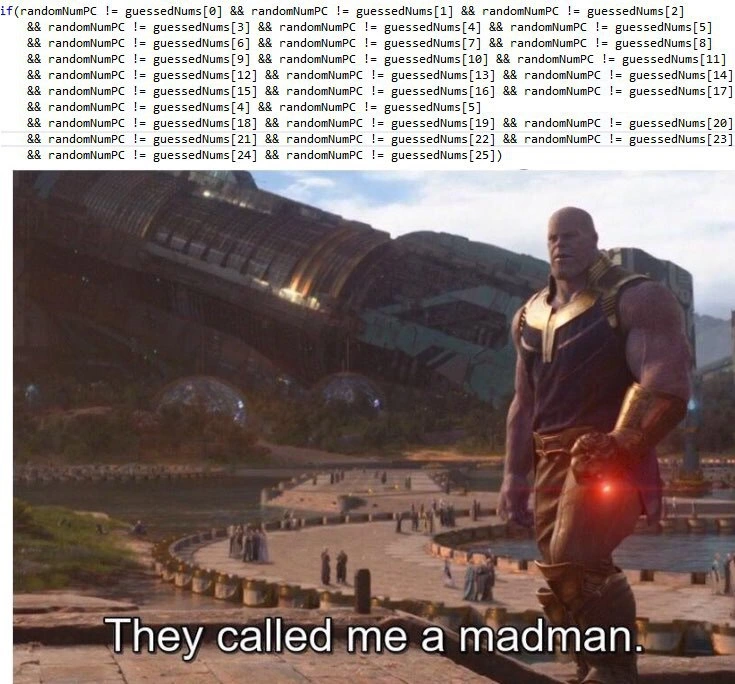
Imagine you want to check that your new toy isn’t the same as any toy you already have. A sensible way is to look through your toy box or ask, “Is this toy new?” to the box as a whole. But instead, you decide to do something wild: you hold up your new toy and one by one ask, “Is it not the same as toy 1? And not the same as toy 2? And not the same as toy 3? …” and so on for 26 toys. You’re basically asking 26 separate questions to be sure the new toy is different from each toy in your collection. That’s a lot of work just to say “It’s a new toy!” It’s a bit like a person who wants to prove they didn’t copy someone’s homework by comparing their work to every single classmate’s – instead of just using a simpler way to check. In the picture, a big strong character (Thanos from the Avengers movies) is standing proudly saying, “They called me a madman.” It’s as if the person who asked 26 questions to do a simple check is bragging, “People said I was crazy for doing it this way!” The whole joke is that the person chose a really complicated and over-the-top method to do something very simple, and they’re oddly proud of it. Even a kid can see it’s funny to take such an unnecessarily long way around to solve a problem – it’s like using a hammer to crack a tiny peanut and then saying, “Everyone said I was nuts for doing that, but hey, it worked!” The humor comes from how silly and extreme that solution is when a much simpler solution was right there.
Level 2: Madness in Plain Sight
This meme highlights a common coding mistake that beginners might make. Let’s break down the scenario. The top half shows a snippet of code with a single monstrous if statement. An if statement runs some code only if a condition is true. Here the condition is extremely long: it checks randomNumPC != guessedNums[0] && randomNumPC != guessedNums[1] && ... && randomNumPC != guessedNums[25]. The != operator means “is not equal to.” The && means “and.” So the whole condition is true only if randomNumPC is not equal to guessedNums[0] and not equal to guessedNums[1] and not equal to guessedNums[2] … all the way up to not equal to guessedNums[25]. In simpler terms, the code is checking that a number (randomNumPC) isn’t the same as any number in the guessedNums array of size 26.
Why is this a problem? Because the coder has written basically the same check 26 times! This is what we call a code smell or an inefficient code pattern – an indicator that something could be wrong with the code structure. A more maintainable and clean approach would be to use a loop to go through the array, or use a built-in function to check if the number exists in the list. For example, instead of writing 26 comparisons, one could do:
boolean found = false;
for (int i = 0; i < guessedNums.length; i++) {
if (randomNumPC == guessedNums[i]) {
found = true;
break;
}
}
if (!found) {
// randomNumPC is not equal to any element in guessedNums
// proceed with the logic
}
This loop does the same job: it checks each element of guessedNums one by one, but with just a few lines of code that automatically repeat instead of 26 manually typed conditions. Many languages also have shortcuts, like a contains() method or a Set data structure, to check if a value is in a collection without writing the loop yourself. The key point is that writing out each comparison by hand is harder to read and error-prone. If someone new joins the project or if the original author comes back to this code later, they might have a hard time understanding or modifying it. What if the array had to grow to 30 elements? They’d have to add four more && randomNumPC != guessedNums[...] parts exactly right, which is tedious and easy to mess up. That’s why a senior developer doing a code review would likely shake their head at this. They’d probably call it an AntiPattern (meaning a bad solution to a problem) and say it needs immediate RefactoringNeeded – which means rewriting the code in a cleaner way without changing what it does.
Now, the bottom panel of the meme shows a scene from the popular Marvel movie Avengers: Infinity War. The character Thanos is walking in a devastated area with the caption “They called me a madman.” In that movie, Thanos had a drastic plan (halving the population of the universe!) that others thought was insane. The meme humorously compares our overzealous programmer to Thanos. The developer’s approach to avoid duplicate guesses (by writing a 26-part condition) is portrayed as a ridiculously over-the-top plan – so much so that people “call them a madman.” It’s an Avengers meme format where the programmer is jokingly cast as a villain who’s proud of their wild approach. This format makes the joke accessible: even if you don’t catch every code detail, you might know Thanos’s infamous line and laugh at the idea that a coder is proudly defending a crazy coding method. The combination of a maintainability_nightmare code snippet with a pop culture reference creates a relatable DeveloperHumor moment: every experienced coder has seen code that made them think, “Only a madman would do this,” and now here’s a meme giving that scenario the dramatic flair of a superhero movie.
Level 3: Infinity If War
In the top panel, we see a giant if-statement that stretches across 26 separate inequality checks. This is essentially a manually unrolled loop – a series of repeated && conditions each checking if randomNumPC is not equal to guessedNums[i] for every index from 0 to 25. In plain terms, the code is trying to ensure randomNumPC isn’t found in the guessedNums array (i.e., it's checking array membership the hard way). Writing it out 26 times is a classic AntiPattern and a serious CodeSmell in terms of CodeQuality. Why? Because it violates the DRY (Don't Repeat Yourself) principle spectacularly. Instead of using a simple loop or a set lookup, the developer chose to explicitly enumerate every single comparison. This kind of loopless validation is technically equivalent in outcome to a proper loop, but it’s a maintainability nightmare. Any senior engineer reviewing this code would likely do a double-take (or a spit-take ☕) upon encountering such SpaghettiCode. It's the sort of thing you might find in unrefactored legacy code or written by an inexperienced coder who hasn’t yet learned about iteration.
From a performance standpoint, 26 sequential comparisons (O(n) with n=26) won't melt any CPUs – it's not a Big O catastrophe in this case. The real damage is to readability and robustness. Imagine if you needed to allow 30 guesses instead of 26 – you'd have to manually insert four more conditions in exactly the right format or risk a bug. One-off errors (like forgetting guessedNums[25] or using a wrong index) are dangerously easy to introduce here, and a future maintainer might not even notice a missing check until a bug surfaces. This is why every seasoned developer would label this code as TechnicalDebt: it “works” today but will make any enhancements or debugging painful tomorrow. We have a classic code review horror scenario – the kind that gives code reviewers heartburn. The meme’s bottom panel cements the humor: it features Thanos from Avengers: Infinity War smugly declaring, “They called me a madman.” The Thanos reference is tongue-in-cheek. In the movie, Thanos’s extreme solution to a problem had others calling him insane. Here, our developer’s extreme solution to avoiding a loop has others (the senior reviewers) calling them crazy. Both went to ridiculous lengths to achieve their goal. The juxtaposition says it all: writing an if-statement with 26 repetitive conditions is so absurd that the coder might as well be an MCU supervillain boasting about a scheme. In a real team, the snap of the code reviewer’s patience is almost guaranteed – they’d insist on a Refactoring faster than you can gather the Infinity Stones. A loop (or a utility method like contains() or a Set lookup) would condense this madness into a few lines, eliminating the inefficient code pattern. In summary, the meme pokes fun at overcomplicated, hard-to-maintain code – the kind that makes seniors exclaim, “Why would you ever do that?!” while the author perhaps shrugs, “Hey, it works... They called me a madman.”
Description
A two-panel meme that contrasts a horrifying piece of code with a moment of triumph. The top panel displays a code snippet with a single, extremely long 'if' statement. This statement checks a variable 'randomNumPC' against 26 hardcoded elements of an array named 'guessedNums' using a chain of '&&' (AND) operators, which is a highly inefficient and unreadable way to check for an item's non-existence in a collection. The bottom panel features a still image of the character Thanos from the film 'Avengers: Infinity War,' looking resolute and powerful with the caption, 'They called me a madman.' The humor arises from the developer defending their terrible but functional code. This meme resonates with experienced engineers who understand the importance of algorithmic efficiency and code quality. The joke is that such a brute-force approach, while technically working, ignores fundamental computer science principles like using appropriate data structures (e.g., a Set for O(1) lookups) for better performance and readability, making it a 'mad' solution that would be torn apart in a code review
Comments
7Comment deleted
Some people use a Set for O(1) lookup. I use 26 boolean expressions for O(WTF) during code review
Sure, it’s O(1) to read, but only if you’re an Eternal with infinite eyesight
When you ship code that makes the senior engineers cry but passes all the unit tests because nobody thought to test for "what if someone actually does THIS?"
When your junior dev discovers the logical AND operator but hasn't yet been introduced to arrays, loops, or the Set data structure. This is what happens when someone reads 'defensive programming' but stops at chapter one - they're defending against duplicates with the computational equivalent of checking every grain of sand on a beach individually. At least when this inevitably needs to handle 100 numbers instead of 26, they'll finally discover why 'DRY' isn't just about moisture levels in the server room
It's randomPC(guessed[ & all the way down
Hand-rolling Set.contains with 26 chained &&s: O(n) runtime, O(infinite PR comments) maintainability - the real Infinity Gauntlet is your cyclomatic complexity
Nothing says production-ready like implementing membership as 26 chained != checks - Set.has(), but with a cyclomatic complexity gauntlet that snaps your code review into dust