The 'I Use Docker, Therefore I Am DevOps' Fallacy
Why is this DevOps SRE meme funny?
Level 1: Microwave Chef
Imagine a kid who just learned how to use a microwave to heat up a cup of instant noodles. He turns around and proudly declares, “You know, I’m something of a chef myself.” 😄 Clearly, warming up one easy meal doesn’t suddenly make him a master chef who can run a whole restaurant kitchen. Real chefs plan full menus, chop ingredients, cook complex dishes, deal with hot ovens and timing – way more than just pressing a button on a microwave.
This meme is making the same kind of joke, but with computers. A developer did one simple thing – they ran a program using Docker (which is like a handy kitchen gadget for software) – and then they boast that they are a DevOps expert (that would be like the master chef of keeping software running). It’s funny because the claim is so out of proportion to what they actually did. Just like heating noodles isn’t the same as culinary expertise, running one command isn’t the same as knowing all about managing and deploying software in the real world.
So, the meme is basically a playful way of saying, “Doing a tiny easy part doesn’t mean you can do the whole big complicated thing.” Even if you’re excited about that first success (and good for you for learning something new!), calling yourself an expert that fast will make people who truly are experts smile and shake their heads. It’s a gentle reminder: we all have more to learn, and big skills take more than one try to earn.
Level 2: Docker ≠ DevOps
Let’s step back and explain the pieces of this meme in simpler terms. First, Docker: this is a popular tool developers use for containerization. Containerization means packaging an application along with everything it needs (libraries, runtime, etc.) into a neat container. You can think of a Docker container like a little box that has a program and its environment inside. This box can run on any computer that has Docker installed, and it will behave the same way. That’s super useful in software development because it solves the “works on my machine” problem – if you ship the whole environment in a container, you avoid the “but it broke on my machine” issue when someone else runs it. Running docker run ... is the command to launch such a container. It’s a single command that, in one go, starts up an application inside its own mini-environment. Pretty cool, right?
Now, DevOps: this is a combination of “Development” and “Operations.” It’s not a specific tool but rather a culture and set of practices aimed at bridging the gap between writing code (dev) and running code in production (ops). DevOps folks set up things like CI/CD pipelines – these are automated workflows that take code from version control (like Git), build it, test it, and deploy it to production without manual steps. DevOps also involves managing infrastructure (servers, databases, networks) using code and configuration – often called Infrastructure as Code. Think of tools like Terraform or CloudFormation, which let you describe, for example, “I need 3 servers, 2 databases, and a load balancer” in a config file, and they will create those resources in the cloud for you. DevOps is also about monitoring and reliability: setting up logs, alerts, and dashboards so you know when something goes wrong, and you can respond quickly (this is where the term SRE, Site Reliability Engineering, comes in – SRE is essentially an approach to DevOps with a focus on keeping systems dependable).
So, why is it silly to say “I’m something of a DevOps myself” after just using Docker once? Because using Docker is just one small part of that whole DevOps picture. Yes, Docker is a tool often used in DevOps workflows (since containers make deploying software easier and more consistent), but mastering DevOps means being familiar with a lot of areas:
- Setting up continuous integration (so that every time developers push code, it gets built and tested automatically).
- Managing continuous deployment (so new versions of the app can go out frequently, maybe multiple times a day, in a safe automated way).
- Automating infrastructure setup and configuration (infrastructure as code rather than manually clicking around in cloud dashboards).
- Ensuring security of deployments (for instance, making sure that Docker container you run doesn’t have vulnerable packages, and that it’s configured with proper access rules).
- Setting up monitoring/alerting (so when your app is live, you know if it crashes or if response times spike).
- Handling rollbacks and failovers (if a new release goes bad, how quickly can you revert to an old version? If a server dies, does your system self-heal by using another server?).
That’s a lot, right? Running a single Docker container is just one piece of the puzzle – arguably one of the easier pieces, since Docker’s whole point is to simplify running software. The meme is making fun of developers who might not realize this and who might prematurely think, “Hey, I put my app in a Docker container and ran it, so I basically did ops… I’m a DevOps engineer now!” It’s poking at the confusion between using a DevOps tool and being proficient in DevOps practices.
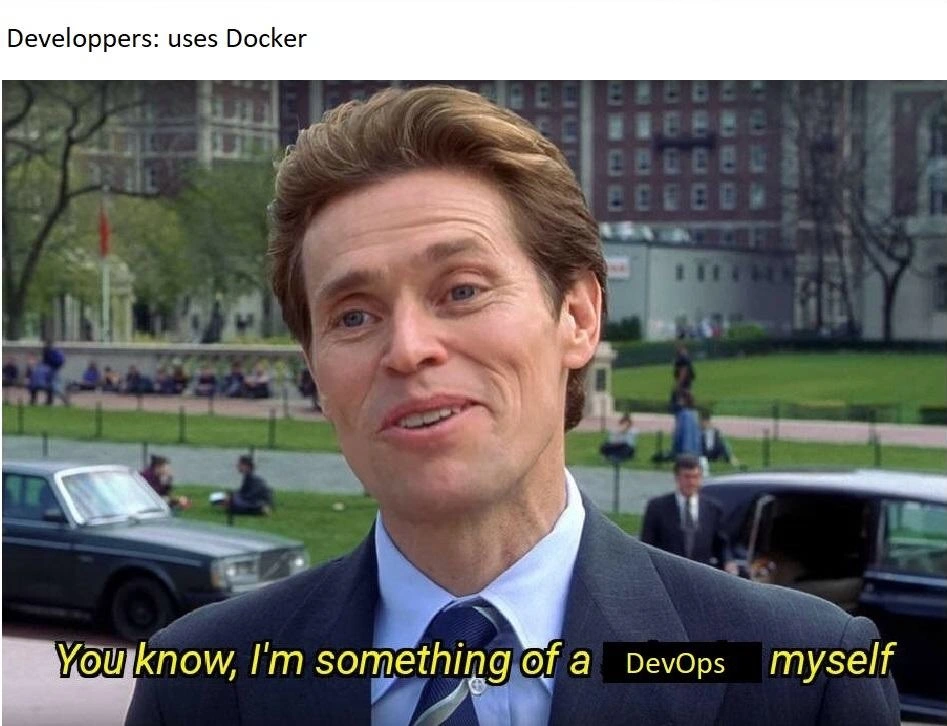
The image used is a popular meme template from the Spider-Man movie. In the real scene, the character Norman Osborn (the guy in the suit, played by Willem Dafoe) tries to bond with Peter Parker by saying, “You know, I’m something of a scientist myself.” Online, people replace “scientist” with other words to joke about someone bragging or taking undue pride in a small accomplishment. For example, if someone successfully changes a lightbulb and then says, “I’m something of an electrician myself,” that’s the humor format. Here, the developer runs one Docker container and says, “I’m something of a DevOps myself.” It’s a tongue-in-cheek way to say the developer is overconfident.
Just to clarify the humor: imagine a junior programmer who just learned how to containerize their code – which is a good step in modern software development – but now they think they have the same skills as an experienced DevOps engineer who has been handling real-world deployments and outages for years. It’s like a student pilot who flew a Cessna once now claiming to be an airline captain. The experienced folks find this funny (or a bit cringe) because they know how much more there is to learn. The meme isn’t mocking Docker or developers learning it – it’s great to learn Docker! – it’s just exaggerating that jump-to-conclusion moment for comedic effect.
In summary, Docker is a tool (for running applications in containers), and DevOps is a broad approach and role that uses many tools (possibly including Docker) to manage software from development all the way to running reliably in production. The meme jokes that some developers mistakenly equate the two after minimal exposure. It’s popular in DevOps humor circles and among developers because it captures a real dynamic in tech culture with a laugh: we’ve all met someone who claims expert status a bit too soon, and sometimes, we are that someone without realizing it!
Level 3: One-Command Wonder
This meme perfectly captures a familiar scenario in tech: a developer uses Docker once and suddenly proclaims themselves a DevOps specialist. The top caption “Developpers: uses Docker” (intentionally mispelled, as if to subtly poke fun at the “expert” who can’t even spell developers right) sets up the joke. The image of Norman Osborn (played by Willem Dafoe in Spider-Man 2002) delivers the punchline: “You know, I’m something of a DevOps myself.” This is a twist on a well-known movie quote (“I’m something of a scientist myself”), a line often meme-ified to mock people who overestimate their abilities after doing something trivial. Here, it’s the archetype of a developer who ran a single Docker container and now thinks they’ve mastered the entire DevOps universe.
Why is this so funny (or painfully relatable) to seasoned engineers? Because DevOps is a broad discipline encompassing a whole lifecycle of practices – continuous integration, continuous deployment (CI/CD pipelines), automated testing, cloud infrastructure management, scaling, monitoring, incident response, you name it. It’s a culture and practice, not just a one-time tool execution. Yet many developers have had that colleague (or have been that person early in their career) who, after containerizing one app, starts throwing around the DevOps title. It’s a classic case of Dunning-Kruger effect in the tech world – knowing just enough to think you know it all, unaware of the vast expanse of what you don’t know. The meme exaggerates it for humor: the developer’s confidence is sky-high after a single docker run, while experienced DevOps folks are smirking because they know there’s so much more to it.
Let’s break down the contrast between what this overzealous developer did and what real DevOps work involves:
| New Developer’s “DevOps” Move | Actual DevOps Engineer’s Work |
|---|---|
Runs docker run hello-world once |
Designs a full CI/CD pipeline (automated builds, tests, deployments for every code change) |
| Packages one app in a Docker image | Manages infrastructure as code for dozens of services (servers, networks, databases defined in config files like Terraform) |
| Exposes an app on localhost with Docker | Orchestrates hundreds of containers in production (using Kubernetes or Docker Swarm, handling load balancing and auto-scaling) |
| Declares “I do DevOps now!” on social media | Gets paged at 3 AM to fix a broken deployment, implements monitoring/alerts, and writes post-mortems without bragging |
In other words, the meme highlights a naïve oversimplification: equating the use of one tool (Docker) with mastery of an entire field (DevOps/SRE). It’s poking fun at the current DevOps culture where everyone is excited about containers, but not everyone respects the depth of skill required to truly do ops at scale. Docker is a fantastic tool that indeed has revolutionized Developer Experience (DX) by making it easier to ensure "it works on my machine" means it works on yours too. And that excitement is great – it’s empowered developers to take on more responsibility for how their code runs. But this meme wryly reminds us that using one modern tool doesn’t instantly transfer all the knowledge of an experienced operations engineer.
The Spider-Man reference amplifies the humor: in the movie scene, Osborn says the famous line with a humble-bragging smile. In meme form, developers are essentially doing the same humble-brag: “Oh I just used Docker… I guess that practically makes me head of DevOps, right?” Seasoned DevOps engineers (the ones who havebeen through on-call nightmares and pipeline failures) see that face and that quote and can’t help but chuckle – or facepalm. They’ve spent years dealing with thorny issues like configuration drift, rollback strategies, security patching, database migrations, uptime SLAs, and disaster recovery. Compared to that, running a single container is child’s play.
So, this meme resonates as an inside joke among tech folks. It caricatures the enthusiasm of a developer who just discovered a powerful tool (Docker) and got a bit too full of themselves. The humor has a slightly bitter edge (especially for ops veterans) because it’s a scenario that happens in real life. In team settings, you might even hear someone jest, “Oh you deployed our app with Docker? You know, we’re all DevOps engineers now!” – a bit of friendly fire to remind people that there’s more to DevOps than just that. The DevOps culture promotes collaboration between dev and ops, but it also involves humility and continuous learning. This meme playfully chastises those skipping the humility part. After all, calling yourself a DevOps expert after one container is like calling yourself a surgeon because you put a Band-Aid on a paper cut – it’s jumping the gun by a mile (and a few on-call rotations).
Level 4: Beyond docker run
At the highest technical level, this meme hints at the hidden complexity behind that innocently simple docker run command. Under the hood, Docker is leveraging advanced operating system virtualization features. When our proud developer types docker run, the Docker engine is busy setting up isolated Linux namespaces (each container gets its own process tree, network stack, filesystem view, etc.) and configuring cgroups (control groups that limit CPU, memory, and I/O usage) to create a sandboxed mini-system. Essentially, Docker uses the host kernel to spawn a contained environment – it's like a lightweight VM (virtual machine) but without the heavy overhead of emulating hardware. Instead of a full guest OS, the container shares the host OS kernel, which is precisely why Docker can spin up containers in seconds. But that speed and ease are a mirage of simplicity: behind it are layers of sophisticated tech like UnionFS/OverlayFS (copy-on-write filesystems that let multiple containers share a base image layer efficiently) and a container runtime (often runc under Docker) invoking low-level syscalls (clone(), chroot(), etc.) to isolate the container’s world from the host.
A developer who’s run one container rarely appreciates these details – they might not realize that Docker is mapping container ports to the host’s network via virtual Ethernet bridges, managing IP addresses, and perhaps even modifying iptables rules for networking. They likely don’t know how a multi-stage Dockerfile cleverly reduces image bloat, or how improper image tagging can turn your CI server into a storage landfill of dangling images. A DevOps expert or seasoned SRE (Site Reliability Engineer) has had to contend with these gritty details: cleaning up container layers, squeezing images to be deployment-friendly, and dealing with kernel quirks (like how container timekeeping or entropy sources work, or when a container mysteriously OOM-kills your process because the cgroup limit was too low).
In short, beneath that one-line command are years of engineering that make containerization easy. Our overconfident developer is oblivious to this richness. They ride on an iceberg’s tip thinking it’s the whole iceberg. Sure, running docker run feels like magic – but that magic rests on a mountain of kernel features, networking protocols, and filesystem wizardry. A true DevOps practitioner not only knows how to use these tools but understands, at least broadly, what’s happening underneath. It’s the difference between wielding a tool and mastering it. By believing that one Docker command makes them an ops guru, the developer in the meme is effectively taking credit for the container sorcery that others (the Docker and Linux kernel engineers) have built. The humor comes from this mismatch between how easy Docker makes a complex task and how much the developer overestimates their own skill as a result.
Description
A popular meme format featuring a screenshot of actor Willem Dafoe as Norman Osborn from the 2002 'Spider-Man' movie. The top of the image has a line of text that reads, 'Developers: uses Docker'. Below, the main image shows Dafoe with a self-satisfied, slightly smug expression. The original movie quote 'You know, I'm something of a scientist myself' is overlaid in yellow subtitles, but the word 'scientist' has been replaced with 'DevOps', which is highlighted with a black background. The meme satirizes the common tendency for software developers to overestimate their operations expertise simply because they can write a Dockerfile. For senior engineers, it's a humorous jab at the Dunning-Kruger effect in the tech industry, where proficiency with a single containerization tool is mistaken for the deep, systemic knowledge required for true DevOps practices like CI/CD, infrastructure management, and site reliability
Comments
8Comment deleted
Claiming you're a DevOps expert because you wrote a multi-stage Dockerfile is like claiming you're a civil engineer because you successfully assembled an IKEA bookshelf
“One flawless ‘docker run -d postgres’ and suddenly the org thinks you’re a DevOps engineer - just wait till Terraform state drifts at 3 AM and your new title comes with a PagerDuty ringtone.”
Writing a Dockerfile is basically DevOps, just like knowing HTML makes you a full-stack engineer and running npm install makes you a package maintainer
He ran `docker run hello-world` without sudo once - the Dockerfile is 400 lines, FROM ubuntu, and he's already updating his LinkedIn title to Platform Engineer
Ah yes, the classic 'docker run' makes me a DevOps engineer - right up there with writing a bash script and calling yourself a systems architect. Meanwhile, the actual SREs are at 3 AM debugging why your single-container deployment just took down production because nobody implemented health checks, proper logging, or understood the difference between orchestration and just... running a container. But hey, at least your local environment works perfectly, which is basically the same as managing a distributed system at scale, right?
‘I used Docker, so I’m DevOps’ is how you discover that packaging an app ≠ operating a system - SLOs, runbooks, and the pager aren’t FROM any Dockerfile
Mastered 'docker run'? Congrats, you're now qualified for Kubernetes quota debates and 3AM PagerDuty
Running docker run once doesn’t make you DevOps any more than kubectl get pods makes you SRE - try SLOs, change failure rate, RBAC, IaC, and 3 a.m. pager duty