Tensorflow vs. a Tiny CSV File
Why is this AI ML meme funny?
Level 1: Sledgehammer vs Fly
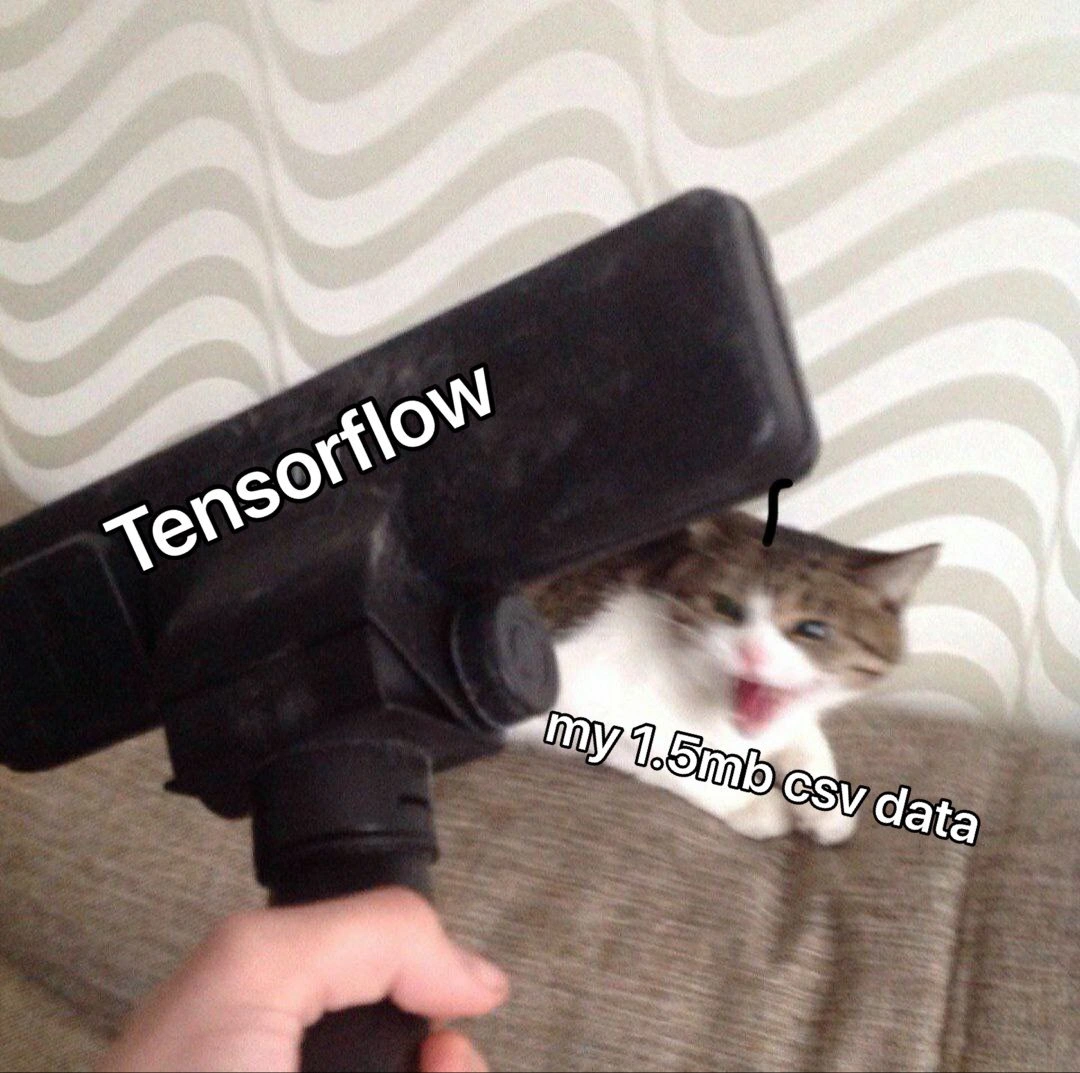
Imagine you have a tiny task to do, like tapping in a small nail or picking up a little crumb, and instead of using a little hammer or just your hand, you bring out a giant sledgehammer or a huge vacuum cleaner. Sounds funny, right? You’d probably scare everyone around and maybe break something in the process! That’s what’s happening in this meme. It’s showing someone using something way too powerful for a really small job. In the picture, a big vacuum (a powerful machine) is being pointed at a little cat. The cat represents a small, simple thing (like a tiny bit of data), and the vacuum represents a super powerful tool (a fancy computer program). The cat looks shocked and scared because it’s like, “Why on Earth are you using that huge thing on me?!”
It’s funny because we all know you don’t need an enormous machine to do a teeny tiny job. It’s like using a cannon to kill a fly – the fly is so small you could just swat it, but someone went and got a huge cannon. The word for this is “overkill”: doing far more than necessary. People laugh at this meme because it’s a silly mistake that’s easy to understand. Even if you’re not a computer expert, you can get the idea: the poor kitty (a small problem) is about to be zapped by this massive vacuum (an overly big solution). We feel a bit sorry for the cat, but it’s also so exaggerated that it’s humorous.
So the core idea is simple: don’t use a super complicated solution for a simple problem. In everyday terms, if you had to butter a single slice of bread, you wouldn’t use a huge road-paving machine to do it – you’d just use a knife. The meme takes that common-sense idea and puts it in a playful picture with a cat and a vacuum. It makes us laugh and also remember to keep things simple when we can.
Level 2: Wrong Tool for the Job
At a more beginner-friendly level, let’s break down what’s happening in this meme. TensorFlow is an open-source software library for machine learning, especially known for creating and training neural networks (the technology behind a lot of modern AI). It’s a very powerful tool – think of it as a huge factory with lots of machines that can process tons of data and build very complex models. On the other hand, a CSV file (Comma-Separated Values file) is a simple text format for storing data in a table (rows and columns), often just used for small datasets or spreadsheets. A file that’s 1.5 MB (megabytes) in size is actually really small in the context of data science – it might contain a few thousand rows of data, something you could open in Excel or load into a trivial Python script in less than a second.
Now, the meme image shows a funny analogy: a person is pointing a vacuum cleaner (labeled “Tensorflow”) at a frightened little cat (labeled “my 1.5mb csv data”). The vacuum cleaner represents this big powerful tool (TensorFlow) and the cat represents the small dataset (the 1.5 MB CSV). In real life, a cat often freaks out when a vacuum turns on – it’s loud, overbearing, and the cat has no idea why this big machine is coming after it. Here, the cat is terrified because it’s like “Oh no, that huge thing is going to suck me up!” This visual metaphor is saying: using TensorFlow on a tiny dataset is as over-the-top and unnecessary as chasing a small cat with an industrial vacuum. It’s the wrong tool for the job. The poor cat (small data) doesn’t warrant such an aggressive approach; similarly, a small CSV file doesn’t “deserve” a complex deep learning framework attacking it.
For someone new to these terms: over-engineering is a concept where someone designs a solution that is far more complicated or powerful than needed for the problem at hand. It’s like building a five-story elaborate treehouse just to get one apple from a tree – sure, it might work, but it’s overly complex. In programming and data science, over-engineering might mean using an unnecessarily intricate tech stack or too many layers of abstraction for a simple task. In this case, using TensorFlow (which is meant for big deep learning tasks like image recognition, large-scale predictions, etc.) on a small CSV (which could likely be analyzed with a few lines of code or even just looked at in a spreadsheet) is a prime example of over-engineering. It’s ultimate overkill, as the title says.
A beginner might wonder, “Well, TensorFlow is just a tool – what’s the big deal? It can handle small data too, right?” The issue is that TensorFlow brings a lot of baggage with it. To use TensorFlow, you usually have to set up a whole environment: install the library (which is large and can be tricky, especially if you try to enable GPU support), write code to load data into TensorFlow’s structures, define a neural network model, and then train it. All that is like setting up a giant factory assembly line to produce one tiny handmade card. Yes, it will produce the card, but you spent way more effort than needed. In contrast, for a 1.5 MB CSV, you could use a simple tool like pandas, which is a Python library specifically good at reading CSVs and doing basic data analysis. With pandas, you can literally do something like:
import pandas as pd
data = pd.read_csv('my_data.csv')
print(data.describe())
…and you’d immediately get some useful stats about your dataset. If you needed to do machine learning on that small dataset, a library like scikit-learn provides straightforward implementations of algorithms like linear regression, decision trees, or small neural networks that are much simpler to use on small data. Scikit-learn would let you train a model in just a couple of lines and it doesn’t require special hardware or heavy setup.
To give an intuitive sense of scale: 1.5 MB of data is tiny enough that you can email it as an attachment or load it into memory on basically any device (even your phone). TensorFlow, however, is like bringing in a whole AI laboratory. Imagine you have a toy car that needs a battery replaced, but instead of doing it yourself with a screwdriver, you call in a Formula 1 pit crew with a truckload of equipment to handle it. Sure, the job gets done, but the preparation was excessive. Likewise, TensorFlow can absolutely analyze 1.5 MB of data – it will churn through that CSV without breaking a sweat – but you’ll have spent time and computing resources that just aren’t necessary. This is why the cat in the meme looks so horrified: it’s thinking, “I’m just a little dataset! Why bring in TensorFlow?!” The humor comes from recognizing that mismatch.
Beginners in data science sometimes think, “I must use the most advanced AI techniques to get the best results.” The truth (and the joke here) is that if your dataset is small or simple, often the simplest tool is actually the best and most pragmatic choice. Experienced folks often advise: try the simple thing first. If you have a small CSV, maybe start by exploring it in pandas, plotting a few charts, or running a quick linear model. You might be surprised that a basic solution gives you everything you need. TensorFlow and deep learning are fantastic, but they shine with large complex data (like thousands of images or millions of records), not a few thousand rows of CSV. Using them when you don’t need to can slow you down and complicate your workflow.
In short, this meme is teaching (with a laugh) the lesson: don’t use a jackhammer to crack a peanut. Make sure your tools match the scale of your problem. If you only have 1.5 MB of data, you probably don’t need the power (or the headache) of a deep learning framework. A simple approach will likely get you to the answer faster and with much less drama (and your “cat” dataset will be much happier!).
Level 3: Everything Looks Like a Nail
At a senior engineer or data scientist’s level, this meme elicits a knowing grin. It highlights a classic over-engineering mistake in AI/ML workflows: reaching for the biggest, flashiest tool in the box when a simple solution was more than enough. The image of a powerful TensorFlow "vacuum" menacing a tiny CSV file "cat" perfectly captures the scenario. We’ve all seen it (or done it ourselves in younger days): a keen machine learning engineer has a small dataset – maybe a few thousand rows of tabular data – yet they insist on spinning up a complex deep learning stack with TensorFlow (and even a GPU or cloud cluster) to crunch it. The result is technically functional but ridiculously inefficient and unwarranted. Seasoned developers find this funny because it’s AI humor reflecting real life. It’s like watching someone deploy a full Hadoop/Spark cluster to parse a 5 MB log file, or containerize a "Hello World" script with Kubernetes – the disparity between the problem and the chosen solution is laughably wide.
Why do people fall into this “TensorFlow everywhere” trap? Part of it is the shiny-tool syndrome: TensorFlow (and deep learning in general) has been so hyped and celebrated that some engineers reach for it by default. They’ve heard of the amazing things it can do – image recognition, speech synthesis, beating humans at Go – so they figure, why not use it on my little data problem? If all you have (or all you want to have) is a hammer, everything looks like a nail. In context, TensorFlow is the hammer, and any data – even a tiny CSV – starts looking like something that must need a neural network. There’s also a bit of resume-driven development at play: being able to say you used a cutting-edge deep learning framework might feel more exciting or prestigious than admitting you just ran a quick linear regression in Excel or pandas. The meme pokes fun at this tendency. A senior dev sees the label “my 1.5 MB CSV data” cowering from “TensorFlow” and immediately recalls meetings where a simple analysis was blown out into a full AI project for no good reason. The cat’s terrified expression is basically the small dataset screaming in protest: “Why are you doing this to me?! I’m just a cute little CSV!” – which is exactly how a beleaguered old-timer imagines the data would feel if it could talk.
From an engineering best practices perspective, the meme underscores the principle of using the right tool for the job. In data science, we have wonderful lightweight tools like pandas (for data manipulation, CSV reading, etc.) and scikit-learn (for classic machine learning algorithms like linear/logistic regression, decision trees, etc.) which are more than sufficient for a dataset of this size. An experienced developer knows that 1.5 MB of data can be loaded into memory in a blink of an eye and processed with simple methods. They’ll chuckle because perhaps they once watched a junior colleague spend days wrestling with TensorFlow’s GraphDef and Session runtime, dealing with cryptic errors or GPU driver issues, all to analyze a tiny file that pandas could have handled in 0.2 seconds with one line of code (pd.read_csv('data.csv')). The vacuum cleaner in the meme could have just as well been labeled “complex pipeline” and the cat “simple problem”. We recognize the broader anti-pattern: over-engineering a solution — building overly complex systems for simple tasks — often leading to wasted effort and increased risk of bugs and delays. In AI/ML projects, over-engineering might mean using a deep neural network (and the entire stack that entails) when a basic statistical model or even a straightforward rule-based approach would be easier and more transparent. Senior folks have been burned by this; they’ve seen projects become unmanageably complex, all because someone dragged in unnecessary tech. This meme gets a laugh (and a few groans) because it’s too true: how many times have teams introduced heavyweight dependencies and frameworks (like TensorFlow) just because they could, not because they needed to?
There’s also an element of empathy and embarrassment in the humor. Many of us recall early projects where we proudly used a big tool for a small job and later realized we’d basically built a Rube Goldberg machine. The cat and vacuum perfectly illustrate that feeling: the cat’s face is basically our face when we realize, “Oops, I really didn’t need to do all that!” The senior perspective appreciates the irony that the simplest solutions are often the best. There’s a famous principle, KISS (Keep It Simple, Stupid), and this meme is essentially a KISS lesson delivered with a chuckle. In meetings or code reviews, a seasoned data scientist might quip, “Let’s not bring out TensorFlow for this, our dataset is kitten-small,” directly alluding to scenarios like the meme. It’s a gentle ribbing that keeps the team pragmatic.
Finally, the meme resonates because it highlights a cost that isn’t immediately obvious to less experienced engineers: maintenance and complexity costs. A TensorFlow model on a tiny CSV isn’t just overkill at dev time — it’s overkill at deploy and maintenance time too. Now you have a complex training script, maybe a TensorFlow Serving setup or a saved model format, and perhaps even GPU dependencies in production, all to handle something that probably could have been an if-else rule or a simple equation. The seasoned pros reading this meme imagine the technical debt of that decision and simultaneously laugh and cringe. In short, everyone in AI/ML and data science who’s been around the block recognizes the vacuum vs cat scenario as a tongue-in-cheek cautionary tale: just because you can use the powerful new framework doesn’t mean you should, especially not for a problem so small. And that recognition – “I’ve seen this movie before!” – is what makes the meme both funny and a bit painful in a lesson-learned kind of way.
Level 4: Overfitting Overkill
On a theoretical level, deploying TensorFlow on a mere 1.5 MB CSV dataset violates the spirit of efficient computing. TensorFlow is a heavyweight deep-learning framework designed to handle massive neural networks and huge datasets (think gigabytes to petabytes). Using it here is like firing up a multi-GPU cluster to analyze a spreadsheet – the framework’s overhead dwarfs the problem size. The fundamental issue is one of disproportionate scale: the computational graph TensorFlow builds and optimizes, the memory it allocates, and the potential GPU context it initializes are complete overkill for a dataset that tiny. In data science theory, we often discuss the bias-variance tradeoff and model complexity. A deep neural network (what TensorFlow excels at) has an enormous capacity (millions of parameters) – far more than needed to model a few thousand data points. This leads to overfitting: the model can memorize every little noise in that 1.5 MB CSV, learning the data too well without generalizing. From a learning theory perspective, you’re deploying a solution with a VC dimension orders of magnitude beyond the complexity of the data’s pattern. The result? A model that perfectly fits your tiny training set (because of sheer brute force capacity) but might perform no better than chance on new data. It’s the No Free Lunch Theorem playing out in practice – the “lunch” (performance gain) you hoped to get from a state-of-the-art deep net doesn’t come free; with so little data, a complex model just overindulges on noise.
Digging deeper into systems, consider the resource overhead: 1.5 MB of data is so small that it could reside entirely in an L3 CPU cache (modern CPUs often have 8–16 MB caches). Processing it with basic methods (like summing a column or fitting a simple regression) can be blazingly fast in pure Python or NumPy, because the data fits neatly in memory. In contrast, loading TensorFlow introduces a huge runtime footprint – the library’s binaries and dependencies alone can be hundreds of megabytes in memory. The time to initialize TensorFlow, build a computation graph, and (if using a GPU) warm up the GPU context, can far exceed the time it would take to just handle the data with simpler tools. It’s a textbook case of what parallel computing experts describe with Amdahl’s Law: if the task (data processing here) is too small, the fixed overhead of a big parallel framework (TensorFlow’s setup) dominates total execution time, yielding no speedup and often a slowdown. For example, copying 1.5 MB of data to a GPU and waiting on kernel launch latencies might be 100x slower than just processing that data in-place on the CPU. In plain terms, the effort to set up the “vacuum” is more work than the actual “mess” you’re cleaning.
There’s also the matter of dependencies and environment. TensorFlow relies on low-level optimized libraries (like CUDA and cuDNN for GPU, or MKL for CPU operations). These bring incredible power for large-scale machine learning, but they also require complex installation and specific hardware. Using such a stack for a tiny CSV means you’ve brought along an army when a single soldier would do. In fact, the TensorFlow library itself (tens of millions of lines of code compiled into a large binary) is far larger than a 1.5 MB dataset. If you think in terms of data-to-code ratio: here the tool is hundreds of times bigger than the data it’s processing! It’s as if you wrote a novel’s worth of code to analyze a haiku of data. This mismatch is fundamentally humorous to seasoned engineers – it flaunts the inefficiency so starkly.
In summary, from an academic and systems-design perspective, using TensorFlow for a 1.5 MB CSV is a performance paradox: the theoretical overhead, model capacity, and resource initialization costs overwhelm any benefit. You’re applying an extremely general, powerful function approximator (deep neural net) to a problem that likely has a simple underlying pattern (and could be solved with basic statistics or at most a linear model). The meme’s absurdity is rooted in this overfitting overkill: it’s a vivid reminder that more powerful isn’t always better – especially when the problem size is several orders of magnitude smaller than the tool’s typical scope. This is deep-learning overkill in its purest form, and the humor lies in just how comically disproportionate the whole setup is.
Description
A popular meme format showing a hand holding a large, black vacuum cleaner nozzle up to a small, terrified-looking cat. The vacuum cleaner nozzle is labeled 'Tensorflow', and the distressed cat is labeled 'my 1.5mb csv data'. The image humorously critiques the tendency, especially among those new to machine learning, to use heavyweight, complex frameworks like Tensorflow for tasks involving very small datasets. For experienced engineers, the joke lies in the massive overkill represented; a 1.5MB CSV file can be easily handled by much simpler tools like pandas or scikit-learn, making the use of Tensorflow akin to using an industrial vacuum to clean up a tiny crumb
Comments
7Comment deleted
My laptop's fan spins up faster when I `import tensorflow` than it does when I'm actually training a model on a dataset that could fit in L2 cache
Because why run pandas.describe() when you can justify a GPU budget, a Kubeflow pipeline, and a TensorBoard screenshot for a CSV that still fits inside the pull-request diff?
Junior dev: "I'm using TensorFlow for this CSV analysis." Senior dev: "That's like hiring a DevOps team to deploy a static HTML page - technically possible, but your AWS bill and I are both going to make you cry."
When your entire training dataset fits in a single Slack message but you're still spinning up a GPU cluster and importing TensorFlow - because nothing says 'production-ready ML pipeline' quite like using a framework whose installation size is 500x larger than your actual data. At this scale, the model will spend more time loading dependencies than training, and the real neural network is the friends we over-architected along the way
If your training set fits in L3 cache, your MLOps stack doesn’t need TensorFlow, a GPU queue, and six Helm charts - just read_csv, train_test_split, and a baseline
TensorFlow at a 1.5MB CSV: we provision GPUs, stand up Kubeflow and a feature store, and end up 0.001 AUC over logistic regression - enterprise ML in a nutshell
TensorFlow loading a 1.5MB CSV: 'Hold my beer - time to provision a Kubernetes cluster for this spreadsheet.'