Why is this developer meme funny?
Level 1: Small Victories
Imagine your room is super messy with toys and clothes strewn everywhere – it's like the whole place is “on fire” with chaos. You start cleaning up, and after a lot of effort you manage to tidy one little corner of the room. Then you notice a new spill on the floor that was hiding under all that mess (uh-oh, a new problem!). The room is still a disaster, but you’re happy about that one clean corner. You smile and say, “This is fine,” because even though most of the room is still messy, at least you fixed something. It’s a small win that shows you’re making progress.
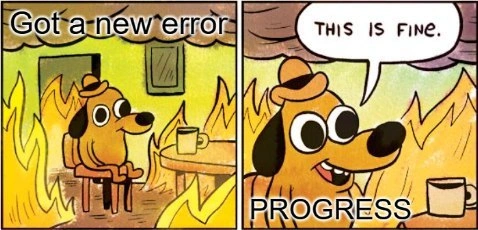
This meme is joking about the same idea: the cartoon dog is a developer who just fixed one error in his program and immediately sees a new error pop up. Everything is still on fire (the project is still broken), but he’s celebrating that little victory. He stays positive and calm, focusing on one step at a time and finding something good (a new error means he solved the previous one) even when the situation looks bad. That contrast is what makes it funny – anyone can relate to feeling happy about a tiny success in the middle of a big mess.
Level 2: Error Means Progress
Let's break down the meme in simpler terms. This image is a variation of the famous “This is fine” meme. In the original, a little cartoon dog calmly says “This is fine.” while everything around him is literally on fire. People share it to joke about staying calm or ignoring a big problem. In this developer version, the text has been changed to a programming joke: on the left it says “Got a new error” and on the right the dog still says “THIS IS FINE.” with the big word “PROGRESS” at the bottom. The scene is the same burning room, but now it’s captioned to fit a software debugging scenario.
The joke is about debugging, which means finding and fixing bugs (mistakes or flaws in code) in your program. When software has a bug, it often crashes or behaves badly and shows an error message – a line of text that tells you something went wrong (for example, NullPointerException or File not found). Developers use those messages as clues while troubleshooting. Fixing one bug can be tricky: sometimes after you fix the first problem, the program runs a bit further and then hits the next bug. That’s exactly what’s happening here. The developer-dog fixed the first error, and now he’s got a new error. Believe it or not, that new error is actually a sign of progress! It means the first issue was solved, and now another issue (which was hidden behind the first one) has come to light. In other words, the code is one step closer to working. You could call this debugging stage two – stage one was fixing the initial error, and now the next error has appeared as stage two of the fix. It's basically progress through failure: each mistake you correct moves you forward, even if another bug pops up right afterward.
It might sound a little crazy – why would anyone be happy about seeing an error? But in a developer’s world, seeing a new error instead of the same old one means you’re advancing. It’s like peeling an onion: you solved the outer-layer problem, and now you’ve uncovered the next layer underneath. Yes, the program is still broken, but it’s broken a little later in the process than before, and that feels like an accomplishment when you’ve been stuck. Developers definitely feel frustration when debugging (watching things fail over and over is annoying), but they also learn to celebrate small wins. That’s why the dog says “This is fine.” while everything is still on fire around him. He’s jokingly acting calm and okay with the situation: “I know things are still a mess, but at least we made some progress!” This kind of developer humor is very relatable in the tech community. Almost every programmer has had that experience of fixing one error only to immediately discover the next bug. Instead of panicking, developers often joke about it as a form of stress relief. It’s part of the developer experience – staying positive through the troubleshooting journey, one error at a time.
Level 3: New Error, Same Fire
At a senior developer vantage point, this meme nails the twisted logic we use to stay sane during debugging disasters. The first panel shows a wide-eyed developer (in the form of that famous cartoon dog) calmly sitting in a blazing inferno of a codebase. The overlaid text “Got a new error” is ironically a reason to smile. To an outsider, it's absurd – everything is on fire, nothing is fixed – but any seasoned engineer knows that a new error message is actually a sign of progress. It means we got past the previous failure. The system is still broken, sure, but at least it's broken in a different way than it was an hour ago.
In the trenches of debugging hell, you learn to celebrate small victories. When you've been staring at the same stubborn crash or bug for hours, seeing it replaced by a new error feels like slaying one mini-boss to reach the next level of a dungeon. The code is essentially a house on fire (hence the flames everywhere), but you treat a fresh stack trace like a clue that you're moving forward through the blaze. It's a coping mechanism and a logical deduction: if error A is gone and now we see error B, then fix A had an effect and we're one step deeper into the execution. We call this the "fix one thing, reveal the next thing" phenomenon – practically a rite of passage in software development.
We've all played this whack-a-mole game with failing software. For example, imagine running a troublesome application:
$ ./runApp
SyntaxError: Unexpected '}' in config.json on line 42
# (Fix the syntax error and try again)
$ ./runApp
Error: Unable to connect to database (Connection refused)
# (Update the DB connection string, then run again)
$ ./runApp
Exception in thread "main": java.lang.NullPointerException at MyClass.java:101
# A new error deeper in the code - progress!
In this dramatized log, each iteration produces a different failure:
- First run: a trivial syntax issue stops everything. You fix that.
- Next run: it gets further, but then hits a database connectivity error. You solve that configuration problem.
- Next run: the app enters its main logic and then bombs out with a
NullPointerException.
Each new error appears only after the previous one is fixed, which means the application is advancing step by step. The environment is still burning (the app still crashes), but the kind of fire has changed. To an experienced developer, that change is tangible progress. It's like peeling layers of an onion: each layer burned away reveals the next bug underneath.
The right panel (the close-up dog with "THIS IS FINE.") captures that classic developer survival instinct: staying outwardly calm and even optimistic in the middle of a production fire. Seasoned devs have seen worse, so they sip their coffee as the servers crash and logs explode with errors. It’s dark humor – we know panicking doesn’t fix bugs, but patiently troubleshooting them does. So you adopt this absurd, Zen-like calm. The bold caption "PROGRESS" at the bottom drives the joke home: yes, it's still chaos, but we choose to see the silver lining (or maybe the orange glow of the fire) as an achievement.
Only in software development do you get this twisted sense of accomplishment from failure. Fixing one bug just means you get to meet the next bug waiting behind it. Any long-time coder has developed a bit of gallows humor about it — a sort of Stockholm syndrome with our code. The meme’s tags like DebuggingFrustration and RelatableDevExperience exist for exactly this reason: every developer has been that dog in the burning room, deadpan-smiling at a new error pop-up because it means "we’re getting somewhere." It’s a humorous reflection of a very real coping strategy in a coder’s life.
Description
This image could not be processed due to an error

Comments
7Comment deleted
I'd make a joke about this image, but I can't see it. Maybe it's a 404 error?
Real progress: when your NullPointerException graduates to a TimeoutException - everything’s still on fire, but at least the call stack is distributed now
After 15 years in the industry, you learn that 'new error' just means the monitoring is finally working - the bug was always there, silently corrupting data in production. Now it's documented, which technically counts as improving observability
When your monitoring dashboard lights up like a Christmas tree at 3 AM and you've already burned through your error budget for the quarter, but the business metrics are still green so you just label it 'observability improvements' in the sprint retrospective. The real progress is learning to sleep through PagerDuty alerts
Got a new error? Perfect - now it fails fast with a trace ID; at scale, progress is when the fire is at least observable
Squashed one race condition, spawned a distributed flock - microservices progress
Only in distributed systems is replacing a CrashLoopBackOff with HTTP 500 considered a successful milestone - the blast radius just moved to another team’s SLO