Skip to content
DevMeme
4036 of 7435
Confronting the Ancient Beast
LegacySystems Post #4397, on May 26, 2022 in TG

Confronting the Ancient Beast

Why is this LegacySystems meme funny?

Level 1: Battle vs Chore

Imagine you're told you have to wrestle a giant monster to get a job. It’s huge, loud, and really scary — that’s like the interview. Now imagine once you get the job, all you actually do every day is something simple and normal, like shoveling snow from the driveway with a friend. That’s like the real job. This meme is funny because the test to get the job is extremely hard and dramatic (like a big monster fight), but the actual work at the job is easy and ordinary (like doing a everyday chore together). The top picture with Godzilla and King Kong fighting shows how the interview felt super intense. The bottom picture with two people in dinosaur costumes shows how the job is actually calm and even silly. The difference between the scary interview and the easy job is so huge that it's humorous. In other words, they made you do something over-the-top to get in, but once you’re in, the work is cozy and straightforward — and that surprise contrast makes people laugh.

Level 2: Dino Suit Duties

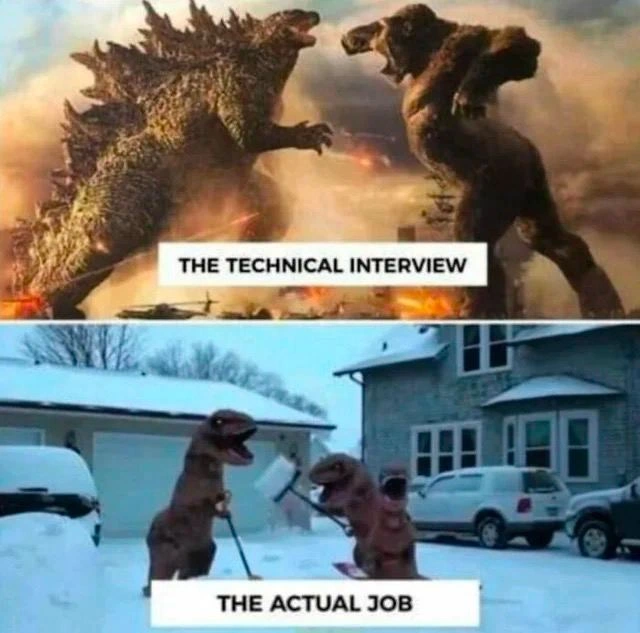
This meme shows a big difference between how a coding interview feels and how a programming job actually is. In the top image, labeled "THE TECHNICAL INTERVIEW," there are two huge monsters, Godzilla and King Kong, fighting in a city with explosions everywhere. That dramatic fight scene stands for the experience of a tough technical interview. A technical interview is when a company tests a developer’s skills before hiring them. It often involves solving tricky coding problems on the spot or answering hard questions about software. It can feel very intense, almost like a high-pressure battle. If you've heard of those big tech interviews where they ask you algorithm questions or brainteaser puzzles, that's what's being referenced. It's the kind of interview where you have to think fast and solve something hard while someone watches, and you might feel nervous, almost as if you're up against a giant challenge.

The term kaiju means giant monster (like Godzilla) in Japanese movies. So when people say "kaiju-level questions", they mean extremely difficult interview questions — the kind that seem as intimidating as a giant monster. For example, an interviewer might ask you to solve an advanced coding puzzle or an unusual algorithm problem that you've never seen before. These questions can be really hard, and facing them in an interview can feel like trying to defeat Godzilla in the middle of an earthquake. That’s why the meme uses Godzilla and King Kong fighting: to exaggerate how scary and epic those interviews can feel.

Now look at the bottom image, labeled "THE ACTUAL JOB." Here, instead of scary monsters, we see two people dressed in cute inflatable dinosaur costumes (they look like funny T-Rex outfits) quietly shoveling snow from a driveway in front of a house. This scene represents what working as a programmer is usually like day-to-day. It's calm, a bit silly, and pretty ordinary. Shoveling snow is a simple, routine chore. By showing people in dinosaur suits doing this, the meme adds humor but also makes a point: once you have the job, the work you do can feel easy or even lighthearted compared to the interview. The dinosaurs are just costumes — unlike Godzilla and Kong, these are not real monsters at all. That implies the actual job isn’t monstrous or terrifying; it might even be fun or at least comfortable.

The suburban driveway setting is quiet and normal, the total opposite of the fiery city battle. This highlights how the job happens in a normal, low-stress environment (like a regular office or working from home calmly), versus the interview which felt like a chaotic do-or-die scenario. In a real software job, you usually work with a team of people, help each other out, and tackle tasks together. Notice in the bottom panel, the two dinosaur-costumed folks are working side by side, not fighting each other. That shows the collaborative nature of actual work: you're typically cooperating with colleagues, not in a one-on-one fight.

Also, the kind of tasks you do on the job are often maintenance and incremental improvements. For instance, you might fix bugs (errors in the code), add small features to a program, or clean up the code to make it nicer (this is known as refactoring). These tasks are important but they’re not epic battles — they’re more like regular chores. In software, there's a concept called technical debt, which is like the "mess" in the code that builds up over time when you take shortcuts or when a codebase gets older. Dealing with technical debt is a bit like shoveling snow: not exciting, but necessary to keep things running smoothly. The meme’s bottom image (shoveling snow) playfully symbolizes that kind of work. It’s steady, routine labor, often done together with teammates, and it’s a far cry from solving a brand new complex puzzle under pressure.

So, the meme is pointing out a real gap between interview expectations vs. job reality. We can call this the interview_vs_job_gap. During interviews, companies might be testing if you can handle tough theoretical problems and quick thinking. They put you through something like an algorithmic obstacle course. But the relatable developer experience for many people is that once they start the job, they realize they needed a whole different set of skills: patience, familiarity with existing code, using Google/StackOverflow to find solutions, understanding teamwork, and writing clean code. In fact, many developers joke that they never once needed to write a complex algorithm from scratch after they were hired; instead, they needed to know how to work with the tools and code that were already there. The top image (Godzilla vs Kong) is the interview humor part — it’s making fun of how over-the-top interviews can be. The bottom image (dinos shoveling snow) is the developer humor part — showing the down-to-earth reality of the job in a funny way.

This contrast is very relatable to anyone in the software field. Imagine studying for weeks to prepare for an interview, learning all about advanced algorithms, and feeling like you have to conquer a giant monster. Then you get the job, and your first week you might be doing things like setting up your development environment, reading documentation, or fixing a small bug in the code. It’s a bit of a relief, but also kind of ironic. The meme captures that irony visually. It says: the interview was like a scary movie, but the job is like a casual everyday task. And that big, almost ridiculous difference is exactly why this meme makes developers smirk and nod. It takes a truth (interviews can be harder than jobs) and expresses it with a clever picture comparison that anyone can understand at a glance.

Level 3: Kaiju Code Showdown

The meme’s top panel (captioned "THE TECHNICAL INTERVIEW") depicts an epic clash between Godzilla and King Kong amidst a burning cityscape. This is a tongue-in-cheek analogy for the modern technical interview process in software development. Just like a city-shattering monster battle, a coding interview at a big tech company can feel like a high-stakes showdown. Candidates are often thrown into an arena of complex algorithmic problems and system design questions, under intense time pressure. In other words, the interview is portrayed as a Kaiju-level confrontation: you, the developer, versus some gigantic algorithmic challenge (or an interviewer armed with tricky questions), with your career prospects on the line. It’s an exaggerated scenario, but any developer who’s sweated through a whiteboard coding session or a live coding test knows that adrenaline feeling all too well.

In contrast, the bottom panel (captioned "THE ACTUAL JOB") shows a quiet suburban driveway blanketed in snow, where two people in goofy inflatable T-Rex costumes are calmly shoveling snow. This hilarious scene represents the reality of day-to-day software engineering work. Instead of dramatic battles, you typically find yourself doing something more like routine maintenance and collaboration — the engineering equivalent of clearing the driveway after a snowfall. The interview_vs_job_gap highlighted here is enormous: the heroic monster-fight of the interview versus the mundane teamwork of the actual job. The meme gets its humor by starkly juxtaposing these two extremes.

Why is this so relatable? In many tech interviews (especially for coveted roles), candidates face gauntlets of algorithmic puzzles and theoretical questions. You might be asked to implement an obscure data structure, solve a tricky dynamic programming problem, or design a scalable system architecture on the fly. It’s like being tested on how you’d handle a city on fire while dueling giant beasts. These are what developers jokingly call kaiju-level questions – challenges so large and fearsome that they feel comparable to battling a monster. For example, an interviewer might ask you to invert a binary tree, find the shortest path in a graph, or analyze the runtime of a complex algorithm. Performing this in front of someone, under a time limit, can indeed feel like fighting King Kong with one hand tied behind your back! The stress and intensity are through the roof.

Now, let’s look at what happens after you land the job. Once you start working as a developer, you quickly realize that most of your tasks are nowhere near that dramatic. The bottom panel’s snow-shoveling dinosaurs capture this perfectly: it’s whimsical and low-pressure. In real life, software engineering involves a lot of maintenance, incremental feature development, and debugging – more akin to diligently shoveling snow than to wrestling a radioactive giant. On the job, you might be reading legacy code, fixing minor bugs, refactoring functions, writing unit tests, or reviewing a teammate’s pull request. These tasks require patience and collaboration, not the adrenaline-fueled heroics that the interview seemed to demand. The two T-Rex-suit figures are working together, which hints at another truth: actual development work is highly collaborative (team meetings, pair programming, code reviews). It's not a one-on-one boss fight; it's a group effort, often a plodding, methodical one.

This ironic mismatch is a well-known phenomenon in the tech industry. Companies have a habit of using interviews as a filter for raw problem-solving ability – often drawing on concepts from computer science classes. Data structures, algorithms, even brain-teaser puzzles from math competitions are common fare. These interviews have been compared to a LeetCode contest (named after the competitive coding platform many candidates practice on). There’s a reason the meme chooses Godzilla and Kong: it feels like you need monster-sized skills to survive these interviews. However, day-to-day work is usually more about using established tools and making steady progress within existing systems. It’s as if you trained to survive a battlefield, but then your actual mission is to tend a garden.

To illustrate the contrast, consider some typical expectations versus reality:

Technical Interview Actual Job
Facing a complex problem solo under tight time pressure Working collaboratively with a team on incremental updates
Emphasis on algorithm puzzles (e.g. invert a binary tree) from scratch Emphasis on maintainable code (fixing bugs, writing tests, improving existing features)
Simulated "do-or-die" scenarios with extreme challenges Real-world "chores" like debugging, refactoring messy code, and handling routine tasks

In a real codebase, your biggest foes are not giant monsters but often technical debt and deadline-driven feature requests. Notice the snow in the driveway: that snow is like the pile of minor issues, outdated code, and small tasks that accumulate in any long-running software project. Shoveling it means regularly cleaning up the code, paying down technical debt, and handling all the unglamorous upkeep that keeps the product running smoothly. Meanwhile, the skills you used to slay that interview monster (like knowing the ins and outs of an advanced graph algorithm or a clever bitwise trick) might not see much action for months, if at all, once you're working.

This meme resonates with developers because it captures a kind of absurd truth: passing the interview often requires exceptional algorithmic combat skills, whereas doing the job often requires cooperative endurance and attention to detail. It's a comical exaggeration, of course – not every interview is a nightmare, and not every job is trivial – but it's close enough to the common experience to make engineers smirk. Essentially, the industry sometimes demands you to be a Godzilla-level coding warrior to get hired, only to assign you tasks that feel as routine (and occasionally silly) as a couple of dinosaurs shoveling a driveway.

Description

This meme likely uses a popular format, such as the 'Archaeologist Discovering a Skeleton' meme, to depict a developer's first encounter with a legacy codebase. The image would show someone cautiously approaching a dusty, ancient artifact, with a caption like 'Me, opening the legacy codebase for the first time.' The humor comes from the shared experience of inheriting old, undocumented, and often fragile systems that feel like they belong in a museum. For senior engineers, it's a humorous representation of the challenges of modernization and the delicate balancing act of maintaining critical business logic while slowly chipping away at years of accumulated technical debt

Comments

12
Anonymous ★ Top Pick A legacy codebase is like an ancient city. You're afraid to touch anything for fear of collapsing the entire civilization, but you also know there's a good chance the plumbing is made of lead
  1. Anonymous ★ Top Pick

    A legacy codebase is like an ancient city. You're afraid to touch anything for fear of collapsing the entire civilization, but you also know there's a good chance the plumbing is made of lead

  2. Anonymous

    Interview: “Design a lock-free scheduler that scales like Godzilla.” Actual job: two devs in T-Rex suits patch-shoveling a 2007 XML monolith so payroll doesn’t freeze

  3. Anonymous

    After 20 years in tech, I've realized technical interviews are like benchmarking a Ferrari engine when the job is maintaining a fleet of Honda Civics - sure, it's impressive you can implement a red-black tree from memory, but we really just need someone who won't break prod on Friday afternoon

  4. Anonymous

    Five rounds on distributed consensus, then your first ticket is changing a button color - and it still takes two sprints to get through review

  5. Anonymous

    After grinding 500 LeetCode problems to invert binary trees in O(log n) time while balancing red-black trees on a whiteboard, you'll spend your actual career writing CRUD endpoints, attending standup meetings, and explaining to stakeholders why their 'simple feature request' will take three sprints. The technical interview asks you to defeat Godzilla with algorithmic precision; the job asks you to shovel snow in a T-Rex costume while your CI/CD pipeline is down

  6. Anonymous

    Passed by implementing a lock-free skip list; spent the quarter shoveling Jira tickets and re-yamling Helm because 'prod' and 'production' were different env vars

  7. Anonymous

    Interviews: Battle kaiju with optimal algorithms. Reality: Herding T-Rexes through the snowstorm of scope creep and tech debt

  8. Anonymous

    You wrestle lock-free queues and dynamic programming in the interview, then spend the job shoveling a queue of Jira tasks - yak shaving around YAML indentation, IAM permissions, and Terraform/CI drift that refuses to melt

  9. @tedspikes 4y

    This would be funny if I didn’t have one coming up in 4 hours...

  10. @bezuhten 4y

    seems legit:

  11. @JanisRUS 4y

    True

  12. dev_meme 4y

    true of life

Use J and K for navigation