Patiently Checking Watch While Two-Year-Old Tech Debt Nears Production Impact
Why is this TechDebt meme funny?
Level 1: Quick Fix, Big Mess
Imagine you have a small leak in your roof, and water is dripping into your living room. Instead of fixing the roof properly, you put a bucket under the drip to catch the water. It works for a while, so you forget about it. Two years pass. That bucket has been filling up slowly, and now it's almost overflowing. In fact, it's the day of a big family party at your house, and you glance at the nearly full bucket and then at your watch, thinking, "Any minute now, this thing is going to spill everywhere." You kind of knew all along that just using a bucket was a bad long-term solution, but you never got around to patching the roof. Now you're literally expecting a huge mess at the worst possible time. This is the same idea the meme jokes about: a quick fix from the past is finally leading to a disaster, and the person who took the shortcut is standing there watching, knowing it's about to go oops. The lesson is simple – if you ignore a problem for too long, eventually you'll have to deal with a much bigger problem (probably at the most inconvenient moment!).
Level 2: Time to Pay Up
This meme is all about technical debt finally coming back to bite a developer. In software, technical debt means doing things the quick-and-easy way now instead of the right way, and planning to fix it later. It's like borrowing time: you get a "loan" of speed today, but you owe some extra work in the future. For example, a programmer might say, "I'll write this messy code now to meet the deadline, and I'll clean it up next month." That messy code is the debt. If you don't "pay it back" by improving the code soon, the problems usually grow worse – just like interest piling up on a credit card. Here, "the tech debt I took on 2 years ago" refers to a shortcut made two years earlier that was never fixed. And "affecting production" means it's about to cause trouble in the live system that real users rely on. In other words, something the developer ignored for a long time is now about to break the production environment (the real app running for customers).
Let's break down why this scenario is both funny and relatable. Two years ago, the team probably said, "We'll come back and refactor this hack later, promise!" – but they never did. We've all seen that happen. Code that was supposed to be temporary ends up sticking around for years (we start calling it legacy code once it's old and nobody wants to touch it). By now, the entire system might be relying on that shaky piece of code. The meme shows a guy checking his watch, as if he knows that any day now, that old workaround is going to fail spectacularly. It's like he's scheduled an appointment with a disaster. Usually, bugs and crashes in production catch people by surprise. But here the developer isn't surprised at all – he's been expecting this failure because he remembers the exact corner that was cut back in 2021. There's a mix of patience and sarcasm in his pose, like he's saying: "Yup... I figured this would blow up around now."
For someone new to these terms: production issues are those scary moments when the website or app breaks for real users. It's when something goes so wrong that customers notice (for example, the site might go down or important data might get messed up). When the meme says the tech debt will affect production, it means that shortcut from the past is about to turn into a real bug or outage on the live site. And if you're the on-call developer (the person assigned to respond if there's a problem at any hour), this is the kind of thing that can ruin your night. On-call devs often have a pager or alarm set up, so if that two-year-old bug triggers a crash at 2 AM, guess who gets woken up to fix it? The meme doesn’t show a phone ringing, but developers who have been on support duty can easily fill in that detail and chuckle (or shudder).
In simpler terms, the meme nods to any dev who's seen a "temporary" fix become a permanent part of the system until it breaks. This is pretty common on real projects. You might even find a comment in the code like // TODO: remove this hack with a date from long ago. If you ask about it, an older teammate might sigh and explain, "Yeah, we put that in under pressure a couple years back and never got around to fixing it." Now imagine that old hack is finally failing. Maybe it set a hard limit on something (like the system only handling 1000 users because at the time we had 100 users, and no one thought to update it). Over time, usage grew or requirements changed, and now hitting that limit is crashing the app. Everyone is super busy with the current sprint, of course, so the timing couldn't be worse (Murphy's Law: production problems always seem to happen when you're at maximum capacity!). The meme captures that gut feeling of inevitability: the debt you ignore will eventually come due, often at the worst possible time.
It's funny to developers because it's true. We've all heard stories or dealt with situations where a tiny workaround lived far longer than intended. When it finally fails, there's this moment of "Ugh, I knew this would happen someday... and that day is today." The image of the man looking at his watch perfectly represents that feeling of waiting for the other shoe to drop. It’s as if he's saying, "I set a timer when I skipped doing it properly, and ding! – time’s up." That’s a very relatable feeling in software development. Even if you're new to coding, you can relate it to school or chores – like when you procrastinate on an assignment thinking you got away with it, until suddenly the due date hits and you're in trouble. The meme is applying that same idea to code: skip the cleanup now, suffer the headache later.
And about that hashtag #jobSecurity in the post: that's a tongue-in-cheek joke among developers. It implies that when things break, the company will desperately need you to fix them, so your job is safe. In this context, the dev is joking that because of this looming disaster, he'll definitely be needed (no layoffs for him!). Of course, in reality it's much better to have a stable system than to rely on disasters for job security. But when you're faced with the consequences of old shortcuts, sometimes joking about it is how developers cope with the stress. So overall, the meme is both a warning and a wink: it says, "We knew this was coming, and now here it is!" in a way that makes engineers smirk and nod knowingly.
Level 3: The Bill Comes Due
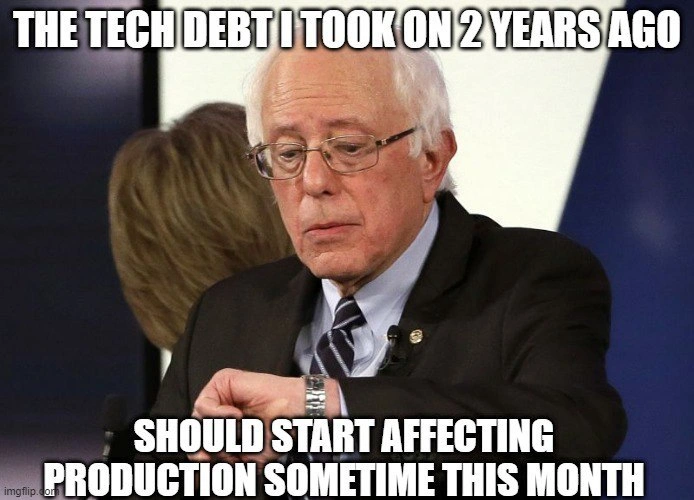
THE TECH DEBT I TOOK ON 2 YEARS AGO
SHOULD START AFFECTING PRODUCTION SOMETIME THIS MONTH.
The image behind this caption shows a well-known senator (yep, that's Bernie Sanders) glancing impatiently at his wristwatch. In developer terms, he's basically a senior engineer waiting for a ticking time bomb in the code to explode. The top text sets up the scenario: two-year-old technical debt – a quick-and-dirty code shortcut made 2 years prior – and the bottom text delivers the punchline: it's due to hit production (the live system) right about now. The meme gets a laugh (and a groan) from any seasoned dev because it captures that ominous feeling of "any day now, that hack is going to cause an outage."
This humor lands so well in the tech world because it's painfully true. When we talk about technical debt, we mean the kind of compromise in code that makes things easier in the short term but accumulates interest (extra complexity and risk) over time. Ward Cunningham, who coined the term, likened it to a financial loan: you get something now (fast delivery) at the cost of owing a cleanup later. Well, here we are later, two years down the road, and the cleanup bill is coming due. The developer in the meme knew back in 2021 that they were writing a "temporary workaround", and now in 2023 that deferred fix is maturing like a bad loan. It's the classic ticking time-bomb scenario: the codebase equivalent of a subprime mortgage about to default.
We can imagine exactly what kind of shortcut was taken. Perhaps a critical routine was left hard-coded or an edge case was ignored just to meet a deadline. It worked fine in 2021 when load was light and requirements were simple. But two years of feature creep and traffic growth later, that brittle code is straining. It's no longer a question of if it'll break, but when. The meme’s bottom text ("should start affecting production sometime this month") drips with sarcasm – as if the team put "Expect Major Outage Here" on their calendar. Usually, production failures are surprises, but with crusty legacy code full of shortcuts, an experienced dev can sometimes predict disaster almost to the date (like scheduling an earthquake). It's funny in a dark way: we don’t often get to schedule our production issues, but when you knowingly ship tech debt, it's like penciling in a future incident.
Let’s put this into code for a second. Picture a quick fix from two years ago that was never revisited:
MAX_USERS = 1000 # quick hack in 2021; won't handle more than 1000 users
if current_user_count > MAX_USERS:
raise RuntimeError("Exceeded user limit – need real fix now!") # Tech debt triggers meltdown
Here a developer took a shortcut by capping MAX_USERS at 1000, thinking, "We'll never hit that number for a while, and we'll improve this later." Fast-forward to today: marketing did great, we have 5000 users, and of course nobody removed the cap. The moment current_user_count crossed 1000, boom – production outage. This snippet is a microcosm of the deferred maintenance situation: the cost of not rewriting that code has come with a vengeance. In reality, the code might not raise a neat exception; instead it would just start failing in odd ways (high latency, crashes, data corruption) once the limit is exceeded. But every senior engineer recognizes this pattern: a hidden assumption in code silently passed its expiration date. It’s like the software equivalent of an old library book you forgot to return – after enough time, the fine is huge and the librarian is at your door.
And speaking of expiration dates, consider the infamous scenario of hard-coded credentials or certificates. Imagine a developer saying, "Our SSL certificate automation isn’t ready, just set the expiry to two years from now and we'll deal with it later." Two years fly by in a blur of feature releases, and suddenly that date is next week. Cue the scramble: the cert expires, users can’t connect, and everyone’s in panic mode. It’s practically a meme in itself how often aging code shortcuts like these come back exactly on schedule. Someone literally put a ticking clock into the system. So when Bernie-dev checks his watch, we all cringe-smile because we've either seen this happen or caused it ourselves.
Now, let's talk about the human side of this scenario – the dreaded on-call nightmare it implies. The person checking the watch isn’t just any dev; they’re likely the poor soul on-call, fully aware that the kludge they shipped two years ago is about to make their phone buzz at 3 AM. You can almost hear their inner monologue: "Any minute now, that duct-tape fix is going to fall apart, and guess who has to deal with it…". This meme perfectly captures that mix of dread and resignation. A senior engineer will relate all too well – it's that special kind of anxiety from knowing a system is fragile and living on borrowed time. The joke in dev circles is that being indispensable during a crisis equals job security – the post even tags it with #jobSecurity. It's a tongue-in-cheek way of saying: "As long as things blow up, they'll need me to fix them." Of course, nobody truly wants an outage as career insurance, but when you’re staring at a looming failure you warned about, a bit of dark humor helps ease the stress.
The broader commentary here is on reality vs. best practice. In an ideal world, teams fix tech debt promptly – they dedicate a sprint to refactoring that mess before it rots. In reality, business pressures mean we keep deferring the cleanup: "Not this quarter, we have to ship new features!" Everyone agrees in principle that the ugly code should be improved, but it gets postponed until something actually catches fire. This meme basically offers a satirical timeline of that pattern. First, the shortcut (yay, we met the deadline!), then a long period of false security (no one touches the hack while new features pile on), and finally the bill comes due (a production meltdown at the worst possible moment). It's a maintenance nightmare compressed into one image.
Ultimately, what makes this meme funny is the sheer relatability of the absurd situation. It's amusing because it’s true: for all our talk about scalability and best practices, sometimes a major outage can be traced to one sloppy fix we left festering in the code. The senator’s deadpan, patient expression says, "I’ve been around the block; I know what’s coming." Every veteran dev has worn that look while tailing logs late at night, thinking, "Here we go...". We laugh at the meme because if we didn't, we might cry – it’s capturing a relatable developer experience through the lens of tech humor. In other words, it's funny because it's painfully real.
Description
Meme format shows a well-known U.S. senator (face intentionally blurred) seated on a debate stage, glancing down and pointing at his wristwatch. Bold white Impact font appears in two parts: top text reads "THE TECH DEBT I TOOK ON 2 YEARS AGO" and bottom text reads "SHOULD START AFFECTING PRODUCTION SOMETIME THIS MONTH." Dark suit, striped tie, lapel mic, and a blurred background of stage panels round out the scene. The joke resonates with senior engineers who know that unaddressed shortcuts quietly accrue compound interest until they surface as reliability issues in prod, usually right when everyone’s sprint capacity is maxed out
Comments
10Comment deleted
Tech debt is the only loan where the interest arrives as 3 a.m. PagerDuty alerts
The only thing more predictable than technical debt coming due is that it'll happen right after the original developer leaves for a FAANG company, leaving you to explain why the 'temporary' MongoDB aggregation pipeline that processes billing is now taking 47 minutes per transaction
Every senior engineer knows that moment when you realize the 'temporary' workaround you shipped to hit a deadline two years ago has metastasized into a critical path dependency with tentacles throughout the entire system - and the original context is lost to git history, the team has turned over twice, and nobody remembers why that bizarre coupling exists. The real kicker? You're now the architect responsible for the inevitable 3 AM incident when it finally fails, and you'll spend the post-mortem explaining how 'move fast and break things' eventually just becomes 'break things.'
That “temporary shim” we accepted as risk has matured into a balloon payment due at 2 a.m. Saturday - payable in pages, rollbacks, and your MTTR
Two years ago: 'Quick hack, ship it.' Today: 'PagerDuty, my old friend, I've come to talk with you again.'
Tech debt’s APR is teaser-low for 23 months, then you pay the principal in PagerDuty alerts and a midnight rollback
Real Comment deleted
Only this month? After two years? 😅 Comment deleted
What does this mean Comment deleted
He's paid his debt so he quit? Comment deleted