Explaining Technical Debt with a Dilapidated House
Why is this TechDebt meme funny?
Level 1: Wobbly Tower
Imagine you built a really tall tower out of toy blocks, but it’s super wobbly. You can tell that if you even poke it a little, the whole thing might fall down. Now your friend comes along and says, “Hey, let’s add a window to your tower! Just take out a couple of blocks from the middle.” From your point of view, that’s a scary idea – removing blocks from the middle of this unstable tower might make everything crash to the floor. But to your friend, it seems simple and they don’t understand why you’re hesitating. The funny part is the difference in what each person sees: you know the tower is delicate and could collapse, while your friend only sees that it looks like a normal stack of blocks and assumes any small change is fine. It’s amusing (and a bit frustrating) because one person is innocently asking for something that could ruin everything, and the other person is nervously trying to hold the tower together. That’s exactly what’s happening in the meme, just with a shaky old house instead of a block tower – one person doesn’t realize how fragile things really are.
Level 2: Just a Window?
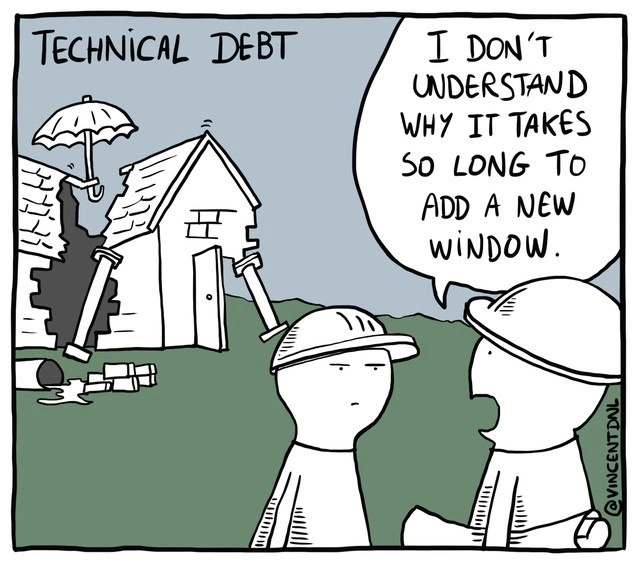
At its core, this meme uses a simple construction metaphor to explain technical debt in software. The crumbling house in the image represents a broken codebase that has been patched up over and over. There are crutches holding up walls and even an umbrella jammed into the roof to stop a leak. In programming terms, those are quick fixes and workarounds that were added to keep an old system running. Technical debt is when developers take shortcuts – for example, skipping tests or writing messy code – to deliver features faster, with the promise of “fixing it later.” But if “later” never comes, all those shortcuts pile up like band-aid repairs on a house. The structure becomes unstable. Just as a house with poor upkeep will develop cracks and faults, a codebase full of hacks and poor code quality will eventually become fragile and hard to change.
A legacy system (or legacy codebase) means the software is old and has been maintained by many different people over time. It might use outdated technology or have design decisions dating back many years. Often, nobody on the current team fully understands every part of it because they weren’t around when it was originally built. Working with legacy code can feel like entering a run-down old building: you’re a bit afraid to touch anything for fear of breaking something else. One common result is spaghetti code – a nickname for code that's tangled and unstructured. Imagine a bowl of spaghetti: all the noodles are interwoven. If you try to pull one noodle out, many other noodles move with it. Similarly, in spaghetti code, changing one part can unintentionally affect other parts because everything is intertwined. For a new developer, encountering spaghetti code is confusing – there’s no clear organization or separation of parts, so even simple tasks become puzzles of finding what connects to what.
Now, think of the two stick-figure workers in the cartoon as two roles in a software project. The one asking “Why does it take so long to add a new window?” is like a stakeholder – this could be a client, a project manager, or an executive who requests features. Stakeholders are people who want the software to do something (add features or changes), but they usually aren’t involved in coding it. They tend to see the product only from the outside (the features and user interface) and assume the inside of the software is as orderly as the screens they click on. The other figure, with the disgruntled look, is the developer (the engineer). The developer knows the inside of this “house” is a mess. When the stakeholder innocently asks for a new window (a new feature), the developer is apprehensive because they know it’s not simple at all given the state of the code. This disconnect is very common in real projects: the stakeholder expects a quick addition, while the developer foresees a bunch of complications. This mismatch of understanding often leads to developer frustration. Engineers feel pressure to say “yes” to keep stakeholders happy, but they also worry that the whole system might break if they rush in a change.
To actually add that “new window” safely, the team will likely need to do some refactoring first. Refactoring means improving the internal structure of the code without changing what the software actually does for the user. In other words, it's cleaning up the mess behind the scenes. It’s like if you want to cut a window in a crooked wall, you first need to straighten and support that wall. In code, refactoring could mean splitting a large, monolithic function into smaller pieces, or rewriting some confusing part of the system in a cleaner way before adding the new feature. This extra work makes the codebase stable enough so that adding the window won’t cause everything else to fall apart. However, stakeholders sometimes don’t understand why developers are spending time “fixing old code” or reorganizing things when they only asked for a simple feature. From their perspective, it can feel like a pointless delay. Part of a developer’s job often becomes explaining these invisible prerequisites so that everyone is on the same page.
For a junior developer (or anyone new to a team), it helps to know that this scenario is very real and very common. You might join a project and inherit code that’s been around forever – full of odd fixes and outdated sections. On your first attempt to add something small, you could end up thinking, “Why is this so hard? Am I missing something?” The truth is usually that the code has a lot of tech debt. Imagine you want to change one icon on a website. You expect it to be a 5-minute job. Instead, you discover that the icon file is used in 10 different places and half of those usages are hard-coded in ways you didn’t anticipate. A simple change turns into hours of carefully checking each place that icon appears to make sure nothing else breaks. It’s not that you’re a bad programmer; it’s that the system is fragile. In the meme’s terms, you tried to add a “window” and found out the whole wall around it was rotten.
Ultimately, this comic is teaching a lesson about why small requests can have big costs in software. Adding a minor feature to a messy, debt-ridden codebase is difficult and time-consuming, just like renovating a very old, shaky house. The humor comes from how oblivious the stakeholder is: they cheerfully ask for a quick change, not realizing they’re actually asking the developers to perform major repairs on a rickety structure just to add that one little window. It highlights in a friendly way why developers sometimes respond to “tiny” feature requests with a heavy sigh or a long explanation – they’re not trying to be difficult, they just know that under the hood, the legacy code might need a lot of work before it’s safe to make that “simple” change.
Level 3: House of Cards Code
"I don’t understand why it takes so long to add a new window."
This naive question from a stakeholder perfectly encapsulates the disconnect between stakeholder expectations and the grim reality of a legacy system drowning in technical debt. In the cartoon, the entire codebase is depicted as a dilapidated building barely standing upright — think of walls propped up by crutches and even an umbrella plugging a gaping roof hole. It's a spot-on construction analogy: the software's structure is so brittle that even a small change (“adding a new window”) risks bringing the whole edifice down. From a senior engineer’s perspective, the meme’s humor comes from painful experience: we’ve all seen a codebase so precarious that one more feature could be the last Jenga block that makes it collapse.
The term technical debt itself tells us how such a situation arises. Over the years, countless quick-and-dirty fixes get applied to keep the software running or to meet urgent deadlines. Each crutch under the wall, each umbrella on the roof in that cartoon represents one of those “fix now, clean up later” band-aids in the code. For example, you might even find code like:
if (roof.isLeaking()) {
// Quick fix: patch the leak with an umbrella
roof.patch(new Umbrella());
// TODO: implement a real fix when there's time
}
These patches were all supposed to be temporary. But in practice, temporary solutions tend to become temporary permanent. The “interest” on this debt has been accruing: the more shortcuts taken back then, the slower and riskier every change becomes now. The codebase has so many hidden cracks and fragile points that implementing what should be a simple feature (cutting a new window) requires extreme caution and extensive rework.
Seasoned developers recognize the dreaded “big ball of mud” architecture in this scene. Over time, the system has lost any clean structure and turned into spaghetti code: a tangled mess where everything is interconnected in non-obvious ways. A seemingly innocuous change might require edits in five different modules because of implicit, unpredictable couplings. Perhaps a crucial logic is duplicated in multiple places, or one giant function controls half the app’s behavior. In such an environment, “just adding a window” might mean first strengthening that weak wall. A senior dev knows they may have to invest time in refactoring — rewriting or organizing parts of the code — to safely support the new feature. It’s akin to a construction crew needing to reinforce the frame of a house before cutting a hole for a window in a load-bearing wall. Without that prep work, the whole house could come crashing down.
The meme also nails the misaligned expectations between non-technical stakeholders and developers. The stakeholder in the comic only sees the feature (“a window”) and the outward appearance of a house, so from their viewpoint it’s puzzling why a small addition should be hard. They can’t see the cracks in the foundation or the fact the walls are held together by duct tape internally. In real projects, this leads to frequent friction: managers or clients ask for a “tiny tweak” or an extra field in a form, not realizing the application’s code quality is so poor that even a tiny tweak can have far-reaching side effects. The developer (like the unhappy hard-hatted figure on the left) has likely seen how one small change in this legacy code can introduce bugs in seemingly unrelated parts of the system. They know that what sounds like a one-hour task might actually take days of careful work and testing. It’s the classic situation of “the last guy built this wrong, and now we have to pay the price.” Meanwhile, the stakeholder might interpret the delay as over-engineering or foot-dragging, not understanding it's actually precaution.
In short, this meme resonates with every engineer who’s inherited a codebase propped up by tech debt. It’s funny because the stakeholder’s innocent confusion (“Isn’t it just a window? Why all the fuss?”) meets the developer’s grim reality (“This whole thing is one nudge away from collapse.”). The humor has an edge of truth: adding features to a brittle system is scary and slow. Every veteran developer reading that caption is smirking (or maybe crying a little) because they’ve been that person trying to explain, in vain, why one does not simply add a window to a crumbling house.
Description
A single-panel comic titled 'TECHNICAL DEBT' that serves as a visual metaphor for the software development concept. In the background stands a decrepit white house with a crumbling roof patched by a small umbrella, collapsing walls propped up by precariously angled pillars, and leaking pipes. The entire structure is on the verge of collapse. In the foreground, two cartoon figures wearing hard hats are in conversation. One figure, presumably a manager or client, is shown complaining with a speech bubble that reads, 'I DON'T UNDERSTAND WHY IT TAKES SO LONG TO ADD A NEW WINDOW.' The other figure, representing the engineer, stares back with a tired, deadpan expression, silently contemplating the impossible task of modifying the fragile structure without causing it to fall apart. The comic humorously and effectively illustrates how years of accumulated quick fixes and poor architectural decisions (technical debt) make even seemingly simple changes a slow, complex, and risky endeavor
Comments
7Comment deleted
The PM wants to add a window. I have to explain that the 'wall' is actually a load-bearing JPEG and the foundation is just three levels of unsupported regex
“Adding the window is easy - the hard part is replacing the load-bearing singleton service, the duct-taped Bash cron that passes for a build, and the 2008-era ORM that thinks SQL injections are a feature.”
The window installation is actually the easy part - it's the three-week archaeological dig through undocumented load-bearing spaghetti that determines which walls won't collapse when you touch them
This perfectly captures the eternal struggle of explaining to stakeholders why 'just adding a feature' to a legacy system takes three sprints. Sure, we could nail that window onto the collapsing wall - but when the whole house falls down because we didn't address the foundation, the umbrella won't save us. Every senior engineer has lived this conversation: 'It's just a simple CRUD endpoint!' they say, not seeing the 15-year-old monolith held together by deprecated libraries, circular dependencies, and the tears of developers past
Adding a window is trivial - the hard part is shoring up the load-bearing global state so the monolith doesn’t collapse during the PR
“Just add a window” - sure, once we refactor the load-bearing abstraction, decouple the shared database, and retire the three cron jobs from 2009 that think the wall is their API
Because the 'temporary' umbrella hack from sprint zero is now load-bearing architecture