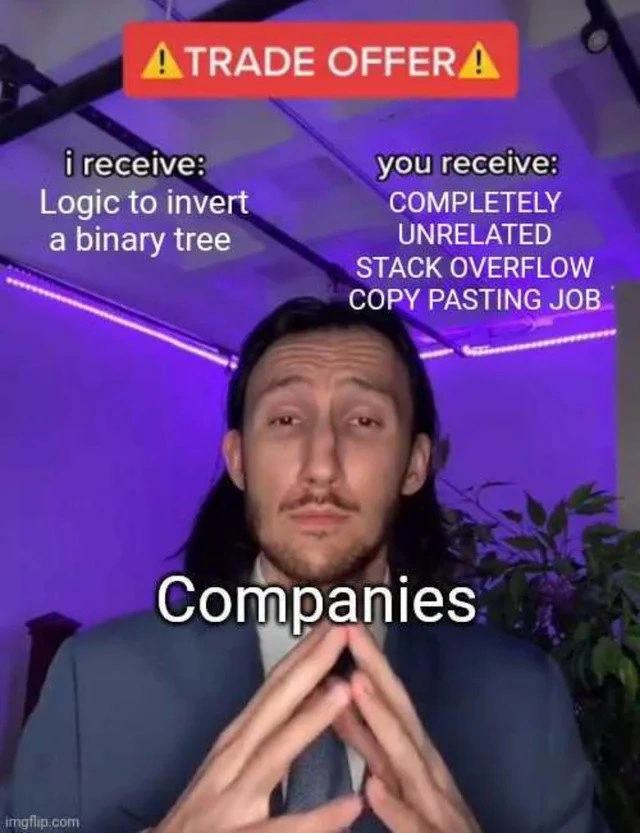
Trade Offer: Binary-Tree Logic for a Stack-Overflow Copy-Paste Job
Why is this Interviews meme funny?
Level 1: A Silly Deal
Imagine your friend makes you a deal: you have to solve a really hard puzzle, and if you do, you get to join a fun game. You spend a lot of time and brainpower solving this tricky puzzle, really impressing your friend. But when you finally join the game, it turns out the game is super easy and never uses that puzzle skill at all — maybe the game is just about running around or stacking blocks. You’d probably think, “Huh, that was a weird trade… I did all that hard work for nothing!” This meme is joking about the same kind of silly deal, but in job interviews. Companies sometimes make people do a hard brainteaser or coding puzzle (like solving a tough riddle) to get a programming job. Then, when the person starts the job, the work is really basic stuff where they just look up answers on the internet and copy them down, nothing to do with that puzzle. It feels unfair and funny, like making someone jump through hoops for no real reason. That’s why the meme makes developers laugh – it’s pointing out this goofy situation where you give something big and difficult, but what you get back is easy and unrelated. It’s a cartoonish way to say, “This deal doesn’t make much sense!”
Level 2: Whiteboard vs Keyboard
Let’s break down the joke in simpler terms. The meme contrasts two things:
What companies ask in interviews: “Invert a binary tree.” This means during a coding interview, you might be given a binary tree (a data structure that looks like an upside-down tree with nodes branching left and right) and asked to write code to flip it. Inverting a binary tree just means swapping every left child and right child in the whole tree. It’s like flipping the tree’s shape as if you held a mirror to it. This is a common coding challenge meant to test your understanding of tree data structures and recursion (solving a problem by having a function call itself on sub-parts of the problem). Interviewers love this kind of question because it’s a clear-cut problem with a neat solution. They expect you to write correct code without any help, often on a whiteboard or in a timed online test. It’s a classic example of a whiteboard interview question – one of those theoretical problems you practice on sites like LeetCode or in textbooks.
What developers often do on the job: “Completely unrelated Stack Overflow copy-pasting.” Stack Overflow is a hugely popular Q&A website where programmers ask questions and get answers from other programmers. If you run into a coding problem or error at work, a very common move is to search the exact error message or problem description online. Nine times out of ten, that search leads you to a Stack Overflow page where someone has asked the same question. There, you’ll find an answer (or several) with ready-made code snippets or explanations. Copying and pasting code from these answers (and then tweaking it to fit your situation) is practically a daily routine for many developers. It’s so common that it’s jokingly said a programmer’s job is “mostly Googling things.” Need to format a date in Python? There’s a Stack Overflow answer for that. Forgot the exact syntax for an SQL query? Stack Overflow has your back. This approach is the polar opposite of memorizing algorithms: on the job you’re encouraged to use all available resources. It’s not cheating – it’s being efficient.
Now, why is this a meme? Because those two things — the interview task and the actual job task — are comically unrelated. In an interview, you might spend 30 minutes writing a function to invert a binary tree by heart. But once you start the job, months might go by without you ever seeing a binary tree! Instead, you’ll be, say, fixing a web page, connecting to an API, or tracking down a pesky bug in code. And how do you fix that bug? Very often, by searching online and finding that someone else had the exact same issue and already posted a solution. You copy that solution, adapt it to your project, and problem solved. That’s the “copy-paste job” the meme refers to. It’s not literally copying entire projects (good developers do read and understand the code they find), but it’s leaning on existing answers rather than inventing new algorithms from scratch.
To put it simply, inverting a binary tree is a neat little programming party trick. Here’s a quick example in Python of what that interview answer might look like:
def invert_tree(node):
if node is None:
return None
# Recursively invert the left and right subtrees
left_subtree = invert_tree(node.left)
right_subtree = invert_tree(node.right)
# Swap the left and right children of the current node
node.left = right_subtree
node.right = left_subtree
return node
In an interview, you’d be expected to produce something like the invert_tree function above (and do it without looking it up!). This code goes down to every leaf of the tree and swaps the children, effectively mirroring the whole structure. It’s short and sweet, but you’d typically only write this code because an interviewer specifically asked for it. In a real project, if you ever needed to invert a tree structure (which is rare), there might already be a library function or existing code to do it.
Contrast that with a real-world task a new developer might get: suppose you need to integrate a payment API into a website. You’ve never done it before, so what do you do? You search online for “How to integrate XYZ payment API example code.” You find a Stack Overflow question where someone has posted a step-by-step answer with code snippets. You copy one of those snippets into your project, replace the API keys and tweak a couple of lines to fit your needs. Boom, you just did your job by leveraging someone else’s shared knowledge. This is normal and smart practice in everyday programming. Another common scenario: you get a weird error message using some library. You paste that error message into Google, hit Enter, and find a Stack Overflow page where the top answer explains exactly how to fix it. You follow those instructions, maybe copying a line or two of code from the answer, and your problem is solved. No algorithmic genius required, just good research skills.
So the meme is pointing out this funny difference. In interviews, companies act like every programmer is primarily an algorithm wizard, writing code with no references — hence the “I receive: logic to invert a binary tree” side of the trade. But in reality, a lot of programming jobs involve assembling solutions from existing pieces and searching for help — hence the “you receive: completely unrelated Stack Overflow copy-pasting job” side. It’s like the company is saying: “Prove you can do this computer science exercise for us, and in return we’ll give you fairly routine programming work that doesn’t use that exercise at all.” No wonder developers find it humorous. It highlights how the interview process can be disconnected from the actual work. Many junior devs experience this first-hand: you study tons of coding puzzles (reversing linked lists, traversing binary trees, dynamic programming, etc.) to land a job, and then once you’re in the role, you realize you could have been just fine without all that whiteboard prep — because you have Google, documentation, and teammates to help in real tasks.
In summary, the meme uses the “Trade Offer” template to point out a real-world inside joke among programmers: companies often test one set of skills but reward another. For someone starting out, it’s a heads-up that interview challenges (like those leetcode_challenges of inverting trees or sorting algorithms) are often just that — challenges for interviews. Day-to-day coding leans much more on understanding existing codebases, using frameworks, and yes, copying good solutions from the internet when appropriate. It’s a lighthearted reminder that being a good developer isn’t only about knowing algorithms by heart; it’s also about knowing how to find and use information effectively.
Level 3: Inverting Expectations
In this meme’s ⚠️ Trade Offer ⚠️ scenario, the suited figure labeled “Companies” proposes a lopsided bargain: “I receive: logic to invert a binary tree. You receive: a completely unrelated Stack Overflow copy-pasting job.” For seasoned engineers, this lands as painfully spot-on satire. It’s highlighting the absurd skills mismatch in many tech interviews: companies demand you demonstrate pure CS_Fundamentals (solving a neat little algorithm puzzle on a whiteboard) and in return they give you a job doing far more mundane tasks (often Googling solutions and gluing code together). The humor is that the trade is comically unequal and irrelevant – kind of like asking someone to perform a piano concerto to prove they can alphabetize files.
Let’s unpack the technical side. Inverting a binary tree is a classic DataStructures interview question. A binary tree is a hierarchical structure where each node points to at most two children (left and right). Inversion (aka tree mirroring) means swapping each node’s left and right subtrees. It’s a fundamental exercise in AlgorithmDesign to test recursion and pointer manipulation. The code for it is delightfully concise – essentially a recursive traversal with a few pointer swaps. Its time complexity is $O(n)$ (you touch each node once) and space complexity $O(h)$ (due to the recursion stack, where h is tree height). In other words, it’s bread-and-butter computer science, often found on LeetCode or in college textbooks. Companies love this as an interview question because it’s quick to evaluate and supposedly shows you grasp basic algorithms.
Now the punchline: once hired, you almost never implement something like invertBinaryTree() in real production code. Seasoned devs chuckle (or groan) because they know what daily coding work looks like. It’s not designing clever new algorithms under neon lights – it’s more like maintaining a gigantic web application, debugging integration issues, and yes, frequently copying snippets from Stack Overflow to solve trivial problems under deadline. One could say the real “inversion” happening is an inversion of expectations: the lofty computer science logic you demonstrated gets zero real use, while the skills you actually need (like reading other people’s code, using libraries, quick-fixing via internet research) were never tested at all.
This irony is deeply rooted in modern CorporateCulture. The TechnicalInterviewProcess at many firms still idolizes algorithmic trivia inherited from big tech hiring playbooks. Whiteboard sessions feel like academic exams – you write code by memory, discuss binary tree traversal or maybe implement a sorting algorithm from scratch. The company “receives” proof of your theoretical knowledge. But what do you receive? A role where the challenges are completely different. You might spend days wrestling with a large legacy codebase, writing glue code to connect microservices, or searching how to properly configure a Docker container. Your proud ability to invert a tree or balance a red-black tree isn’t saving any 3 A.M. outages. In 20+ years of on-call firefighting, no senior engineer has ever been woken up because someone failed to invert a binary tree. On the other hand, plenty of us have spent bleary-eyed nights untangling fragile code that someone copy-pasted without fully understanding.
The meme strikes a chord because it’s a shared industry joke: “Why did I have to study all those LeetCode puzzles just to end up copying code from tutorials all day?” The trade_offer_meme format exaggerates this disconnect perfectly. It’s styled like a shady deal: the company (with steepled fingers and sly smirk) takes your algorithm prowess, and in exchange you get a job full of Stack Overflow-driven tasks that never mentioned balanced binary trees or Dijkstra’s algorithm. It’s a form of hiring bait-and-switch. The experienced dev in all of us finds it both hilarious and exasperating. We’ve seen brilliant coders eliminated in interviews because they stumbled on a binary tree inversion, even though they could architect a whole system and ship code like a pro. Meanwhile, those who memorize textbook problems get in and then have to learn on the fly how to actually deploy a service or fix a gnarly JavaScript bug by Googling.
Ultimately, the meme uses humor to critique this broken trade. It calls out the gap between interview theater and real-world coding. The “I receive / you receive” format usually highlights an unfair deal – here the unfairness is that companies claim to seek top algorithm talent, yet reward you with work that any resourceful developer (with a good internet connection and stack_overflow_copy_paste skills) could do. It’s a sarcastic wink to every developer who prepped for hours on binary tree problems and then found their job was more about reading API docs and dealing with XML config files build scripts. In short, the industry’s hiring criteria and actual job requirements are inverted – much like that binary tree. 🤷
Description
The meme uses the popular '⚠️ TRADE OFFER ⚠️' template: a suited figure sits under purple LED lights with hands steepled, the face partially obscured in this version. Text on the left reads "i receive: Logic to invert a binary tree" while text on the right states "you receive: COMPLETELY UNRELATED STACK OVERFLOW COPY PASTING JOB." The caption "Companies" is overlaid on the figure, implying employers. Visually it mocks whiteboard algorithms (inverting a binary tree) that are demanded during interviews even though day-to-day work ends up being unrelated Stack Overflow copy-pasting. Technically, it highlights the disconnect between CS-fundamental interview questions and real-world coding tasks, resonating with developers frustrated by skills mismatch in hiring processes
Comments
13Comment deleted
Sure, I’ll invert your binary tree in linear time - just don’t act surprised when my first day is spent diff-ing a 2010 Stack Overflow snippet someone shoe-horned into your 400-service Kubernetes maze
After 20 years in the industry, I've inverted exactly zero binary trees in production, but I've definitely inverted my work-life balance debugging someone else's 'clever' recursive solution that should have been a simple database query
Companies: 'We need you to invert a binary tree in O(n) time on a whiteboard while explaining your thought process.' Also companies after hiring: 'Your sprint consists of updating dependencies, copying authentication boilerplate from our last three projects, and making this button 2px to the left.' The real algorithm is figuring out how to stay engaged when your CS degree is gathering dust while you're essentially a professional Stack Overflow query optimizer
They screen for recursive tree inversion; the job is inverting YAML indentation across a 400‑service Helm chart with a Stack Overflow snippet from 2015
Hiring signal: invert a binary tree in O(n); production SLO: four nines of Ctrl+C/Ctrl+V from Stack Overflow
Corporate specs: the binary tree where leaves manage the root, ensuring O(n) confusion at every level
⚠️TRADE OFFER⚠️ Today in my "school" my teacher: I recieve: Perfect labyrinth solving program, in a crappy invented programming language. The language also doesn't support any kind of variables or call parameters or stack. You recieve: The only IDE for it what's editor sometimes saves the count of the characters subracted one, and if you paste something on that position, it will break the editor with a segfault/brokenrendering. Btw the program is Robot Carol requires Java to be installed. OS independent Comment deleted
F to you. I at least had Hamstersimulator to work with. (similar, but better - just simpler java with a hamster you can control) Comment deleted
I am literally rewriting Robot Karel from scratch and fix all its crappyness. Also I do not look at the source at all. I rewrite it from what I can see by intention and what it can do using its UI. This is basically clean room reverse engineering plus one level above since I also dont read docs lol Comment deleted
> doesn't read the docs like a chad I salute you Comment deleted
😂😂😂 Comment deleted
Czech represent. I remember ye olde DOS one. Might have been my first attempt at programming. Comment deleted
Been there Comment deleted