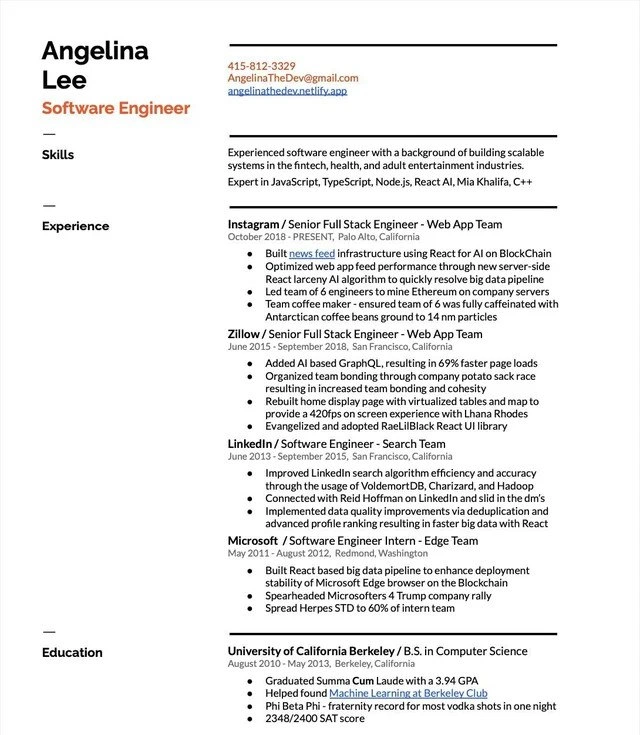
Parody resume crams blockchain AI buzzwords and outrageous corporate accomplishments
Why is this Career HR meme funny?
Level 1: Too Good to be True
Imagine a kid on a playground boasting to their friends: “I can run faster than a race car, I read 10 books every day, and I even taught my dog to do math homework!” The friends all giggle because the claims are just too outrageous to believe. This meme is doing the same thing, but with a tech twist. It shows a fake résumé where the person brags about everything under the sun in the tech world – from super trendy tech skills like AI and blockchain, to crazy workplace stories like giving half the office the cooties (but the grown-up version). It’s funny because no one could have done all that for real, and putting it on a résumé (which is supposed to be true and professional) is as silly as that kid’s playground bragging. In simple terms: the résumé is way too good to be true, and that’s the joke. It exaggerates to the point where everyone can see it’s a big, goofy lie – and we all laugh because sometimes real résumés or job ads feel almost as unbelievable, and this one finally just says out loud how ridiculous it sounds.
Level 2: Buzzword Breakdown
Let’s dissect some of the jargon and references in this parody résumé and explain why they’re amusing to those in the tech world. If you’re a junior developer or not deeply familiar with tech lingo, some of these terms might look impressive at first glance – which is exactly the point. The humor comes from using real tech words in ridiculous ways. Here’s a breakdown:
Blockchain: A technology for keeping a secure, decentralized ledger (think of it like a digital record book that no single person controls). In reality, you might use blockchain for cryptocurrency or other tamper-proof records. But in the résumé’s context (e.g. “React for AI on BlockChain” or “blockchain-orchestrated microservices”), it’s thrown in where it doesn’t belong. That absurd placement is intentional comedy. Techies joke that some people add “now with blockchain!” to any project just to sound cutting-edge, even if it’s as out of place as putting pineapple on pizza (polarizing and usually unnecessary).
AI (Artificial Intelligence): Software that tries to mimic human intelligence, like learning patterns and making decisions. AI is genuinely used in news feeds (Instagram’s feed does use machine learning to show you posts you’ll like). However, phrases like “React latency AI algorithm” are gibberish – React is a UI framework, not something you pair with an “AI algorithm” for latency. The résumé writer is basically doing buzzword stuffing – inserting AI everywhere because it’s trendy. For a junior, note that real résumés should mention AI only if you actually did AI work; here it’s clearly overused for comic effect.
React: A popular JavaScript library for building user interfaces (particularly web frontends). Many web developers list React as a skill. This fake résumé cranks it up to absurdity by saying “React for AI on BlockChain” – which doesn’t describe a sensible project at all. It’s like saying you built a car using a spoon for rocket science: the tools and goals don’t line up. That mismatch is why it’s funny to those in the know.
Node.js, JavaScript, TypeScript, C++: These are programming languages or platforms. It’s normal to list languages on a résumé. The joke is that Mia Khalifa is listed among them. For clarity: Mia Khalifa is not a technology – she’s a former adult film star and internet personality. Including her name in a skills list is completely out-of-place (imagine someone listing “Leonardo DiCaprio” as a programming skill!). This starkly signals that the résumé is a farce. It’s referencing the earlier claim that the person has a background in the “adult entertainment industry” and cheekily implying this “skill”. No real résumé would ever include something like that, which is why it elicits a double-take and a laugh.
Ethereum mining on company servers: Ethereum is a popular cryptocurrency. “Mining” it means running computations to secure the blockchain network and earning coins as a reward. It’s very resource-intensive (tons of electricity and computing power). If someone did this on company servers, it would be a serious misuse of resources – essentially stealing computing power. There have been real-life incidents where employees got caught mining crypto at work. Here it’s presented as if it were a proud accomplishment (“Led a team of 6 engineers to mine Ethereum on company servers”), which is absurd. That’s like bragging you led a team to bake cakes using your office’s computers – it’s not what those computers are for, and it’s definitely not something an employer would sanction. The humor for a tech audience is in spotting that this “achievement” is actually very wrong (and funny to list so nonchalantly).
Antarctican coffee beans ground to 14 nm particles: Okay, this one is just silly on purpose. Antarctica doesn’t grow coffee (it’s all ice, no coffee plantations at the South Pole!). Coffee beans from there would be impossible, hence it’s a joke. Grinding coffee to 14 nanometers is equally crazy – 14 nm is about the size of a few dozen atoms in a line. We measure microprocessor transistors in nanometers (e.g., modern CPUs might be 7nm or 5nm technology). Nobody measures coffee grind that way. A normal fine espresso grind might be, say, 200 microns (0.2 mm). 14 nm is tens of thousands times smaller. So this bullet point is making fun of extreme geekiness and coffee_snobbery: the candidate acts as if they approached making coffee with the precision of a semiconductor engineer. It’s highlighting how over-the-top the résumé is willing to go for a laugh. For a junior reader: it’s important to realize real résumés should keep things professional and relevant (like you might mention you set up coffee for the team, but you definitely wouldn’t talk about nanometers!).
GraphQL resulting in “69% faster” page loads: GraphQL is a real tech – a query language for APIs, used to request data from a server in a flexible way. It can make certain data loads more efficient compared to traditional REST APIs, by reducing over-fetching of data. So yes, using GraphQL might speed up an app. However, claiming a precise “69%” improvement is tongue-in-cheek. Normally, you’d say something like “improved page load times by ~20%.” The choice of 69% specifically is a nod to a meme (the number 69 has an inappropriate connotation from pop culture, often used in jokes). It’s the kind of number a real résumé would avoid because it looks made-up or childish. Here it’s deliberately chosen to signal, “Don’t take this seriously.” For a younger dev, if you see oddly specific improvement numbers in a résumé or product announcement, sometimes they’re exaggerated or cherry-picked. In this meme it’s done purely for humor.
Potato sack race for team bonding: Many companies do team outings or fun activities to boost morale (from escape rooms to picnics). A potato sack race is a simple game where people hop in sacks to race – something you’d associate more with summer camp or elementary school field day than a serious workplace. Listing it as something you organized for “increased team cohesity” is poking fun at corporate lingo. The word “cohesity” isn’t standard English; likely they meant “cohesion” or “cohesiveness.” Or possibly it’s a pun referencing Cohesity, which is actually the name of a tech company (though that might be reading too deep – it’s probably just meant to sound like clumsy jargon). The whole bullet mocks how companies sometimes try goofy activities and then overstate their impact. On a real résumé, you might mention organizing a team event as an aside, but you wouldn’t seriously claim it improved productivity by some metric – that’s why it’s humorous here.
420fps on screen experience: FPS means frames per second, a measure of how many images a screen can display each second. Higher FPS makes motion look smoother. Most standard computer monitors run at 60fps (60 Hz). High-end gaming displays might do 144fps or 240fps. 420fps is way beyond typical, and it’s that number 420 again – a wink to another meme (4/20 is associated with marijuana culture, so 420 used in jokes implies something “high”, pun intended). Saying you achieved 420fps in a web app is comically exaggerating a performance accomplishment (and sneaking in the meme number for those who notice). For reference, achieving extremely high frame rates is usually relevant in video games, not business web apps like Zillow’s home listing page. So this line is both a technical absurdity and a cultural joke. A junior dev might not catch the 420 reference immediately, but they’d surely know that 420fps is overkill. The humor is in boasting about an impossibly high number that has a hidden jokey meaning.
RealLiBlack React UI library: This one’s a bit mysterious because it’s not a famous library outside this meme. It sounds plausible – tech libraries often have funky names. It could be combining words like “Real”, “LI” (maybe LinkedIn?), and “Black” to sound like some internal or niche open-source project. The key is, nobody lists something so obscure on a public résumé unless it’s widely known. This person “evangelized and adopted” it, meaning they promoted its use in their team. “Evangelized” in tech means you strongly advocated for a technology and got others on board (common in resumes to show leadership in adopting new tools). The joke is the ridiculous name of the library – it hints the author just made up something trendy-sounding to pad the résumé. For a junior dev: if you see unknown tool names dropped casually, often it’s either a niche skill or, as in this parody, just added to impress without context. The lesson (and joke) is that throwing around fancy libraries can be meaningless if you can’t explain what they are or why they matter.
VoldemortDB & Charizard vs Hadoop: We touched on this earlier, but to clarify: Apache Hadoop is a legit big data system. Project Voldemort is a legit distributed database (LinkedIn used it for a while; it’s named after the Harry Potter villain, continuing a Silicon Valley habit of whimsical code names). Charizard, on the other hand, is famously a Pokémon (a fire dragon). There’s no known database or tool named Charizard in mainstream tech. By listing it as if it’s a technology, the résumé parodies how out-of-hand tech naming can be, and how an uninformed reader might just assume it’s another fancy tool. It’s the equivalent of saying “I used Hadoop, Voldemort, and PixieDust to improve performance” – two are real, one is fantasy, good luck picking which if you’re not in the know! The presence of Charizard is a clear “gotcha” joke for those who catch that reference.
Reid Hoffman (LinkedIn founder): When someone says they “connected with [Person] on LinkedIn,” that usually just means they clicked the connect button on the social network – a trivial thing. Putting it on a résumé as if it’s an achievement is ridiculous. Reid Hoffman co-founded LinkedIn, so bragging about connecting with him is like bragging you shook hands with the CEO – it doesn’t mean you accomplished work together. In the context of linkedin_name_dropping, this line mocks people who might name-drop famous figures they’ve only had fleeting contact with, to seem more important. For a junior professional: networking is good, but listing your LinkedIn connections in your CV is not. This joke highlights that.
Daily standup: Standup is a short daily team meeting common in Agile software development, where everyone quickly says what they did yesterday and will do today. Mentioning “after daily standup” in a bullet point is comically mundane – it’s like saying “I did X after my morning coffee.” Everyone has a daily standup; it’s not noteworthy. So including that detail exaggerates how someone might fluff up a simple statement with unnecessary context. The humor is subtle: it’s parodying those who write résumé lines like diary entries. For someone new to the field, just know that a résumé should focus on achievements, not trivial routine like attending meetings – that’s why this stands out as silly.
“Blockchain-orchestrated microservices” for Microsoft Edge:
- Microservices are an architectural approach where an application is split into many small, independent services (as opposed to one big monolithic app). They communicate over a network. Orchestrating microservices usually involves tools like Kubernetes or other service mesh technologies. Blockchain, however, is not used to orchestrate microservices. The meme combines these terms to exaggerate the trendiness. In 2011–2012 (the date of that Microsoft job), microservices weren’t even a big thing yet – that buzz came a bit later. Blockchain definitely wasn’t mainstream in Edge’s context. So this bullet is temporally and technically absurd. It’s as if someone just threw every buzzword they could think of into one solution.
- To unpack it: If you truly tried to use a blockchain (which is slow and meant for distributed trust) to coordinate microservices (which need fast, reliable communication), you’d get a very inefficient system. It’s basically a nonsense idea. Tech folks find this funny because it’s exactly the kind of suggestion a non-technical executive might make after reading too many hype articles: “Should we put our web browser on the blockchain? That’ll make it better, right?” The meme plays on that disconnect between hype and reality.
Spreading Herpes to interns: It’s an example of way too much information. In a professional setting, you keep personal indiscretions or scandals far away from your résumé. This line is so outrageous that it serves as a punchline. From a junior perspective, you might just be shocked – did they really say that? Yes, they did, because the résumé is not real. It’s humor via shock value, highlighting how completely off-the-rails this document is. If this were a real person, admitting to spreading an STD at work would be catastrophic for their career (and personal reputation). This parody uses it to ensure the reader understands it’s a joke (just in case “Charizard” and “14 nm coffee” didn’t tip you off).
In summary, each section of Angelina Lee’s résumé is filled with legit tech terms used in illegitimate ways or combined with frat-boy humor numbers (69, 420) and scandalous tidbits. For a junior dev or someone outside the industry, here’s why it’s funny:
- It exploits the contrast between the serious tone of a résumé and the ridiculous content listed.
- It shines a light on how people sometimes feel the need to oversell in the tech industry – but takes that impulse to a comedic extreme.
- If you’ve started job hunting, you might notice far-fetched requirements or candidates claiming they know everything. This meme simply strips away any subtlety and goes all-in, which is why developers share it with a knowing laugh. It’s a form of DeveloperHumor and HiringHumor – we’re laughing at ourselves, at the hiring process, and at the absurdity that can surround CareerExpectations in tech.
For someone new, the key takeaway (besides getting a good laugh) is: real résumés should be honest and relevant. When you see one that reads like this, it’s almost certainly a joke. The tech world loves poking fun at its own trends, and this parody résumé does exactly that – it’s a send-up of résumé inflation, over-the-top corporate culture, and the buzzword overload that we sometimes drown in. Now you’ll hopefully catch the inside jokes: from why “420 fps” is silly to why mixing blockchain with everything is mock-worthy.
Level 3: Full-Stack Hyperbole
This parody résumé is essentially a buzzword bingo card masquerading as a CV. It satirizes the worst of tech Career_HR culture: cramming every trendy term and outrageous claim to impress recruiters. Seasoned engineers read this and feel a mix of amusement and second-hand embarrassment. Why? Because we’ve all seen résumés (and LinkedIn profiles) flirting with this level of inflated_job_titles and self-aggrandizement, albeit usually not as blatantly absurd. Here, every line is a comedic gem reflecting CorporateCulture clichés and industry fads taken to the extreme.
Take the skills section: “Expert in JavaScript, TypeScript, Node.js, React AI, Mia Khalifa, C++.” The first few are normal web development skills, but then it spirals into madness. React AI on BlockChain? Mia Khalifa? Dropping a famous adult entertainer’s name into a list of programming languages is a cheeky flag that this is pure IndustrySatire. It’s poking fun at how applicants and job postings sprinkle buzzwords like AI or blockchain anywhere to stand out, even if it makes zero sense. The resume claims experience in fintech, health, and adult entertainment – a bizarre combo clearly chosen for shock value and laughs (the inclusion of Mia Khalifa is a winking nod to that last domain). It’s a caricature of the “full-stack developer” who quite literally has done everything, from curing database performance issues to, apparently, working on adult content platforms. A cynical senior dev will recognize this as a swipe at ridiculous_skill_set lists that try to cover all bases (often to game keyword-scanning HR software).
The experience section reads like a fever dream of a blockchain_buzzword_bingo champion. Each job entry mixes real technologies with utter nonsense, highlighting how ridiculous resume puffery can get:
Instagram – Senior Full Stack Engineer (2018–Present): The bullets under Instagram pile on the hype. “Built news feed infrastructure using React for AI on BlockChain.” This mashes together hot keywords (React, AI, Blockchain) in a way that screams meaningless techno-babble. It’s as if the writer thought, “Instagram? Let’s throw AI and blockchain in there because why not – recruiters love that!” In reality, Instagram’s feed is powered by machine learning algorithms, but no sane engineer would describe it as “React for AI on Blockchain.” That’s pure parody of tech hype. Next lines: “Optimized web app feed performance through new server-side React latency AI algorithm to quickly resolve big data pipeline.” This is a jumble of buzzword salad – server-side React isn’t even how React works (React is typically a frontend framework, though it can do server-side rendering, but that’s not about feed latency algorithms). It’s riffing on how people force-fit terms like big data pipeline and AI into descriptions to sound impressive. The absurdity continues with “Led team of 6 engineers to mine Ethereum on company servers.” Mining Ethereum (a cryptocurrency) on company hardware is both unethical and ludicrous for a Facebook/Instagram team – but it nods to real scandals where employees did secretly mine crypto at work. It’s making fun of how someone might falsely inflate leadership (“led team of 6”) with a sensational but irrelevant project. Finally, “Team coffee maker – ensured team of 6 was fully caffeinated with Antarctican coffee beans ground to 14 nm particles.” Here the résumé veers into absurd humor: claiming a title like “Team coffee maker” ironically mocks those fluff lines about “team player” or trivial duties. And Antarctican coffee beans ground to 14 nm is hilariously over-the-top – 14 nanometers is extremely tiny (think computer chip transistor scale). No coffee grind is measured in nanometers, and certainly no coffee grows in Antarctica. This bullet pokes fun at coffee_snobbery in tech (teams bragging about fancy coffee) and the hyper-precision engineers joke about. It’s basically saying: “I even took making coffee to an extreme tech level, because I’m just that extra.” The mixture of genuine tech jargon with ridiculous specifics is a classic satire technique – it highlights how inauthentic and exaggerated these claims are.
Zillow – Senior Full Stack Engineer (2015–2018): Here the satire targets different facets of developer life. “Added AI based GraphQL, resulting in 69% faster page loads.” GraphQL is a real technology (a query language for APIs), and integrating it might improve performance, but “AI-based GraphQL” is gibberish – GraphQL isn’t typically described as AI, it’s just a query system. The 69% improvement figure is a not-so-subtle juvenile joke (69 being a wink-wink meme number). It mocks how résumés or press releases often tout oddly specific performance gains (“X% faster!”), sometimes without context, to sound impressive. The next line: “Organized team bonding through company potato sack race resulting in increased team bonding and cohesity.” This one skewers CorporateCulture team-building clichés. A potato sack race is a silly schoolyard game; picturing corporate employees doing it is comedic already. Claiming it “resulted in increased team bonding and cohesity” is redundant corporate jargon (bonding resulted in bonding, wow!) and even uses a malapropism – “cohesity” isn’t actually the correct word (they likely meant cohesion). It’s lampooning those cringey office perks and how companies justify them. The humor lands especially for devs who’ve endured mandatory fun events that supposedly improve teamwork. Next: “Rebuilt home display page with virtualized tables and map to provide a 420fps on-screen experience.” This is pure tech gibberish turned up to eleven. Virtualized tables and maps are real (likely referring to rendering large lists efficiently, and an interactive map UI), but boasting about 420 fps is ridiculous. Even high-end gaming monitors max out around 144Hz, and the number 420 is an obvious nod to the 420 meme (associated with cannabis culture and basically used humorously like “420 blaze it”). It’s absurd to claim a web app runs at 420 frames per second – a dead giveaway that this résumé is a joke. The combination of virtualized tables (a mundane performance technique) with a meme number is poking fun at unrealistic performance bragging. Finally: “Evangelized and adopted RealLiBlack React UI library.” This sounds plausible on surface (tech folks “evangelize” new libraries all the time), but RealLiBlack is not a known library – it’s a spoof. It could be playing on the naming trend of JavaScript libraries (perhaps riffing on something like “Really Black” to sound cutting-edge or just being random). By including a nonsensical library name, it parodies how developers love to pepper résumés with whatever hot frameworks they’ve touched, even if obscure or irrelevant. Essentially, the Zillow section mocks the trend of attributing every minor improvement to some hot tech (“we used GraphQL/AI and now it’s 69% faster!”) and padding résumés with trivial stuff (sack races and random libraries) framed as accomplishments.
LinkedIn – Software Engineer (2013–2015): Now the humor shifts to early-career grandiosity. “Improved LinkedIn search algorithm efficiency and accuracy through the usage of VoldemortDB, Charizard, and Hadoop.” This mixes something real with something fictional. Hadoop is a real big-data framework, commonly used in that era for large-scale processing. Project Voldemort is also real – it’s an open-source distributed key-value storage system that LinkedIn actually created (the name is quirky but legit in tech). But Charizard? That’s a Pokémon (a fire-breathing dragon from Nintendo games), not a database or algorithm. By tossing Charizard in the middle, the résumé maker parodies the habit of name-dropping cool internal tools or projects – except one of these is clearly not like the others. It’s a sly way to see if the reader is paying attention. Any senior dev reading that line would chuckle: “Wait, did that say Charizard?!” It mocks the opacity of some résumés where candidates list proprietary tools or codenames that outsiders wouldn’t recognize (though usually not that outsider – Charizard is just a joke). Next: “Connected with Reid Hoffman on LinkedIn and other colleagues to implement data quality improvements after daily standup.” This is dripping with satire on corporate name-dropping and fluff. Reid Hoffman is the co-founder of LinkedIn – bragging that you “connected” (literally sending a connection request) with him on LinkedIn is absurd to put on a résumé. It’s something a clueless over-eager networker might boast about, not an actual professional achievement. The bullet then mentions implementing data quality improvements (which is plausible work) but frames it in a weird way: why does connecting with Reid or doing it “after daily standup” matter? It’s highlighting how some people pad their descriptions with unnecessary details to sound busy or connected. This line jabs at the linkedin_name_dropping culture and the filler many put into CVs (“I attend daily standups and then save the world”). Finally a short bullet: “Implemented employee data quality improvements.” This is humorously vague and redundant (didn’t we just talk about data quality improvements?). It reads like the person ran out of buzzwords, and just stated something generic because many résumés end with a bland statement. It’s a subtle joke about those unclear résumé lines that don’t really say much but appear to be work done.
Microsoft – Software Engineer (2011–2012): The first bullet here is almost believable in a mad-scientist way: “Reduced page load time by implementing new frame deployment stability of Microsoft Edge browser with new blockchain-orchestrated microservices.” This is a word salad mixing a legitimate concern (page load time) with current fads (blockchain + microservices) in a context that makes no sense. Microsoft Edge is a web browser; improving its page load time might involve low-level optimizations or better rendering, but certainly not “blockchain-orchestrated microservices.” Blockchain is a distributed ledger technology – it has no sane role in browser frame rendering. By jamming blockchain in there, the résumé parodies how every problem magically gets solved by adding blockchain or microservices in the imagination of someone who doesn’t really get them. It’s taking the hype to a ridiculous place, which seniors recognize as a nod to all the times management or clients have asked, “Can we use blockchain/AI for this?” even when it’s utterly unnecessary. Then we have the kicker: “Spread Herpes STD to 60% of intern team.” This line throws professionalism out the window and goes straight for shock humor. It’s entirely inappropriate (which is the point) – you’d never put a personal scandal or something negative on a real résumé, let alone something as outrageous as giving your intern colleagues an STD. The fact that it’s included as if it were just another achievement is dark comedy gold. It mocks any attempt to overshare or include truly irrelevant personal information in a job application. Also, it’s so over-the-top that it assures the reader, if they somehow weren’t sure already, that “Angelina Lee” is not a real person you’ll find on LinkedIn – it’s a satirical character. A seasoned engineer reading this might shake their head laughing, thinking, “This went from tech exaggeration to pure insanity.” It underscores the meme’s theme: no line is too absurd to break the pattern of exaggeration. It’s the résumé equivalent of an onion article (satirical news) – starts in the realm of conceivable and then free-falls into the outrageous.
By the time you finish the Experience section, the humor lands: this document is a roast of how tech résumés (and even company job postings) can sound. It’s reflecting CareerHumor truths: candidates feel pressure to be “superhuman” and list every hot skill (AI, blockchain, you name it). Companies sometimes create roles asking for impossible combinations like “5+ years experience in React and Angular and Docker and Rust and must grind coffee to 14nm” – okay, maybe not that last one, but you get the idea. The meme exaggerates to highlight the underlying satire: how ridiculous it is to measure oneself by buzzwords and vanity metrics. Even the Education section isn’t spared:
- The degree from Berkeley with high GPA – okay, that’s normal boasting.
- “Helped Machine Learning at Berkeley Club develop neural nets” – plausible (a lot of CS students join clubs), though phrased to squeeze in Machine Learning cred.
- “Ranked at the top of hackathons by never winning one in night” – this sentence collapses under its own nonsense. It sounds like someone trying to spin failure into a strange achievement (“ranked at the top by never winning” is contradictory). Possibly implying they went to many hackathons overnight and though they never actually won, they’re still “ranked at the top” – a sly dig at the tendency to fluff up something unimpressive into an accolade. It’s deliberately confusing, much like some résumé lines that leave you scratching your head.
- The SAT score “2348/2400 (perfect on math)” – listing SAT on a professional résumé is already a bit out-of-place once you have work experience. It’s something a try-hard new grad might do to seem special. The score is nearly perfect, which fits the overachiever vibe. (Sidenote: 2348 is an unusual number – SAT section scores were increments of 10, so a real score would be 2340 or 2350. 2348 is off by 2 points, maybe another subtle hint this whole thing is a joke – they can’t even pick a valid score.)
In essence, the entire résumé lampoons CareerExpectations and TechHumor by showing an extreme case of resume_parody. It resonates with developers who have encountered unrealistic job postings or candidates overselling themselves. The humor works on multiple levels of tech inside-jokes:
- It’s making fun of blockchain and AI hype (everyone claiming to use them even when irrelevant).
- It’s spoofing corporate team culture (sack races, coffee snobbery at Antarctican coffee levels).
- It jabs at tech recruiting (padding keywords for HR filters, using fancy titles like “Senior Full Stack Engineer” for relatively short stints, etc.).
- It even touches on the absurd lengths people go to stand out (mining crypto at work or befriending execs on LinkedIn as bragging rights).
A senior engineer or hiring manager reading this is likely chuckling and rolling their eyes because it’s a spot-on satire of the worst résumés and corporate buzzwords we’ve encountered. It’s funny because there’s a kernel of truth: in tech, there indeed exists a problem of inflated job titles and keyword stuffing. This meme just pushes it to comical extremes, acting like a funhouse mirror for the industry. Truth be told, if anyone actually submitted something like this, it’d either be flagged as a joke or as a delusional applicant. But as a meme, it’s brilliant commentary on tech’s buzzword obsession. The next time you see a real résumé claiming a candidate “implemented a revolutionary synergy of AI and blockchain to optimize microservice throughput by 10x,” you might just remember Angelina Lee – the imaginary engineer who did all that and more, with a side of 420fps and a LinkedIn founder connection to boot. It’s a caution not to take résumés (or ourselves) too seriously. After all, if everyone’s a “rockstar ninja” on paper, the claims become meaningless – much like this parody, where the grandiosity collapses into hilarity.
Description
The image is a single-page résumé on a white background with black body text and orange section headers. Top left shows the name “Angelina Lee” in large black font with the subtitle “Software Engineer” in orange beneath it. Top right lists contact details: “415-812-3329”, “[email protected]”, and “angelinathedev.netlify.app.” Skills section reads: “Experienced software engineer with a background of building scalable systems in the fintech, health, and adult entertainment industries. Expert in JavaScript, TypeScript, Node.js, React AI, Mia Khalifa, C++.” Experience section contains four tongue-in-cheek entries: 1) “Instagram / Senior Full Stack Engineer - Web App Team (October 2018 - PRESENT, Palo Alto, California)” with bullet points: “Built news feed infrastructure using React for AI on BlockChain; Optimized web app feed performance through new server-side; React latency AI algorithm to quickly resolve big data pipeline; Led team of 6 engineers to mine Ethereum on company servers; Team coffee maker - ensured team of 6 was fully caffeinated with Antarctican coffee beans ground to 14 nm particles.” 2) “Zillow / Senior Full Stack Engineer - Web App Team (June 2015 - September 2018, San Francisco, California)” with bullets: “Added AI based GraphQL, resulting in 69% faster page loads; Organized team bonding through company potato sack race resulting in increased team bonding and cohesity; Rebuilt home display page with virtualized tables and map to provide a 420 fps on screen experience; Evangelized and adopted RealLiBlack React UI library.” 3) “LinkedIn / Software Engineer - Search Team (June 2013 - September 2015, San Francisco, California)” with bullets: “Improved LinkedIn search algorithm efficiency and accuracy through the usage of VoldemortDB, Charizard, and Hadoop; Connected with Reid Hoffman on LinkedIn and other colleagues to implement data quality improvements after daily standup; Implemented employee data quality improvements.” 4) “Microsoft / Software Engineer - Edge Team (May 2011 - August 2012, Redmond, Washington)” with bullets: “Reduced page load time by implementing new frame deployment stability of Microsoft Edge browser with new blockchain-orchestrated microservices; Spread Herpes STD to 60 % of intern team.” Education section lists “University of California Berkeley / B.S. in Computer Science (August 2010 - May 2013, Berkeley, California)” and bullets: “Graduated Summa Cum Laude with a 3.94 GPA; Helped Machine Learning at Berkeley Club develop neural nets; Ranked at the top of hackathons by never winning one in night; 2348/2400 SAT score (perfect score on math section).” The entire document is a comedic exaggeration stuffed with buzzwords like AI, blockchain, GraphQL, and improbable achievements, poking fun at résumé inflation and corporate culture in tech

Comments
40Comment deleted
This résumé is basically a Kafka topic of buzzwords - AI, blockchain, 420 FPS React - partitioned for peak ATS throughput but with exactly-once credibility semantics set to false
When you're so desperate to stand out in the ATS system that you optimize your resume with keywords from both PornHub's trending page and npm's most downloaded packages - because at this point, what's the difference between getting screwed by recruiters and getting your dependencies screwed?
This resume perfectly captures the senior engineer's dilemma: you've seen enough embellished resumes to know that 'optimized performance by 420fps' is about as real as mining Ethereum on company servers, yet somehow 'Led team of 4 engineers' still sounds more plausible than the actual team sizes at most startups. The real red flag isn't the Charizard in the tech stack - it's that after 15+ years, you've absolutely worked with someone who would unironically list 'VoldemortDB' as production-ready technology
This résumé reads like a distributed trace: flashy spans - React + AI + blockchain, GraphQL “699% faster,” 420fps UI, coffee beans at 14nm - then the root span that explains the whole incident: mined Ethereum on company servers
Claiming React AI on blockchain with 69% faster pages at 420fps while mining ETH on company servers is the only résumé I’ve seen that tries to beat CAP theorem with a fourth property: Plausible Deniability - fueled by 14‑nm coffee grounds
Spread Herpes to 60% in test? That's coverage even your flaky integration suite could only dream of - truly infectious metrics
рукастая девка, а вернее - головастая Comment deleted
please use English in this chat Comment deleted
или что? Comment deleted
ili tobi pizda Comment deleted
wow Comment deleted
warn once, then ban (according to the rules) Comment deleted
omly stupid russians are trying to shitpost their stupid opinion Comment deleted
said Andrey... Comment deleted
(he is probably Ukrainian) Comment deleted
Difference? Comment deleted
good question Comment deleted
Ukraine has not the best relationship with Russia. Comment deleted
Expert in Mia Khalifa? Comment deleted
Why not Comment deleted
that's not the only joke in the text Comment deleted
People with interests are always better than no-lifers. Comment deleted
You know, I'm something of a expert in Mia Khalifa myself Comment deleted
So, i am something of an expert myself Comment deleted
MiaKhalifa.js Comment deleted
*mia_khalifa.jpg* Comment deleted
Seemed legit. had to use all my powers to overcome banner blindness only then lold Comment deleted
ahaha, 420fps, Mia Khalifa Comment deleted
What is the exact record for Phi Beta Phi? I don't need sleep, I need answers! Comment deleted
angelinathedev.netlify.app Comment deleted
ffffuuuuuuu Comment deleted
screaming out loud, crazy rickroll Comment deleted
I wouldn't be surprised if Mia Khalifa was another JS framework Comment deleted
Oh my.. look at the experience! There is a lot of crazy things. Like “spread herpes” Comment deleted
Team caffeinator - that's a title i wanna get Comment deleted
So much react Comment deleted
Microsofters 4 Trump Comment deleted
there is a difference. I'm not russian which means I'm not sick thief. But you wouldn't understand Comment deleted
Guys, please try opening the link in the header! Comment deleted
what the...? index.mk ? Comment deleted