Skip to content
DevMeme
2248 of 7435
Beyond FAANG: Get Ready for FATASS MAN
IndustryTrends Hype Post #2503, on Dec 22, 2020 in TG

Beyond FAANG: Get Ready for FATASS MAN

Why is this IndustryTrends Hype meme funny?

Level 1: The Funny Group Name

Imagine you and a bunch of friends want to name a cool new club by using the first letter of each friend’s name. Let’s say your friends are Frank, Alice, Tom, Andy, Sam, Sally, Mike, Amy, and Nick. If you put all those first letters together, you get FATASSMAN. Now say that out loud – it sounds like “fat ass man,” which is pretty silly! You all thought the club’s name would sound important and cool, but instead it turned out goofy and made everyone laugh. This meme is doing the same thing, but with famous tech company names. It squishes their first initials together into one big word, and that word ends up sounding really funny. In other words, by trying to mash all those big, serious names into one name, it became so silly that nobody can take it seriously. It’s like trying to be super cool, but by accident you come up with a nickname that’s just plain hilarious.

Level 2: From FAANG to FATASSMAN

The meme riffs on the famous acronym FAANG, which has been a buzzword in the tech world for years. FAANG stands for Facebook, Apple, Amazon, Netflix, and Google – five massive tech companies known for their outsized influence. People often refer to these as the “FAANG companies” when talking about top-tier tech firms or sought-after employers. An acronym like FAANG is basically a word formed from the first letters of a list of names. For example, the letters F-A-A-N-G come from those five company names. It’s a handy way to say “those big tech companies” without having to list each one every time.

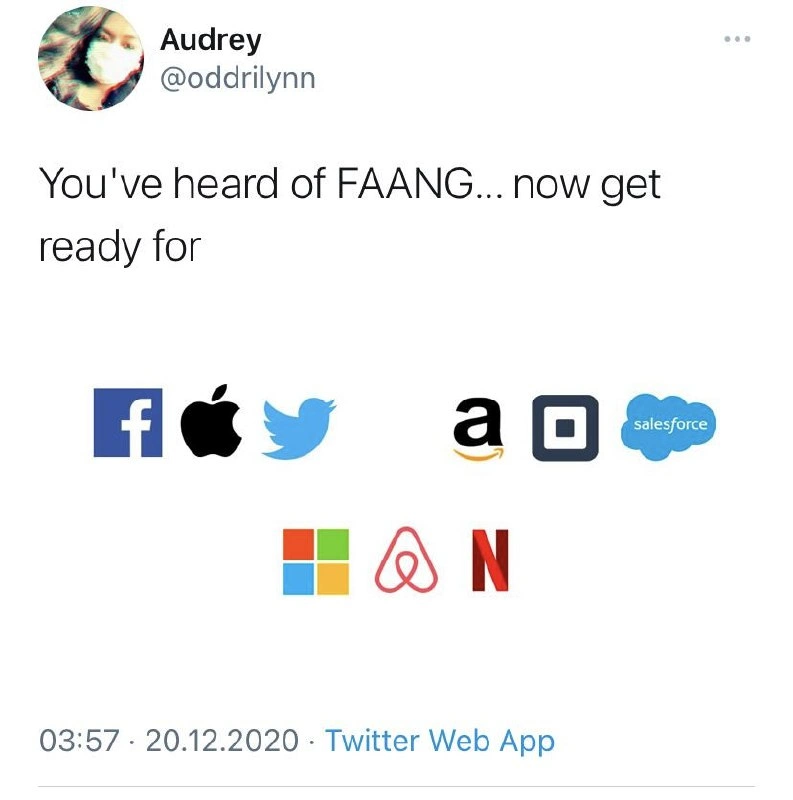
The tweet in this meme jokes that “FAANG is old,” and presents a new, even bigger acronym to replace it. Below the tweet’s text, we see nine familiar company logos arranged in a grid. If you take the first letter of each logo’s company name (reading left-to-right, top row then bottom row), they spell out FATASSMAN. Here’s the lineup of logos and what each one represents:

  • FFacebook (the blue f logo of the social media giant).
  • AApple (the black silhouette of an apple, for the iPhone maker).
  • TTwitter (the blue bird icon for the popular social network where people post short updates called tweets).
  • AAmazon (the black “a” with an orange smile/arrow underneath, representing the huge e-commerce and cloud computing company).
  • SSquare (the dark square-shaped logo for Square, a financial tech company known for payment processing; Square is now called Block, but in 2020 it was still Square).
  • SSalesforce (the blue cloud logo with the word “salesforce” inside, representing Salesforce, a big enterprise software company that offers CRM – Customer Relationship Management – services in the cloud).
  • MMicrosoft (the four-colored window pane logo of Microsoft, the software and cloud powerhouse behind Windows and Azure).
  • AAirbnb (the pinkish round symbol that looks like an A, for Airbnb, the popular home rental booking platform).
  • NNetflix (the red letter N logo for Netflix, the streaming entertainment company).

Take those first letters in order, and you get FATASSMAN. The tweet setup says, “You’ve heard of FAANG... now get ready for ____”, and the punchline is delivered by this new acronym constructed from that mashup of brand logos. It’s presenting a kind of successor to the FAANG group, including more of today’s big tech players. In other words, the meme is saying: FAANG was yesterday’s news; now here’s the new lineup of tech giants.

One thing you might notice: Google (the “G” in FAANG) is not included in FATASSMAN at all. In reality, Google is still one of the biggest tech companies (its parent company is even named Alphabet), so normally you’d expect it in any list of top industry players. The meme-maker left Google out, likely to make the acronym spell a nifty word. If they had added the “G” for Google, the acronym would have been “FATASSMANG,” which doesn’t have the same ring to it. Excluding Google let the creator plug in other rising stars like Twitter, Square, and Salesforce without ruining the joke. (Plus, having the final result read as the funny phrase “fat ass man” was clearly the goal.)

The humor here comes from two places. First, there’s the idea of constantly renaming the “cool kids” club of tech companies whenever the lineup changes – it pokes a bit of fun at the tech media’s hypey habit of rebranding industry trends. Second, and most obviously, “FATASSMAN” sounds like “fat ass man,” which is a very unflattering and absurd thing to call a bunch of powerful corporations. Usually, acronyms like FAANG are meant to sound sharp or at least neutral, but by adding more letters, this new one turned into a complete joke. It’s an extreme, silly exaggeration. The meme is basically saying: if we keep shoving more and more big names into one acronym, eventually we’ll end up with something that just makes us laugh. It highlights how over-the-top and ridiculous these buzzwords can become when we’re too eager to lump every big tech firm together under one catchy banner.

Level 3: Acronym Arms Race

In a classic display of tech’s CorporateCulture obsession with buzzwords and IndustryTrends hype, industry watchers love to coin ever-longer acronyms for our big tech overlords. The original FAANG companies (Facebook, Apple, Amazon, Netflix, Google) became shorthand in corporate culture for the dominant BigTechCompanies — it had a fierce ring (like actual fangs, sharp and powerful). But by late 2020, FAANG was apparently getting long in the tooth. The tech landscape had shifted: Microsoft was back on top as a trillion-dollar giant, Twitter and Square were making waves (remember the epic Twitter controversies and Jack Dorsey’s fintech moves?), Salesforce was gobbling up companies (buying Slack for ~$27B), and Airbnb had a blockbuster IPO. With so many new players and changed fortunes, the hype machine needed a bigger tent. So what do we get? A tongue-in-cheek FAANG successor acronym that’s supersized to include almost everyone: FATASSMAN.

This meme tweet is a brand logo mashup of nine logos that spell out FATASSMAN – and yes, it literally reads as “fat ass man.” The humor here is pure TechIndustryHumor: by trying to include all the hottest companies, the new mega-acronym turns into a goofy insult. It’s like the once-fearsome FAANG grew into a fat and unwieldy creature overnight. The joke practically writes itself – the mighty tech titans have been summed up as a fatass man. That’s a far cry from the sleek, predatory vibe of a fang. TechHumor often thrives on this kind of contrast between grandiosity and silliness. Here we have the grand roll-call of tech heavyweights ending up sounding like a clumsy superhero parody (“Fat Ass Man,” defender of the internet!).

It’s no accident either. The tweet’s author deliberately picked companies so their initials form that exact phrase. (Notice Google is absent – ironically, Google’s parent company is literally named Alphabet, but adding a “G” would have spoiled the cheeky spelling.) This highlights a truth about acronyms: cram in enough letters and you often stumble into a ridiculous word. The visual gag of this brand logo mashup drives it home – a gallery of famous logos lined up solely to serve the joke. Grouping these disparate brands together is also a nod to how we tend to lump all tech giants into one big category of influence.

Historically, the urge to name-check powerful companies as a set isn’t new. Back in the mainframe era, people spoke of “IBM and the BUNCH” – where BUNCH stood for Burroughs, Univac, NCR, Control Data Corporation, and Honeywell (IBM’s rivals at the time). In the PC era, we had the Wintel duopoly (the Windows + Intel power couple). Fast-forward to the 2010s: Wall Street pundits popularized FANG, later expanded to FAANG, to track the era’s star tech stocks. Each time, as the industry evolved and market caps shifted, the acronym evolved too. Some tried new combinations – adding Microsoft to get FAAMG, or rearranging to GAFAM – but those never rolled off the tongue like “FAANG.” So this meme takes the acronym arms race to its absurd extreme: if five letters aren’t enough, just throw in ALL the big names until you end up with a 9-letter monstrosity that one-ups FAANG (and as a bonus, spells a not-so-flattering word).

To illustrate, we can even recreate the FATASSMAN acronym in code by extracting the first letters of each company name:

companies = ["Facebook", "Apple", "Twitter", "Amazon", "Square", 
             "Salesforce", "Microsoft", "Airbnb", "Netflix"]
acronym = "".join(company[0] for company in companies)
print(acronym)  # FATASSMAN

As expected, this prints out "FATASSMAN". We’ve basically written a mini-script that mirrors how the tweet’s acronym was formed – an alphabet soup of tech logos boiled down to one chunky word.

The meme really pokes fun at our obsession with labeling the “top dogs” of tech. There’s an underlying truth: insiders, recruiters, and media love these acronyms. They serve as shortcuts to sum up an entire era of dominance and a clear CorporateCulture pecking order. Saying “FAANG” (or now, half-jokingly, “FATASSMAN”) is way easier than listing all nine companies, and it signals to everyone in the room that we’re talking about the elite club of tech. In fact, FAANG became a staple term in tech recruiting — everyone knows that working at a FAANG company means you’ve “made it” to the big leagues. But this new mega-acronym flips the script into pure parody. It’s self-aware humor highlighting how excessive this grouping game has become. Can you imagine a serious conversation where someone boasts, “I just landed a job at a FATASSMAN company”? It doesn’t exactly roll off the tongue or exude prestige. Instead of inspiring awe, that phrase would probably just draw laughs or confused looks.

Ultimately, the joke lands because it exposes the absurdity of chasing the next catchy label for tech’s power players. The companies may change — one falls out of favor, another rises — but the impulse to coin a flashy new acronym remains constant. Today’s FAANG was yesterday’s “Big Five,” and tomorrow we might see an even longer acronym if the trend continues (prepare for the next evolution, perhaps “MEGAFATMAN” with even more letters!). For now, FATASSMAN sets the bar (or maybe lowers it) for how ridiculous it can get when we turn the dominance of big tech into one giant inside joke.

Description

A screenshot of a tweet from user Audrey (@oddrilynn) that presents a humorous, new acronym for a collection of major tech companies, as a successor to 'FAANG'. The tweet reads, 'You've heard of FAANG... now get ready for'. Below this text are two rows of company logos. The first row includes the logos for Facebook, Apple, Twitter, Amazon, Square, and Salesforce, with their first letters spelling 'FATASS'. The second row contains the logos for Microsoft, Airbnb, and Netflix, spelling 'MAN'. The joke is a parody of the finance and tech industry's tendency to create acronyms for high-performing tech stocks (like FAANG: Facebook, Amazon, Apple, Netflix, Google). This meme cleverly subverts the trend by creating a profane and memorable alternative, which resonates with tech professionals tired of corporate buzzwords
Comments

18
Anonymous ★ Top Pick I see your FAANG and raise you one FATASS MAN. The compensation is comparable, but the acronym is definitely more honest about its impact on your work-life balance
  1. Anonymous ★ Top Pick

    I see your FAANG and raise you one FATASS MAN. The compensation is comparable, but the acronym is definitely more honest about its impact on your work-life balance

  2. Anonymous

    FAANG just refactored into FATASSMAN - perfect, now my dependency tree has nine transitive CEOs and every quarterly earnings call is a breaking change

  3. Anonymous

    The real joke is that by the time you've finished explaining to the board why you need all nine of these in your tech stack, three have been acquired, two have pivoted, and somehow you're still paying for all of them

  4. Anonymous

    The real joke is that by the time you finish your System Design interview prep for the original FAANG, the acronym has already pivoted three times, acquired two startups, and deprecated itself in favor of a microservices-based naming convention. Meanwhile, your TC (total compensation) spreadsheet now needs horizontal scaling just to compare offers from this expanded universe of tech giants - each with their own unique blend of RSU vesting schedules, on-call rotations, and 'we're not like other tech companies' culture decks

  5. Anonymous

    FAANG refactored into a nine-letter namespace - breaking acronym change, same O(months) hiring latency

  6. Anonymous

    FAANG for the resume flex, FATASSMAN for the on-call hell that keeps seniors lean

  7. Anonymous

    FAANG’s refactor to FATASSMAN is peak distributed monolith: more services, same eventual-consistency recruiter spam

  8. @AmindaEU 5y

    Who are 5 & 6 or what do they do? 8 is Airbnb?

    1. dev_meme 5y

      5 - Square 6 - Salesforce

      1. @AmindaEU 5y

        What do they do?

        1. dev_meme 5y

          I mean, that's quite big companies, especially salesforce, you better google yourself

        2. @ArchieWindragon 5y

          Salesforce is kinda like a ui/portal for support. Manages tickets, searching, databases. At least that's how it's configured in my workplace

  9. @bit69tream 5y

    fat ass man

  10. @RiedleroD 5y

    what that

    1. Никита Зайцев 5y

      BMW i

      1. @RiedleroD 5y

        ah bruh. My stepdad works at BMW… I am ashamed.

  11. @ekeetkinders 5y

    Epic n*gger moment

  12. Deleted Account 5y

    Glorious

Use J and K for navigation