Skip to content
DevMeme
2247 of 7435
And Then Brainfuck Enters the Chat
Languages Post #2501, on Dec 22, 2020 in TG

And Then Brainfuck Enters the Chat

Why is this Languages meme funny?

Level 1: Monster Languages, Simple Story

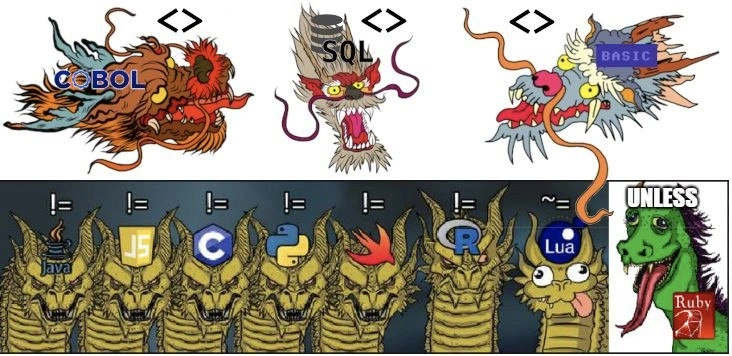
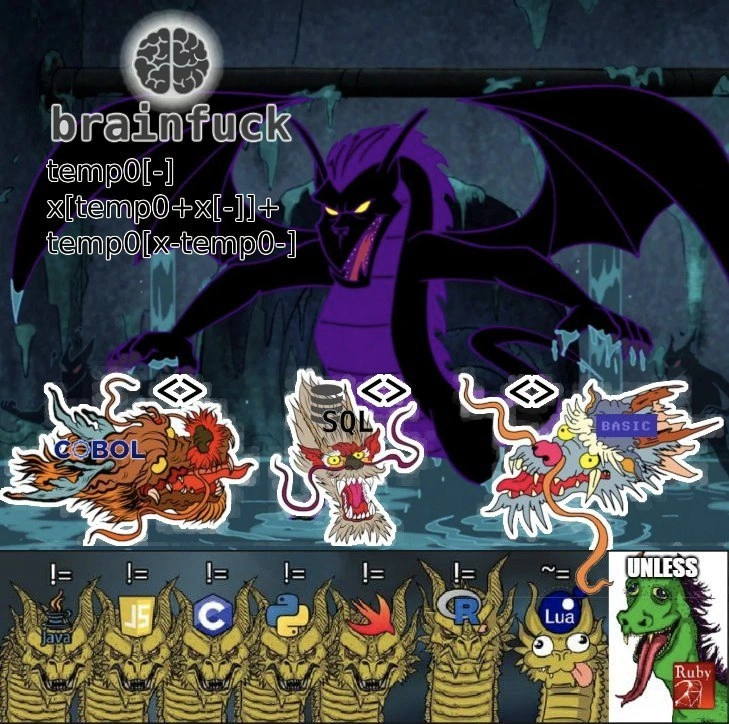
Imagine all the programming languages as dragons or creatures. On one side, you have some old dragons – they’re big, cranky, and kind of scary because they come from a long time ago (these are like languages your grandparents might have used, such as COBOL or BASIC). They snort smoke and look mean, because working with those old languages can feel like dealing with a grumpy old dragon guarding treasure. Then, down below, you have a hydra, which is a creature with lots of heads. Each head is a modern language like the ones we use today (Java, JavaScript, C, etc.). Funny thing is, all those heads look goofy and almost the same! This shows that today’s languages, even if they have different names, are like siblings – they act more alike than we sometimes admit, and our arguments about them are a bit silly (picture a bunch of cartoon dragon heads all arguing but none really being that different). One of those heads is sticking its tongue out and saying “unless” – that’s a wink to Ruby, a language that has a quirky way of saying “do this except if something” using the word unless. It’s just a little joke about how Ruby likes to be special.

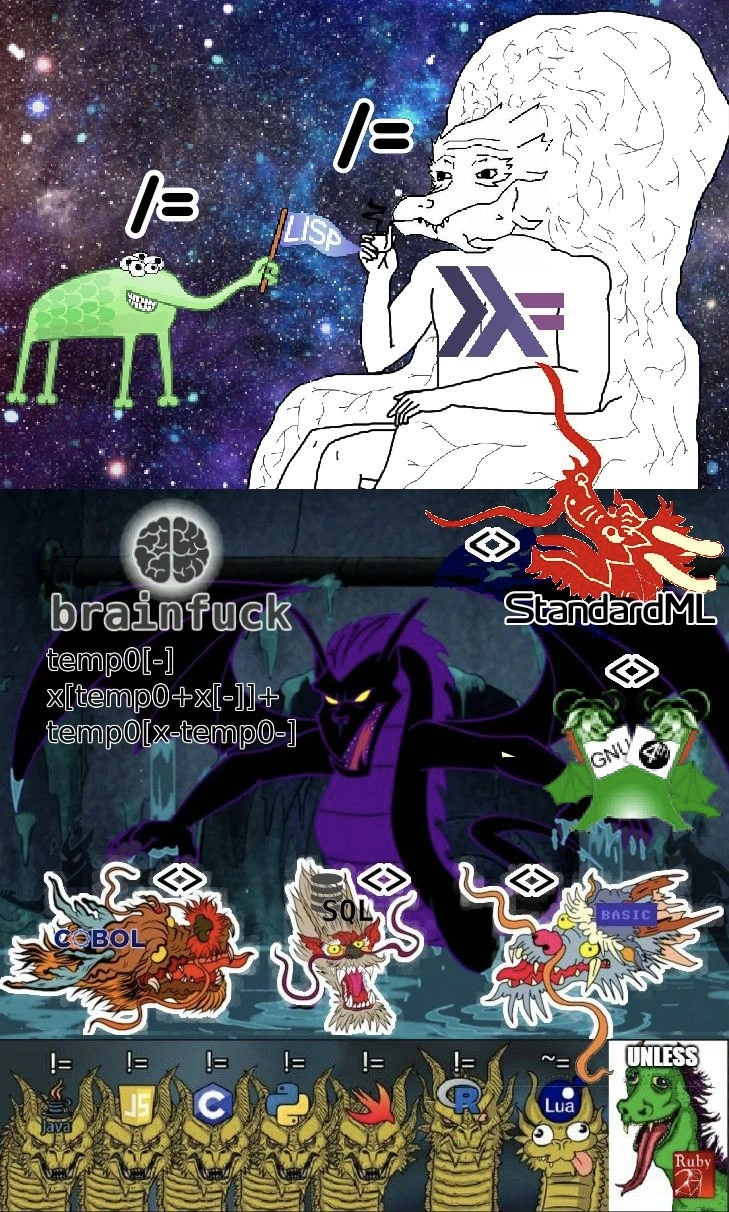
Now, towering over all of them is the big purple dragon with a brain symbol – that’s a language called Brainfuck. Brainfuck is drawn as the biggest, scariest monster because its “language” is super hard to understand (even harder than the old dragons!). Its code looks like complete nonsense, like someone mashing a keyboard. So in this funny scene, even the old angry dragons and the whole crowd of modern dragon-heads are overshadowed by this gigantic brainy dragon speaking gibberish. The joke is kind of like if a bunch of kids were arguing about who has the hardest homework, and then a professor walks in with a crazy impossible puzzle. All the kids — even the older ones — go silent seeing that puzzle. Here, Brainfuck is that over-the-top puzzle. It makes all the other languages, old and new, seem easy or at least understandable by comparison.

So the meme is funny because it exaggerates how we think of programming languages: old ones are monsters, new ones are a many-headed goofy monster, and then there’s an ultimate mega-monster language that’s basically unreadable. It’s like a little story: no matter how much we squabble about our favorite tools or how scary some old tech seems, there’s always a crazier thing out there. In a simple way, it’s saying: every programming language has its quirks and challenges, but be glad you’re not trying to tame the Brainfuck dragon!

Level 2: Language Zoo Explained

This image is using a funny cartoon to compare programming languages to a bunch of dragons. Each dragon or dragon head has a label of a programming language, and they’re drawn with different expressions to show how we programmers feel about them. Let’s break down what each part means in real-life terms:

  • Brainfuck (big purple dragon with a brain icon): Despite its shocking name, Brainfuck is actually the official name of a tiny esoteric programming language. “Esoteric” means it’s not really meant for serious use – it was made more as a puzzle or joke for coders. Brainfuck has only a few symbols as commands (like +, -, > for moving a pointer, etc.), and as a result, its code looks like gibberish. It’s Turing complete, meaning it can, in theory, do anything other full programming languages can do, but it’s incredibly hard to read or write. The meme shows a snippet of Brainfuck-like code (temp0[-] ... temp0[x-temp0-]) to illustrate how confusing it looks. This giant dragon towering over the rest represents Brainfuck as the scariest, most unintelligible code monster. It’s basically the meme’s way of saying “here is a programming language so hard to read that it overshadows all the others.”

  • COBOL (one of the smaller dragons, brown and angry): COBOL stands for Common Business-Oriented Language. It’s one of the oldest programming languages still in use, dating back to the late 1950s and 1960s. Banks, insurance companies, and governments used COBOL for their big important systems (like processing payrolls or transactions), and many of those systems are still running today. COBOL code is known for being very verbose and kind of clunky by modern standards – it was designed to look a bit like English. For example, instead of writing total = a + b, a COBOL program might write something like ADD A TO B GIVING TOTAL. Because it’s old and not many new programmers learn it, people often consider maintaining COBOL code a daunting task. In the meme, COBOL is a snarling dragon to symbolize that it’s an old beast that can be difficult to deal with, but also powerful because so much critical software depends on it even now. It’s filed under “LegacySystems” because it’s typically found in older (legacy) systems that just keep on running.

  • SQL (another dragon head, greyish and angry): SQL is a very common language used in programming, but it’s not a general-purpose language like Java or Python – it’s specifically a query language for databases. SQL (pronounce it either “ess-cue-ell” or “sequel”) lets you ask questions about data. For instance, you might write SELECT * FROM Users WHERE age > 30; to get all users older than 30 from a database table. SQL is everywhere in software that deals with data storage. People don’t normally write entire applications in SQL, but they use it whenever they need to retrieve or manipulate data in a relational database. The reason SQL is drawn as a dragon with a fierce face is that, while the basics of SQL are straightforward, complex SQL queries can become extremely hard to read or optimize. If you’ve ever seen a huge SQL query with lots of joins and subqueries, you know it can turn into a monster. The meme is basically joking that SQL can be a “dragon” too – perhaps a bit unpredictable or scary when it grows in complexity (like when that one query accidentally slows the whole system down!). SQL is a bit unique since it’s a declarative language (you declare what data you want, not exactly how to get it), which is different from languages like C or Java.

  • BASIC (third small dragon head, white with a “BASIC” label, also angry-looking): BASIC is short for Beginner’s All-purpose Symbolic Instruction Code. It was created in the 1960s to make programming easier to learn for students. Many people in the 70s and 80s learned to code using BASIC on early personal computers. It’s… well, basic. A simple example in BASIC might be:

    10 PRINT "HELLO"
    20 GOTO 10
    

    That would print “HELLO” over and over. BASIC often used line numbers and the GOTO command to jump around, which led to a lot of messy structures in larger programs. As programming practices evolved, BASIC was seen as encouraging bad habits (like spaghetti code), but it also evolved into more structured variants (like Visual Basic later on, which added more modern features). In the meme, BASIC’s dragon is snarling as well, meaning it’s another old-school language that can be quite unruly or “monster-like” if you have to deal with old BASIC code. It’s grouped with COBOL and SQL because these are all somewhat outdated or legacy in style (even though SQL is still heavily used, it’s from an older generation of design).

  • Mainstream languages (the row of identical goofy hydra heads at the bottom): Here we have a hydra, which is a mythical creature with many heads. Each of these heads has a tiny flag or icon indicating a modern popular programming language. The ones mentioned are:

    • Java (one head has a Java coffee cup logo perhaps): Java is a very popular general-purpose programming language from the mid-90s, widely used in enterprise software, Android apps, and more. It’s known for its motto “write once, run anywhere” thanks to the Java Virtual Machine. Java code has a lot of boilerplate (ceremony) but is very explicit.
    • JavaScript (JS) (another head, likely with the yellow “JS” logo): JavaScript is the main language of web browsers, used to make web pages interactive. Despite the name, it’s quite different from Java. It’s a dynamic, interpreted language and has some quirks (like the infamous double vs triple equals == vs === for comparison). Today it’s everywhere, not just in browsers but also on servers (Node.js).
    • C (head with a letter C icon): C is one of the oldest still-used languages (from early 1970s), and many later languages borrow its syntax. It’s a low-level language in the sense that you manage memory manually and it’s compiled to machine code. Operating systems, embedded systems, and high-performance software often use C. It’s powerful and minimal, but errors can crash your program (like buffer overflows).
    • C++ (head with “C++” or maybe a blue icon): C++ extends C with object-oriented features and more. It’s used in scenarios where performance is critical but you want more abstraction than plain C. It’s notoriously complex as a language (it has many features and a very large specification), but it’s a workhorse for things like game engines, high-frequency trading systems, etc.
    • Go (head with Go gopher icon or text): Go (or Golang) is a relatively newer language (from 2009) created at Google. It was designed to be simple, efficient, and good at handling concurrent operations (things happening in parallel). It has a mascot (the Go gopher) and is often used for cloud services and tools. Go’s syntax is simpler than C++ and it handles memory for you (garbage-collected), so it has gained a lot of fans for being pragmatic and easy to deploy.
    • R (head with an R icon): R is a programming language mainly used in statistics and data analysis. It’s popular among data scientists for doing things like statistical tests, plotting graphs, and machine learning. R code can be a bit odd-looking to general programmers because it’s very vector and math oriented. But it’s mainstream in the sense that it’s widely used in its field (academia and analytics).
    • Lua (head maybe with a Lua logo): Lua is a lightweight scripting language often embedded in applications (for example, many video games use Lua to script game logic). It’s simple and fast, often used where you need a small extension language.
    • (and possibly others): The meme likely includes more heads than the ones explicitly named, which might represent languages like Python, Ruby, C#, PHP, Rust, etc. The idea is to show a whole bunch of current languages that today’s programmers use. They’re drawn as identical goofy heads to humorously suggest that, compared to the big distinct dragons of the past, these modern languages are kind of one family. They all share a lot of similarities (especially many have roots in the C style syntax and run on modern hardware with similar capabilities). In other words, from a distance, all these mainstream languages might blend together – they solve similar problems and have borrowed ideas from each other over the years.
  • Ruby’s “UNLESS” head (the goofy dragon with tongue out next to a Ruby logo): Ruby is indeed one of the mainstream languages (created in the mid-90s, popularized by the Ruby on Rails web framework in the 2000s). It’s known for having very human-friendly syntax. One quirky feature is the unless keyword. In most languages, to do something only when a condition is false, you’d write an if with a negation (e.g., in JavaScript: if (!isReady) { ... }). Ruby lets you write that more English-like: unless isReady { ... }, which reads like “unless this is ready, do something” – effectively “if not”. The meme specifically highlights this by labeling Ruby’s head with “UNLESS”. This is likely a playful jab at Ruby being a little different from the pack, syntax-wise. The Ruby head is depicted kind of like a derpy lizard (a komodo dragon) instead of a fierce dragon, to indicate it’s the odd one out doing something silly (sticking its tongue out with unless). It doesn’t mean Ruby is bad; it’s just the meme’s way to represent a unique trait that Ruby has among otherwise similar-looking modern languages.

The overall scene shows generations of programming languages as creatures in a cave: the old guard (COBOL, SQL, BASIC) up top, the multitude of modern choices (Java, JS, C, etc.) at the bottom. And towering above them all is Brainfuck, an inscrutable giant. The humor comes from exaggeration and contrast: we often talk about some languages as if they’re monsters – “Oh, that old COBOL system is a beast to maintain” or “C++ is a dragon with all its complex features” – so here they are literally drawn as dragons. Meanwhile, newer languages sometimes come in droves (so a multi-headed hydra fits) and often share so much DNA that to a greybeard programmer they seem like the same creature with different names. By giving the hydra goofy identical faces, the meme suggests that our fierce debates over which modern language is better are a bit cartoonish; they’re all similar “heads” of the same hydra.

Finally, Brainfuck being the biggest, scariest dragon is a joke about readability and complexity. No matter how hard you think learning SQL or debugging C++ templates is, Brainfuck code is almost guaranteed to be harder to make sense of! It’s a way of saying “There’s always a bigger dragon.” It also makes fun of the endless “language wars” among developers – people arguing over Java vs. Python, etc. – by introducing an absurd contender (Brainfuck) that sort of ends the argument by being so extreme. It’s like, “Alright, you kids argue all you want, but meanwhile here’s Brainfuck making all of you look easy.” In developer humor, Brainfuck and other esoteric languages often come up as the punchline because they’re so deliberately obtuse that everyone can agree they’re impractical except as a brain teaser.

In summary, the meme is depicting a hierarchy of programming languages in a humorous way: The old languages (COBOL, SQL, BASIC) are shown as scary dragons that we respect but find daunting, the popular modern languages are a bunch of similar-looking heads that often fight among themselves (which is silly when you step back), and then there’s Brainfuck, a wild monster that out-terrifies everyone purely by how impossible its code is to read. It combines tech history (legacy vs modern) with a classic developer humor trope (language flame wars and the absurdity of extreme examples) in one picture. If you’re a programmer, each element of the image corresponds to a set of inside jokes or experiences: maintaining ancient COBOL code, wrestling with SQL queries, nostalgia (and frustration) with BASIC, debates over today’s best language, and the collective “Haha nope!” at the idea of coding in Brainfuck. The meme uses the well-known three-headed dragon cartoon format and expands it into a whole assembly of dragons to tell this story. It’s a fun way to visualize the landscape of programming languages and poke fun at our industry’s tendencies.

Level 3: Legacy Dragons vs Modern Hydra

This meme taps into the shared folklore of programming: the eternal language wars and the generational shift of technology. We see three snarling dragon heads labeled COBOL, SQL, and BASIC – these are the ancient ones, the legacy languages that every seasoned developer has heard horror stories about. They’re depicted as mean-looking, battle-scarred dragons for good reason. COBOL is notorious in industry lore: it was written in the 60s to run on mainframes and still powers a huge number of legacy systems in banking, government, and insurance. Maintaining COBOL code can feel like deciphering ancient scrolls; it’s verbose (a simple arithmetic operation might be one long sentence) and often written in a decades-old style that predates structured programming. Many senior engineers recall wartime-like tales of hastily patching COBOL systems when something breaks in a finance platform or after discovering a two-digit year field (remember the Y2K bug?). The COBOL dragon’s fierce glare in the meme is the look of a guardian of huge legacy troves of data – and a warning: do not meddle in the affairs of this old code lightly.

SQL, the middle dragon, represents every epic battle a developer has had with a complex database query. At first glance, SQL (Structured Query Language) is quite logical: SELECT this, WHERE that. But any developer who’s had to optimize a monstrous 50-table join or untangle a nested subquery from the depths of a stored procedure knows that SQL can breathe fire, too. It’s a different kind of beast – a declarative language for databases – which means you state what you want, and the database query planner decides how to get it. This abstraction is powerful but can surprise you; one wrong condition and that “simple” query suddenly takes down your production database with a full table scan. The SQL dragon has that wild-eyed expression as if it’s about to unleash a surprise (like an EXPLAIN plan revealing your innocent query turned into a Cartesian product of billions of rows). In day-to-day developer humor, SQL is sometimes the butt of jokes (“SQLBolt: when your query accidentally SELECTs everything and locks the DB”), yet it remains indispensable. It’s the dragon that jealously guards the treasure of enterprise data, and taming it requires respect for its centuries (okay, decades) of evolved complexity.

Then there’s BASIC – depicted as another grumpy old dragon. BASIC is the grandfather many current programmers never met, but it left a mark on coding culture. Baby Boomers and Gen-X programmers might have written their first programs in BASIC on an Apple II or Commodore 64, with code like:

10 PRINT "HELLO"
20 GOTO 10

BASIC was intentionally simple (the acronym literally stands for Beginner’s All-purpose Symbolic Instruction Code) and had a friendly learning curve. But as projects grew, BASIC programs could turn into a mess of spaghetti code – much like a dragon that seems cute when small but grows unwieldy and unpredictable. By the time you had hundreds of GOTO statements cross-jumping, you had a fire-breathing maintenance nightmare. In the meme, BASIC’s dragon is just as pissed-off and agitated as COBOL and SQL, reflecting the collective memory of debugging impossible BASIC spaghetti logic or working with its later evolved but bloated forms (looking at you, VB6). These three “legacy dragons” are portrayed as fearsome but familiar monsters to veteran developers – they’ve terrorized codebases for ages, yet we coexist with them because they still run critical stuff.

Enter the mainstream language hydra at the bottom of the image. This is where the meme really leans into comedic contrast. All those identical goofy heads with tiny flags represent today’s popular languages – Java, JavaScript (JS), C, C++, Go, R, Lua, and likely others not explicitly labeled (we can imagine Python, C#, PHP, and Rust in that lineup too, since they’re part of the modern pantheon). The hydra imagery is apt: in Greek myth, if you cut off one of the Hydra’s heads, two more would grow. The tech world often feels like that – new programming languages keep sprouting up. The identical silly faces imply that, despite all the flame wars over syntax and performance, many mainstream languages share a family resemblance. After all, a lot of these languages borrow from the syntax DNA of C (curly braces {}, semicolons, if/else statements, etc.). A seasoned dev can usually switch between C, C++, Java, and JavaScript with a bit of adjustment – they have differences (static vs dynamic typing, manual vs garbage-collected memory, etc.), but the overall feel is analogous enough that we sometimes joke they’re just variations of one multi-headed creature. The hydra heads grinning goofily also poke fun at how petty and cartoonish modern language wars can be. Java vs. C#, Python vs. R, Rust vs. C++ – developers argue passionately over which head of the hydra breathes hotter fire, but to an outside observer (or a battle-weary senior engineer), these disputes can seem as silly as a bunch of identical dragon heads snapping at each other.

The meme even gives a special nod to one quirky head: the Ruby head, styled like a derpy komodo dragon with the caption "UNLESS". This is a clever inside joke. Ruby is a beloved modern language known for elegant syntax and the principle of programmer happiness – but it has its idiosyncrasies, one being the unless keyword. In Ruby, instead of writing if (!condition) like in C-style languages, you can say unless condition to mean “if not”. For example:

unless is_dragon_tamed
  run_for_your_life
end

To developers used to other languages, seeing unless can be jarring or even humorous – it reads almost like English (“unless the dragon is tamed, run away!”) which is very much Ruby’s philosophy of being readable. Yet to the uninitiated, it’s an extra twist: most languages only have if, so Ruby’s unless stands out like that goofy lizard head among the hydra. By labeling the silly head "UNLESS" next to a Ruby logo, the meme playfully ribs Ruby for being the oddball in the pack of mainstream languages. It’s saying: most mainstream languages might as well be clones... unless you’re Ruby, which always has to do something a little different. This is all good-natured teasing familiar in developer humor – every language has its quirks that its fans defend and its detractors poke fun at. Ruby gets the “derpy” head here for its unless, just as another meme might give JavaScript a derpy face for its == vs === confusion, or give C++ a crazy face for its template errors.

Now, the real punchline of this meme is the towering Brainfuck dragon overshadowing all of these. In the art, Brainfuck’s dragon is huge, purple, and menacing, with a brain icon and the word "brainfuck" above it, plus an indecipherable snippet of code. The smaller dragons (COBOL, SQL, BASIC) look angry, but the big Brainfuck dragon looks outright evil. This humorously suggests that as scary or obtuse as older legacy languages can be, and as much as mainstream languages bicker, there’s something out there even more formidable – an esoteric programming language so incomprehensible that it makes everything else look friendly by comparison. Every programmer who’s struggled with convoluted legacy code or fought through multi-head meetings about whether to adopt Go or Rust can chuckle at the notion that, hey, it could be worse: someone could force us to write in Brainfuck! It’s the ultimate trump card in a language war argument. “You think maintaining COBOL is hard? Try debugging Brainfuck at 3 AM.” Of course, Brainfuck isn’t actually used in real production systems (except as a party trick or obfuscation challenge), but the meme exaggerates for comedic effect. It’s casting Brainfuck as the final boss of programming languages – the dragon that even COBOL fears.

This resonates with experienced developers because it captures a few truths with tongue in cheek:

  • Legacy Horror vs Modern Hype: We often demonize older tech (like those legacy dragons) as ugly or hard to work with. Younger devs might scoff at COBOL’s verbosity or BASIC’s lack of structure. But then those same devs will argue ferociously over nuanced differences between modern languages (the hydra heads snapping at each other), not realizing how good they have it. Seeing all the mainstream languages as one goofy hydra underscores that from a high vantage point, they’re more alike than different – especially compared to something truly alien like Brainfuck.
  • Perspective through Extremes: Brainfuck’s presence is a reality check. It’s a reminder that no matter how “bad” you think another language is, there exists something intentionally worse. Complaining about Python’s whitespace or Java’s boilerplate? Imagine if every program looked like pure cipher text. It unites programmers in laughter because almost everyone agrees Brainfuck is an unreadable mess by design. It’s a bit like a unifying enemy – we may feud about Java vs JavaScript, but we all can come together and say, “At least we’re not coding in Brainfuck.”
  • Historical Cycles: The meme hints at the history of computing as cycles of innovation. The old dragons were once the cutting-edge languages of their day (COBOL was the enterprise solution of 1965, BASIC was revolutionary for teaching programming, SQL was groundbreaking for data handling). Over time, new languages (the hydra heads) emerged, often claiming to slay the problems of their predecessors – “Java will eliminate the errors of C! Go will simplify what C++ made complicated! Rust will eradicate C’s memory bugs!” – a lot of heads rising to replace the old. Yet, those old dragons never fully disappear (COBOL systems still handle our bank transactions reliably, thank you very much), and the new heads often end up coexisting rather than truly vanquishing anyone. The Hydra metaphor nails this: cut off one legacy head, and two new languages pop up, yet the old head might still be snapping around somewhere in the background.
  • Quirks and Culture: Each language, old or new, comes with its own culture and oddities that become the stuff of jokes. Seasoned devs have seen enough to recognize patterns. The goofy hydra suggests that many arguments are superficial – maybe poking fun at how each new language promises to be the one true solution but often repeats old ideas with a new coat of paint (the heads look the same!). Meanwhile, the angry legacy dragons remind us of the real fear factor: not theoretical quibbles about syntax, but the very practical challenge of maintaining ginormous legacy codebases written in those languages. There’s a collective chuckle (and wince) at remembering, say, that time you found a critical business algorithm coded in Visual Basic or a 5000-line COBOL module that no one fully understands but “don’t you dare touch it because it works.”

All these layers make the meme hilarious to developers. It exaggerates reality to create a fantasy battle scene: old vs new, with an unexpected cosmic horror (Brainfuck) entering the fray. It satirizes the language wars – those impassioned debates about which programming language is superior – by showing how petty those squabbles appear under the shadow of a true monstrosity. It’s as if the meme says: “We argue about syntax and semantics in our favorite languages, but behold the Dark Lord of Obfuscation that renders all such differences moot!” That resonates because any experienced programmer has learned that no language is perfect; each has strengths, flaws, and more in common than zealots like to admit. And when confronted with something as unfriendly as Brainfuck, suddenly Java’s verbosity or JavaScript’s quirks don’t seem so bad.

In sum, the senior perspective appreciates the humor on multiple levels: the historical irony (ancient languages still kicking and scaring folks), the current reality (mainstream languages multiplying hydra-like and developers arguing among them), and the ultimate comparison (the absurdity of Brainfuck which puts our complaints in perspective). It’s a tongue-in-cheek acknowledgment that while we might call one language a dragon and another a hydra head, at the end of the day all high-level languages are our allies compared to the truly arcane stuff. As the saying goes in tech circles, "There are only two kinds of languages: the ones people complain about, and the ones nobody uses." Brainfuck squarely belongs to the latter (nobody actually uses it for real work) and thus everyone can laugh at it without feeling attacked – making it the perfect “big boss” for a meme that unites all programmers in a collective sigh of relief and laughter.

Level 4: Turing Tar-Pit Titan

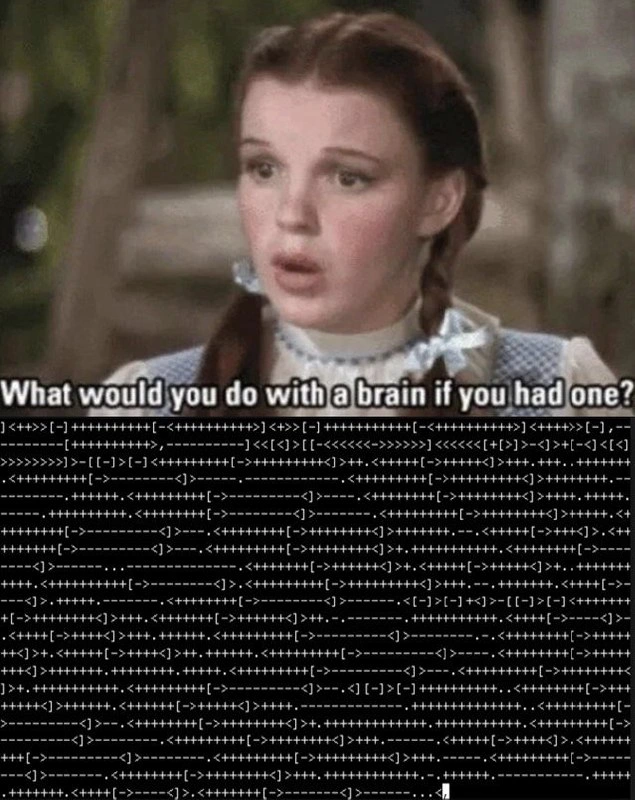
In the pantheon of programming languages, Brainfuck looms as an almost mythological beast – a textbook example of a Turing tar-pit. The term refers to languages that are Turing complete (able to compute anything any other general-purpose language can) but are so low-level and minimalistic that doing even simple tasks becomes an arcane ordeal. Brainfuck was deliberately designed (in 1993 by Urban Müller) with only eight single-character commands (>, <, +, -, ., ,, [ and ]). This tiny instruction set is equivalent in power to a universal Turing machine. In theory, you could implement an operating system or a compiler in Brainfuck – the Church-Turing Thesis assures us it’s possible – but in practice writing anything substantial in it feels like summoning an elder god. The snippet shown in the meme (temp0[-], x[temp0+x[-]]+, temp0[x-temp0-]) hints at how unintelligible even a few lines can become. Real Brainfuck code typically looks like pure line noise (e.g. +++++[-<++++++++>]<. to print one letter). That jumble of brackets and signs implements logic at the level of moving a memory pointer on an array of bytes and incrementing values – essentially manual pointer arithmetic and loop constructs with no helpful syntax. It’s a stark demonstration of the trade-off between machine simplicity and human readability.

Contrast this with the other dragons in the cave: COBOL, SQL, and BASIC each come from an earlier era of computing and have rich, structured grammars. COBOL (born in 1959) was one of the first high-level languages and was intentionally verbose and English-like, making it a behemoth in code size but easier for humans of the day to read. It introduced the idea that code could almost read like a business memo (e.g. ADD HOURS TO TOTAL GIVING SUM.) – a far cry from Brainfuck’s cryptic tape manipulations. SQL, conceptualized in the 1970s from relational algebra, took a declarative set-oriented approach: you tell the database what data you want (SELECT * FROM Dragons WHERE Age > 1000;) and not how to get it. Under the hood SQL queries can be translated into query plans and optimized by the database engine – a sophisticated dance of relational theory and algorithms – but on the surface it remains (mostly) comprehensible English keywords. And BASIC (mid-1960s) represents an early effort to make programming accessible: it’s a procedural language with straightforward syntax (often line-numbered instructions and simple keywords like PRINT, GOTO). It lowered the barrier to entry for a generation of hobbyists and students, though at the cost of encouraging some poor practices like unstructured jumps (the infamous GOTO 10). These older languages are powerful enough (COBOL and BASIC are Turing complete, SQL is theoretically Turing-complete when extended with recursion or procedural features) but they reside higher on the abstraction ladder than Brainfuck. They provide variables, readable keywords, and in the case of COBOL even self-documenting code style (or at least that was the intent). Brainfuck, by contrast, operates almost directly on memory cells and loops, forcing the programmer to manage every detail much like assembly – it’s essentially a portable assembly language with a perversely minimal syntax.

From a formal language theory perspective, Brainfuck’s simplicity is both its defining feature and its terror. Its entire syntax can be described by a simple grammar where [] forms the only control structure (a loop). With just that, it achieves the full power of unrestricted computation (a Type-0 grammar in the Chomsky hierarchy, meaning it can represent any computable function). This highlights a profound truth of computation: any Turing-complete language can emulate any other – computational equivalence. So in principle, the old COBOL payroll program and a Brainfuck program have the same capability to calculate salaries; the difference is that one would be in a human-readable 500-page source file, and the other would be a mind-bending string of + and - likely stretching to an even more absurd length. The meme humorously casts Brainfuck as the apex predator of this theoretical equivalence – the Titan of obscurity that makes even other “dragons” look tame. It’s the ultimate embodiment of a programmer’s nightmare language: maximal power, minimal mercy for the human reading or writing it. In other words, Brainfuck is a kind of dark mirror to all programming languages, showing what lies at the limit of code minimalism. Every nicety we enjoy in mainstream languages – descriptive variable names, structured control flow, syntactic sugar like Ruby’s unless – is absent in Brainfuck. That giant purple brain-branded dragon represents the raw, unfettered complexity that arises when you strip away all humane design considerations, leaving only the bare bones needed to make a computer perform tasks. The result is both frightening and awe-inspiring to seasoned engineers: frightening because it’s basically write-only code (once written, even the author struggles to understand it later), and awe-inspiring because it proves how incredibly simple the core of computation can be. Brainfuck sits in the same esoteric hall of fame as languages like Malbolge or INTERCAL, reminding us that there’s a gulf between what is computable and what is maintainable.

Description

A complex, multi-layered meme that expands on the 'not equal' operator comparison. The bottom half of the image retains the previous meme's structure: three traditional dragon heads for COBOL, SQL, and BASIC ('<>'), the multi-headed King Ghidorah for modern languages like Java and Python ('!='), the goofy 'Kevin' head for Lua ('~='), and a silly side dragon for Ruby ('unless'). However, a new top layer has been added, dominated by a large, menacing purple and black dragon representing the esoteric programming language 'Brainfuck'. This dragon has a brain icon above its head and a snippet of its notoriously cryptic code is displayed: 'temp0[-] x[temp0+x[-]]+ temp0[x-temp0-]'. This addition reframes the entire joke, suggesting that while mainstream languages have their minor syntactical squabbles, they are all insignificant compared to the sheer, intimidating complexity of an esolang like Brainfuck
Comments

7
Anonymous ★ Top Pick Arguing about '!=' vs '<>' is like debating the color of the bike shed, then Brainfuck shows up on a unicycle, juggling chainsaws, proving you're all arguing in the wrong dimension
  1. Anonymous ★ Top Pick

    Arguing about '!=' vs '<>' is like debating the color of the bike shed, then Brainfuck shows up on a unicycle, juggling chainsaws, proving you're all arguing in the wrong dimension

  2. Anonymous

    Language wars are cute until you trace the nightly batch job and discover it’s a Brainfuck one-liner embedded in a COBOL copybook calling SQL - suddenly the Java hydra feels like clean code

  3. Anonymous

    The architect who convinced the team to write the authentication service in Brainfuck is the same one who insists Kubernetes is "too simple" and maintains a custom orchestrator written in sed

  4. Anonymous

    Brainfuck sits atop the complexity hierarchy not because it's powerful, but because reading it requires the same mental gymnastics as debugging a race condition in production at 3 AM - except the race condition would be easier to fix. Meanwhile, Ruby's 'unless' keyword stands alone in the corner, a monument to syntactic sugar that makes code read like English but makes every other language developer do a double-take during code reviews

  5. Anonymous

    Legacy systems: Dragons you can't slay, just keep feeding gold (maintenance contracts)

  6. Anonymous

    Language wars end instantly when the critical-path service is in brainfuck - the design doc collapses to one word: rewrite (UNLESS it’s the COBOL system underwriting the SLA)

  7. Anonymous

    We’re busy debating whether SQL counts as a language while prod is gated by a Ruby “unless” around a Brainfuck migration - perfect summary of 20 years of enterprise architecture

Use J and K for navigation