Sentenced by a 16-Bit Integer Overflow
Why is this Bugs meme funny?
Level 1: When More Means Minus
Imagine you have a little toy counter that can only go up to 10. You start counting: 8, 9, 10… but if you add one more, instead of getting 11 (because the toy can’t show 11), it flips to a weird result – like it shows a -9 or some nonsense. That’s basically what happened in this joke! The judge gave the biggest punishment possible (like reaching the limit of the counter at 10), and the prisoner cheekily asked for one more day (trying to go to 11). But the “punishment counter” couldn’t handle any more, so it wrapped around and came out the other side as a negative number. It’s as if you filled a cup to the brim and tried to pour one extra drop – the cup overflows. But here the overflow made the punishment do something crazy: it turned into negative years, which is like saying “you’ve already served time we haven’t even counted!” It’s a silly way of showing that when you push something past its maximum limit, it can behave in a totally unexpected (and funny) way.
The reason this is funny is that in real life, punishments don’t just become negative — you can’t serve “negative years”! It’s an obvious mistake. We’re laughing because a very serious situation (a life sentence) turned upside-down into an impossible situation (the guy would theoretically get out of prison immediately, since a negative sentence might mean he’s owed time). It’s like if your game score was so high that the score display couldn’t handle it and suddenly showed a negative number, or if a car’s mileage meter rolled over so far that it looked like the car has “gone backwards” in miles. In everyday terms, the meme is saying: sometimes asking for “just a little more” when something is already at the max can cause a total glitch. And seeing that happen to a stern judge in a courtroom is unexpected and hilarious — it’s a big “uh-oh!” moment that makes even non-tech people go, “That doesn’t look right at all!”
Level 2: One Day Too Many
Let’s break down the technical joke for those newer to coding. In programming, an integer overflow happens when you try to store a number that’s outside the range that a given integer type can represent. Think of an old-fashioned odometer in a car that can only show five digits: it goes up to 99,999, and if you drive one mile more, it “overflows” back to 00,000. Computers have similar limits for numbers. A 16-bit signed integer is a type of variable that uses 16 bits (binary digits) to store a whole number, and “signed” means it can store both positive and negative values. With 16 bits, the range of possible values is limited: from -32,768 up to +32,767 (that’s 2^15 – 1 for the positive max, because one bit is reserved for the sign). If you add 1 to 32,767 in such a system, it doesn’t magically become 32,768 – there isn’t enough bit-length to represent that, so it wraps around into the negatives, landing at -32,768.
Now, an off-by-one error is a very common mistake where a calculation or loop goes one step too far or not far enough by one count. In this meme’s story, the judge’s sentence was at the maximum limit (we can imagine the “max punishment” might correspond to 32,767 days or years – the exact unit isn’t clear, but the idea is the value hit the cap). The defendant cheekily asks for one more day. That single extra increment is the “off-by-one” that the program (or judge’s logic) wasn’t prepared to handle. It’s like a fence that’s just a bit too short – everything beyond the intended boundary slips through. Without proper bounds checking (meaning, without code that guards against going past the maximum value), the system computes a result that doesn’t make sense in the real world: a negative number of years in prison.
In simpler terms, the judge’s “sentence counter” rolled over. The meme uses the number -32,768 years, which is a weirdly specific negative number chosen because it’s exactly what you get if a 16-bit counter tries to go above its positive limit. This negative value is obviously not intended – you can’t serve a negative term in prison! In a computer, though, the number would legitimately be -32768 if the overflow isn’t handled. This is why programmers must be careful with the limits of data types. If you’ve ever heard a programmer talk about a program having a “bug,” this is a prime example of one: specifically an integer overflow bug. It falls under the category of Bugs that can occur when the program’s logic doesn’t account for extreme values.
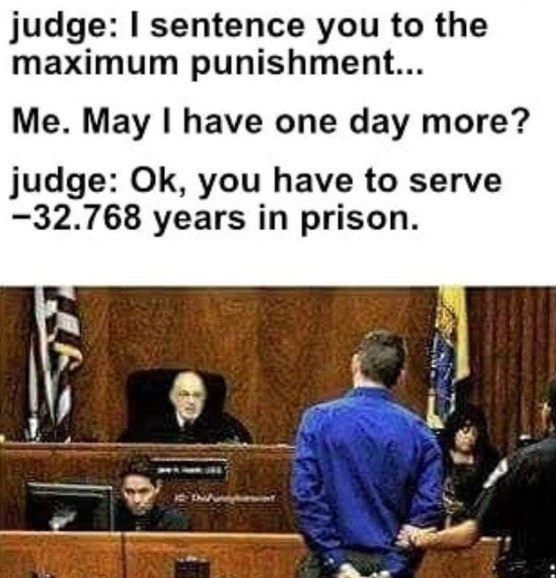
The meme’s format itself – text on top, image at the bottom – sets up a little story. The top text has the judge and me (the defendant) talking. It reads:
judge: I sentence you to the maximum punishment…
Me: May I have one day more?
judge: Ok, you have to serve –32,768 years in prison.
The bottom part shows a courtroom scene with a judge and a defendant, making it look like a real scenario. The humor here is mixing a real-life courtroom with a totally computer-y problem. If you didn’t know about number limits or overflow, you’d just see nonsense: “serve negative years? that’s not possible!” But when you do know, it clicks: the judge is behaving like a program that tried to add one to a maxed-out number and glitched. This kind of DeveloperHumor finds comedy in imagining what if human systems followed the strict rules (and mistakes) of computer systems. It’s also a lighthearted warning: always double-check those signed integer limits and handle your edge cases, or you might end up with outcomes that make no sense. In real coding, that could mean a program crashing or producing wrong results. In the meme, it means a prisoner might hilariously get out of jail because of a math error!
Level 3: Courtroom Edge Case
At this level, we see why developers chuckle knowingly: this meme humorously portrays a software bug in a life-and-death context. The dialogue sets up a scenario where the judge (think of him as a computer program variable) proudly declares “I sentence you to the maximum punishment…” Meanwhile, the cheeky defendant essentially exploits an edge case by asking for “one day more.” This extra day is the perfect trigger for an off-by-one error at the boundary of allowed values. In coding terms, the sentence length was at its maximum value, and the judge’s sentencing system didn’t have adequate bounds checking for an overflow. So when the judge agrees, the counter goes from its max value to an absurd negative number of years. It’s as if the defendant found a loophole in the code of the legal system – a maximum_punishment_bug.
The bottom panel showing a real courtroom image (judge on the bench, defendant in a blue shirt) makes the absurdity even funnier. It’s a familiar meme format to developers: take a serious real-world setting and smash it together with a programming glitch. In this case, the courtroom meme format delivers a punchline only a coder would truly appreciate. The idea of “serving -32,768 years in prison” is ridiculous in a literal sense, but any programmer immediately recognizes the int16_overflow reference. The oddly specific number -32,768 is a dead giveaway – it screams “signed 16-bit integer minimum!” This specificity is what makes it solid CodingHumor: it’s an inside joke relying on a shared understanding of how computers count. Developer culture has countless anecdotes of similar bugs, maybe not in courts, but in code: counters rolling over, health values in games turning negative, or leaderboard scores glitching out after exceeding a limit. Seasoned devs have seen or heard of these, so the meme taps into that shared experience of “Oh, I know exactly what happened here!”
Why is this so relatable (and cringeworthy)? Because off_by_one_error and integer overflow bugs are incredibly common in software development. There’s even a running joke: “There are two hard things in computer science: naming things, cache invalidation, and off-by-one errors.” Here, the judge fell victim to that off-by-one blunder – granting one extra day when the system could not handle one more. Experienced developers have learned (often the hard way) that you must account for extreme limits and edge cases. Forgetting to handle the case of “one past the maximum” is a recipe for a bug, sometimes a security vulnerability, and always a source of TechHumor in hindsight.
In a real software system (say, a prison management program), such a bug could have hilarious or serious consequences. If a prisoner’s remaining sentence days were tracked in a 16-bit variable, giving them an additional day beyond the maximum could wrap the value to a negative. The system might interpret a negative remaining time as “time served” or even a credit, potentially triggering an immediate release or some erroneous calculation. It’s DeveloperHumor gold to imagine a hardened criminal walking free because of a tiny integer overflow bug! Of course, in reality, we use larger data types for such things (modern languages default to 32-bit or 64-bit ints, and many have arbitrary precision), but the principle remains: BugsInSoftware often lurk at those untested boundaries.
The meme also subtly underscores the importance of CS fundamentals in everyday coding. Understanding how data types work (like the limits of a 16-bit short) helps prevent these errors. Seasoned devs might recall debugging sessions where a variable inexplicably “went negative” only to realize it overflowed its type. It’s both a rite of passage and a facepalm moment. Here, we get to laugh at that scenario in a low-stakes, absurd setup. The maximum punishment became ironically its own undoing due to a signed_integer_limits oversight. In short, the meme hits that sweet spot of TechHumor: it’s funny because it’s true – if you don’t account for that one extra increment, your carefully calculated max can roll over and bite you, or in this case, set a prisoner free!
Level 4: Two’s Complement Overflow
At the heart of this meme is a classic lesson in binary arithmetic and the limits of fixed-size data types. Computers represent integers in binary, and a 16-bit signed integer can only store values from -32,768 to +32,767. This range is determined by the two’s complement representation, a fundamental CS_Fundamentals concept. In two’s complement, the most significant bit of a 16-bit number is a sign bit (0 for positive, 1 for negative). So 0111 1111 1111 1111 in binary is 32,767, and adding 1 to it flips it to 1000 0000 0000 0000, which represents -32,768. In other words, 32767 + 1 = -32768 when using a 16-bit signed integer due to integer overflow wrapping around. It’s an arithmetic quirk of working in a finite binary “modular” space (math folks would say we’re doing arithmetic mod $2^{16}$).
We can illustrate this overflow with a quick addition in hexadecimal (base 16), since 0x7FFF is 32,767 and 0x8000 is -32,768 in two’s complement:
0x7FFF (binary 0111 1111 1111 1111) = 32,767
+ 0x0001 (binary 0000 0000 0000 0001) + 1
-----------------------------------------------
0x8000 (binary 1000 0000 0000 0000) = -32,768 (in signed 16-bit)
Notice how the result 0x8000 would normally be a large positive in unsigned math (32,768), but in signed two’s complement interpretation it’s the most negative number, -32,768. The hardware doesn’t signal an error for this in many systems – it’s just how overflow naturally wraps around in binary. The judge in the meme effectively encountered this integer overflow: when he tried to increase the sentence by “one day more” beyond the maximum, the sentence length wrapped around from the largest positive value to a negative value.
This phenomenon is not a bug in binary arithmetic itself – it’s an intended behavior given the fixed number of bits. Two’s complement is designed so that adding binary numbers works uniformly for positive and negative values, at the cost of discarding any overflow beyond the fixed width. If the software (or the judge’s “sentencing algorithm”) doesn’t check for overflow, you get this wrap-around. In real-world computing history, such overflows have caused serious Bugs: from early video game score counters rolling over, to the infamous Year 2038 problem (when a 32-bit Unix time value will overflow), and even critical failures like the Ariane 5 rocket incident. The meme takes this dry concept of numeric overflow and personifies it in a courtroom for comedic effect. It’s a reminder that even the most serious systems (or judges!) must guard against exceeding their signed_integer_limits – otherwise, adding a seemingly harmless “+1” can flip the situation dramatically (quite literally from life in prison to an impossible negative sentence). The humor here is deeply rooted in an appreciation of low-level details: if you know why 32,767 turning into -32,768 is significant, you’re in on the joke.
Description
A meme featuring a courtroom scene below a text-based dialogue. The dialogue reads: 'judge: I sentence you to the maximum punishment... Me: May I have one day more? judge: Ok, you have to serve -32.768 years in prison.' The image below shows a judge at the bench and a defendant in handcuffs. The humor is a classic computer science joke about a 16-bit signed integer overflow. In many programming languages, a signed 16-bit integer has a maximum value of 32,767. When you attempt to add one more to this value, it doesn't become 32,768; instead, it 'wraps around' to the minimum possible value, which is -32,768. The meme cleverly applies this programming bug to a real-world legal sentencing, creating an absurd scenario where asking for more punishment results in a negative sentence, effectively setting the person free
Comments
8Comment deleted
A junior dev sees a clever loophole. A senior dev sees a critical system where the length of a prison sentence is inexplicably stored in a 'short int'
Early release tip: find a courthouse whose COBOL still stores sentence_length as a signed int16 - one off-by-one and you’re paroled 32,768 years ago
This is why we always use unsigned integers for prison sentences - though explaining to the parole board why their system shows you've already served 4 billion years might require a hotfix in production
This is the programming equivalent of asking for a raise and ending up owing the company money. Classic signed 16-bit integer overflow: when 32,767 + 1 becomes -32,768 because two's complement arithmetic doesn't care about your legal system. It's the same bug that made Gandhi go nuclear in Civilization - turns out aggression values and prison sentences both suffer when you don't validate your bounds. The real crime here? Not using a larger data type or implementing proper overflow checks. At least the defendant discovered an exploit for early release through underflow - though explaining 'I'm serving negative time' to the parole board might be challenging
Signed shorts for sentencing: because unsigned would imply parole after 65k years
He asked for one more day past INT16_MAX and the judge did a wrapping_add - legal leniency by way of two’s‑complement time travel
Justice CMS stored sentence length in int16; the +1 day feature request wrapped it to −32,768 years - two’s complement parole, courtesy of legacy APIs and bad domain modeling
Shift right Comment deleted