Sam Altman Tells Satya Nadella 'He Calls Me New Elon' at State Dinner
Why is this IndustryTrends Hype meme funny?
Level 1: Here We Go Again
Imagine you’re at a school talent show and one kid comes up to you, chest puffed out, and says, “My teacher calls me the next Einstein.” They’re basically bragging that someone thinks they’re going to be as brilliant as one of the smartest people ever. You and your friends have heard this kind of thing before, so you just smile politely. It’s kind of funny because everyone seems to say they’re the “next” somebody famous, right? It’s like every kid at the playground claiming they’ll be the next big superhero or the next sports superstar. Hearing it over and over, you start to roll your eyes a little. In this meme’s case, a man at a fancy party is saying someone calls him “New Elon,” comparing himself to a hugely famous inventor. It’s humorous in the same way – it’s big talk that people love to repeat, and the rest of us can’t help but grin because, well, here we go again with the giant claims.
Level 2: The Elon Effect
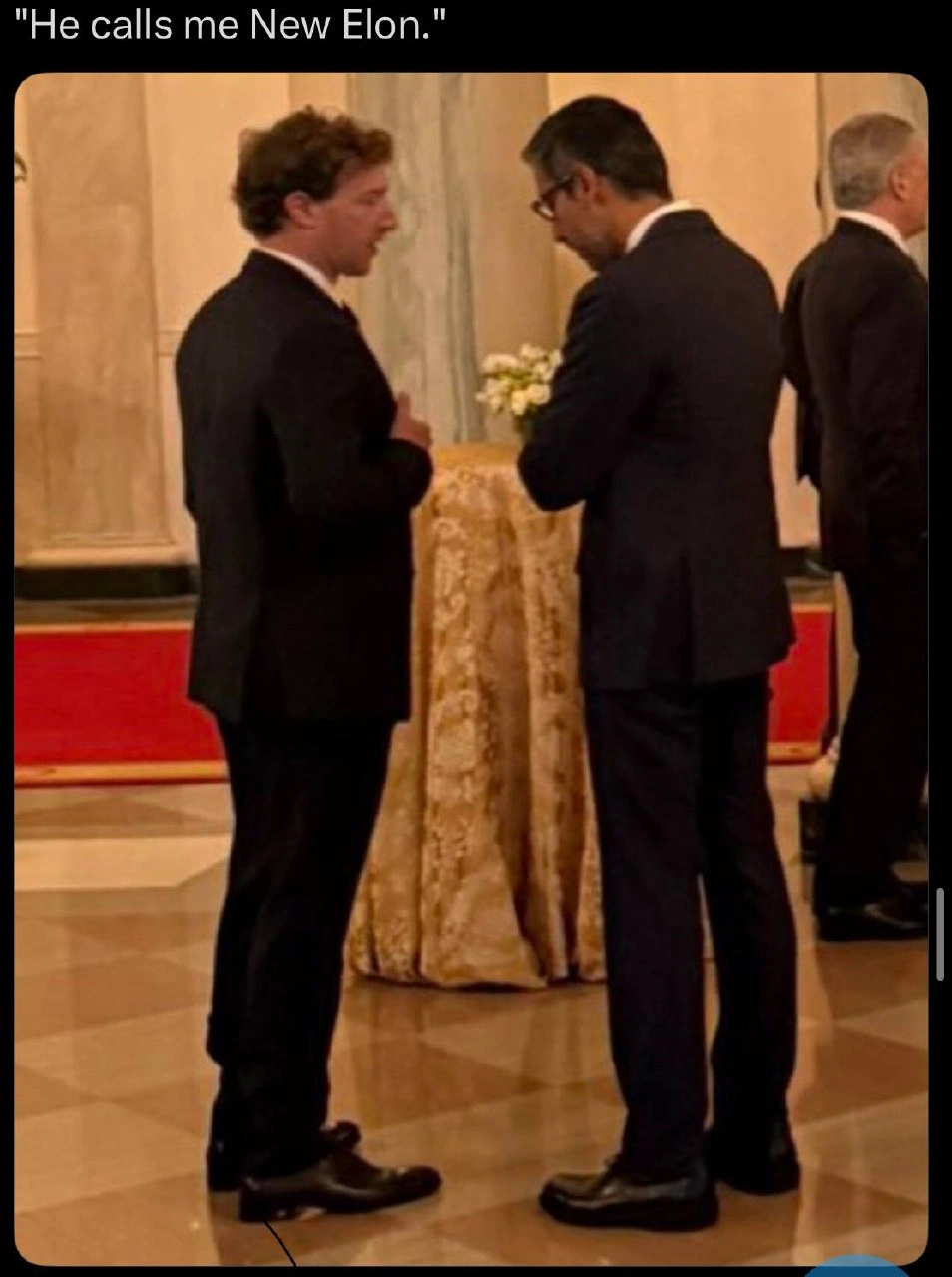
Let’s break down what’s happening in this meme for those new to the tech scene. We have two men in suits at what looks like a fancy networking gala – imagine a high-end cocktail party where startup founders and investors mingle. They’re in a classic networking pose: drink in one hand, business card likely in the pocket, and an over-the-top conversation on tap. The caption at the top says, “He calls me New Elon.” This is the punchline. Here, one founder is bragging that someone (maybe a big-shot investor or mentor) referred to him as “the new Elon” – a reference to Elon Musk, who is one of the most famous tech entrepreneurs in the world.
Why mention Elon Musk? Because in StartupCulture, Elon Musk is seen as a visionary icon – the guy behind Tesla (electric cars) and SpaceX (rocket ships to Mars). Being compared to Elon is supposed to be high praise, implying “I’m as innovative and world-changing as he is.” So when this founder proudly says someone calls him the new Elon, he’s basically patting himself on the back in a huge way. It’s like a kid on a basketball team boasting “Coach says I’m the next Michael Jordan.” It’s a self-esteem boost and a sales pitch rolled into one. He’s signaling: “I have big ideas and leadership just like that famous guy you know.”
Now, the humor here comes from the fact that this kind of bragging is very common (and eye-roll inducing) in the tech industry. The meme is tagged with TechHypeCycle and TitleInflationInTech – let’s explain those. The tech hype cycle is a pattern we see whenever there’s a new technology or trend: first there’s a ton of hype and excitement (people claim it will change the world), then reality sets in when it’s harder than expected, and eventually things level out. This doesn’t only apply to gadgets or software – it can apply to people too. In this context, calling someone “New Elon” is part of that hype. It’s like a trend where each new startup founder gets momentarily hyped up as the next big visionary, often before they’ve proven anything.
Title inflation in tech means giving ourselves fancier titles or comparisons than merited. For example, someone with a tiny startup calling themselves CEO (technically true, but the company might be 2 people in a garage) or a developer with a few months of experience calling themselves “Lead Visionary Officer.” In this meme, the title inflation is the nickname “New Elon.” It’s an unofficial leadership title he’s claiming to impress others. CorporateCulture at flashy events like this often encourages people to talk themselves up. Everyone is a founder or a CEO of something, everyone’s project is “transformative”, and apparently everyone’s friend thinks they’re the next Elon Musk. It’s both a networking strategy and an inside joke in the industry.
So, what’s the real-world translation of this scene? Picture a startup conference or a tech awards dinner. You, a newcomer, might see folks in suits and gowns, clinking glasses of champagne, and hear conversations like:
- “My app is going to revolutionize the way people park their cars – investors are calling us the next Tesla of parking.”
- “Our founder? Oh, people are saying he’s the next Steve Jobs with how creative his vision is.”
These statements sound exciting, but they’re often hyperbole (exaggeration). The meme pokes fun at this because experienced tech workers have heard it a million times. Every year there’s a “hot new founder” with big talk, and every year many of those big promises don’t pan out. Startup culture encourages dreaming big – which is great – but it also means there’s a lot of hype (talking something up) before the hard work is done. The line “He calls me New Elon” perfectly captures that blend of ego and optimism. It’s funny to people in tech because it’s such a trope (a common theme) at this point.
The visual details add to the joke as well. The men are in formal attire at a glitzy event, which tells us this is a high-level networking scenario – not two engineers casually chatting over coffee, but likely founders or executives trying to impress each other. The fancy red carpet, big columns, and elegant flowers all scream “prestige”. It’s the kind of environment where saying something grandiose, like being compared to a famous leader, is part of the game. The faces are blurred because it’s not about who these specific people are – it suggests that honestly, this could be any pair of guys at a dozen tech events. The meme’s author is basically saying: “Here we go again, another startup guy crowning himself as the next big visionary.” In other words, the TechIndustryHumor here comes from recognizing this pattern. It’s an inside joke: if you’ve been around tech parties or startup conferences, you’ve likely met someone who compared themselves to Elon Musk (or heard someone introduce a newcomer as “this guy is like Elon”). It’s almost become a running gag among software engineers and startup employees.
To a junior developer or someone new, the key takeaway is: this meme is laughing at ego and hype in the tech industry. The phrase “He calls me New Elon” is a brag, and the scene highlights how common and almost silly that brag can be in certain settings. It’s not mocking Elon Musk himself, but rather mocking how others constantly invoke his name as a benchmark for greatness. The humor lands because the people who actually have to do the work (like engineers) have seen many “next Elons” come and go, and it usually means a lot of talk now and a lot of tough work (or disappointment) later. In simple terms: big talk is easy at a cocktail party, but delivering on those big promises is the hard part. The meme winks at anyone who’s had to smile through an over-the-top pitch and thought, “I wonder if this guy can actually back that up.”
Level 3: Founder Pattern Matching
In the marble halls of startup aristocracy, a familiar drama plays out. Two well-dressed founders huddle over a cocktail table at a tech gala, trading grandiose introductions. One leans in with a smug half-smile and drops the line: > "He calls me New Elon." This single sentence is dripping with the TechHypeCycle and veteran engineers can practically feel their eyes rolling. Why? Because this scenario is an IndustryTrends_Hype classic – the overconfident founder anointing himself with a moniker that compares him to a tech titan. It’s a polished façade (cue the ornate gold brocade tablecloth and red carpet) propping up a well-worn narrative. In high-end networking events, everything shines – marble floors, crisp suits – and so do egos. The blurred faces in the image might as well be any two entrepreneurs from the past decade, because we’ve all met that guy who’s ready to audition for the role of “Next Elon Musk”. It’s startup culture’s version of pattern matching: find a famous visionary archetype, then claim “I fit that pattern, I’m the next big thing.”
This particular combination of elements is humorously too real for seasoned developers. The formal attire and opulent setting set the stage for high-level schmoozing where titles inflate faster than a poorly indexed database under load. The punchline lands because of the contrast: a groomed, self-assured founder proudly relaying that someone (likely an investor or mentor) bestowed upon him the title “New Elon.” To a Cynical Veteran in the room (probably nursing their drink in the corner), this triggers a flashback to every ambitious project pitch they’ve heard at 2 AM deployments. The meme cleverly satirizes how every gala conversation births another self-proclaimed visionary: the next Elon Musk, the next Steve Jobs, the next Whoever-Is-In-Vogue. The industry keeps recycling these lofty comparisons as if greatness is a role to be cast at a cocktail party.
Why is this funny in a darkly humorous way? Because experienced engineers know the gap between vision and reality all too well. They’ve had to build (and rebuild) the dreams these “New Elons” keep pitching. Today’s gala boast is tomorrow’s unrealistic Jira ticket. When a founder brags about being “New Elon,” it usually means by Monday the engineering team will be asked to “pivot and revolutionize” something again. It’s almost algorithmic – call it the ego_comparison_algorithm of tech hype:
def new_elon_factor(pitch):
score = 0
if "revolutionize" in pitch: score += 1
if "world-changing" in pitch: score += 1
if "next Elon" in pitch: score += 100 # Jackpot: major ego boost
return score
conversation = "Our product will revolutionize transport. Investors say I'm the next Elon."
print(new_elon_factor(conversation))
# Output: 102 (hype level off the charts)
In StartupCulture, boasting such a high score might impress gullible investors for a moment, but engineers see a blinking warning sign. It means a storm of scope creep, impossible deadlines, and late-night deploys could be looming. The joke’s on us: we know that when someone self-identifies as a visionary on Elon Musk’s level, we might soon be refactoring a half-baked rocket-launch algorithm in a web app because “Elon runs SpaceX, why can’t we?”
The corporate culture irony here is rich. Tech leadership often idolizes figures like Elon, so much that simply invoking his name is expected to command respect. It’s become a credibility hack in leadership talk: “Our CEO is basically the next Elon” – as if that will magically attract funding or talent. But those of us in the trenches have seen this pattern before. We remember the next Steve Jobs hype of the 2000s, or the next Mark Zuckerberg wave of the 2010s. Each time, insiders quietly chuckle because these comparisons usually signal inflated expectations. It’s the TitleInflationInTech phenomenon: calling a rookie founder a visionary does not a visionary make. In meetings, it translates to grand roadmaps drawn on whiteboards that ignore pesky realities like finite budgets or the laws of physics. The meme’s humor taps into that collective PTSD: a roomful of devs recalling how many “visionary” projects cratered when reality (and maybe a production outage or two) hit.
There’s also an ego economics at play. Investors and media love a good narrative, and proclaiming someone the “New Elon” feeds directly into the tech hype economy. It’s essentially pattern matching in venture capital – investors have an algorithm of their own: Has big audacious goals? Check. Talks about Mars colonization or AI for humanity? Check. Wears a black turtleneck or edgy techno-CEO vibe? Check. If enough boxes tick, boom: “This founder could be the next Elon, let’s pour money in!” For the cynical engineer, it’s both amusing and exasperating because we know that behind each of those grandiose checks is an unchecked code repository waiting to catch fire. When the hype balloon pops (as it often does), who’s left picking up the pieces? Not the gala attendees in tuxedos, but the devs refactoring the entire codebase after the visionary pivoted the business model for the third time this quarter.
Ultimately, the meme hits home because it captures a cycle we’ve all seen: Ego soars high at the gala, reality crashes down in the sprint planning. The line “He calls me New Elon” encapsulates that puffed-up moment of self-importance before the fall. It’s a wry nod to how the tech industry’s hype cycle isn’t just for products and trends, but for personalities too. As a battle-scarred senior dev, you laugh because if you didn’t, you might cry remembering the project where a self-styled Elon 2.0 promised “five nines uptime on launch day”. This meme winks at all of us who have learned, the hard way, that visionary branding and actual execution are galaxies apart – and no amount of gala glitz can bridge that gap when Monday morning comes.
Description
A photo from what appears to be a formal state dinner or gala event showing two men in black suits conversing at a small table with a gold ornate tablecloth. The caption at the top reads '"He calls me New Elon."' The image appears to show Sam Altman and Satya Nadella at a high-profile political event, with the joke implying Altman is bragging about being compared to Elon Musk. The setting includes marble floors, red carpeting, and elegant decor suggesting a White House or similar prestigious gathering
Comments
9Comment deleted
Being called 'New Elon' is like getting a code review that says 'interesting approach' -- it sounds positive until you realize nobody knows if it's a compliment or a warning
The 'New Elon' starter pack: a multi-billion dollar social network, a questionable rebranding, and the deep-seated need for public validation. He's at least two-thirds of the way there
If he’s the “New Elon,” does that mean the burn-rate is denominated in rockets-per-quarter instead of dollars-per-sprint?
When your startup's entire pitch deck is 'We're the Uber of X' but the VCs have evolved to 'We're looking for the next Elon' - because apparently one person simultaneously disrupting automotive, space, social media, and neural interfaces while tweeting through SEC investigations is now the baseline for tech leadership
Being called 'New Elon' by your CEO is the corporate equivalent of a git force push to production on a Friday evening - technically a compliment about your impact, but everyone who understands the implications is quietly updating their résumé and checking their equity vesting schedule
Translation: schedule by press release, rebrand to a single letter, then mandate a ground-up rewrite with no migration plan - please update the error budget accordingly
Sam Altman: the fork of Elon Musk's repo after too many controversial commits
Being dubbed 'New Elon' is basically a feature flag that flips the org to PR-driven development - budgets shift to “AI initiatives,” APIs become “platforms,” and the roadmap turns into a roadshow
bro you don't need antisemitism just be mad at people for their actions it's way easier Comment deleted