Cloudflare Routes 50% of Free Tier US Traffic to EU During Peak Hours
Why is this Cloud meme funny?
Level 1: Free but Far
Imagine you have a free cookie stand in your neighborhood. Every day at lunch time, tons of people line up because, hey, free cookies! đȘ But the stand only has so many ovens and cookies it can bake at once. When too many people show up, the stand has a trick: to keep everyone happy, they send some of the crowd to another kitchen across town to get their free cookie there. So you still get a cookie for free, but you have to take a longer walk (or ride) to a faraway bakery and then come back. By the time you return, you waited longer because of the extra distance. Thatâs basically whatâs happening in the meme. Cloudflareâs free service is like the free cookie stand â it will serve your website data for free. But when the local servers are very busy (lots of websites and users at once), it says, âHmm, letâs use the ovens in another location that arenât as busy.â If youâre in the US and those ovens are in Europe, your data has to travel very far (over the ocean and back) to get cooked and delivered. You still get your âcookieâ (the webpage or content loads), but itâs slower because of the long trip. And if your parents (or a law) said âdonât take my data out of the neighborhood,â well, now it went on a surprise trip abroad â that could be a worry, right? The joke is that when something is free, you sometimes have to take the long way around. In short: with Cloudflareâs free plan, your web traffic sometimes goes on a far journey to get the job done, making it a bit slower â thatâs the little catch behind the free service.
Level 2: Surprise Detour
So what exactly is happening in this Cloudflare routing meme? Letâs break it down in simpler terms. Cloudflare is a big network service that helps websites load faster and handle lots of users (itâs a CDN â Content Delivery Network â with servers all around the world). They have different plans: a Free Plan (which doesnât cost money) and paid plans like Pro, Business, etc. On the free plan, you still get to use Cloudflareâs global network, but there are some hidden limitations. One of those, as we learned, is how they handle traffic when things get busy. Normally, if someone in North America visits your website, Cloudflare will use a server in North America to respond â thatâs nearby, so itâs fast. But when the North American servers are under heavy load (very busy during the day with lots of requests), Cloudflare will sometimes route some of those requests to servers in Europe instead. In other words, your U.S. web traffic takes an unexpected detour across the ocean!
Why does that matter? Two big reasons: speed and data location. First, speed: Sending data farther away introduces more latency, which is the fancy word for delay. Itâs like if youâre in New York and need to get a file from a server â itâs quicker to grab it from Virginia than from Paris, right? The farther the server, the more milliseconds tick by. Usually, CDNs exist to reduce latency by having local servers, but on the free plan Cloudflare is basically saying âour nearby servers are too busy, so weâll use a far one thatâs free.â That can make some requests slower (you might notice pages taking a bit longer or a slight lag). The meme calls it a âtransatlantic coffee breakâ â joking that your data went on a quick trip across the Atlantic Ocean, maybe grabbed a coffee in Europe, then came back, which of course takes some time. If youâve ever run a ping test (which measures round-trip time to a server), youâd see a much higher ping if the server is in Europe versus in the U.S. The post even mentions âanomalous ping jumpsâ â meaning sometimes the ping suddenly is much larger for some requests, which would be a clue that those requests didnât stay domestic.
Second reason, data location: data sovereignty and compliance. These are terms about where your data is allowed to go. For example, some companies or regulations (like Europeâs GDPR privacy law) require that user data stays in a certain region (say, within the EU or within the US). If half of your U.S. traffic is actually being handled in the EU, that could be a surprise problem if you assumed everything stayed in-country. Itâs like you stored some files in a local office for safety, but secretly half of them were being copied and handled in a branch office overseas. For big enterprises, knowing exactly where data goes is a big deal, and they usually pay for guarantees about that. Free users donât get such promises, which is why this is a âyou get what you pay forâ situation.
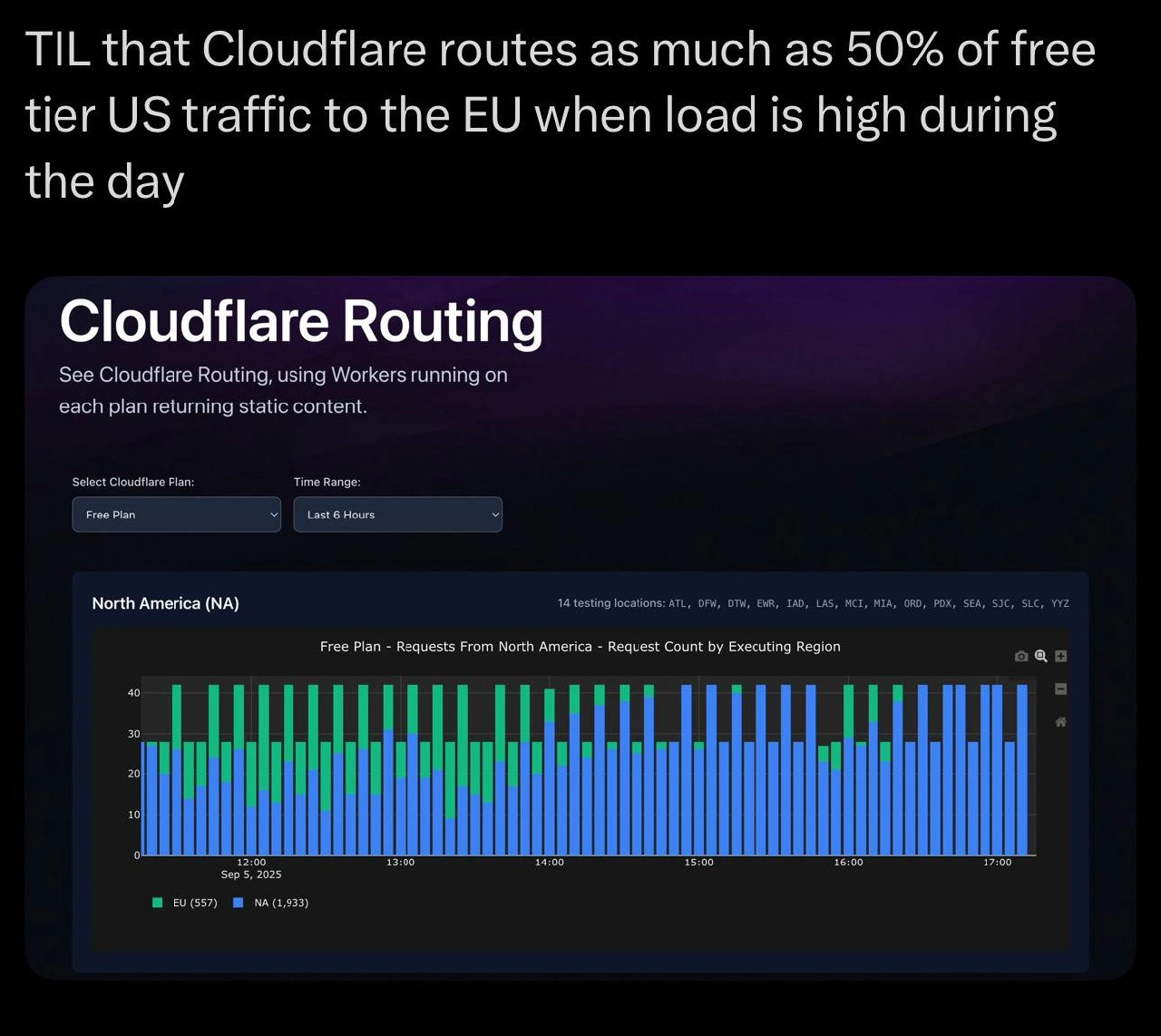
Now, the meme image itself shows a dashboard labeled âCloudflare Routingâ. It has dropdowns for selecting the plan (set to Free Plan) and time range (Last 6 hours), and a chart for âNorth America (NA)â. Each bar in that chart represents requests from NA, split by where they were executed (blue for NA, green for EU). The legend shows something like âEU (557)â and âNA (1,933)â for one of the bars â probably meaning in that specific hour, 1,933 requests ran in NA and 557 ran in EU. We can see many bars are about half green, half blue, which indicates roughly 20-50% of the traffic is green (EU). Geo load balancing in action! Cloudflare was sending a significant chunk of North American visitorsâ work to Europe to be processed. For someone on the Free Plan, this might be eye-opening. If youâre new to cloud services, you might have assumed all your users in the US were served from the US data centers (because thatâs logical for speed). But Cloudflareâs free tier has an internal rule: when things get busy during peak hours, free traffic can be handled by any Cloudflare data center that has capacity, even if itâs in another continent. This is a free_plan_limitation that isnât obvious until you monitor it.
How would you even notice this? Possibly by doing some observability and monitoring of your own. One way is to use a Cloudflare Worker (a little bit of code running on Cloudflareâs edge servers) that reports its location. For example, a worker could return a value like the data center ID that handled the request. Cloudflare data centers each have codes (e.g., DFW for Dallas, LHR for London Heathrow, etc.). A simple script might look like:
// Cloudflare Worker example to reveal the executing region
addEventListener('fetch', event => {
const region = new URL(event.request.url).searchParams.get('region');
// Respond with the Cloudflare "colo" (data center identifier) handling this request
event.respondWith(new Response("Served from: " + event.request.cf.colo));
});
If you run something like that from the U.S. on a Free plan during a busy time, you might unexpectedly see âServed from: FRAâ (Frankfurt) or âServed from: LHRâ (London) in the response, instead of an NA location code. Thatâs basically what the memeâs author did across multiple test locations and times, and then plotted it. It confirms the traffic_spillover: Cloudflare is moving some traffic to EU data centers.
For a junior developer or someone new to cloud networks, the takeaway is: the cloud tries to be smart with traffic, and free services come with hidden trade-offs. Load balancing doesnât just happen within one region â on a global platform like Cloudflare, it can be worldwide. âFreeâ often means youâre not guaranteed the fastest or nearest service at all times. Cloudflare will still deliver your content (they wonât fail outright), but if youâre not paying, theyâll use whatever part of their network is available. This keeps things running smoothly for everyone overall, but your individual request might occasionally take the scenic route. Itâs a bit like taking a free shuttle bus that, when it gets too full, some of you have to take a longer route to the destination. Youâll still get there, but later than those on the direct route.
The meme also has an element of advice: âIf you have weird high ping times for some requests â itâs worth investigating.â In simpler terms: if you notice your website is sometimes slow for no obvious reason, it might be because of something like this, especially if you rely on a free-tier service. The person commenting âSame with Pro and Businessâ suggests that even the lower paid tiers might experience a similar effect (perhaps less frequently or to a lesser extent), implying this routing policy isnât just for Free, but anything below the top Enterprise plan. The vendorâs strategy here is clear â higher-tier plans presumably get more consistent local service, whereas everyone else shares whatâs available globally.
In summary, this meme is pointing out a Cloud Infrastructure quirk in a funny way: Cloudflareâs free plan can send your U.S. traffic all the way to Europe during peak hours, which might slow things down and cause data location concerns. Itâs a lesson in reading the fine print of services and understanding how networking decisions can impact performance. As a newcomer to these concepts, remember that when something online is free, thereâs usually a reason. Here, the reason is that Cloudflare will optimize for cost on their side â by using any server anywhere â which might not always align with the optimal outcome for you or your users. Keep an eye on such details with good monitoring, and you wonât be caught off guard by an Atlantic-sized detour.
Level 3: Free Tier Fine Print
This meme hits home for every veteran of cloud infrastructure: it humorously exposes the fine print of âfreeâ services. The imageâs text reveals a dirty little secret: Cloudflareâs free plan will quietly route up to half of U.S. traffic to European data centers during peak hours. In other words, if youâre not paying, your packets might go on an international adventure. Why is this funny (in a painful way)? Because itâs a classic âyou get what you pay forâ scenario that weâve all seen before. Seasoned devs immediately recognize the implications: increased latency (your data takes a cross-Atlantic coffee break, adding an extra few dozen milliseconds or more), possible compliance headaches (uh oh, user data that was supposed to stay in the US just took a vacation to the EU without a passport), and the general reality that free-tier customers are second-class citizens in terms of resource priority. The chart in the meme â blue bars (NA) and green bars (EU) for North Americaâs traffic â visually confirms what the text says: during busy daytime hours, Cloudflare is effectively doing geo load balancing across continents. Half of those requests that originated in North America are being executed in Europe (the green portions). This is the hidden cost of âfreeâ: Cloudflare wonât drop your traffic when NA servers are overloaded, but theyâll bounce it to wherever capacity exists, even if thatâs an edge server an ocean away.
From a cloud architecture design perspective, itâs a pragmatic solution. Cloudflare runs a huge edge network with PoPs (Points of Presence) all over the world. Paying customers likely get assured performance and regional preferences, but free and maybe even mid-tier Pro/Business customers? They get a best-effort service. When North Americaâs edge locations (like ATL, DFW, LAX, etc. listed at the top of the dashboard) are swamped at noon, the system says, âAlright, free-tier requests, take the next flight to Europe.â Itâs essentially traffic spillover: an overflow mechanism to handle load without adding cost. Experienced engineers have seen similar patterns â like CPU throttling or task offloading â where lower priority work gets shifted out or delayed to keep the system stable for higher priority tasks. Thatâs exactly whatâs happening here: free_plan_limitations in action. Cloudflare is prioritizing its resources for those who pay (and ensuring overall reliability) by making free-tier traffic nomadic.
The humor also comes from the nonchalant tone: âToday I learned Cloudflare routes up to 50% of free tier US traffic to the EU when load is high.â Itâs presented like a trivial fun fact, but anyone who has managed production systems feels the subtext: âGood luck explaining to your boss why your appâs response times spiked at lunchtime â your free CDN was quietly sending requests 4,000 miles away.â The meme is a gentle jab reminding us that Cloud services always have a catch. Sure, Cloudflareâs free CDN and even their free Workers (serverless functions at the edge) are amazing deals â until you hit an edge case (pun intended) like this cdn_edge_case. Then you realize youâre not getting the performance optimization you assumed. Itâs a shared story of developer life: the small print of a platform biting you at scale.
In practice, engineers monitoring their apps (observability is key) might have noticed odd ping times or slow requests at certain times of day. The postâs message even advises: if you see strange latency spikes on random requests, maybe investigate this routing issue. It resonates because many of us have chased ghost problems, only to find a vendorâs âfeatureâ or limit was the culprit. This meme essentially says: Cloudflare free tier is awesome, but donât be shocked when it offshores your traffic without telling you. The âtransatlantic coffee breakâ phrasing jokes that your data is literally taking a coffee break in Europe â implying a leisurely, unintended layover â instead of being a quick errand down the street. Seasoned devs smirk at this because itâs a scenario of free_tier_tradeoffs we know too well: you saved money, but at the cost of consistency and maybe legal simplicity. Itâs funny because itâs true â and itâs better to laugh than cry when you realize half your user requests detoured through Frankfurt or Amsterdam. The memeâs dark humor hides a real lesson about cloud performance: always read the fine print (or measure things yourself), because that âFree Planâ may come with strings attached, like an intercontinental game of networking roulette.
And letâs not ignore the data_residency_surprise aspect. In an era of GDPR and data sovereignty, companies pay Cloudflare for features that guarantee regional handling of data. Free users⊠well, they get whatever server is available. If you promised your users or compliance team that âall our data stays in the US,â and you were on Cloudflareâs free tier, surprise! đ€Ą Thereâs a non-zero chance some of it went overseas. Thatâs the hidden punchline only a grizzled engineer would immediately sigh at â because theyâve learned (often the hard way) that âfreeâ cloud services are free like a puppy: you still deal with the consequences. Ultimately, this meme is a nod to the cloud architecture insiders: it wraps up a real production quirk (Cloudflareâs cross-ocean load balancing) in a one-liner that says TIL (âToday I Learnedâ), inviting others to commiserate. Itâs both a cautionary tale and a badge of honor to know about it. As the meme suggests, âyou may not pay Cloudflare in dollars on the free plan, but youâll pay in other waysâ â whether thatâs latency, performance hits, or hidden complexity. Cue the collective knowing chuckle from the senior dev crowd, likely followed by someone muttering, âTime to convince the boss to budget for Pro plan⊠or at least monitor this more closely.â
Level 4: Anycast Overflow Algorithm
At the network architecture level, Cloudflareâs traffic routing is a dance of anycast BGP and dynamic load allocation. Cloudflare announces the same IP addresses from data centers worldwide (using anycast), so a userâs request normally reaches the geographically closest edge server. However, when a region (like North America) is saturated with requests â especially low-priority ones from the free plan â the global load-balancing algorithm kicks in. Think of it as overflow routing: the system intentionally directs a chunk of traffic to less loaded regions (e.g. Europe) to prevent meltdowns in the busy datacenter. This is akin to multi-queue scheduling in an OS: if one CPU core (NA region) is maxed out, tasks get punted to another core (EU region) to keep things running. The math is straightforward in principle but brutal in effect: sending bits across the Atlantic introduces a hard floor on latency due to the speed of light (~60-100ms one-way). No matter how optimized Cloudflareâs edge network is, physics wonât budge â a request offshored to Europe must hop thousands of kilometers of fiber. The result? A graceful degradation strategy: free-tier requests still get served (nothing crashes), but by taking an intercontinental detour they pay a latency tax. In academic terms, Cloudflare is trading off tail latency for overall system throughput and prioritization. The algorithmic goal is clear â preserve capacity for higher-tier customers locally, while spilling over excess free traffic to wherever global capacity exists. Under high midday load, the system might settle into a roughly 50/50 distribution: half the free-tier traffic served locally, and half handed off to a transatlantic data center. This isnât random; itâs an engineered equilibrium between queueing theory and cost management. Essentially, Cloudflare treats its entire worldwide network as one giant resource pool, applying a policy (likely a mix of priority queuing and adaptive routing) that says: âIf North America is too hot, send some of the workload to Europe where itâs cooler.â The beauty (and horror, if youâre a user) of this global scheduling is that itâs completely transparent to the application â the DNS resolution and IP donât change, but under the hood your requestâs executing region might switch mid-day based on dynamic algorithms. Itâs a clever solution to maximize free-tier capacity, grounded in distributed systems principles. But itâs also a reminder that you canât outrun physics or policy: the transatlantic hop introduces inevitable delay, and if your app assumed all requests run nearby, well⊠surprise! The latency optimization for paid users is achieved by making free users quietly take the long way around. Cloudflare has essentially encoded âyou get what you pay forâ into routing math â a prime example of how complex load balancing algorithms and network protocol tweaks (like BGP path prepending or internal redirect strategies) implement business priorities. In short, the free-tierâs secret traffic-spillover mechanism is a masterpiece of global systems engineering, ensuring reliability through controlled inefficiency. Itâs an algorithmic trade-off: preserve core performance for some by slightly sacrificing it for others, all invisible unless youâre measuring closely. And indeed, seasoned engineers measure everything â which is how this came to light via the observability of that dashboard.
Description
A post with the text 'TIL that Cloudflare routes as much as 50% of free tier US traffic to the EU when load is high during the day'. Below is a screenshot of a 'Cloudflare Routing' dashboard showing Workers running on each plan returning static content. The dashboard displays a bar chart titled 'Free Plan - Requests From North America - Request Count by Executing Region' with data from 14 testing locations (ATL, DFW, DTW, EWR, IAD, LAS, MCI, MIA, ORD, PDX, SEA, SJC, SLC, YYZ). The chart shows time range from Sep 5, 2025, 12:00 to 17:00, with green bars (EU: 557) and blue bars (NA: 1,933) stacked, clearly showing significant EU routing for North American requests during daytime hours
Comments
11Comment deleted
Cloudflare's free tier: where your US users get a complimentary 100ms transatlantic vacation for every HTTP request during business hours. GDPR compliance included at no extra charge
Cloudflare's free tier has a unique feature: it helps your US users experience European culture by giving their data packets a brief, high-latency vacation abroad
Nothing says âfree tierâ like discovering your Round-Trip Time includes an actual round trip across the Atlantic - sadly, your RUM dashboard still canât redeem those frequent-flier miles
Nothing says 'free tier' quite like your Virginia users getting served from Frankfurt during lunch hour - because apparently GDPR compliance is easier when half your US traffic already lives in the EU anyway
Ah yes, the classic 'free tier' experience: your US users getting their content served from Frankfurt because Cloudflare's capacity planning apparently involves a transatlantic game of hot potato during business hours. Nothing says 'globally distributed CDN' quite like adding 80-100ms of latency when your North American edge nodes are too busy. It's the infrastructure equivalent of being told 'you get what you pay for' - except they're showing you the receipts in real-time with a nice bar chart. At least they're transparent about routing half your traffic across an ocean; most providers would just let you wonder why your TTFB suddenly looks like you're hosting on a Raspberry Pi in a submarine
On the free tier, ânearest edgeâ apparently means ânearest capacityâ - often somewhere in the EU - perfect if your SLO is eventual locality
Free tier edge computing: where 'low latency' means optimizing for Cloudflare's costs, not yours - hello, 100ms Atlantic detour
On Cloudflareâs free tier, âedge computeâ sometimes means âa different continentâ; anycast + capacity steering quietly swaps NA for EU and your p95 becomes a geography quiz
ah i have an cloudflare worker to keep an eye on uptime and it keeps switching region so im not suprised lol Comment deleted
Worth noting, does it happen vice versa too? Like, a high load traffic is in the EU region, and Cloudflare routes them to US. Comment deleted
what why Comment deleted