A Hacker's First Bedtime Story: SQL Injection for Babies
Why is this Security meme funny?
Level 1: Nerdy Lullaby
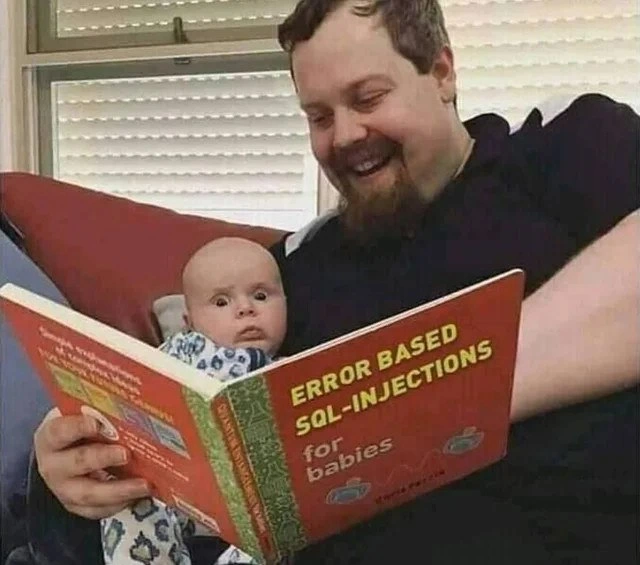
Imagine your bedtime story is supposed to be Goldilocks and the Three Bears, but instead, your dad starts reading from a guide on how to hack a computer database! That’s exactly the goofy idea in this picture. A daddy is reading to his baby, which is normally a sweet, simple moment – maybe you’d expect Goodnight Moon or a cute fairy tale. But here the book is about a complicated computer trick (called SQL injection) used by hackers. It’s like if someone read a baby the instruction manual for a spaceship as a bedtime story. The baby doesn’t understand a word – he just stares with big surprised eyes, kind of like “What is happening right now?!” The humor comes from how ridiculous and out-of-place that book is in a baby’s hands. It mixes something very grown-up and technical with something as innocent as a nursery story. In simple terms, it’s funny for the same reason it’d be funny to see a toddler in a business meeting or a kindergartener doing taxes – some things are just way too advanced for babies, and that contrast makes us laugh. Here, the loving dad is sharing his passion (computer security stuff) much, much sooner than the baby could ever handle. It’s a silly storytime surprise, showing how overly eager tech-nerd parents might jokingly try to raise the next super-hacker right from the cradle. And even if you don’t know anything about databases or hacking, you can chuckle at the basic idea: baby’s first bedtime story… is about breaking into computers! How absurd and cute is that?
Level 2: Baby’s First Exploit
Let’s break down the technical stuff and the joke in simpler terms. The meme is built around SQL injections, which are a type of security vulnerability involving databases. Databases are like big electronic filing cabinets where applications store information (like user accounts, passwords, or product data). They understand commands written in SQL (Structured Query Language) – basically sentences like “Select all the records where the name is Alice”. An SQL injection happens when a bad actor (hacker) sneaks malicious SQL commands into places they shouldn’t be, usually through an application’s input. Think of it like this: an application might ask a user for their name and then build a query that says SELECT * FROM Users WHERE name = 'Alice'. But if the app isn’t careful, a hacker could input something wild like Alice' OR '1'='1. If the app naively plugs that into the query, it becomes SELECT * FROM Users WHERE name = 'Alice' OR '1'='1'. The part OR '1'='1' is always true, so suddenly the database is told “give me all the users” – oops! The hacker tricked the system into returning data they weren’t supposed to see.
Here’s a quick illustration in code form of a simple SQL injection scenario:
const userInput = "' OR '1'='1";
const query = "SELECT * FROM accounts WHERE username = '" + userInput + "'";
// The query becomes: SELECT * FROM accounts WHERE username = '' OR '1'='1'
// The condition '1'='1' is always true, so this would return ALL accounts!
In a properly secured application, the developer would either sanitize (clean up) that input or, better yet, use a parameterized query (which keeps data separate from code) so that ' OR '1'='1 is treated as just a quirky username, not as part of the SQL logic. But if they don’t, the input “' OR '1'='1” essentially injects new instructions into the SQL command – hence the term SQL injection. It’s one of the most notorious security vulnerabilities on the web. In fact, it’s so well-known that it's often one of the first things new developers learn to avoid, and it appears in countless programming tutorials and tech jokes.
Now, error-based SQL injection (the specific kind mentioned on the book cover) is like a special flavor of this attack. When an application is configured a certain way, the database might include detailed error messages with information when something goes wrong. For example, if a query has a mistake, the error might say exactly what the mistake was, sometimes revealing things like table names or bits of data. An error-based injection deliberately causes an error that coughs up something useful. It’s a bit more advanced: instead of directly getting the data, the attacker asks the database to do something invalid (like dividing by zero or calling a function with bad input) that produces an error containing the secret info. Imagine if you could ask a teacher a trick question, and in the teacher’s frustrated answer, they accidentally reveal the correct answer to a test – that’s the idea here. Hackers use these error messages as clues to exploiting database errors and piece together sensitive data.
Knowing all this, the humor of the meme becomes clearer. We have a father enthusiastically reading a book titled “Error Based SQL-Injections for Babies.” Of course, there’s no real kids’ book about hacking databases – that’s the joke! It’s parodying those educational baby books (you might have seen things like "ABCs for Future Coders" or the tongue-in-cheek "Machine Learning for Babies"). Techie parents sometimes joke about turning their kids into little programmers or baby coders, but this scenario takes it to a comical extreme by choosing a topic that is highly technical and frankly inappropriate for a baby’s intellectual level. Error-based SQL injection is something you’d learn in an advanced security course or during penetration testing training, not in kindergarten. But here it is, presented with colorful baby-friendly graphics and even two tiny teacup icons to make it look sweet and innocent. That absurd mismatch is exactly why it’s funny. You don’t expect to see words like “SQL-Injection” and “for babies” on the same cover.
Let’s also talk about the characters in the image. The dad (with a magnificent beard and a big grin) looks excited and proud, like he’s sharing a beloved fairy tale. This could be a nod to how passionate developers are about their field – we often light up when explaining tech concepts we love, even if the audience (in this case, a literal baby) has no clue what we’re saying. It’s a playful jab at ourselves; how we can get so deep into tech humor that we’d even try to make it a bedtime story. The baby on his lap has a hilariously wide-eyed stare, almost breaking the fourth wall, as if to say, “Are you guys seeing this?!” It’s the perfect “I have no idea what Dad is talking about” face. Even though babies can’t actually understand any of this, the photo captures a moment that every parent recognizes – reading to a child – but the content is completely off-the-wall for that context.
The Security and Database themes in the meme connect to real concerns developers deal with. By joking about teaching these to a baby, it indirectly emphasizes how important and fundamental they are (since we jokingly assume they should be taught from day one of life!). It also lightly mocks the idea of the “genius baby” — you might brag your toddler is learning numbers, but here we tongue-in-cheek pretend a baby is mastering database exploits. Essentially, it’s making fun of both the complexity of these tech concepts and the sometimes overzealous ways tech folks approach learning. After all, learning in real life starts with simple things like “A is for Apple,” not “A is for Authentication Bypass via SQL Injection.” This stark contrast delivers the laugh.
Lastly, for a newbie developer (or anyone outside the tech bubble), if you explain the elements: a parent, a baby, and a ridiculously advanced topic in a picture book format, the absurdity is pretty clear. It’s saying: What if we treated hardcore computer security lessons like a nursery rhyme? Clearly, that’s a silly idea – and that silliness is exactly why people are sharing this meme. It’s a gentle poke at both parenting and programming – two worlds that don’t usually overlap in this way – and it resonates especially with those of us who know just how out-of-depth a baby would be hearing about SQL syntax errors at bedtime.
Level 3: Little Bobby Tables
For seasoned developers and security engineers, this image hits on multiple layers of developer humor. The scene immediately calls to mind the famous “Little Bobby Tables” comic from XKCD – where a mother names her child Robert'); DROP TABLE Students;-- and the school’s database gets wrecked because it wasn’t prepared for that input. In that classic joke, a child (innocently) causes an SQL injection havoc just by having a maliciously formatted name. This meme channels that same absurd idea of children and database exploits colliding. Here we have a beaming dad, presumably an infosec professional, reading a bedtime story about error-based SQL injection exploits to his wide-eyed baby. The book cover is styled just like those bright, chunky children’s books, complete with cute teacup illustrations and the subtitle “for babies,” which makes it ridiculously incongruent with the topic of SQL injection. This contrast is the heart of the humor: it’s infosec parenting taken to a comical extreme.
Why is this so funny (and a tad relatable) to veteran devs? Well, anyone who’s been on the front lines of web development or security has likely battled SQL injections or at least been trained thoroughly to avoid them. It’s a running joke in the industry that despite all our modern frameworks and ORMs, someone somewhere still manages to build a login form with string concatenation and no input sanitization, leaving a door wide open for ' OR '1'='1 to log in as admin. Security vulnerabilities like this are so common that they feel almost folkloric – passed down as cautionary tales to each new generation of programmers. The meme exaggerates that notion: instead of teaching juniors during onboarding, this dad isn’t even waiting until the kid can talk! He’s starting at the diaper stage. It’s a cheeky nod to the idea that perhaps we should be teaching secure coding and SQL injection prevention as early as possible, given how persistent these bugs are.
There’s also an element of self-parody in tech culture here. Many developers are passionate about their work to the point of humorously over-sharing. You know the stereotype: the parent who is a software engineer dressing their baby in a “#!/usr/bin/baby” onesie or using programming jokes as lullabies. In reality, tech parents might introduce their kids to coding toys or logic puzzles at young ages – but reading about exploiting_database_errors at bedtime is a hyperbolic twist on that. It ridicules our propensity to project our interests onto our kids. The dad’s expression in the photo says it all: a big proud grin as if penetration testing basics are the new Goodnight Moon. Meanwhile, the baby’s face is meme-gold: eyes wide and staring as if thinking, “Wait… our database has what vulnerability?!” – an expression of comic bewilderment. That look could also be how junior devs feel the first time a senior rants about SQL injections and prepared statements; eyes wide, not quite getting it yet, but aware that something serious is being discussed.
By invoking error-based SQL injections, the meme specifically appeals to those who know the nuances of SQL hacking. Error-based attacks are a classic technique where, instead of directly dumping data via a normal output, the attacker uses verbose error messages to extract data. In practice, it’s one of the trickier SQL injection methods (often a step beyond the basic ' OR '1'='1 trick taught in Security 101). So the book title is oddly specific — that’s part of the joke. It’s like saying “We’re not just teaching baby the alphabet, we’re teaching them a very particular database exploit technique.” This specificity makes the scenario even more absurd. It’s akin to imagining a children’s bedtime book titled “Advanced Tensor Calculus for Toddlers” – hyper-niche and comically out-of-place. Developers steeped in security lore recognize that specificity and chuckle because it shows the meme-creators know their stuff: they picked a real exploit type to put on the cover. It’s an inside joke for the InfoSec crowd wrapped in a wholesome family photo.
Finally, on a meta level, the meme pokes fun at our industry’s eternal learning curve. There’s so much to learn (and so many ways to fail) that one might jape, “Start ’em young, or they’ll never catch up with all the pitfalls!” It satirizes the fact that even something as mature as SQL (around since the ’70s!) still has common pitfalls that we’re teaching and re-teaching. The juxtaposition of Learning and Security here is brilliant: it’s literally learning about security at an age when most of us were learning Peekaboo. Seasoned devs find that hilarious and maybe just a tiny bit cathartic – considering how many late-night hours have been lost to patching injections, it’s nice to laugh at the notion of a future where babies raised on “hacker nursery rhymes” might finally put an end to those 3 AM SQL injection fire-drills.
Level 4: Cradle to Root
At the deepest technical level, this meme touches on the fundamentals of SQL injection vulnerabilities and how they exploit the very way databases process queries. SQL (Structured Query Language) is the lingua franca of databases, and an error-based SQL injection is a crafty technique where an attacker intentionally triggers verbose database errors to glean sensitive information. It relies on the DB engine acting as an unintended oracle: by causing a syntax or type error in a query, the resulting error message might spill the beans about the database’s structure or contents. This is possible because traditional SQL query processing doesn’t inherently distinguish between code and data – an input like O'Hara needs careful handling, or else O'Hara can accidentally break out of a query string and execute as SQL code. The core issue is unsanitized input flowing directly into query text, allowing malicious payloads to be parsed as commands.
In theory, computer science has robust solutions for separating code from data (e.g., using prepared statements or query parameterization), but in practice developers still sometimes concatenate strings to build queries. This leaves cracks for attackers to slip in '; DROP TABLE users;-- or more subtle payloads. Error-based injections are an advanced variant: for example, an attacker might append a snippet like ' AND (SELECT 1/0 FROM dual);-- to a query. The division-by-zero causes a database error, and if the error message includes part of the injected expression (some SQL engines do reveal details), the attacker gains one piece of the puzzle – perhaps a column name or a data value included in the error text. By systematically probing these errors (like adjusting a query until an error says "Unknown column 'password'"), a skilled hacker can extract information one clue at a time. It’s a bit like cracking a safe by listening to the clicks – each error message guides the next step.
From a historical perspective, SQL injections have been plaguing web applications since the late 90s and remain on the OWASP Top 10 list of security risks to this day. They’re so prevalent that one might jokingly say we ought to start training developers about them from infancy – hence the absurd notion of teaching a baby about error-based exploit techniques. There’s a tongue-in-cheek logic here: if our industry still struggles with preventing basic injection attacks after decades, maybe the next generation should learn these concepts literally in the cradle. It’s a playful exaggeration of the Learning curve in security. The title “Error Based SQL-Injections – for babies” satirically invokes those real-life board books like "Quantum Physics for Babies" or "Rocket Science for Babies", but swaps in a Security topic that’s arcane even for many professionals. This juxtaposition tickles veterans because it points to a truth under the joke: the earlier you grasp secure coding principles (like not trusting user input), the safer your software will be. In security parlance, knowledge is power – or in this case, powerful enough to SELECT * from the cookie jar. The meme cleverly transforms a hardcore penetration testing concept into a nursery rhyme setting, implying a future where baby’s first words might be “DROP DATABASE”. It’s a lighthearted take on how deeply ingrained in tech culture these exploits have become that we joke about passing them down as bedtime lore.
Description
A humorous photograph showing a smiling, bearded man sitting on a couch and reading a book to a very young baby. The baby, sitting in the man's lap, has a wide-eyed, slightly alarmed expression. The humor is revealed by the book's bright red cover, which reads in large yellow letters: 'ERROR BASED SQL-INJECTIONS for babies'. This meme plays on the absurdity of teaching an infant a complex and malicious cybersecurity topic as if it were a simple children's story. It satirizes the push for early technical education and resonates with developers, particularly those in cybersecurity, who appreciate the dark humor of introducing a baby to database vulnerabilities. The baby's shocked face perfectly captures the appropriate reaction to learning about unsanitized user inputs
Comments
7Comment deleted
And the little query said, '... or 1=1; --'. The baby, having not yet learned of parameterized statements, was horrified. The end
Teaching her to SELECT from information_schema before she can crawl - because by the time she walks, product will have shipped three more string-concat queries to prod
After 20 years of explaining to junior devs why Bobby Tables is a cautionary tale, not a tutorial, you realize the only way to truly fix SQL injection is to start the education before they can even type SELECT * FROM users WHERE 1=1--
Starting them young on SQL injection? Bold parenting choice. By age two, they'll be sanitizing inputs in their sleep and lecturing you about prepared statements during diaper changes. Though I suspect the real lesson here is that even babies know the look of horror appropriate when encountering unsanitized user input in production code
If your prod still concatenates queries and returns verbose stack traces, a toddler armed with UNION SELECT will outgrow your WAF by nap time
Error-based? Perfect for when baby's verbose errors spill the entire schema
Bedtime reading: Error‑Based SQL Injection - start them young on the idea that error messages are side channels and prepared statements are pacifiers