Skip to content
DevMeme
1703 of 7435
When A Patch Was Literal
TechHistory Post #1904, on Aug 12, 2020 in TG

When A Patch Was Literal

Why is this TechHistory meme funny?

Level 1: Fixing the Recipe Card

This is like having a recipe written on a long strip of paper, finding one wrong step, taping over that part, and writing the correct step on top. Today programmers fix mistakes by changing files on a computer. In this old example, the program itself was something you could hold, tape, and punch holes into, which makes the word "patch" feel surprisingly literal.

Level 2: Programs Were Physical

Early computers often used punched tape or punched cards to store instructions and data. Holes represented information that a machine could read. If a sequence had a mistake, the fix could involve physically covering part of the tape and punching new holes in the corrected area.

In modern software, a patch usually means a small change to code. Developers create patches with version control tools, review them, test them, and deploy them. The image is funny because it shows an older version of the same idea where "patching" was not just a metaphor. Someone really did patch the program.

This helps explain why software terms carry old machinery inside them. Words like bug, patch, terminal, and core dump often come from earlier computing environments. A new developer might think patching is purely digital, but the image shows that software has always depended on physical tools, storage media, and people making careful edits under pressure.

Level 3: Hotfix With Holes

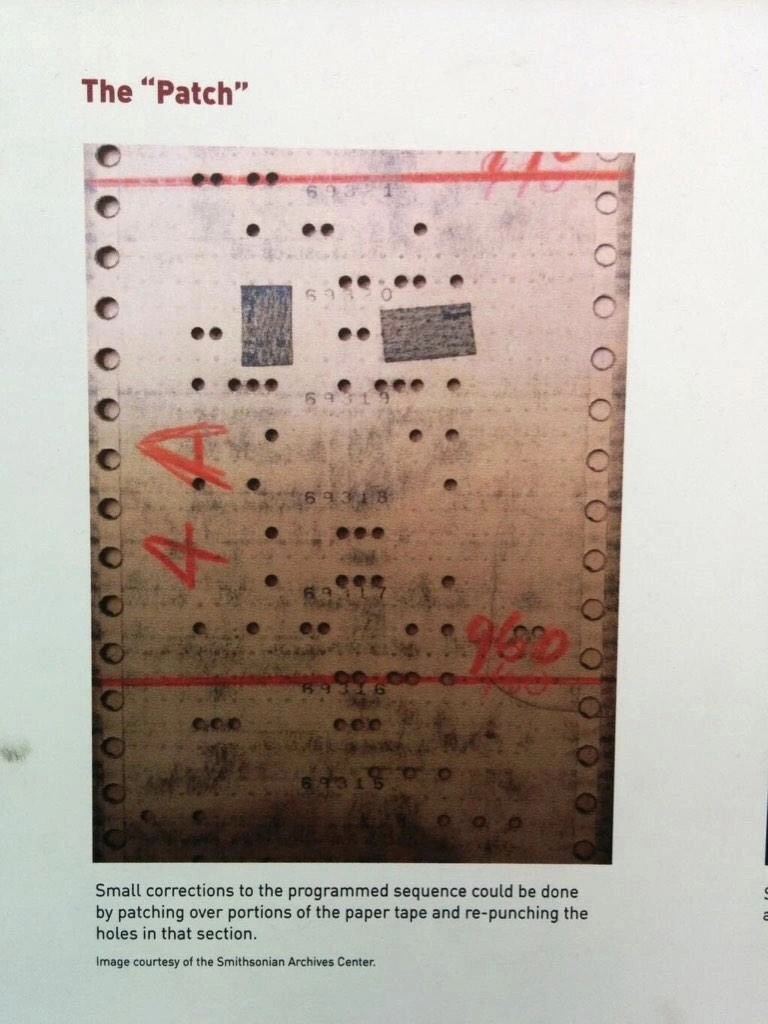
The image title is:

The "Patch"

The caption explains the joke in beautifully antique terms:

Small corrections to the programmed sequence could be done by patching over portions of the paper tape and re-punching the holes in that section.

Modern developers use patch to mean a small software change: a diff, a hotfix, a minor release, a security update, or the tiny commit that somehow requires three approvals and a deployment window. This image shows the word before it became invisible metaphor. The program is a physical strip of punched paper tape. The "patch" is a literal covered section where holes were blocked and re-punched. Software maintenance, at this stage, had office supplies in the critical path.

That is why the meme lands as tech history rather than simple nostalgia. Today, a patch might be git diff, a package update, or a CI-built artifact. Here, the program medium itself carries the instructions, and changing behavior means altering the artifact that the machine reads. Bugs are not abstract entries in an issue tracker; they are wrong holes in the tape. Version control is not a branch; it is the hope that someone kept the earlier strip and labeled it correctly.

The red markings and dark covered rectangles make the whole thing feel like a forensic exhibit from the pre-cloud era, because it is. The picture collapses the distance between legacy systems and present-day software practice. We still patch over bad assumptions. We still make small corrections to long sequences. We still add local fixes to systems whose original authors are unavailable, except now the tape is a build pipeline, a dependency graph, or a YAML file with the temperament of a haunted vending machine.

The historical sting is that the fundamentals have not changed as much as we pretend. A patch is still a compromise between correctness, urgency, and confidence. The medium changed from paper tape to repositories and deployment platforms, but the social problem survived intact: something is wrong, the system must keep running, and the smallest possible change is suddenly the most important piece of engineering in the room.

Description

The image shows a photographed museum-style page titled "The \"Patch\"" above an old strip of punched paper tape with red markings, dark punched holes, and two darker taped-over rectangular areas. The caption below reads, "Small corrections to the programmed sequence could be done by patching over portions of the paper tape and re-punching the holes in that section." A smaller credit line says, "Image courtesy of the Smithsonian Archives Center." The technical humor comes from seeing the word "patch" before package managers, CI pipelines, or hotfix branches: a software correction was once a physical repair to the program medium itself.

Comments

1
Anonymous ★ Top Pick The original hotfix had perfect observability: you could hold production up to the light and see exactly where it broke.
  1. Anonymous ★ Top Pick

    The original hotfix had perfect observability: you could hold production up to the light and see exactly where it broke.

Use J and K for navigation