Parents buy coding board books, three-year-old instantly becomes mini dev prodigy
Why is this Languages meme funny?
Level 1: Baby See, Baby Do
This meme is basically a funny exaggeration of how kids copy whatever they’re exposed to. Imagine parents think that giving their toddler some quirky books won’t do anything – like if you gave a baby a cookbook as a toy thinking they can’t possibly understand it. But in the joke, the baby does pick it up and by age 3 is acting like a tiny master chef! Here, instead of cooking, it’s coding. Mom and Dad gave their little one books with coding language stuff (HTML, CSS, JavaScript, C++ – which are tools to make websites and computer programs). They assumed, “Oh, it’s just cute, he won’t really get it.” Meanwhile, the kid surprises everyone by actually becoming super tech-savvy. In the bottom picture, the three-year-old is shown like he’s already a little developer at a company.
The humor comes from the surprise and irony. Parents say it won’t affect the child, but kids are sponges – they absorb everything! It’s like if you always spoke French around a baby and then one day your toddler says, “Bonjour!” perfectly. Here the toddler’s “second language” just happens to be computer code. It’s funny because it’s so unexpected: normally three-year-olds are finger-painting or learning their ABCs, not writing software. Yet this pretend scenario has a tot who maybe writes his name in HTML tags and plays with code instead of crayons. The emotional core of the joke is the mix of pride and comic absurdity – on one hand it’s saying, “Look how brilliant the kid turned out!” and on the other it’s clearly joking because no real toddler is debugging JavaScript. It’s a lighthearted way to say kids pick up more than you think, and it makes us laugh because the outcome is adorably over-the-top.
Level 2: Little Programmer Primer
For those newer to coding or the joke, let’s break down why this scenario is funny. The parents in the meme gave their three-year-old child a set of baby books that are all about programming. Board books are those thick-paged, durable books meant for babies and toddlers – usually they teach basics like ABCs, shapes, or simple words. In this case, the books are teaching the basics of programming languages. The titles on the shelf are:
- HTML for Babies – HTML stands for HyperText Markup Language. It’s the standard language used to create the structure of web pages. HTML isn’t a programming language that “runs” logic; instead, it uses tags (like
<p>for paragraph or<h1>for a header) to lay out content. An HTML board book might just show things like a big<html>tag and basic words, to introduce how a web page is organized. - CSS for Babies – CSS stands for Cascading Style Sheets. This is the language used to style and design web pages (colors, layouts, fonts). If HTML is the structure (the walls of the house), CSS is the paint and decorations (making it look nice). A baby book about CSS might have colorful examples of how changing a CSS rule can turn text blue or big – obviously simplified for a child.
- JavaScript for Babies – JavaScript is a true programming language that runs in web browsers (and elsewhere, like on servers). It’s what makes a website interactive: responding to clicks, showing alerts, handling forms, etc. JavaScript code looks more like sentences and math combined (for example:
if (name == "Toby") { alert("Hello, Toby!"); }). A board book here is likely just introducing the idea of a<script>and maybe showing some fun example of code. - C++ for Kids – C++ is a powerful compiled programming language used for all sorts of software, from games to operating systems. It’s much more complex in syntax and concept than the web languages above. C++ involves things like
#includestatements,int main()functions, and pointers to memory. Seeing a kiddie book for C++ is intentionally over-the-top – it’s like having a toddler book for advanced calculus. Perhaps it simplifies C++ by just showing the concept of counting with++(the plus-plus is actually an operator that means “add one”).
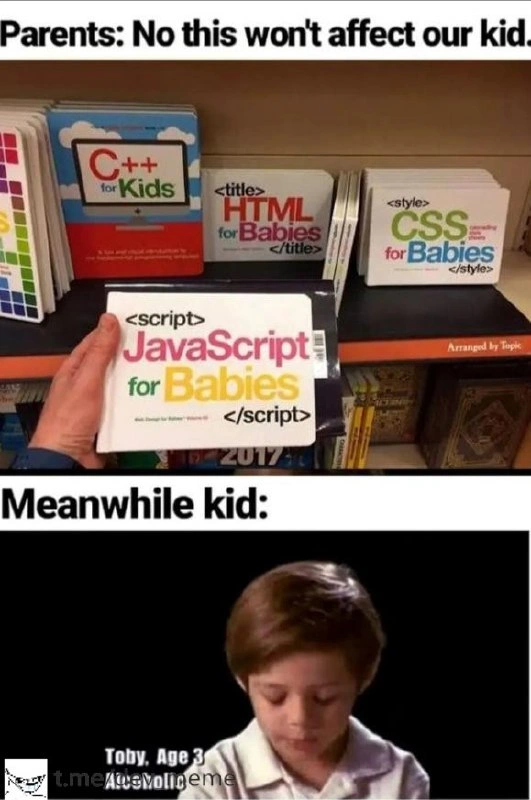
All these books on the shelf are real-looking (and indeed, novelty books like “HTML for Babies” actually exist for geeky parents). The top text, “Parents: No this won’t affect our kid,” implies the parents think giving these tech books is just harmless fun. Meanwhile, the bottom image captioned “Meanwhile kid:” reveals the outcome: the child is now acting like a seasoned tech expert. In the image, we see a small child named Toby (age 3) on a black background, as if he’s being showcased or interviewed, perhaps with a subtitle of his “accomplishment.” The exact subtitle isn’t fully clear from the description, but the idea is Toby might be introduced as something like “Toby, Age 3, Developer Prodigy.” The humor is that the kid has absorbed so much that he’s effectively a mini developer now – a prodigy who can code before he can tie his shoes.
This taps into the LearningToCodeJourney in a playful way. Usually, people start learning programming later in life – maybe in their teens with simple HTML or in college with a language like Python or Java. We all remember how confusing those first lines of code were! The meme jokes that Toby’s journey started practically in infancy. It’s relatable to new developers in that everyone feels a bit like a child when they first encounter code: everything is new, strange words and symbols everywhere (<>, {}, ;). Now imagine literally being a child confronted with code – it’s both adorable and absurd. If you’re a junior dev (maybe just learning JavaScript or C++ yourself), the joke might also ease your mind: hey, nobody’s actually born knowing this stuff! Even Toby, the “mini dev prodigy,” is a fantasy – in real life, everyone has to start from nothing.
However, it also reflects reality in a sweet way: kids do pick up on what’s in their environment. If tech and code are around them (like mom or dad coding on the computer, or geeky books in the nursery), then those things feel familiar instead of scary. We often encourage young people to learn coding now, with kid-friendly tools like Scratch (a visual programming language with drag-and-drop blocks) or toy robots that teach coding logic. So the meme takes that trend and exaggerates it humorously. Parents reading this meme might chuckle and think, “Maybe we should get little Alice a Python board book and see what happens!” Meanwhile, new programmers might joke, “Wow, I feel late to the game – this toddler already knows C++!” It’s a playful take on both parenting and learning in tech. The relatable humor comes from imagining a child who instead of watching cartoons is reading code documentation. And the contrast is clear even in the meme’s text styling: the formal code tags on the book covers versus the everyday setting of a kid’s life. It’s mixing two worlds – early childhood and software development – which rarely overlap, and that mismatch is what makes it funny and memorable.
Level 3: Full-Stack in Diapers
At first glance, this meme humorously suggests a toddler has become a full-stack developer before outgrowing their crib. The top panel sets up classic irony with the parents saying, “No, this won’t affect our kid.” In a bookstore scene, we see chunky board books on a shelf with tongue-in-cheek titles: C++ for Kids, <title> HTML for Babies </title>, <style> CSS for Babies </style>, and <script> JavaScript for Babies </script>. These are actual programming languages – C++, HTML, CSS, JavaScript – being packaged as baby-friendly primers. The parents assume that exposing their three-year-old to code this early is just cute and harmless. The punchline comes in the bottom panel labeled “Meanwhile kid:” where little Toby, age 3 is introduced like a prodigy developer. It’s as if early exposure to code turned the toddler into a mini software engineer. This format parodies the idea of parental expectations vs. reality: the folks thought these geeky books wouldn’t influence their child, but now they’ve accidentally spawned a kid genius in tech.
For seasoned developers, the humor operates on multiple levels. First, there’s the absurdity of a toddler fluent in multiple programming languages – a pint-sized polyglot who can handle everything from low-level memory management in C++ to building web pages with HTML/CSS and scripting with JavaScript. That’s the entire classic web stack plus a systems language, all before preschool! Each of these languages has a notoriously different learning curve. C++ is a compiled language known for its complexity (manual memory management, pointers, a strict compiler, and the joys of segmentation faults). Even seasoned engineers find C++ challenging, so seeing “C++ for Kids” on a cutesy board book is hilariously incongruous. By contrast, HTML and CSS are the bread-and-butter of basic web development – more approachable, since HTML is just structured markup (using <tags> to denote headings, paragraphs, links, etc.) and CSS is styling rules. There are even real-life books like HTML for Babies that just show big colorful tags to familiarize infants with the look of code. The meme riffs on that reality and exaggerates it. JavaScript, enclosed in <script> tags on the cover, is the dynamic programming language of the web. It’s what makes pages interactive, and it can be quirky (any developer who’s experienced NaN !== NaN or "5" - 3 turning into 2 can attest JavaScript has its odd parts). Envisioning a toddler mastering JavaScript’s oddities or using console.log() during playtime is both impressive and comical.
This scenario pokes fun at the modern tech culture of getting kids into coding as early as possible. There’s a real-world trend of early childhood programming: parents buying programming language board books, enrolling kids in coding camps, or giving them STEM toys. The meme cranks that trend to the extreme. It imagines that by age three, little Toby is deploying code to production between nap times. The subtitle likely lists Toby with a fanciful qualification (maybe “Toby, Age 3 – AWS Certified” or “Toby, Age 3 – DevOps Lead”), echoing those TV interviews that introduce child prodigies with their accomplishments. The “Meanwhile kid:” meme format sets up the joke: the parents’ actions absolutely did affect the kid, turning him into the ultimate “junior developer” (literally junior, as in still a toddler!). seasoned devs chuckle because it resonates with how we half-jokingly measure ourselves by how early we started coding. Many of us remember encountering our first programming language in our teens or later, fumbling through basic tutorials. Here, the joke is that Toby’s “LearningToCodeJourney” started with bedtime stories about <html> and <css> before he could even read normal words. It’s taking the often-heard advice “start ’em young” to a hilarious new level.
On a deeper level, the meme highlights the nature vs. nurture discussion in tech skills. Are great programmers born, or made through early exposure? The parents in the meme clearly gave their kid a very nurturing environment for coding – literally stocking the nursery with code. The sarcastic text “No this won’t affect our kid” winks at the fact that kids are sponges. If you surround a child with any language – be it Spanish or Python – they’ll pick it up intuitively. There’s even a subtle nod to how programming languages have to be “learned” just like spoken languages. In fact, HTML/CSS/JS are sometimes called the “languages of the web.” We often quip that children can learn new human languages faster than adults; this meme extends that idea to include programming languages as well. Toby essentially became bilingual – except one of his languages is C++ instead of French. For veteran developers, there’s an extra layer of humor in imagining the practical consequences. What does a three-year-old developer do? Maybe he optimizes his Lego sorting algorithm complexity from $O(n^2)$ to $O(n \log n)$, or insists on daily stand-up meetings with his stuffed animals to go over “blocker” toys. Perhaps Toby’s scribbling pseudo-code in crayon on the walls. This all taps into relatable humor for anyone in tech: we joke about how quickly tech moves and how each new generation seems more tech-savvy, but seeing it taken to literal infancy is ridiculously funny.
Another aspect is the combined Languages, Learning theme. The meme is definitely self-referential for developers: those book titles (<title> HTML for Babies </title>, etc.) are full of inside jokes. Only someone who knows HTML would appreciate seeing the <title> and </title> tags used like quotes around the words “HTML for Babies.” It’s a meta-joke: the book cover itself is written in the syntax it’s teaching. The same with <style> around “CSS for Babies”. It’s implying that even the cover of the book obeys the code format (which, of course, a real baby wouldn’t understand, but the parent who bought the book would chuckle at it). Similarly, the C++ book cover using the ++ might remind devs of increment operators or C++’s reputation. There’s a playful nod here: arranged by topic (as the shelf label says) – indeed, the topic is “programming for infants.” It’s such a niche topic that seeing a whole shelf of baby books on it tickles any programmer’s funny bone. It reminds us of our own early days, except pushed to an absurd timeline.
In summary, at the most advanced level this meme is lampooning the idea of early childhood coding immersion. It speaks to developers who know the landscape of different languages and the push to start coding younger. It brings together shared experiences: discovering HTML for the first time (maybe as a teen, making a “Hello World” webpage) or struggling with a first C++ program – and then imagining a tiny child breezing through those lessons. The humor lands because it’s simultaneously ridiculous and oddly plausible. In a world where tech is everywhere, maybe tomorrow’s coders will start in diapers. For now, though, it’s a hilarious mental image for any programmer: a toddler opening a JavaScript board book instead of a pop-up story, and by age 3 complaining that “you forgot a semicolon, Dad.”
Description
The meme is split into two panels. Top text reads, “Parents: No this won’t affect our kid.” Below that, a bookstore shelf shows chunky board books with tech-themed covers: “C++ for Kids,” “<title> HTML for Babies </title>,” “<style> CSS for Babies </style>,” and a hand holding “<script> JavaScript for Babies </script>.” An orange shelf label says “Arranged by Topic.” The bottom panel caption says, “Meanwhile kid:” and shows a small child on a black background (face blurred) with white subtitle “Toby, Age 3.” The visual joke is that early exposure to programming languages has turned the toddler into an advanced developer, poking fun at how soon developers start learning HTML, CSS, JavaScript, and C++. Technically, it riffs on language learning curves and the culture of teaching code at ever younger ages
Comments
9Comment deleted
Three days after getting those “C++/HTML/CSS/JS for Babies” board books, Toby (age 3) opened a merge request converting nap time into an idempotent Kubernetes CronJob - and wouldn’t drink his milk until the CI pipeline turned green
Poor Toby's already discovered that CSS centering doesn't work like the book said it would, and he's only three years into his career
Ah yes, the classic parental delusion that exposing kids to HTML, CSS, and JavaScript won't have consequences. Fast forward three years and little Toby's already debugging production issues in a three-piece suit, probably arguing about whether semicolons in JavaScript are necessary and why CSS Grid is superior to Flexbox for certain layouts. The real tragedy? He'll spend his teenage years explaining to his parents why 'just center the div' isn't as simple as it sounds, and by 25 he'll be maintaining a legacy jQuery codebase while contemplating the life choices that led him here. The pipeline from 'for Babies' books to existential dread over webpack configs is shorter than most parents realize
Kid’s sleep is now event‑driven: setTimeout(bedtime, Number.MAX_SAFE_INTEGER); implicit coercion turns broccoli into dessert until someone introduces TypeScript at preschool
Toby at 3 already knows the truth: CSS floats don't float, they just summon eternal debugging sessions
Parents: “This won’t affect them.” Kid schedules naps with setTimeout, refuses to share toys because they’re unique_ptrs, and picks outfits using !important
Braindead watermark 🤔👍 Comment deleted
😂😂😂😂😂💀💀💀💀💀 Comment deleted
for such watermarks you should have a separate boiler in hell ... Comment deleted