Linux users smiling at every post - until the joke targets Linux itself
Why is this OperatingSystems meme funny?
Level 1: Not So Funny Now
Imagine you and your friends are joking about different hobbies at school. You giggle when the jokes are about sports you don’t play or characters from other TV shows. It’s easy to laugh because it’s not about you. But then, someone makes a joke about your favorite video game or your most loved cartoon character. Suddenly, you’re not laughing anymore, right? You might feel upset or say, “Hey, that’s not funny!” That’s exactly what’s happening in this meme. The Linux user was laughing at all the other jokes (because they weren’t about him), but as soon as the joke was about the thing he really cares about, he felt bad. It’s a funny way of showing that jokes are fun until they get personal – then it’s a different story. In simple terms: it’s all smiley faces 😄 until the joke points at you, then it’s crossed arms and a frown 😞.
Level 2: The Penguin Paradox
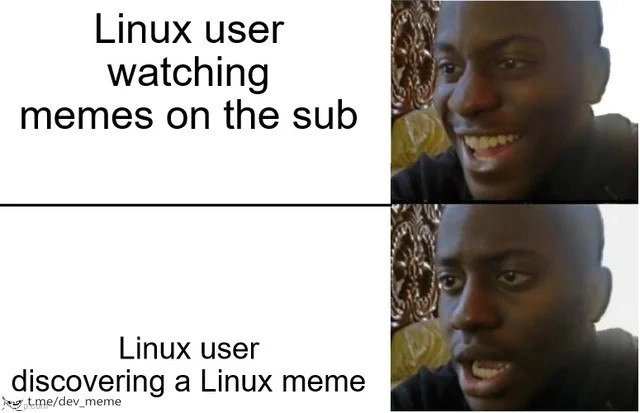
Let’s break down what’s happening. We have a two-panel reaction meme – a popular format where the first panel shows someone’s initial happy reaction, and the second panel shows a not-so-happy reaction after a situation changes. On the left of each panel, there’s text narrating the scenario. The top text says “Linux user watching memes on the sub”, and we see a man grinning ear to ear. “The sub” here likely means a subreddit (an online forum community on Reddit) for programming jokes or tech humor. In other words, a Linux fan is browsing a developer meme page, enjoying all the funny posts. He’s smiling because the memes are poking fun at general topics in tech – maybe a joke about Windows crashing or a programming language quirk – nothing that touches his personal tech choices. Like many folks, he finds these TechMemes entertaining and harmless when they’re about other people’s tools.
Now look at the bottom panel: the text says “Linux user discovering a Linux meme”. The same man’s face has fallen into disappointment; he’s half in shadow, mouth open in a pained “oh no…” expression. This is the classic smile-to-disappointment punchline. The moment he realizes the joke is aimed at Linux (the Operating System he loves), his enjoyment vanishes. Why the drastic change? Because the meme suddenly feels personal. Linux isn’t just any OS to him – it’s his favorite, something he’s proud of. Linux is a Unix-like operating system known for being open-source (anyone can see and modify the code), and it’s a big part of many developers’ identities. There’s even a cute mascot, Tux the penguin, symbolizing the friendly yet nerdy UnixCulture around Linux. Many Linux users belong to tight-knit DevCommunities both online (like a Linux subreddit) and offline, where they share tips, show off custom desktop setups, and bond over their love of this free OS. They’re used to seeing jokes about other systems – for example, poking fun at Windows for getting the “Blue Screen of Death” or teasing macOS for its expensive hardware. Those make them smile because, to a Linux user, it reinforces why they chose Linux (“Haha, glad I’m not dealing with that problem on my system!”).
However, when a Linux meme appears – say a joke about how complicated Arch Linux is, or how someone’s Ubuntu upgrade broke something – the niche_os_jokes suddenly hit their home turf. The meme might be light-hearted, but a passionate Linux fan can feel like, “Hey, you’re laughing at my team now.” It’s similar to how sports fans or gamers react if their favorite team or game is mocked. They feel a need to defend it. In the context of tech, Linux users are often a minority among everyday desktop users (Linux runs on tons of servers and gadgets, but only a small percent of people’s personal computers). So they’re a bit protective of it. They might think mainstream users misunderstand Linux, so a joke at Linux’s expense can rub them the wrong way. It’s DeveloperHumor turning inward, and it sometimes bruises the ego. On forums like the linux_subreddit or other dev groups, you’ll actually see this happen: lots of laughs at jokes about JavaScript or Windows, but a mild outrage or flood of defensive comments if someone makes fun of Linux.
To put it simply, this meme is showing an OS pride phenomenon. Initially, the Linux user is having a great time laughing along with everyone else at generic dev jokes. But when it’s his beloved OS in the crosshairs, he’s no longer laughing. It’s a playful call-out of how biased we can be about the tech we love. We’re happy to joke about others, but we can be hypersensitive about our own choices. The “penguin paradox” is that the very person who believes in open, free technology (often symbolized by a friendly penguin) can close up and get defensive over a mere joke about it! In plain terms, he can dish it out but can’t take it.
Linux user: “Haha, all these Windows jokes are gold! 🤣”
Same Linux user, five minutes later: “Wait… a meme making fun of Linux? Not cool. 😠”
Level 3: Kernel Panic at Humor
On seasoned teams, this meme evokes a knowing smirk: it's highlighting a classic case of tech tribalism. In the world of Operating Systems, every power user has their chosen camp – be it Linux, Windows, or macOS – and a war-story to match. Here we see a Linux enthusiast reveling in general DeveloperHumor on a subreddit, happily chuckling at jokes about other technologies. Why not? Windows crash memes, JavaScript quirks, DevOps fails – it's all fair game. But the moment a meme lands a playful jab at Linux itself, our grinning penguin fan goes stone-faced. The joke suddenly hits a nerve, as if someone found a bug in their identity. This flip from joy to offense is comic gold because it's so true in many DevCommunities: we dish out jokes about others' tech stacks all day, yet we get defensive when the joke targets our own beloved tools. It’s a kernel of truth about human nature inside tech culture – even the famously stable Linux kernel can “panic” when prodded with humor at its expense!
Historically, experienced devs have seen this pattern in every holy war from editor battles (vim vs Emacs) to the browser wars. For Linux specifically, there's a proud UnixCulture dating back to the ’90s: an almost evangelical love for the open-source ethos, the stability of a Linux server, the freedom to tinker with everything from the kernel to your window manager. That pride breeds strong community loyalty. Veterans remember countless forum flame wars where any criticism of Linux – be it “Year of the Linux desktop” jokes or pointing out a rough edge – was met with fiery rebuttals. Why? Because many Linux users wear their OS choice like a badge of honor. They’ve invested countless hours mastering the command line, scripting dotfiles, contributing to open-source projects – so a meme poking fun at Linux can feel like it’s undermining all that hard-won geek credit. The meme cleverly captures this dynamic in a simple two-frame story: Linux user = 😀 when laughing at others, then 😟 when he becomes the target. Any senior developer can recall similar moments on Slack or Reddit – one second the room is laughing at a generic coding joke, the next there’s an awkward silence because someone’s favorite tech just got roasted. It’s equal parts hilarious and painfully relatable: even the most open-source minds can close up when the humor cuts close to home.
Description
Two-panel reaction meme: each panel has black text on a white background at the left and a photo at the right. Top panel text reads "Linux user watching memes on the sub"; the accompanying photo shows a man with a wide, happy grin. A horizontal black line separates the scenes. Bottom panel text reads "Linux user discovering a Linux meme"; the photo shows the same man now looking disappointed, face partially shadowed (blurred here for privacy). Technically, the joke riffs on how niche operating-system enthusiasts eagerly browse general developer content yet feel personally attacked when a meme pokes fun at their favorite OS, poking fun at Linux community pride and sensitivity
Comments
6Comment deleted
Linux fans laugh at every meme - until someone jokes about systemd; then their smile daemon exits with status 1 and they start debating PID 1 purity
It's like finding a perfectly configured dotfile in production - you know it's been battle-tested by someone who actually understands the pain of maintaining a custom kernel patch while your colleagues debate whether to upgrade from Windows 10 to 11
The moment when a Linux user realizes they've become the very systemd they swore to destroy - caught in an infinite loop of meta-awareness, watching memes about watching memes, recursively discovering they're both the observer and the observed in the great /proc/self/meme filesystem of life
That split-second when a Linux meme decodes your .Xinitrc better than strace ever did
Linux memes are the only ones that escalate from ‘lol’ to a 300‑comment postmortem on init systems - with a rebuttal compiled from source using custom CFLAGS
Most memes: > /dev/null. Linux meme: sudo make rant about PID 1, filesystems, and why your laptop obviously needs ZFS