Skip to content
DevMeme
TDD vs. Reality: The Deadline Always Wins
Deadlines Post #71, on Feb 7, 2019 in TG

TDD vs. Reality: The Deadline Always Wins

Why is this Deadlines meme funny?

Level 1: Eating Dessert First

Imagine you're supposed to do your homework before watching TV — that's the rule, and deep down you know it makes your life better. But the show starts in five minutes. So homework loses, every single time, and you sit down smiling exactly like the guy in the bottom picture. That's the whole joke: developers know they should carefully check their work first (the top picture), but when time runs out, "just hurry up and hand it in" suddenly feels like a brilliant plan — right up until tomorrow, when the teacher hands the homework back covered in red ink.

Level 2: What These Terms Actually Mean

  • Test Driven Development (TDD): a workflow where you write an automated test before the code it tests. The test fails (red), you write code until it passes (green), then you clean up (refactor). It forces you to define what "correct" means up front and leaves behind a safety net that catches future breakage.
  • Unit tests / test suite: small programs that automatically check your code's behavior. Run them after every change; if something turns red, you broke it — better to find out now than from an angry user.
  • Deadline: the date by which the feature must ship, frequently chosen before anyone estimated the work.
  • "Deadline Driven Development": not a real methodology — it's the sarcastic name for what happens when the ship date overrides the process. Symptoms: tests skipped "temporarily," // TODO: add tests comments, and a commit at 11:58 PM titled final fix FINAL v2.

If you're junior, here's the experience this meme is preparing you for: in week one someone explains the team's rigorous testing standards. In week six, two days before a release, that same person reviews your untested PR with a single comment: "LGTM, we'll add tests after launch." Nobody adds tests after launch. The meme is funny because the smiling panel is a confession, not a recommendation — the pain it causes shows up a month later, and you'll be the one debugging it.

Level 3: Red, Green, Refactor, Rush

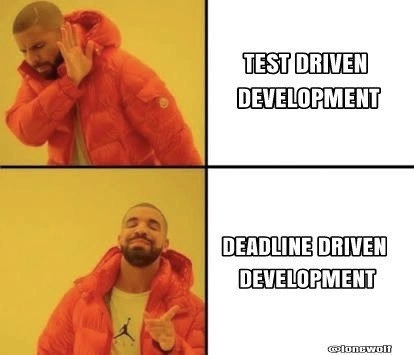
The Drake format is doing precise work here. Top panel: Drake recoils from "TEST DRIVEN DEVELOPMENT". Bottom panel: a serene smile and approving point at "DEADLINE DRIVEN DEVELOPMENT". The joke isn't that developers dislike TDD — it's that the schedule decides the methodology, and everyone in the room knows it while pretending otherwise in the retro.

TDD has a strict discipline: write a failing test, write the minimum code to pass it, refactor, repeat — the famous red-green-refactor loop. Its advocates (Kent Beck formalized it as part of Extreme Programming) argue it produces better-designed, regression-proof code. And the empirical record is genuinely decent. So why does it lose to a calendar? Because TDD's costs are immediate and visible (you ship slower this sprint) while its benefits are deferred and invisible (the bugs that never happened, the refactor that wasn't terrifying). When a delivery date looms, every incentive structure in a typical org — sprint velocity charts, quarterly OKRs, the PM whose bonus depends on the launch — points at the bottom panel. Nobody gets promoted for the outage that didn't occur.

"Deadline Driven Development" is also a sharp entry in the long-running ***-Driven Development** parody taxonomy that the industry uses to confess its sins: Resume Driven Development (pick the tech that looks good on LinkedIn), Hype Driven Development (rewrite it in whatever's trending), Panic Driven Development (its close cousin, practiced after midnight). The parody names persist because they describe the actual forcing functions better than the official ones. Most codebases are stratigraphic records of deadlines: this module has 95% coverage because it was written in a calm Q2; that one has a single test named test_works() that asserts true, carbon-dated to three days before a conference demo.

The deeper satire is about technical debt accounting. Deadline Driven Development doesn't eliminate testing — it relocates it. The tests still run; they just run in production, executed by customers, with results delivered via PagerDuty instead of a CI dashboard. The time you "saved" gets repaid with interest as incident response, hotfixes, and the eventual "quality initiative" that management announces after a sufficiently public failure — which lasts exactly until the next deadline.

Description

This is a classic two-panel 'Drake Hotline Bling' meme format used to show preference. In the top panel, the rapper Drake, wearing a bright orange puffer jacket, holds up a hand in a gesture of rejection towards the text 'TEST DRIVEN DEVELOPMENT'. In the bottom panel, Drake is smiling and pointing in approval at the text 'DEADLINE DRIVEN DEVELOPMENT'. There is a small watermark in the bottom right corner that reads '@lonewolf'. The meme humorously captures the conflict between software development best practices and the real-world pressures of project timelines. While Test-Driven Development (TDD) is an industry ideal for creating robust, high-quality code, experienced developers know that the urgency of meeting a deadline often forces teams to prioritize speed over process, leading to a 'deadline-driven' approach where the primary goal is to ship the product on time, sometimes at the expense of thorough testing
Comments

8
Anonymous ★ Top Pick The main difference between Test-Driven Development and Deadline-Driven Development is that in TDD, your tests tell you when you're done. In DDD, the project manager tells you when you're done, usually three weeks ago
  1. Anonymous ★ Top Pick

    The main difference between Test-Driven Development and Deadline-Driven Development is that in TDD, your tests tell you when you're done. In DDD, the project manager tells you when you're done, usually three weeks ago

  2. Anonymous

    We still do TDD - just the enterprise edition: Ticket-Deadline-Dictated. Ship at 17:00, let PagerDuty generate the failing specs by 17:05, and call it user-driven test coverage

  3. Anonymous

    The real TDD: writing tests after deployment when the bug reports come in, then claiming you always believed in Test-Driven Development

  4. Anonymous

    Every methodology converges to Deadline Driven Development eventually - the tests get written too, just renamed 'production incidents'

  5. Anonymous

    The irony is that 'deadline-driven development' is actually a form of test-driven development - it's just that production is the test environment, and your users are the QA team. The real kicker? When the inevitable bugs surface post-deployment, you'll spend 3x the time firefighting that you 'saved' by skipping those unit tests. But hey, at least you hit that arbitrary date that stakeholders will have forgotten about by the time you're debugging at 2 AM on a Saturday

  6. Anonymous

    Our architecture review endorsed DDD; turns out they meant deadline‑driven development - red‑green‑refactor became red‑green‑rollback

  7. Anonymous

    TDD crafts cathedrals; deadlines ship tents that withstand the first storm - barely

  8. Anonymous

    Our TDD used to be red->green->refactor; after OKR season it became red->green->release->postmortem - management calls it “evidence-driven development.”

Use J and K for navigation