Skip to content
DevMeme
The Relentless Recruiter's Gambit
Career HR Post #72, on Feb 8, 2019 in TG

The Relentless Recruiter's Gambit

Why is this Career HR meme funny?

Imagine someone knocks on your door selling cookies. You say no thanks. They say "come onnn." You say no. They slide a cute kitten photo under the door and whisper "pwetty please?" You sigh, open the door, and say "fine, show me the cookies." And the salesman straightens up, pulls out a clipboard, and asks in a serious voice: "So. Why did you come to us looking for cookies?" That's the whole joke — they spent all that effort convincing you, then instantly forgot it was their idea. The laugh comes from how fast the begging turns into an interrogation, as if the last two minutes never happened.

Level 2: Decoding the Ritual

A few terms behind the joke:

  • Sourcing / cold outreach: recruiters proactively message developers who never applied — on LinkedIn, Telegram, email — because demand for engineers exceeds the supply of active job-seekers.
  • Passive candidate: someone employed and not job-hunting. Most of the industry's hiring effort targets exactly these people, which is why your inbox fills up the moment your title says "developer."
  • Pipeline: the recruiter's tracking funnel — contacted → responded → screening → interview. The slide's bug happens at the "screening" handoff, where a generic question list takes over.
  • Stock screening questions: "Why are you leaving your current job?", "Where do you see yourself in five years?" — questions asked from a template regardless of how you actually arrived in the conversation.

Early in your career you mostly apply to companies, so the questions make sense. The rite of passage this meme describes comes later: the first time a recruiter chases you, wears down your polite refusals, and then asks why you're so eager to leave. The correct answer — "I'm not; you messaged me, with a cat" — is honest, accurate, and will be entered into the tracking system as "candidate motivation: unclear."

Level 3: A State Machine With No Memory

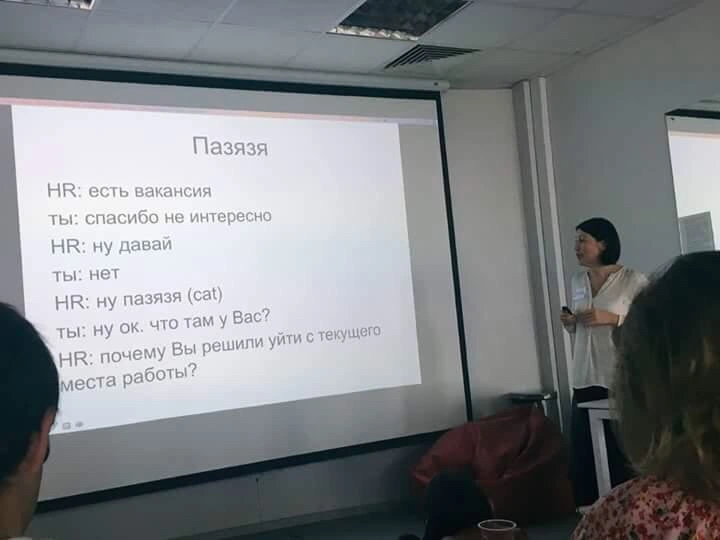
The photo shows a presenter at a Russian-language tech conference next to a slide titled "Пазязя" — baby-talk for "пожалуйста," i.e. pwetty pwease — and the slide is a near-verbatim transcript of an outreach ritual every senior engineer has lived through:

HR: есть вакансия (there's an opening) ты: спасибо не интересно (thanks, not interested) HR: ну давай (come on) ты: нет (no) HR: ну пазязя (cat) (pwetty pleeease + cat sticker) ты: ну ок. что там у Вас? (fine, what have you got?) HR: почему Вы решили уйти с текущего места работы? (why did you decide to leave your current job?)

The punchline is a context discontinuity so clean it reads like a protocol bug. For five messages, the recruiter holds total state awareness: they know you didn't apply, they know you refused twice, they deployed escalating persuasion up to and including feline imagery. Then the instant you concede, the conversation is handed off to the standard interview script — a script written for inbound applicants — and its very first question presupposes the exact opposite of everything that just happened. You didn't decide to leave anywhere. They begged you. The state machine transitioned and dropped its entire history on the floor, like a service that retries you into submission and then asks why you initiated the request.

What's being satirized is the structural reality of passive-candidate sourcing. In tech hiring, the best candidates are mostly employed and not looking, so sourcers work outreach funnels with quotas: contacts made, responses logged, candidates "converted" into the pipeline. The persuasion phase and the screening phase are often different scripts — sometimes literally different people, with the chat handed from sourcer to recruiter mid-thread. The candidate experiences it as one conversation; the company runs it as two disconnected pipeline stages with no shared context. The question "why do you want to leave your current job?" isn't malice — it's a hardcoded default that nobody parameterized for the cold-outreach path. Every developer recognizes this failure mode because we build it ourselves: it's the support bot that asks for your order number right after you typed it.

There's an extra layer in the venue itself: this absurdity isn't a screenshot circulating in a chat — it's a conference slide. The dysfunction of tech recruiting has been so universally experienced that it's become professional content, presented to a room of people who have all received the cat sticker.

Description

A photograph from a tech presentation. A woman stands beside a large projector screen that displays a slide with a title in Russian, 'Пазязя' (a cute, misspelled version of 'please'). The slide contains a humorous dialogue between an HR recruiter and a developer. The dialogue reads: HR: 'есть вакансия' (I have a job opening), ты: 'спасибо не интересно' (thanks, not interested), HR: 'ну давай' (oh, come on), ты: 'нет' (no), HR: 'ну пазязя (cat)' (oh pwease (cat)), ты: 'ну ок. что там у Вас?' (well ok. what do you have?), HR: 'почему Вы решили уйти с текущего места работы?' (why did you decide to leave your current job?). The joke captures the universally frustrating experience for developers of being hounded by persistent recruiters who use unprofessional tactics, only to pivot to standard, impersonal HR questions once they get a response. It humorously highlights the disconnect in tech recruiting, a scenario that deeply resonates with senior engineers who are frequently targeted by low-effort outreach
Comments

8
Anonymous ★ Top Pick The recruiter's final question is the equivalent of a CAP theorem trade-off. They can either get a candidate (Availability) or a meaningful answer (Consistency), but rarely both from the same person
  1. Anonymous ★ Top Pick

    The recruiter's final question is the equivalent of a CAP theorem trade-off. They can either get a candidate (Availability) or a meaningful answer (Consistency), but rarely both from the same person

  2. Anonymous

    HR’s transport protocol: SYN, SYN, SYN, SYN (with cat GIF), and the millisecond you finally ACK they fire a GET /reasons-for-leaving - no wonder every connection resets

  3. Anonymous

    It's like watching a distributed system negotiate consensus - the recruiter keeps retrying with exponential backoff until they get an ACK, then immediately questions why the node wants to leave its current cluster

  4. Anonymous

    Recruiter state machine: three rejections transition to 'pwetty please', acceptance transitions to 'so why are you abandoning your beloved employer?' - no state retains context

  5. Anonymous

    The classic recruiter pattern: `while(candidate.interested === false) { recruiter.beg(); }` followed immediately by `if(candidate.interested === true) { askGenericQuestion(); }` - a perfect O(n) algorithm for wasting everyone's time before even mentioning the tech stack, compensation, or whether they're actually looking for your skillset

  6. Anonymous

    Classic recruiter FSM: NotInterested -> retry with cat(); on accept(), run legacy_script.ask('why leaving current job?') - a precondition failure hidden behind cute retry logic

  7. Anonymous

    This recruiter’s outreach looks like a non‑idempotent job queue - every “no” triggers a retry with a cat payload, then a mandatory “why are you leaving?” form; please install a circuit breaker and respect 429

  8. Anonymous

    HR's Lazarus hire: Zero recent commits, but unbreakable uptime - ideal for eternal on-call shifts

Use J and K for navigation